-
-
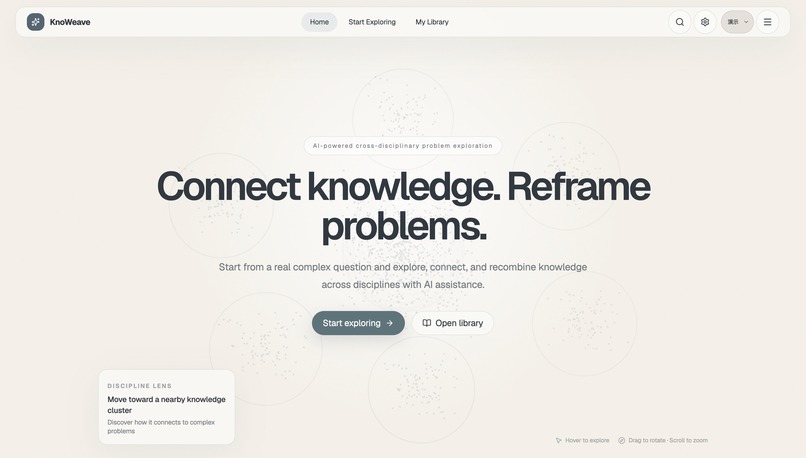
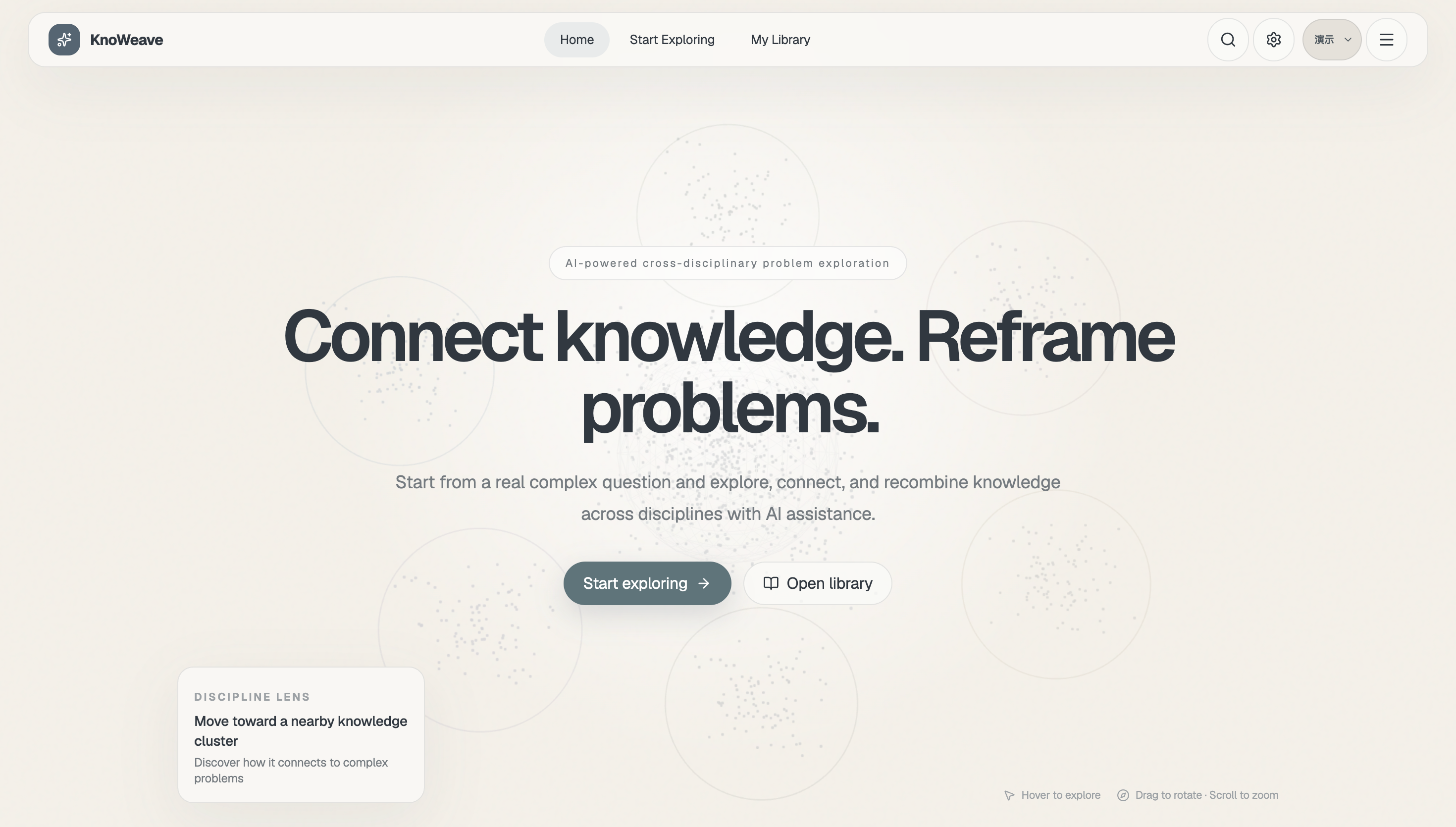
Project Homepage
-
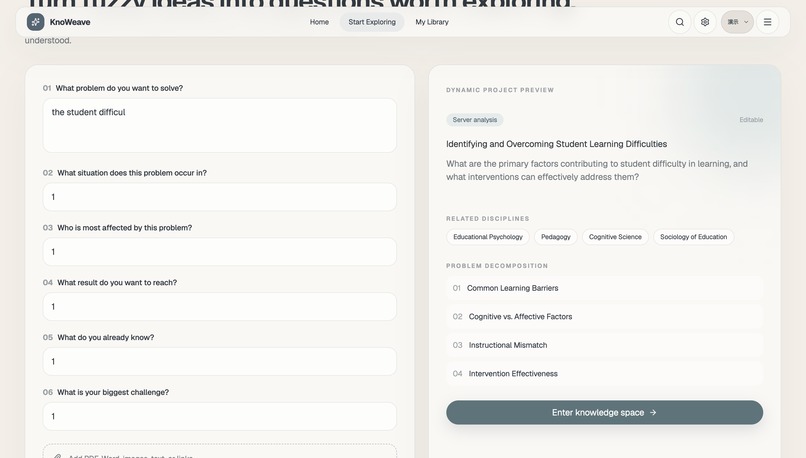
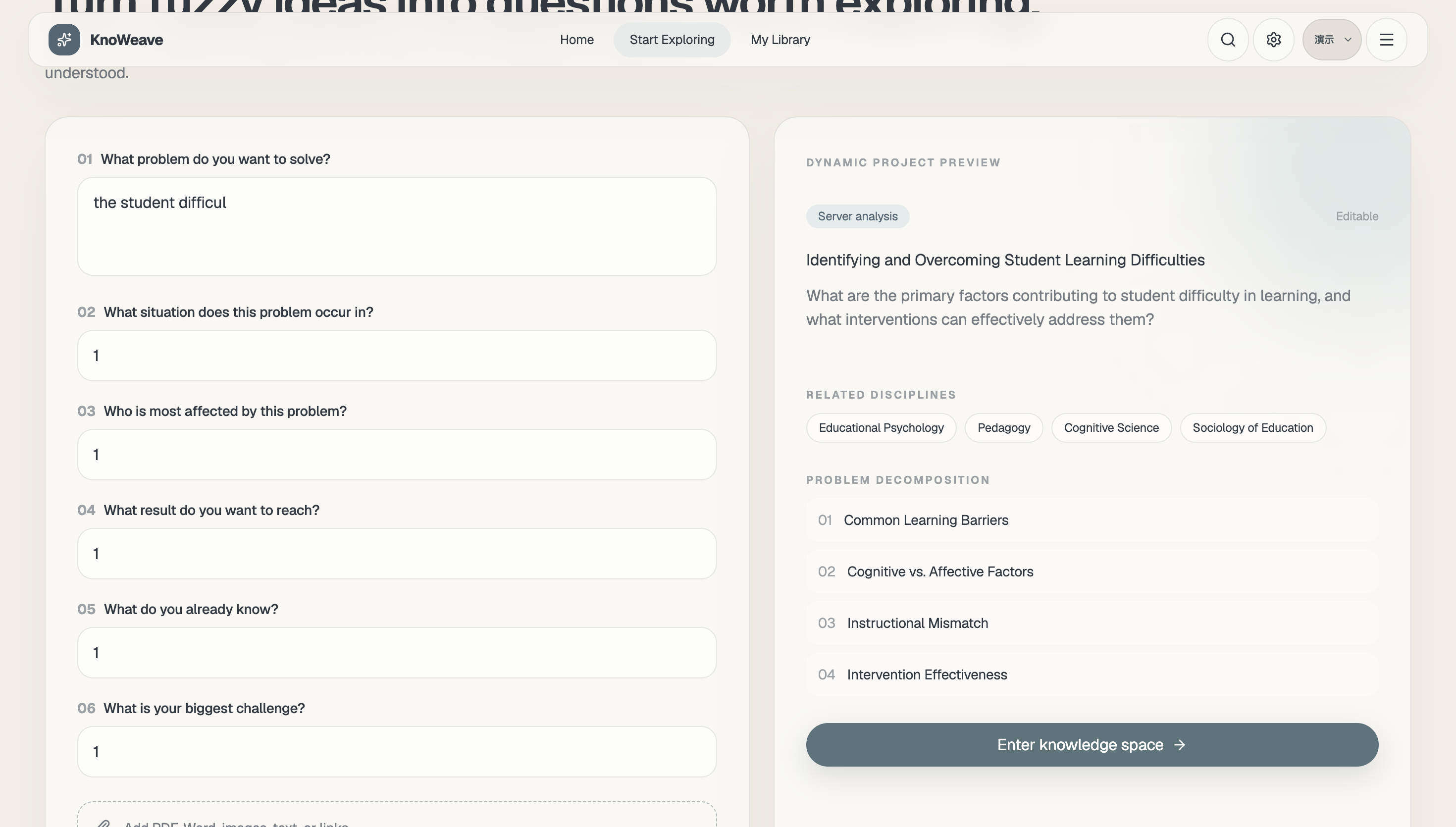
New Project Page
-
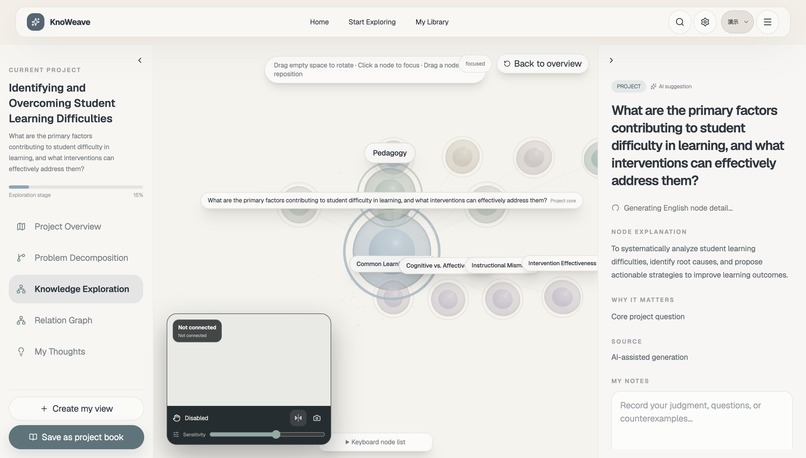
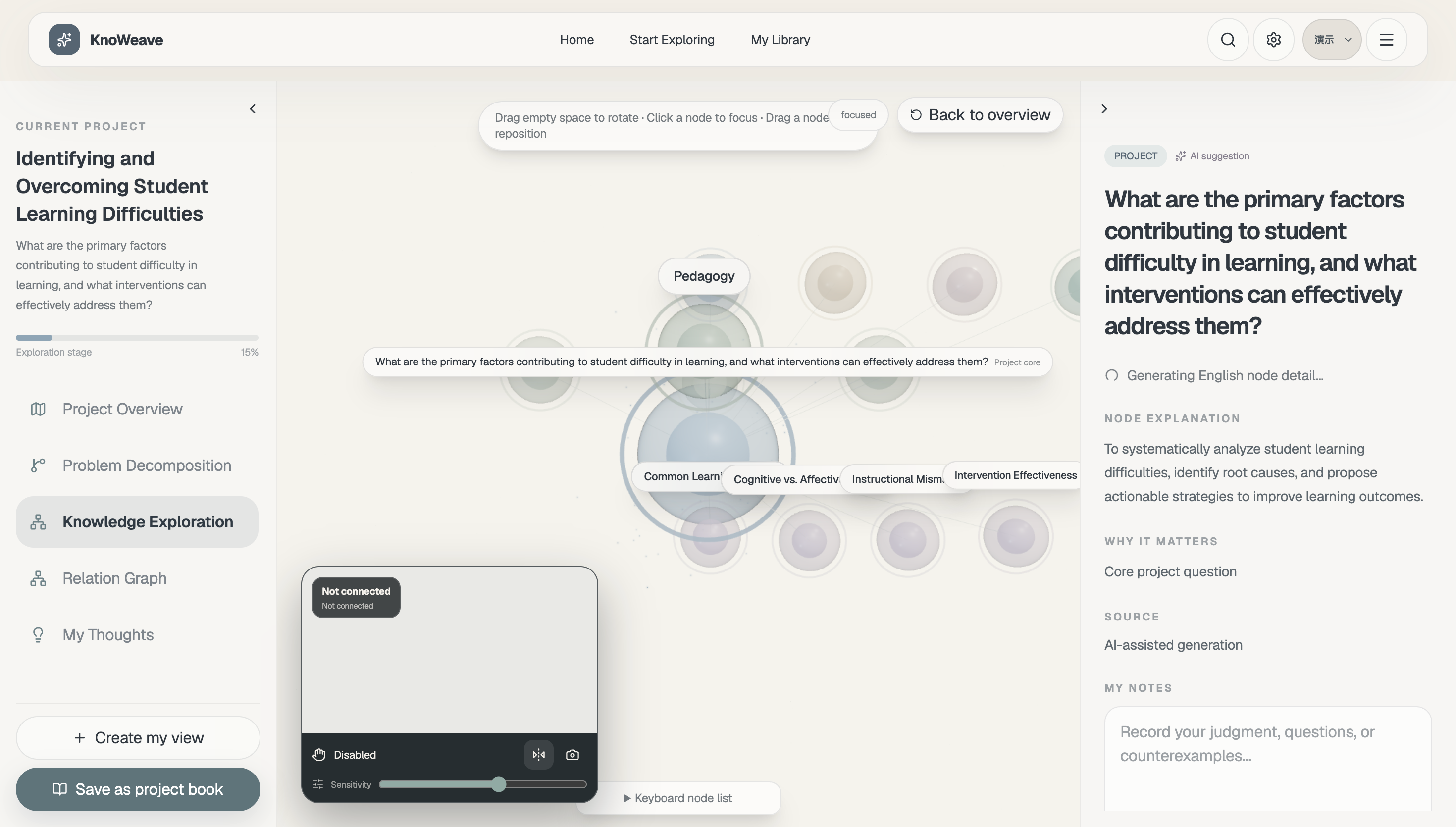
3D Knowledge Universe Interface Users can explore the AI-generated knowledge space through an immersive 3D environment
-
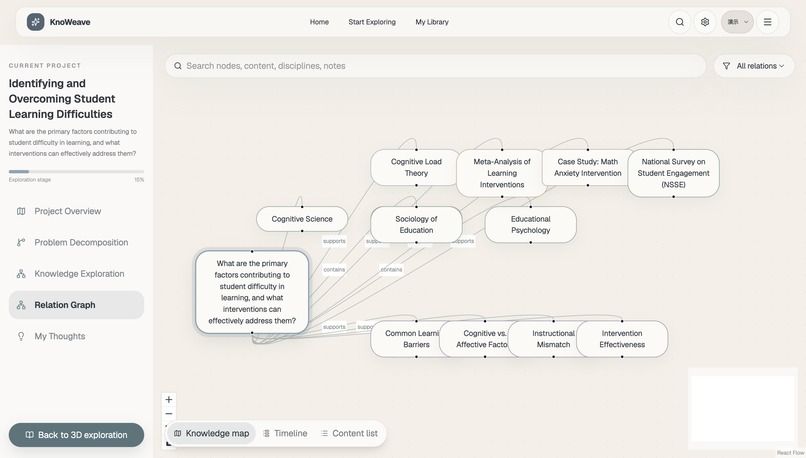
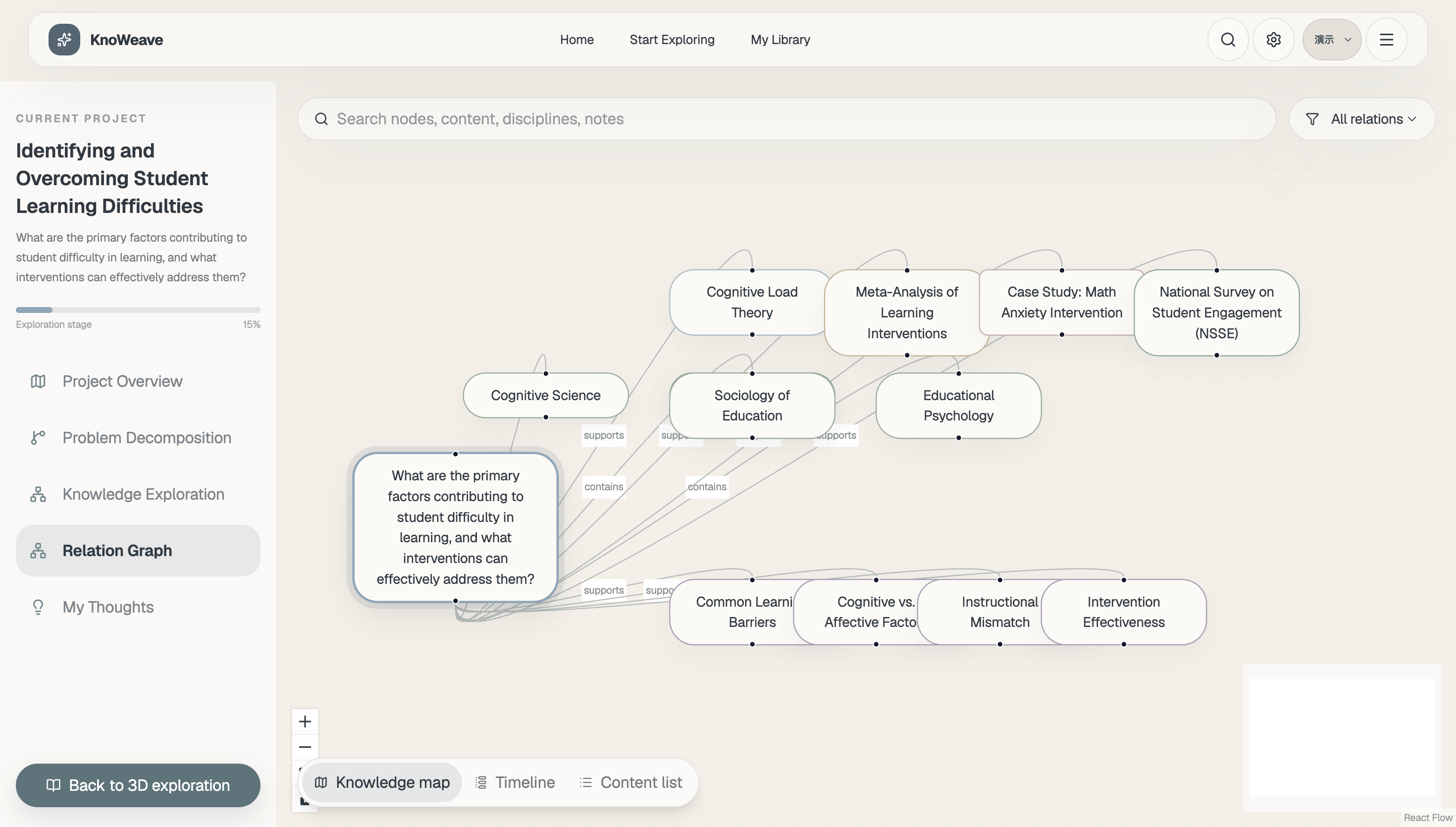
Knowledge Universe Overview in 2D
-
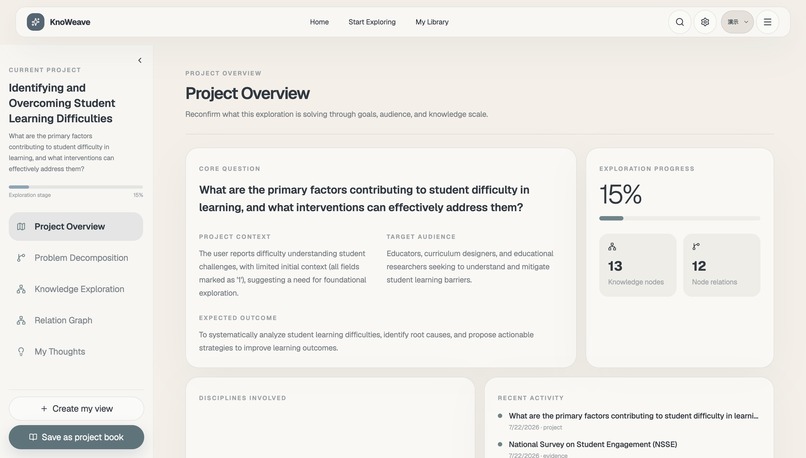
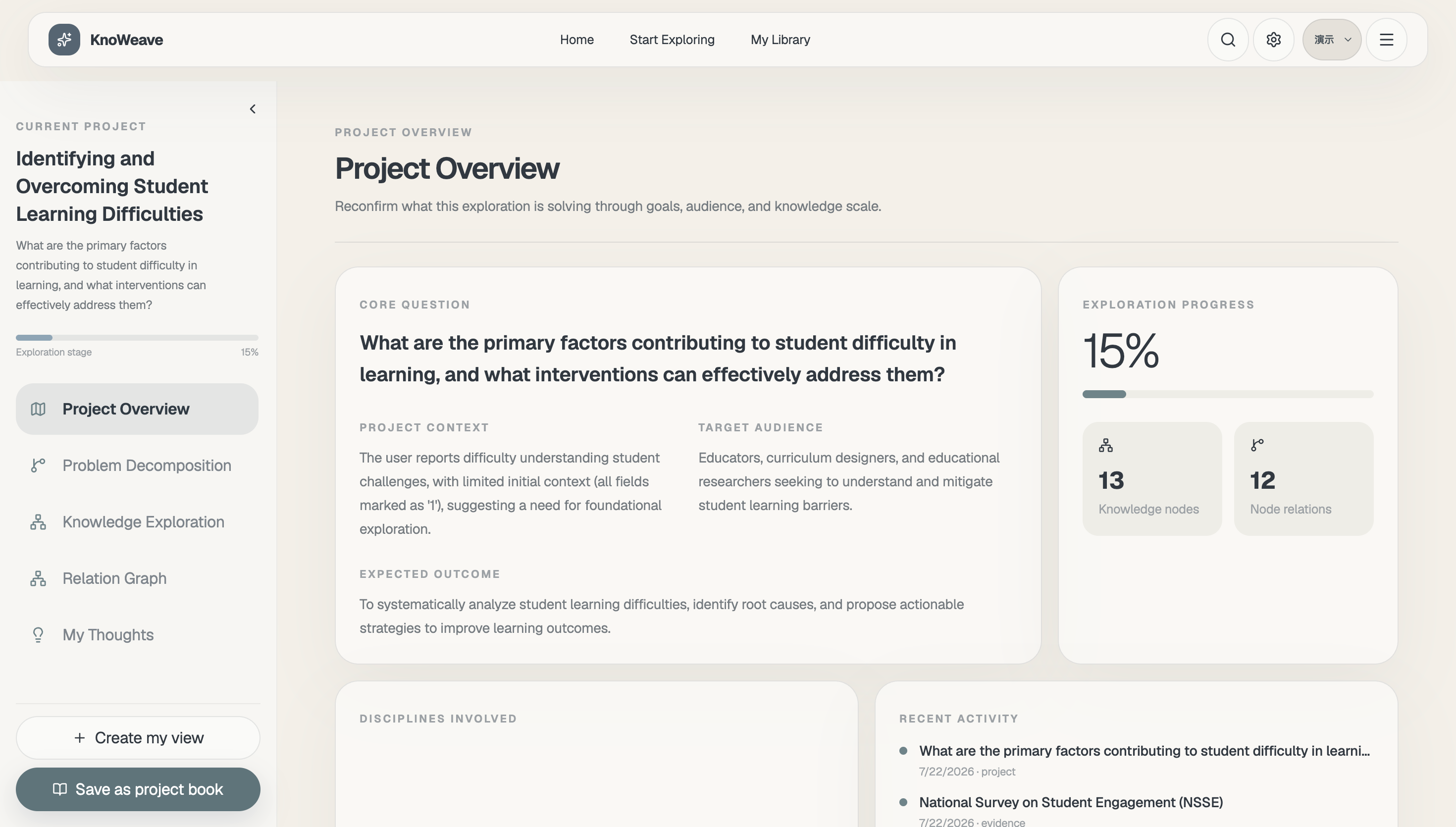
Project overview
-
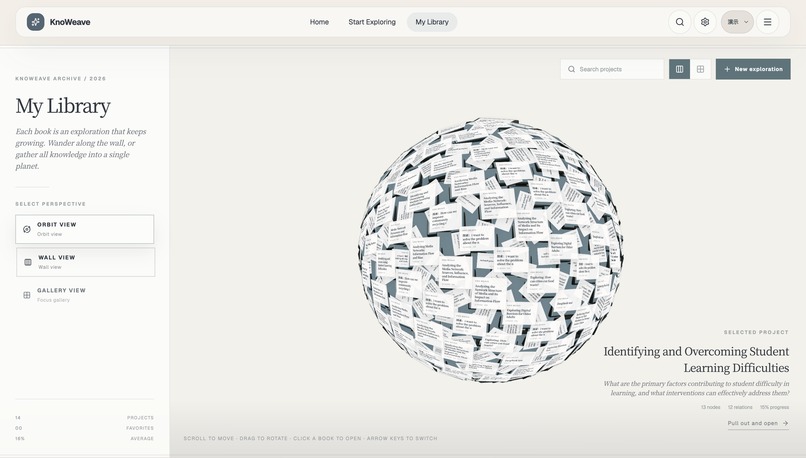
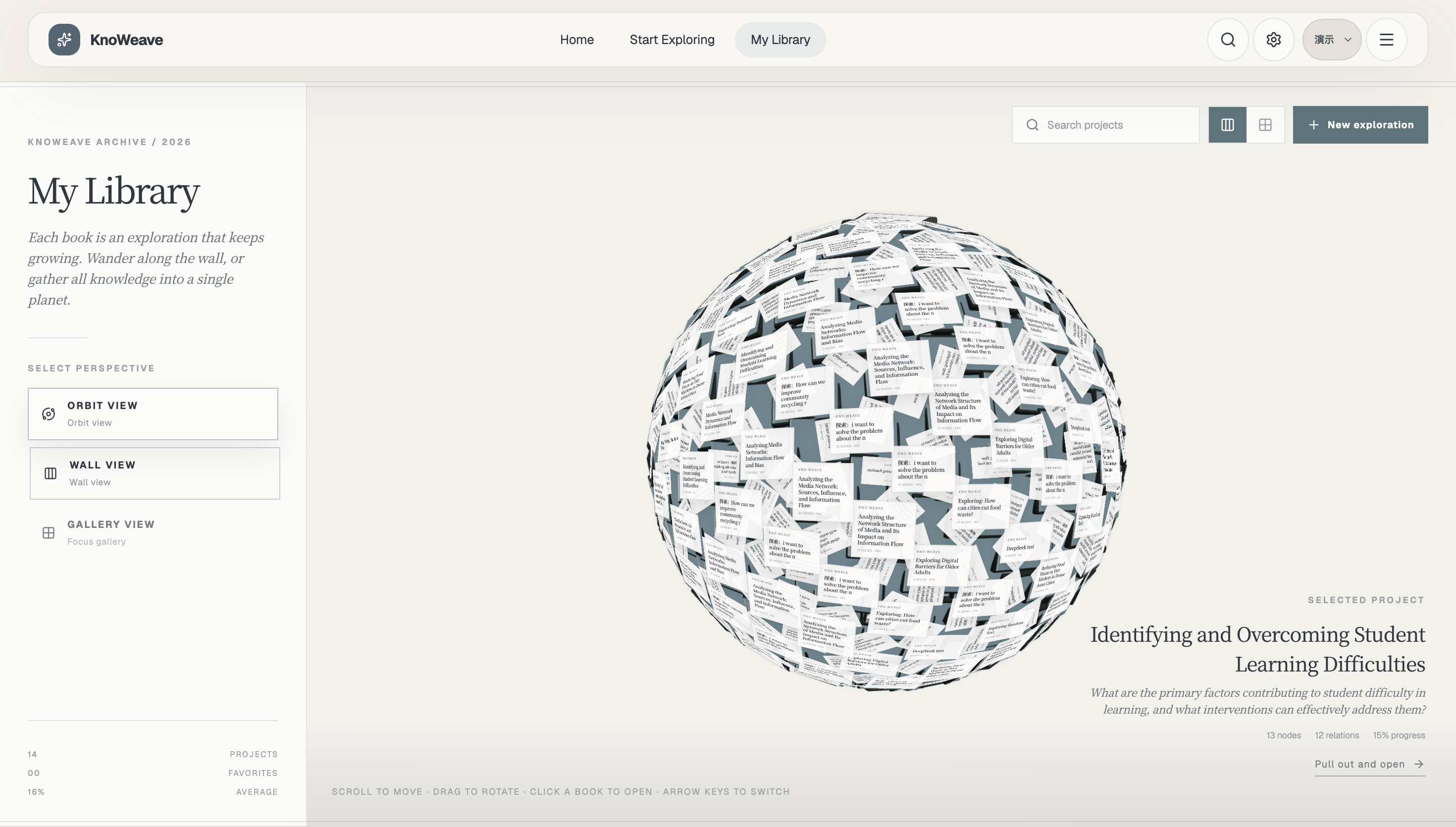
User library
Inspiration
KnoWeave was inspired by a common problem: when people face a complex real-world question, they often find plenty of information but struggle to understand how the pieces connect.
Search engines return long lists of links, while many AI tools provide a single polished answer. Both approaches can hide the reasoning process, overlook conflicting evidence, and make it difficult for users to build their own understanding.
We wanted to create a platform that treats knowledge as a connected system rather than a flat collection of results. KnoWeave helps users explore how questions, disciplines, concepts, methods, evidence, cases, and personal ideas relate to one another.
Our goal was not to build another AI answer generator. We wanted to build a transparent thinking environment where users could explore a complex problem, inspect the supporting knowledge, challenge assumptions, and gradually develop their own solution.
What it does
KnoWeave is an AI-powered interdisciplinary knowledge exploration platform.
A user begins by entering a complex project question. The platform analyzes the question and transforms it into an interactive knowledge structure containing:
- a central project problem;
- smaller subquestions;
- relevant academic disciplines;
- concepts and theories;
- research methods;
- real-world cases;
- supporting or conflicting evidence;
- AI-generated suggestions;
- user-created ideas;
- potential solutions.
The knowledge is displayed as an interactive Three.js universe. The central problem acts as the core, while related questions and disciplines form surrounding knowledge clusters.
When a user selects a node, KnoWeave explains:
- what the node means;
- why it matters to the current project;
- how it connects to other nodes;
- how the knowledge can be applied;
- what limitations or uncertainties it has;
- which sources support it;
- what the user could explore next.
Users can deepen a topic, expand into another discipline, search for evidence, challenge an assumption, compare cases, or turn selected knowledge into an actionable solution.
KnoWeave also records the user’s exploration process and organizes it into a structured project book that can be reviewed and expanded later.
How we built it
We built the frontend with Next.js, React, TypeScript, Three.js, React Three Fiber, and Drei.
The central interface uses a warm, off-white “knowledge universe” rather than a traditional dark space theme. Knowledge nodes appear as softly colored planets, particles, clusters, and orbiting structures. Different disciplines use different low-saturation colors, while curved lines show relationships between nodes.
The graph is organized around a shared Three.js rotation group. When a user selects a node, the entire knowledge structure rotates smoothly so that the selected node moves into focus while the relative positions of connected nodes remain unchanged.
The platform also supports camera-based hand interaction. MediaPipe detects hand landmarks, maps gestures to the Three.js scene, and allows users to highlight or select nodes through pinch gestures.
For the AI system, we designed a retrieval-augmented generation pipeline:
- The user’s project and selected node are converted into search queries.
- Relevant document fragments are retrieved from the connected knowledge base.
- The AI model receives the retrieved material, project context, existing nodes, and requested exploration mode.
- The model generates structured JSON containing new nodes, relationships, citations, confidence values, and suggested next steps.
- The backend validates the response before saving it to the project.
Vector retrieval can be represented using cosine similarity:
[
\operatorname{similarity}(q,d)
\frac{q \cdot d} {\lVert q\rVert \lVert d\rVert} ]
where (q) is the query embedding and (d) is the embedding of a document fragment.
We created separate schemas for concepts, methods, cases, evidence, questions, disciplines, user thoughts, AI suggestions, and solutions. This allows each node type to display content that matches its purpose instead of using one generic template.
We also designed authentication, guest access, protected project routes, personal libraries, local project storage, and data migration from guest mode to a registered account.
Challenges we ran into
One of the main challenges was making the 3D knowledge graph useful rather than merely decorative.
Early versions displayed static nodes with limited spatial meaning. Selecting a node sometimes moved only that node, which broke the visual structure of the graph. We solved this by rotating the entire graph group through quaternion interpolation, allowing users to focus on a node without destroying its relationship to the rest of the system.
Another challenge was combining camera input, MediaPipe hand tracking, raycasting, Three.js animation, and interface updates without causing performance problems. Hand detection could block the main thread, while unstable pinch detection caused accidental or repeated node switching. We improved this by throttling hand inference, smoothing cursor movement, introducing gesture hysteresis, and using a single selection function for mouse, touch, and gesture input.
AI reliability was also a major concern. Language models can generate plausible but unsupported information. To reduce this risk, we created strict source rules and evidence states:
source-supportedai-inferredunverifieduser-confirmed
Evidence and case nodes must contain valid citations. The backend also checks node types, relationship types, confidence ranges, source identifiers, duplicated concepts, and invalid references before accepting AI output.
Performance was another challenge. The scene includes particles, labels, curved edges, node animations, camera input, and interactive panels. We used point clouds, instanced meshes, limited device pixel ratio, distance-based label visibility, reduced-motion support, and simplified mobile rendering to keep the experience responsive.
Accomplishments that we're proud of
We are proud that KnoWeave does more than display an AI answer. It makes the structure of reasoning visible.
We created a system where every knowledge node has a clear role, relationship, source status, project relevance, and next action. Users can see not only what the AI suggests, but also how the suggestion connects to evidence and where uncertainty remains.
We are also proud of the visual identity. The off-white knowledge universe creates a calm, accessible environment that feels exploratory without relying on dark science-fiction or neon interface conventions.
Another major accomplishment is the integration of multiple interaction methods. Users can navigate the same graph through mouse input, touch controls, or hand gestures while preserving a consistent selection and focus system.
Finally, we developed a reusable node framework that can support many types of projects. A research question, design challenge, policy problem, educational investigation, or business case can all be represented using the same underlying knowledge structure.
What we learned
We learned that knowledge visualization requires more than placing information inside nodes. A useful knowledge node must be specific, understandable, connected, actionable, and traceable.
We also learned that interdisciplinary exploration should not simply add more subjects to a project. Each discipline must contribute a distinct perspective, method, assumption, or type of evidence.
The project showed us that AI is most useful when it supports the user’s reasoning instead of replacing it. Users need opportunities to question, compare, verify, reorganize, and contribute their own ideas.
We also learned that interaction design and technical architecture are closely connected. Smooth visual behavior depends on clear state ownership, stable rendering, consistent event handling, and carefully controlled animation.
Most importantly, we learned that uncertainty should be visible. A knowledge system becomes more trustworthy when it clearly separates sourced facts, AI synthesis, unverified suggestions, and user-created ideas.
What's next for KnoWeave
The next step is to expand KnoWeave into a collaborative knowledge workspace.
We plan to add:
- real-time multiplayer project exploration;
- shared annotations and team discussions;
- version history for nodes and solutions;
- stronger document ingestion and citation extraction;
- automatic comparison of conflicting sources;
- knowledge-gap detection;
- personalized learning paths;
- exportable project reports and presentations;
- improved mobile and accessibility support;
- more accurate gesture interaction;
- integration with academic databases and organizational knowledge bases.
We also want to develop stronger evaluation tools. Future versions could measure source coverage, disciplinary diversity, unresolved questions, evidence strength, and the contribution of each node to the final solution.
Our long-term goal is for KnoWeave to become a space where people do not simply ask AI for answers, but actively build transparent, evidence-based, and interdisciplinary systems of understanding.
Built With
- codex
- cursor

Log in or sign up for Devpost to join the conversation.