-
-
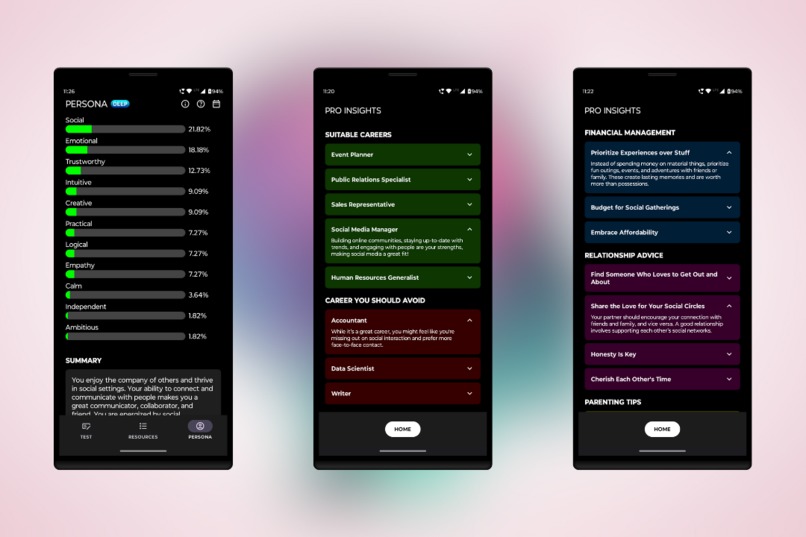
Personal insights
-

App Icon generated with Copilot
-
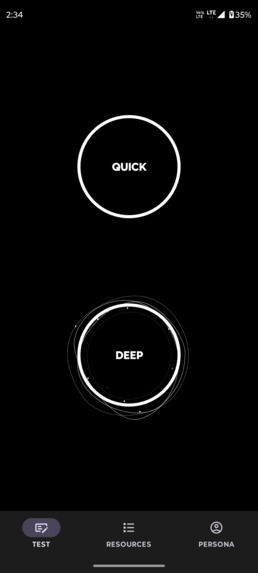
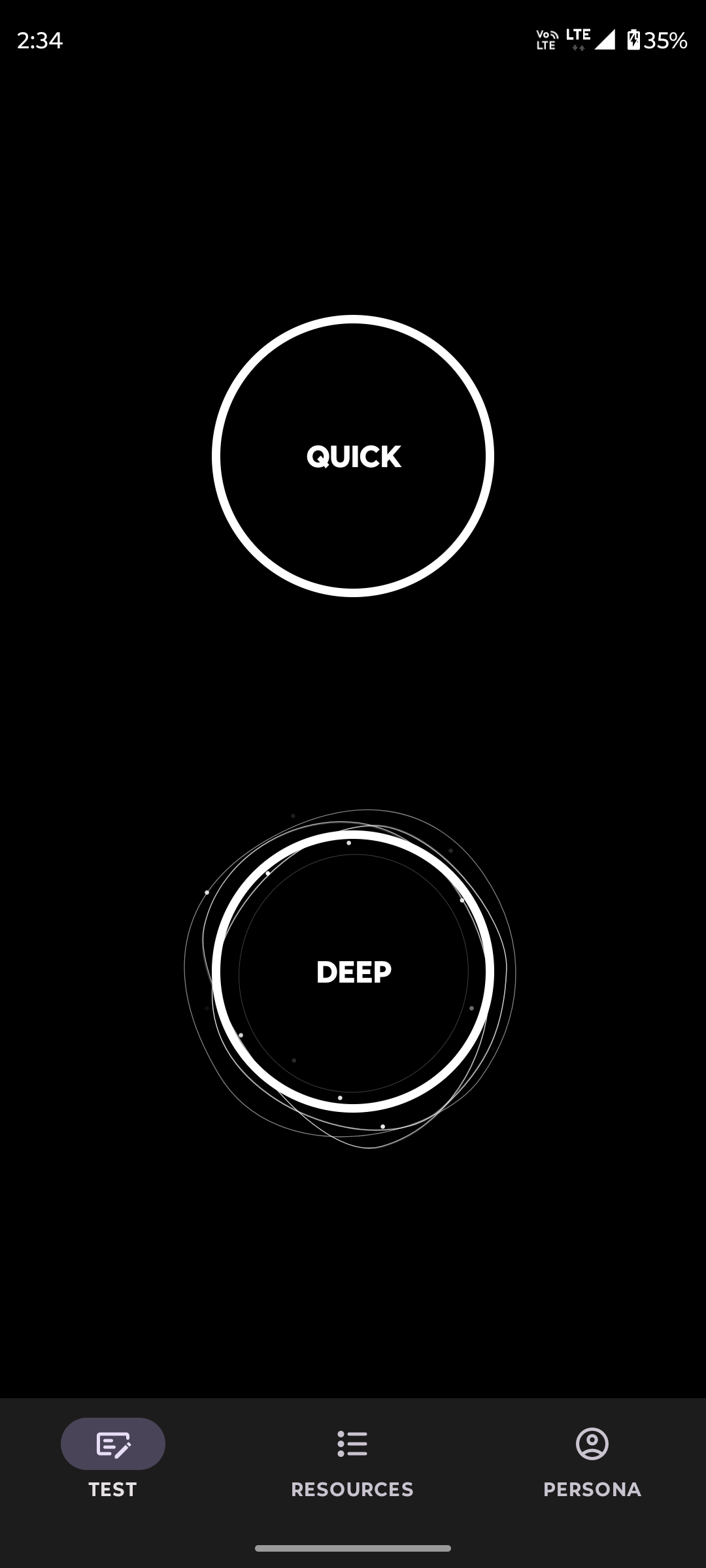
Home tab
-
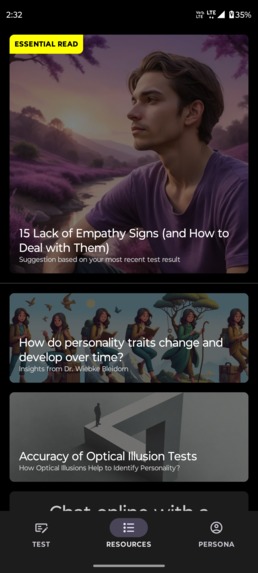
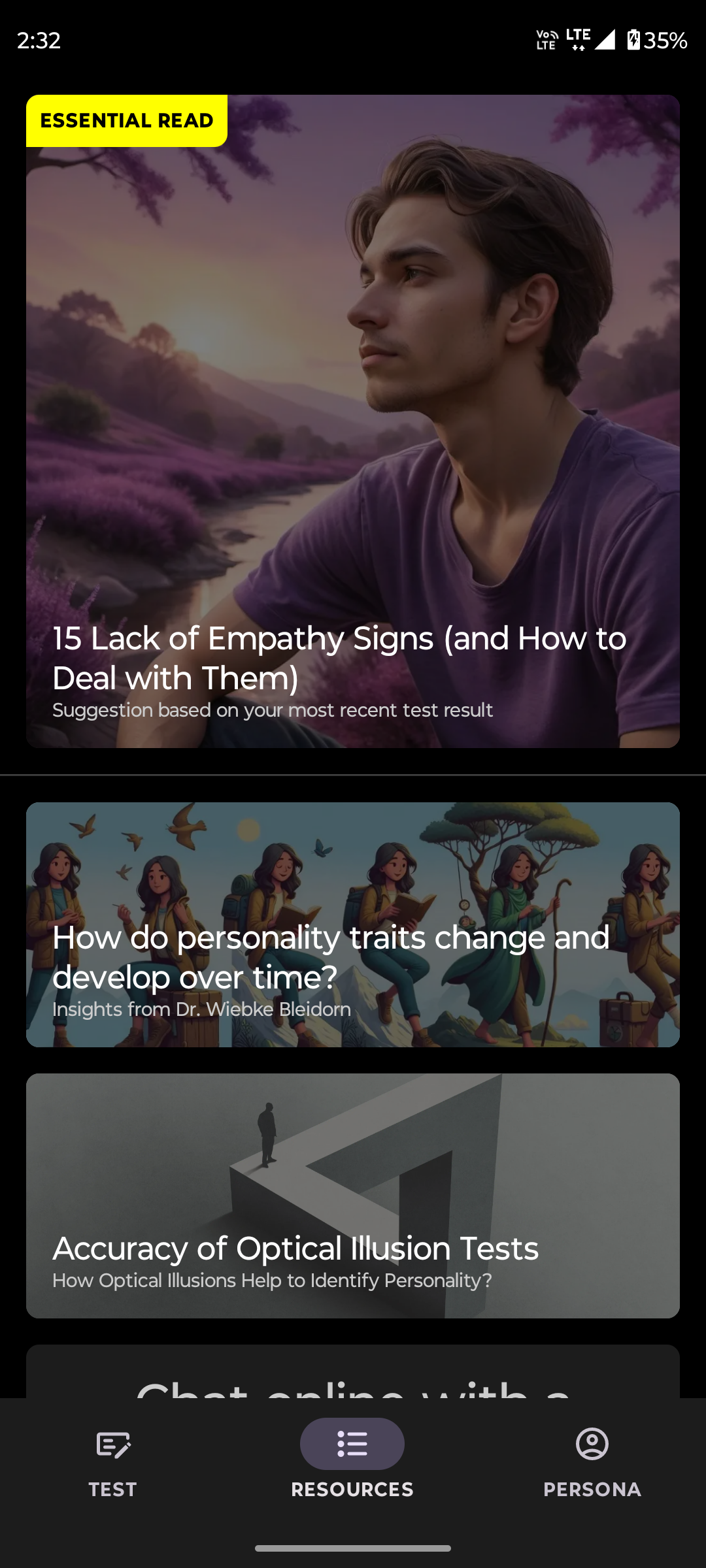
Resources tab
-
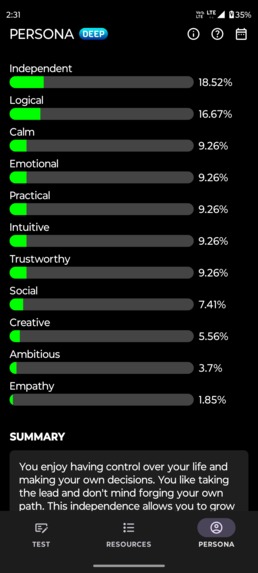
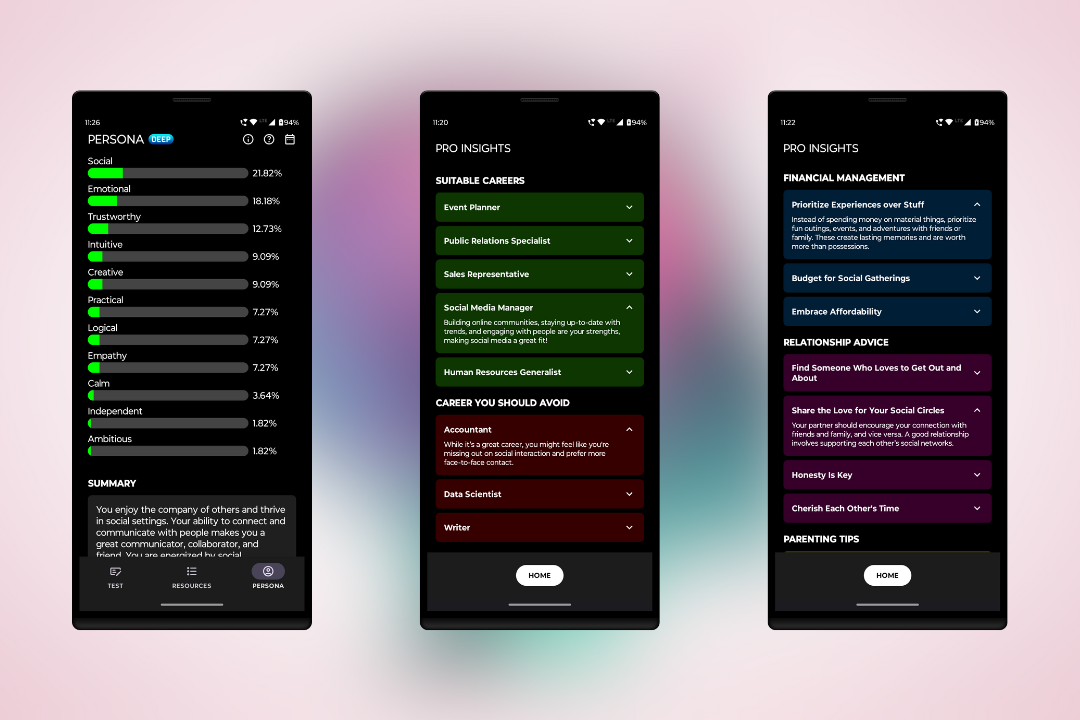
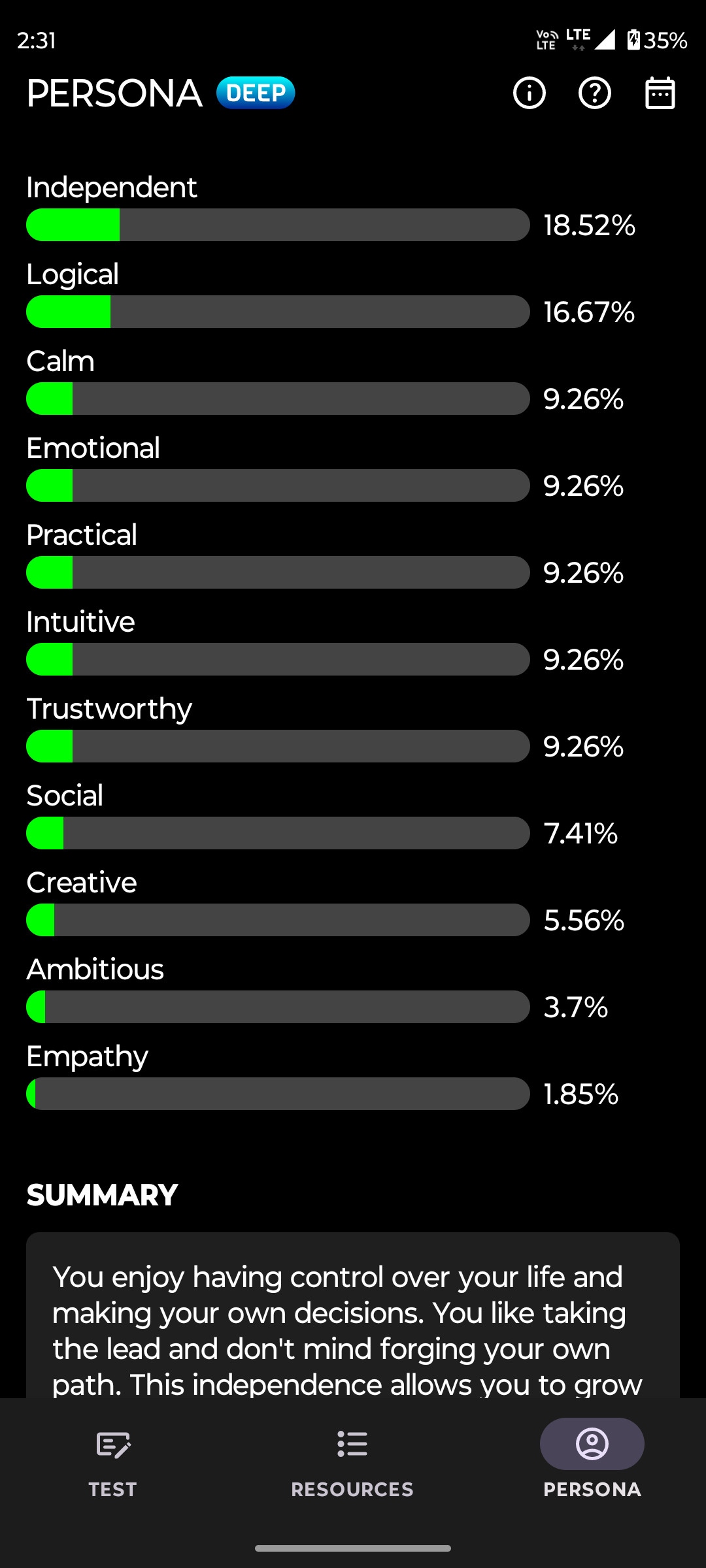
Persona screen
-
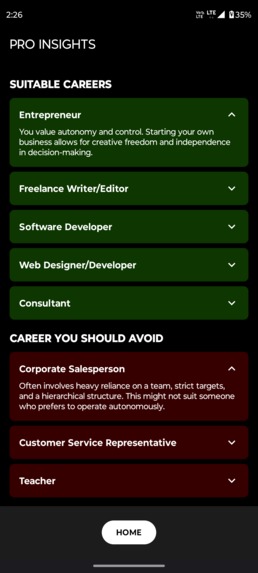
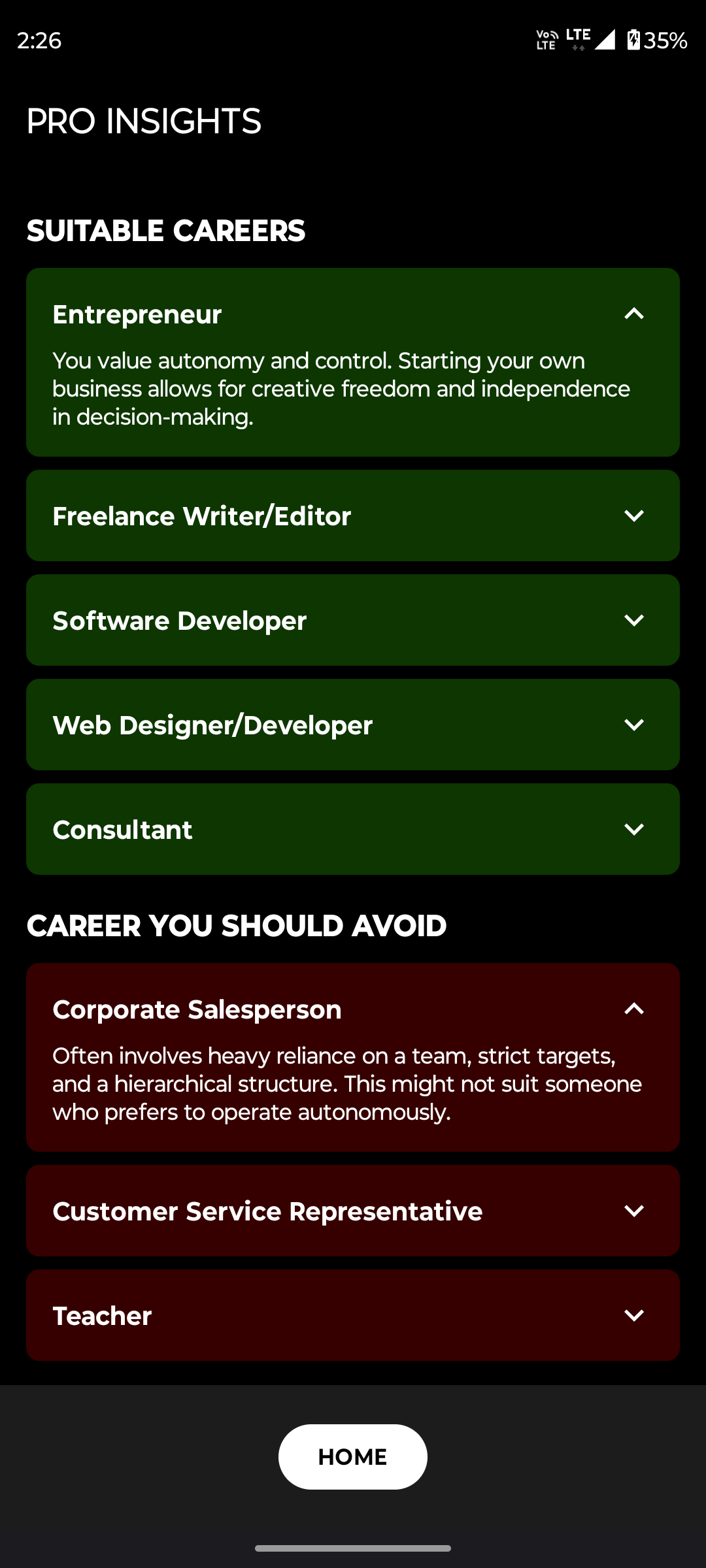
Personalized Pro insights
-

Personality Evaluation screen


INSPIRATION:
Last year, while working in Bangalore, our office conversations often revolved around various topics. One day, a colleague asked if there was an easy way to evaluate a person’s needs and motivations, particularly in understanding what their child wants to learn or what drives them... Another colleague introduced the concept of the Rorschach test to this discussion. This conversation planted the idea of a need for an easily accessible digital personality assessment tool. I made a note of this idea in my bucket list.
After my time in Bangalore, I began working remotely for a startup in Delhi. To strengthen our remote work culture, we often played games online, one of which involved optical illusions. Participants were shown ambiguous images and asked to describe what they saw. This game was fun and engaging, ultimately inspiring me to develop the "SelfSpectrum" app.
Originally, I planned to work on this project next year, but thanks to #ShipATon, it happened earlier.
WHAT IT DOES?
The app presents a series of optical illusions, including Figure-Ground illusions, Ambiguous Images, Distorted Perceptions, and Paradoxes. The user's responses to these images are recorded, and their personality traits are calculated along with corresponding percentages. This data is then analyzed by an artificial intelligence model, which provides personalized suggestions and advice in the following areas:
- Suitable career paths.
- Job fields to avoid.
- Relationship advice (What to consider when choosing a life partner).
- Parenting tips for handling children
- Financial management advice.
- Tips for maintaining mental health.
- Strategies to overcome weaknesses.
- Motivational Factors (Identifying what drives and motivates you the most).
- Personal growth tips.
- Lessons to learn from renowned personalities with similar personality traits.
HOW WE BUILD IT?
Before starting the implementation, I conducted market research, analyzing similar personality assessment apps and websites. I identified the pros and cons of each, noting common issues such as:
Many apps do not provide actionable insights, and users often complain about the language being too complex for the average person who doesn't have a degree in psychology.
Most of them conduct personality tests by selecting a topic and asking direct questions in which an individual will tend to tweak options to belong to a particular category.
Detailed insights from market research here
Our app consists of two major components: the optical illusion-based personality assessment and the AI-powered insights. The development process was divided into three phases:
Collection of Optical Illusion Images for the Image Library:
This was a challenging task. We conducted extensive research to find high-quality, copyright-free optical illusion images. Most of the images were sourced from the public domain, contributed voluntarily by creators, AI-generated, and developed by our team.
Fine-tuning the AI Model for Quality and Actionable Insights:
Thanks to Google Gemini and Google AI Studio, fine-tuning models for BASIC INSIGHTS and PRO INSIGHTS was straightforward. Initially, the model was giving a more generalized response. Then I tuned the BASIC INSIGHTS model with 100 queries and the PRO INSIGHTS model with 250 queries for quality personalized results based on the individual's response to optical illusions.
Integration of the Optical Illusion Image Library and AI-Powered Insights into the Android Application:
I used Jetpack Compose to develop the native Android application, integrated the RevenueCat SDK for payment processing, and utilized Glide and Lottie libraries for displaying images and animations.
CHALLENGES WE RAN INTO:
Accuracy Of Test Results:
One of the major challenges I faced was establishing credibility regarding the accuracy of the tests and content for SelfSpectrum. Much of the feedback suggested enhancing the app's credibility. To address this, I decided to collaborate with psychologists and mental health professionals. I connected with many, both in person and via LinkedIn, and gathered their insights. However, most were already engaged in other commitments and could not join my project. Eventually, I found the right fit - Tanmayi Sandeep Vaste, MA graduate in Forensic Psychology, who now manages all content, including tests, insights, and articles.
In addition to collaborating with mental health professionals, We also conducted real-world testing by gathering feedback in person and meeting people in public places such as shopping malls and during evening walks.
API Permission Issues Between Google Play and RevenueCat:
It took more than 36 hours for Google Play Console to activate the necessary permissions for RevenueCat. I resolved the issue by creating a dummy subscription plan, which enabled the permissions immediately.
See post on X
Tuning the AI Model for Quality Responses:
Initially, the model responses were generalized and not formatted properly. Then I found out that we can specify Gemini to give responses in JSON format. This helped with formatting. To improve the quality of responses, I tuned the BASIC INSIGHTS model with 100 queries and the PRO INSIGHTS model with 250 queries.
ACCOMPLISHMENTS THAT WE ARE PROUD OF:
I had initially planned to develop SelfSpectrum project next year, but thanks to “Ship A Ton”, it just happened within a month. This experience also allowed me to connect with like-minded individuals, indie developers, and small business founders. Even if I'm an Independent App developer #BuildInPublic enables me to collaborate with people from other fields.
Of Course, #BuildInPublic helped us to get initial traction for downloads.
During real-world testing in shopping malls and other public places, I received valuable feedback. Although there were some disagreements regarding personality percentages, most users agreed with the insights, and their wow moments motivated us to continue refining the SelfSpectrum app.
WHAT WE LEARNED:
This was my first time using Gemini’s JSON format, and it made presenting well-structured insights much easier, even though I’ve integrated Gemini with Android apps before.
Although I had previously integrated billing via the RevenueCat SDK in other apps, this was my first time using RevenueCat's ready-to-use paywall, significantly improving my productivity by streamlining the payment process. In my past experiences working for companies, I observed that some even maintained separate modules for billing integration and pricing conversion, which was time-consuming.
Apart from development, Build In Public helped me identify the need to collaborate with experts from other fields (Psychology) to make my app better.
Refer hereThe Build In Public community also allowed us to experiment with optical illusion images before the official release.
Refer hereBuild In Public also helped me to discover various tools that I previously never heard of. For example Shots.so and PaywallScreens which enhanced my content creation and productivity.
WHAT NEXT FOR SELF SPECTRUM PROJECT:
Since this project involves human psychology and competes with organizations like Psychometrica.org, it’s crucial to collaborate with mental health professionals. Currently, our team consists of a tech person and a psychology graduate. I plan to expand the involvement of psychological experts to develop additional tests, content, and in-app games.
Since our AI model provides personalized career advice, collaborating with career coaching services would align well with our business goals.
On the AI front, we want to evaluate users directly with an AI model rather than passing calculated personality percentages to the model to get insights.
To enhance user retention, we plan to add personalized games that help users improve their weaknesses. We will also introduce a weekly journal based on the user’s personality. A minimum viable approach to this can already be seen in the Resources tab, where we suggest articles based on users' weaknesses. Currently, these articles are sourced externally, but they will eventually be replaced with in-house content.
Built With
- android
- firebase
- gemini
- google-cloud
- kotlin
- revenuecat


Log in or sign up for Devpost to join the conversation.