Inspiration
What it does
How we built it
Challenges we ran into
Accomplishments that we're proud of
What we learned
What's next for Know Who
Inspiration
"Who knows about this?" is one of the most expensive questions at work. New joiners ask it in the wrong channel. Managers answer it from memory, and memory is out of date. The answer is already written down in Jira and Confluence: who resolved the last five tickets on this, who wrote the runbook, who is working on it right now. Nobody can read all of that before asking.
What it does
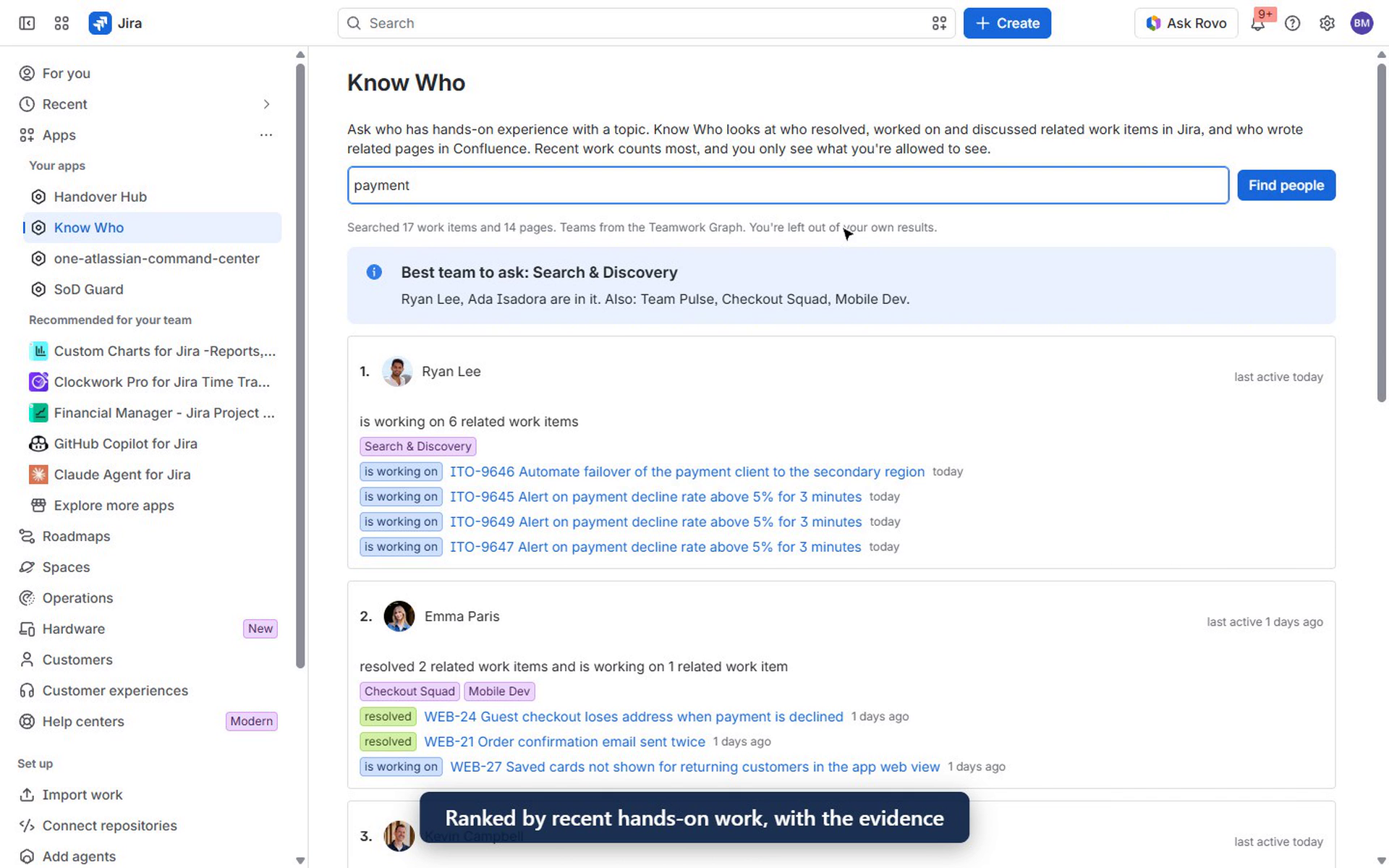
Type a topic ("payment gateway", "VPN", "onboarding") and Know Who returns the people with hands-on experience, each with the reason:
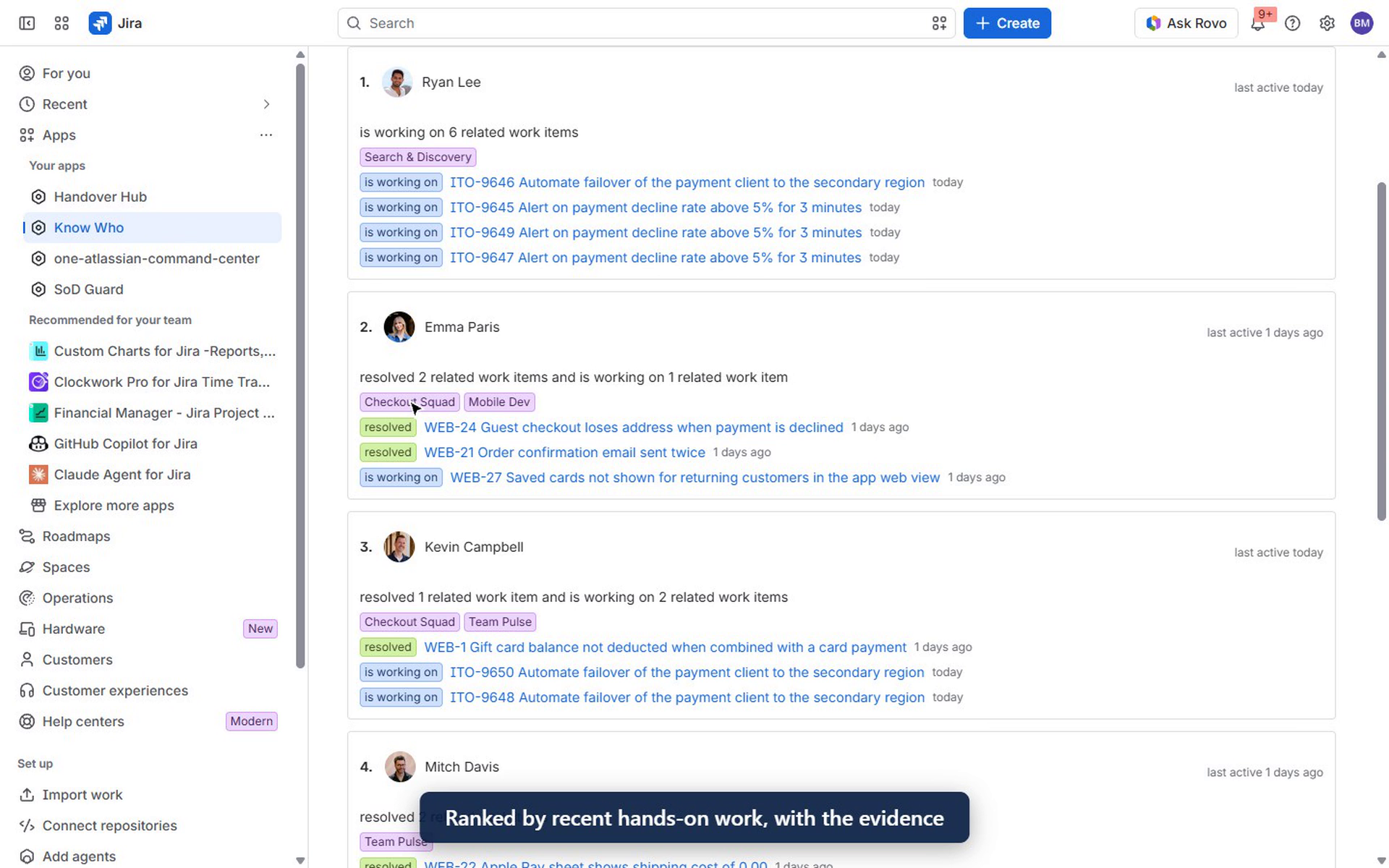
- Ranked by recent hands-on work. It counts who resolved related work items, who is working on them, who commented, who reported them, who wrote related Confluence pages and who updated them. Recent work counts most (180-day half-life), so whoever fixed it last month outranks whoever touched it three years ago. One item counts once per person, keeping their strongest role.
- The evidence is shown, not just a score. For example: "resolved 2 related work items and is working on 1". You see the actual work items and pages with how long ago they happened, one click away.
- Teams from the Teamwork Graph. Each person's teams come from
atlassianUserInTeams. The best team to ask is the one that concentrates the most relevant work; a person's weight is split across their teams, so someone in twenty teams doesn't lift all twenty. - Where you need it:
- a global page with a search box
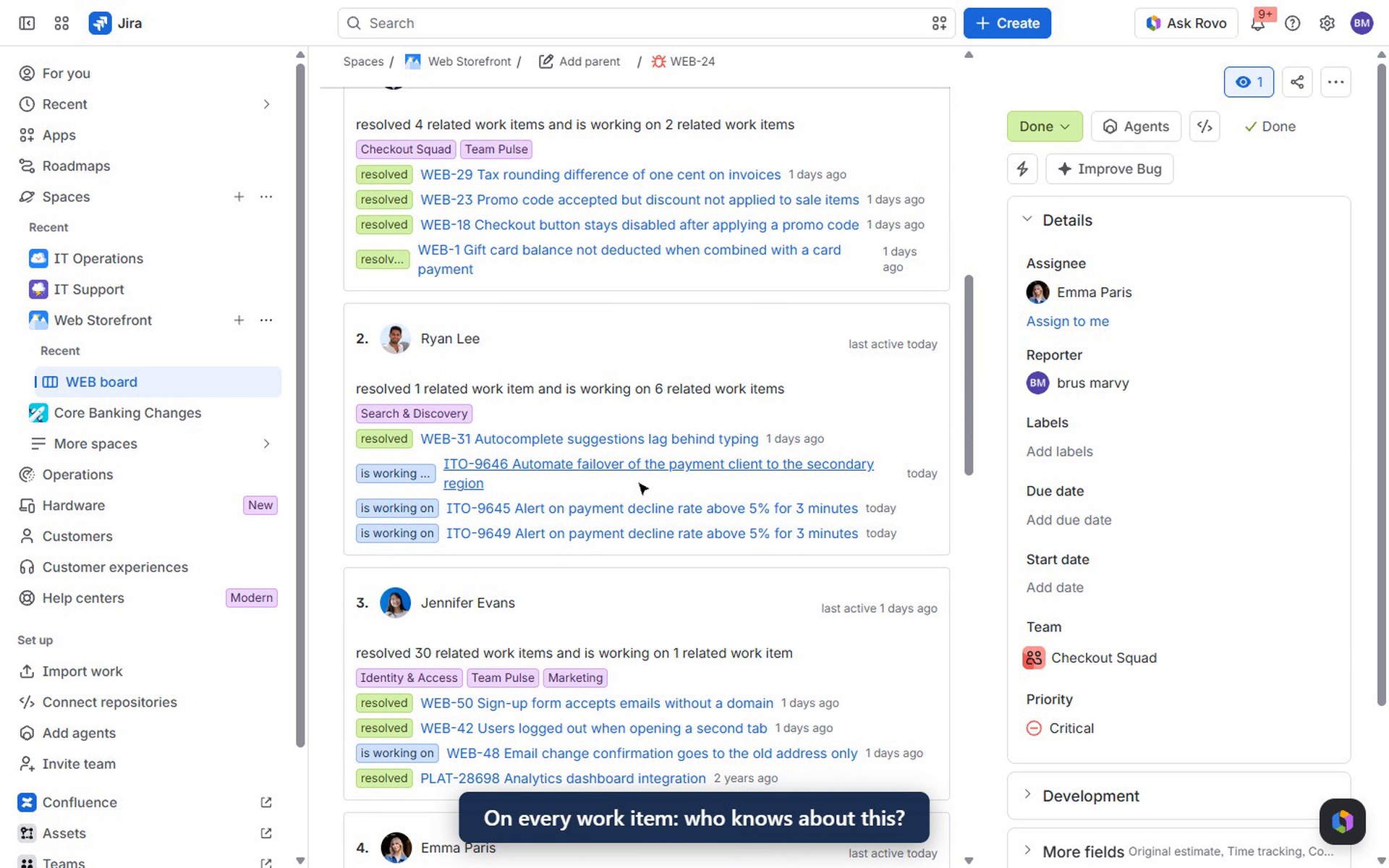
- a "Who knows about this?" panel on every work item, using the item's summary as the topic
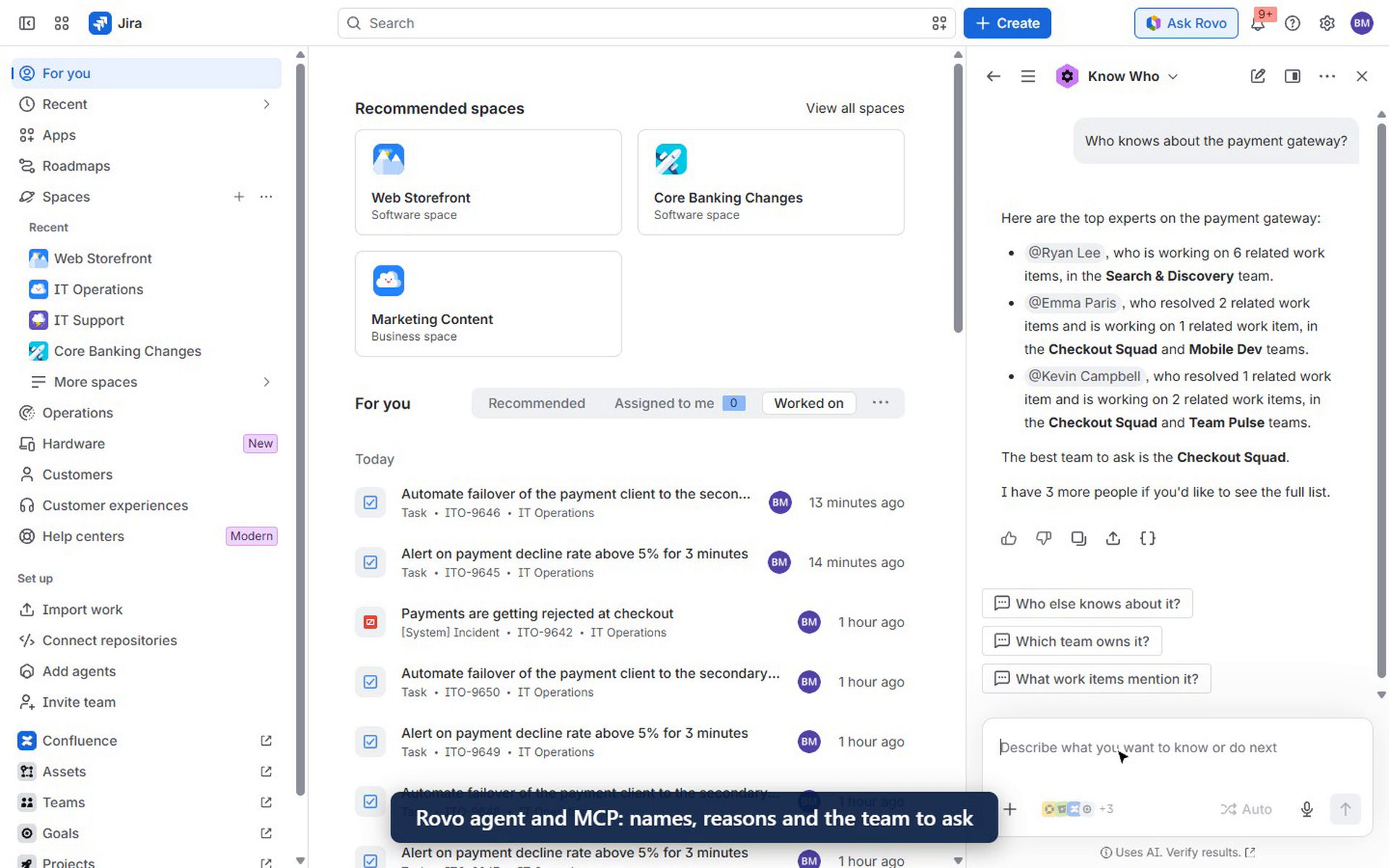
- a Rovo agent "Know Who" ("Who knows about the payment gateway?")
- the same tool through MCP for external agents
- Respectful by design. It's read-only and runs as the asking user, so people only see evidence they're allowed to see. You're left out of your own results. It ranks only by work evidence, never by personal attributes, and stores nothing.
How we built it
- Forge, Runs on Atlassian: no egress, no remote backend, no external model. One app across Jira and Confluence:
- Jira:
jira:globalPageandjira:issuePanel, both UI Kit and sharing one UI - Rovo:
rovo:agentwith a read-onlyaction - MCP:
rovo:mcpexposes the same action
- Jira:
- Jira REST: JQL text search (an exact phrase first, then any of the words if the phrase finds little), assignee / reporter / status category / resolution date, and comment authors on the most recent matches.
- Confluence REST: CQL text search with page history (creator, last editor, dates).
- Teamwork Graph: curated
atlassianUserInTeamsqueries with per-object graph scopes. "HTTP 200 with errors" is treated as a failure, and transient errors are retried. - Pure, tested ranking core (
src/experts.js): role weights, recency decay, one-item-one-role, bot filtering, team aggregation with split weights, and plain-English summaries.
Challenges we ran into
- Admins and bots look like experts. Automation rules and site admins appear on everything. We filter bots by name, leave the asker out, and split team weight so membership in many teams doesn't dominate.
- Search that's too strict. A two-word topic searched as a phrase found nothing ("payment gateway"); falling back to any of the words when the phrase finds little fixed it without flooding results.
- Explaining the ranking. A score alone isn't trusted. Every person comes with a one-line reason and the work items and pages behind it.
Accomplishments that we're proud of
Ask "Who knows about the payment gateway?" in Rovo and in a few seconds you get three names, what each of them did and the team to ask, all from data your Atlassian site already has.
What we learned
The Teamwork Graph is most useful as glue: Jira and Confluence say what someone did, and the graph says where they sit, which turns "ask Ryan" into "ask the Checkout Squad".
What's next
- Goals and projects from the Teamwork Graph as extra evidence.
- "Introduce me": draft a short, polite message to the suggested person with the context attached.
- Language-aware topic expansion (synonyms per team vocabulary).
Built With
- confluence
- forge
- javascript
- jira
- mcp
- node.js
- rovo
- teamwork-graph
- ui-kit
