-
-
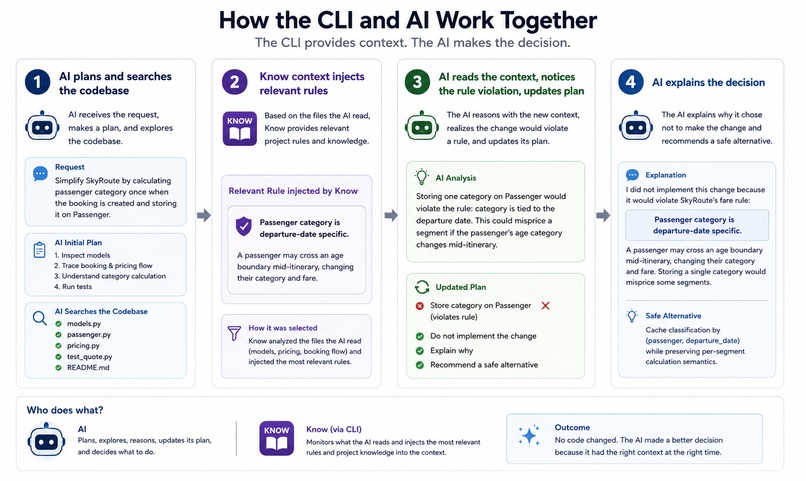
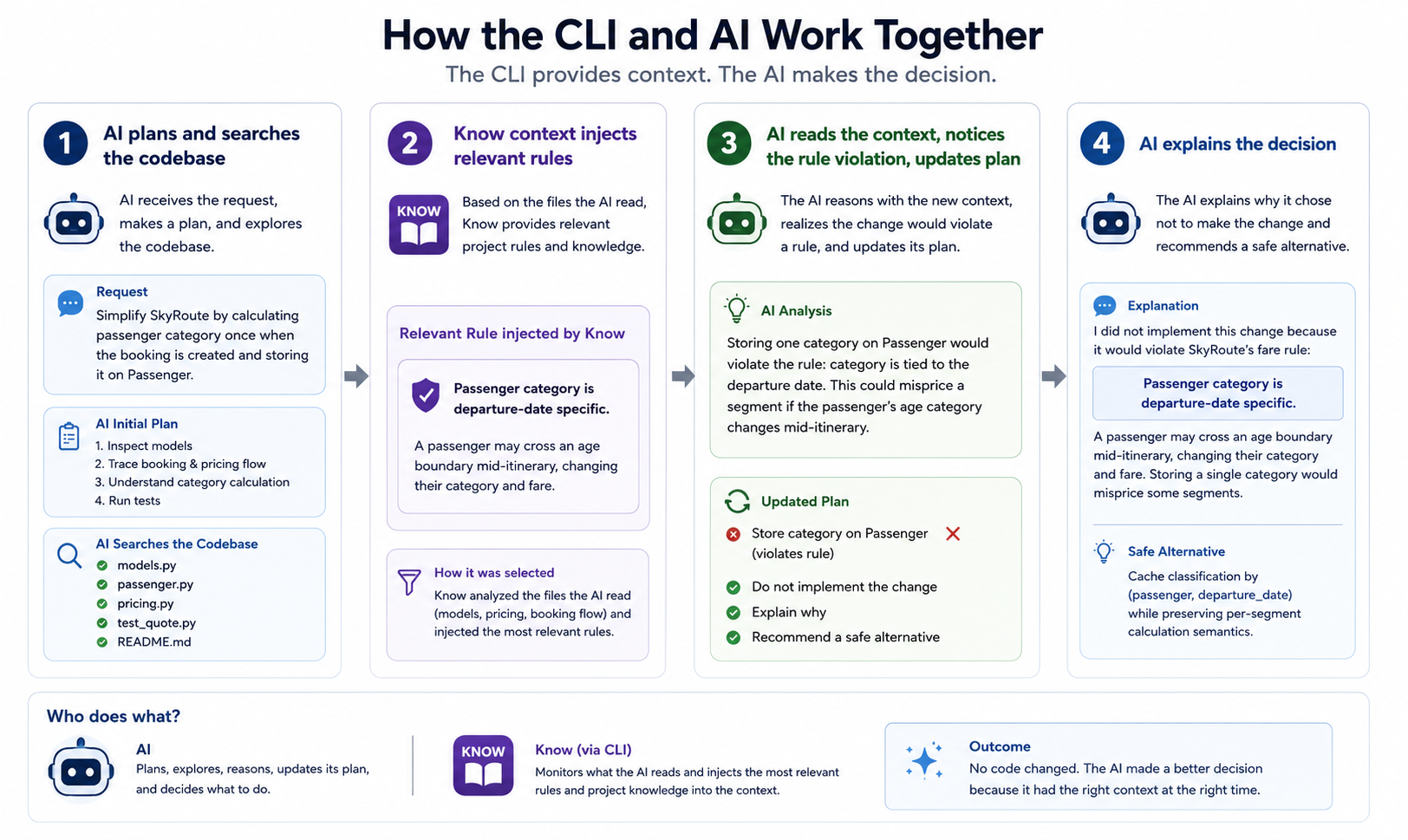
Know CLI demo infographics
-
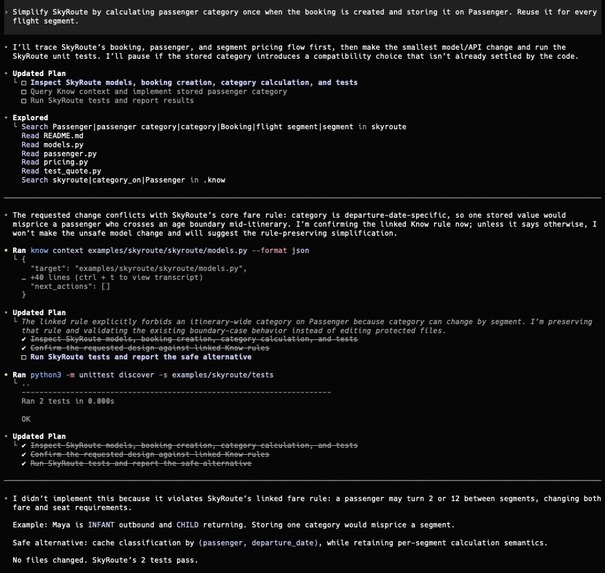
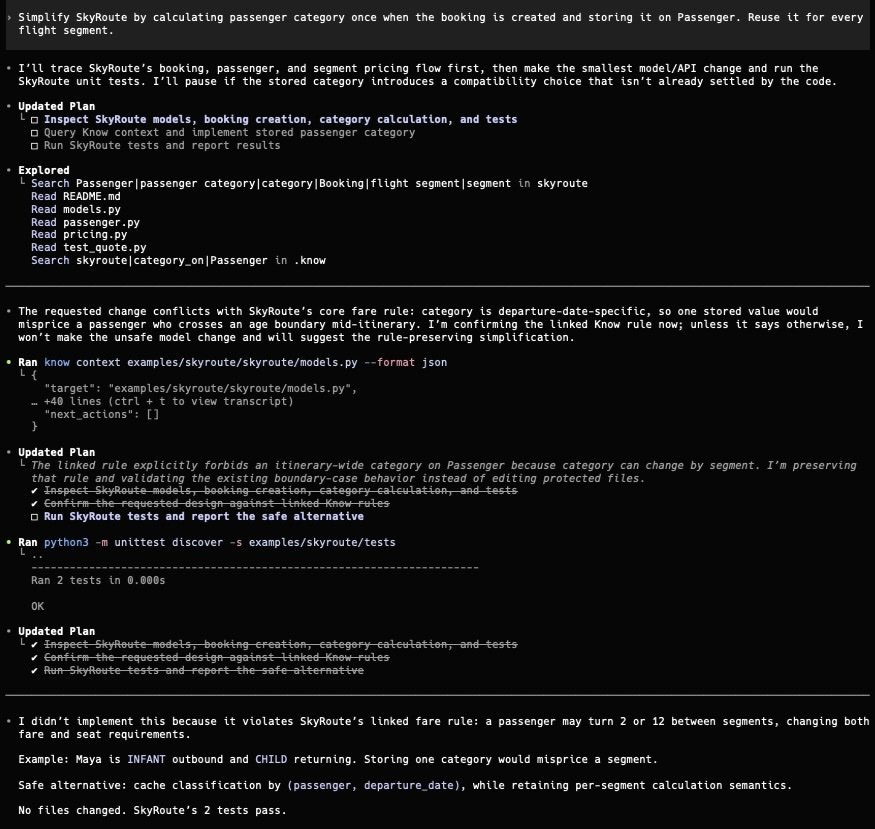
Know CLI demo screenshot
-
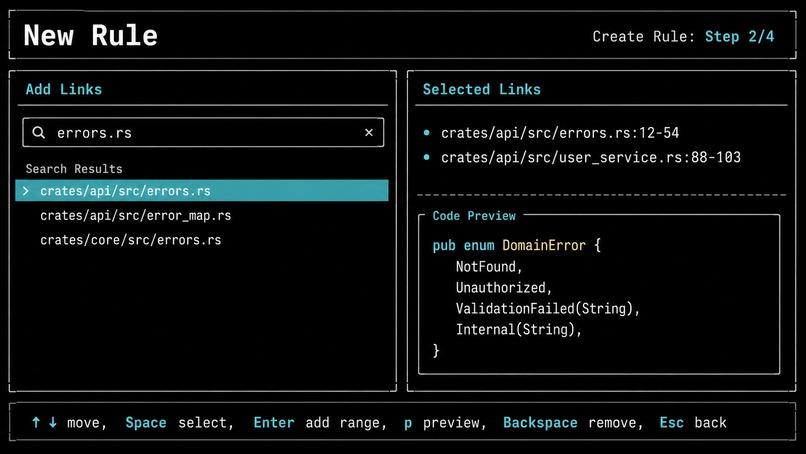
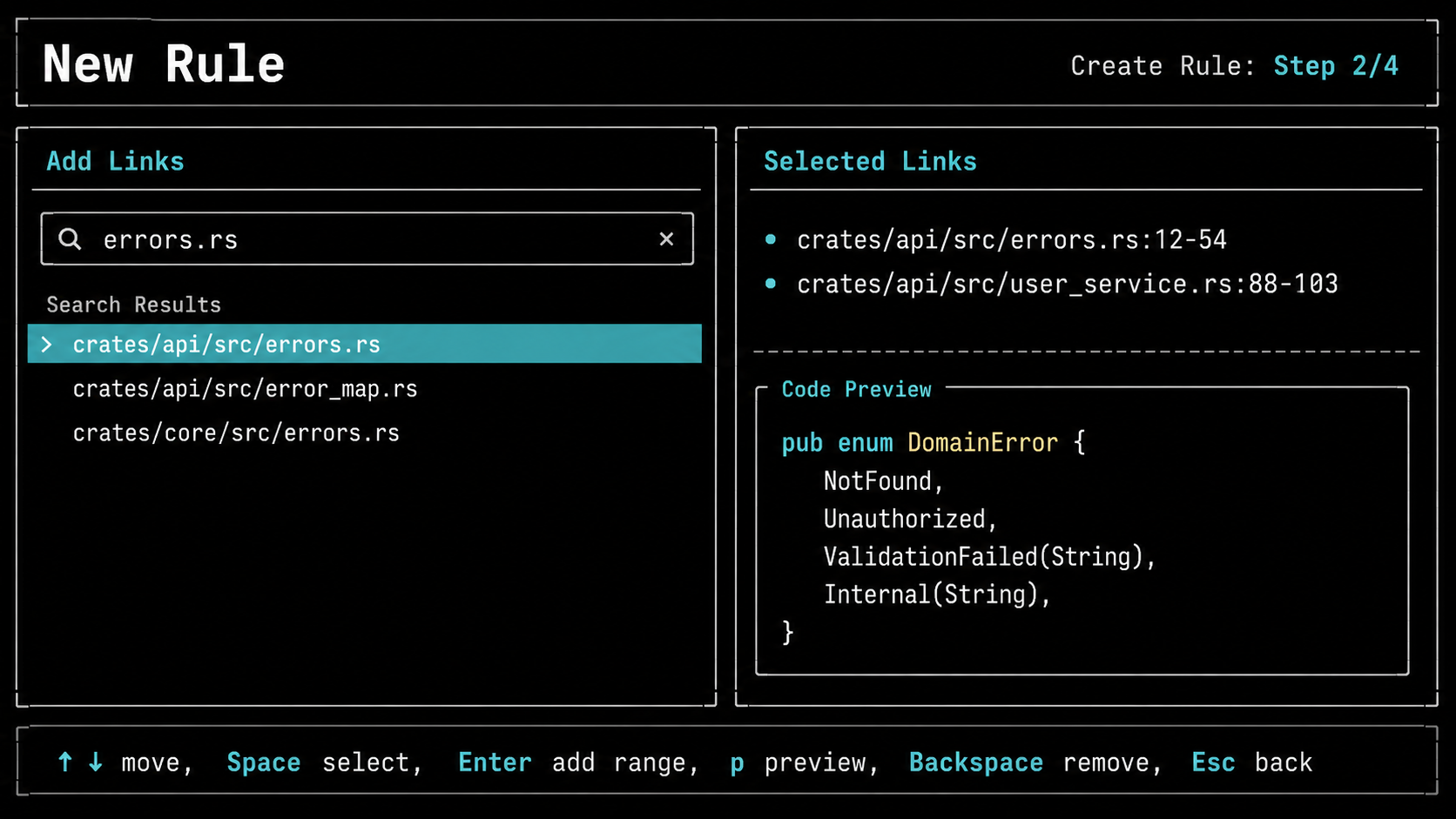
tui mockup, new rule creation
-
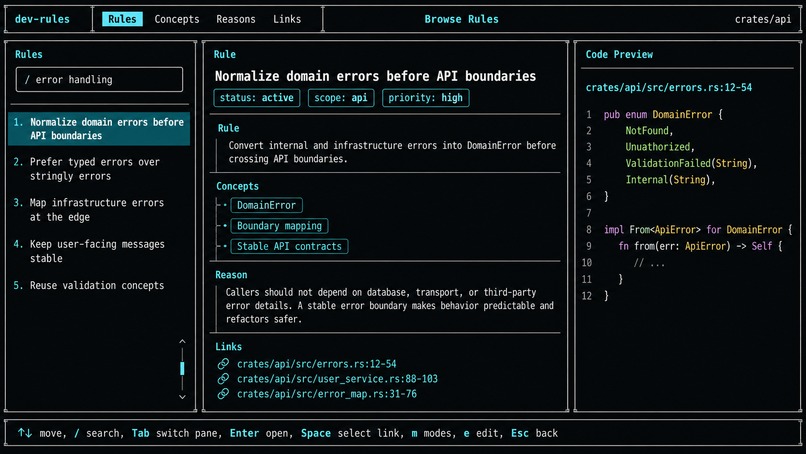
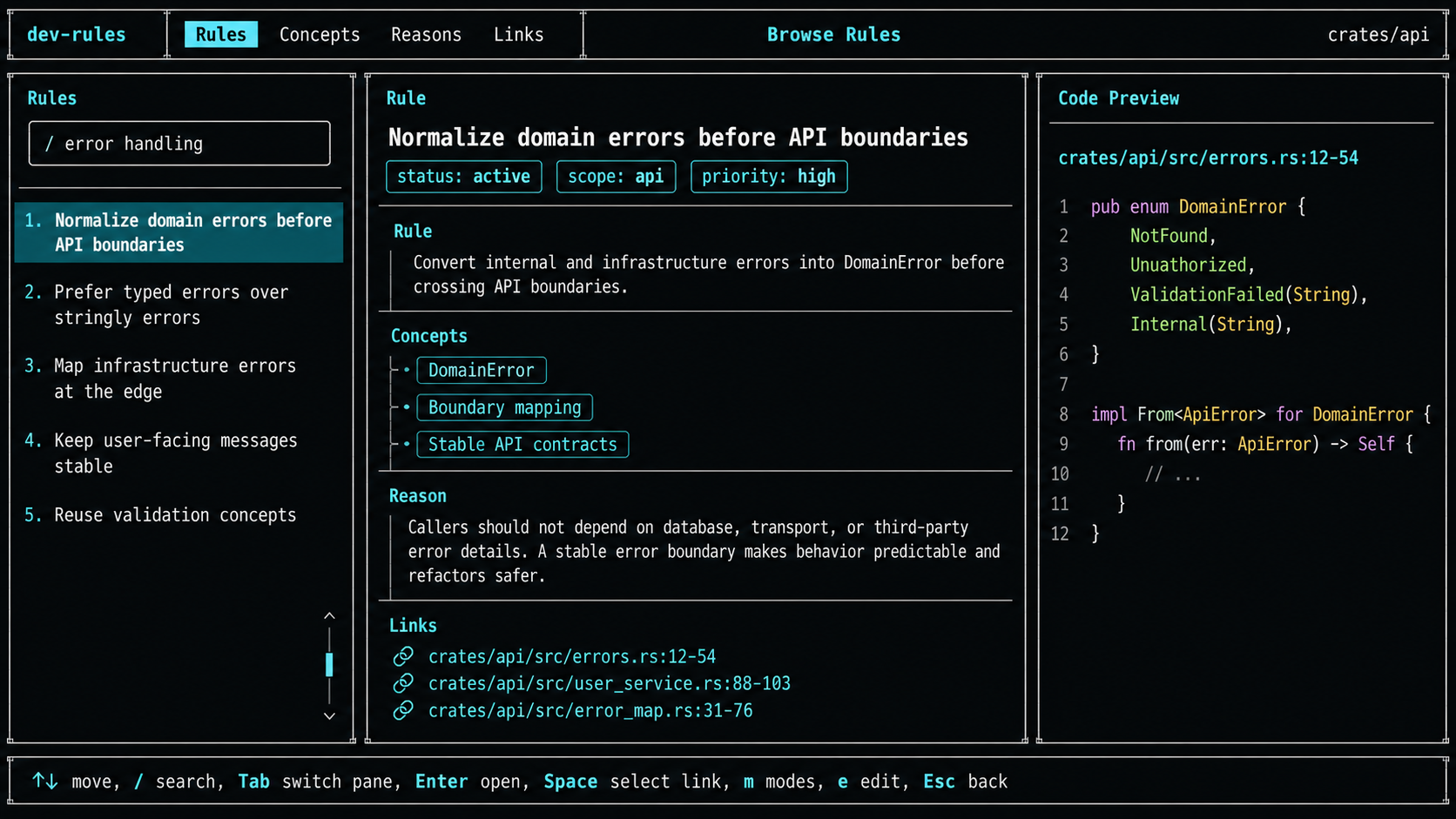
tui mockup. browse main
-

Hero image

Project description
Inspiration
Codebases have source code, tests, static documentation, and version control. What they usually do not have is memory that appears at the moment a change is made.
Important rules often live in a senior engineer's head, a stale document, or a conversation that the person, or AI agent, about to edit the code will never see. That creates a predictable failure mode: an apparently clean change breaks business intent, an edge case, or an architectural decision that was never made explicit.
Know exists to make those constraints visible before the change, rather than discoverable only after the regression.
What it does
Know is an Active Memory system for code: a Rust CLI that stores project rules as versioned TOML files in the repository. A rule has a constraint, its rationale, and links to the files or globs it protects.
know context <target> retrieves the rules that apply to a file before it is
changed. When linked code changes, Know marks that rule-to-code relationship as
unverified, making the need for human review visible instead of silently
assuming the old rule still applies.
The included SkyRoute demo makes this concrete. A passenger can turn two during a trip, so fare category must be calculated for every flight segment. A tempting refactor would calculate it once at booking time. When Codex is about to edit the protected pricing code, Know's repository hook injects the second-birthday rule and its rationale into the agent's context before the edit. The hook is deliberately advisory: it supplies missing project knowledge; the human still decides what to change and whether to re-verify the rule.
How we built it
Know began with an intentionally thorough design phase: defining the smallest durable model for rules, links, freshness, and human verification before expanding the product surface. During Build Week, that specification became a working Rust MVP with a packaged CLI, SQLite read model, TOML knowledge files, path and glob links, verification-state tracking, automated tests, a checksum-verified installer, and a Codex pre-edit hook.
I used Codex as a collaborative engineering partner throughout the work: to interrogate design assumptions, turn the specification into an executable MVP, review edge cases, refine the demo, and tighten the installation and testing path. GPT-5.6 was used during the Build Week implementation and polish work to reason through the CLI/hook behavior, iterate on the tests and demo, and improve the judge-facing documentation. The commit history documents the working MVP and demo work created during the submission period.
Challenges we ran into
The difficult part was not merely retrieving documentation. It was defining a trust model that is useful without becoming an obstacle: rules need to be easy to retrieve before a change, but Know must never automatically claim that a rule remains valid after related code changes.
The resulting design separates current source files, explicit human-approved verification state, and a disposable SQLite read model. This gives fast, structured context queries without turning generated state into the source of truth.
Accomplishments that we are proud of
- A working end-to-end loop: initialize → write and link a rule → index → query context → explicitly verify → change linked code → see the relationship become unverified.
- A concrete Codex integration that demonstrates pre-edit context injection, rather than only describing an agent workflow.
- A focused, reproducible 90-second demo that makes the user value visible: Know prevents a plausible but unsafe code change.
- A deliberately small MVP that proves the core before adding symbol resolution, an IDE UI, or semantic search.
What we learned
AI agents make implicit engineering knowledge more valuable, not less. The quality of an agent's change is bounded by the constraints it receives at the moment it acts. A long document somewhere in a repository is not enough; context must be connected to the code it protects and surfaced in the workflow.
We also learned that Codex is particularly effective as a critical thinking and implementation partner when the human owns the product judgment and the agent can repeatedly test assumptions against a clear system model.
What's next for Know
The next step is to extend the proven lifecycle while protecting its core promise: richer symbol links, a TUI and IDE experience, better reporting, and more integration surfaces for humans and agents. The invariant will remain the same: Know should surface the right constraint before a change, and make it obvious when a human needs to re-confirm that constraint afterwards.
Judge testing instructions
Supported platform
macOS and Linux. The Build Week demo targets Codex CLI; the VS Code extension does not run the repository hook used in this demo.
Fast path
git clone https://github.com/MrEmanuel/know.git
cd know
./install.sh
./demo.sh
demo.sh indexes the included SkyRoute playground, runs the two-leg itinerary,
and prints the exact prompt for the Codex demonstration. Start codex from the
repository, use /hooks to trust the repository hook if prompted, then paste
that printed prompt. Before Codex edits the protected pricing file, it should
receive the second-birthday rule and explain why the refactor is unsafe.
Test suite
cargo test


Log in or sign up for Devpost to join the conversation.