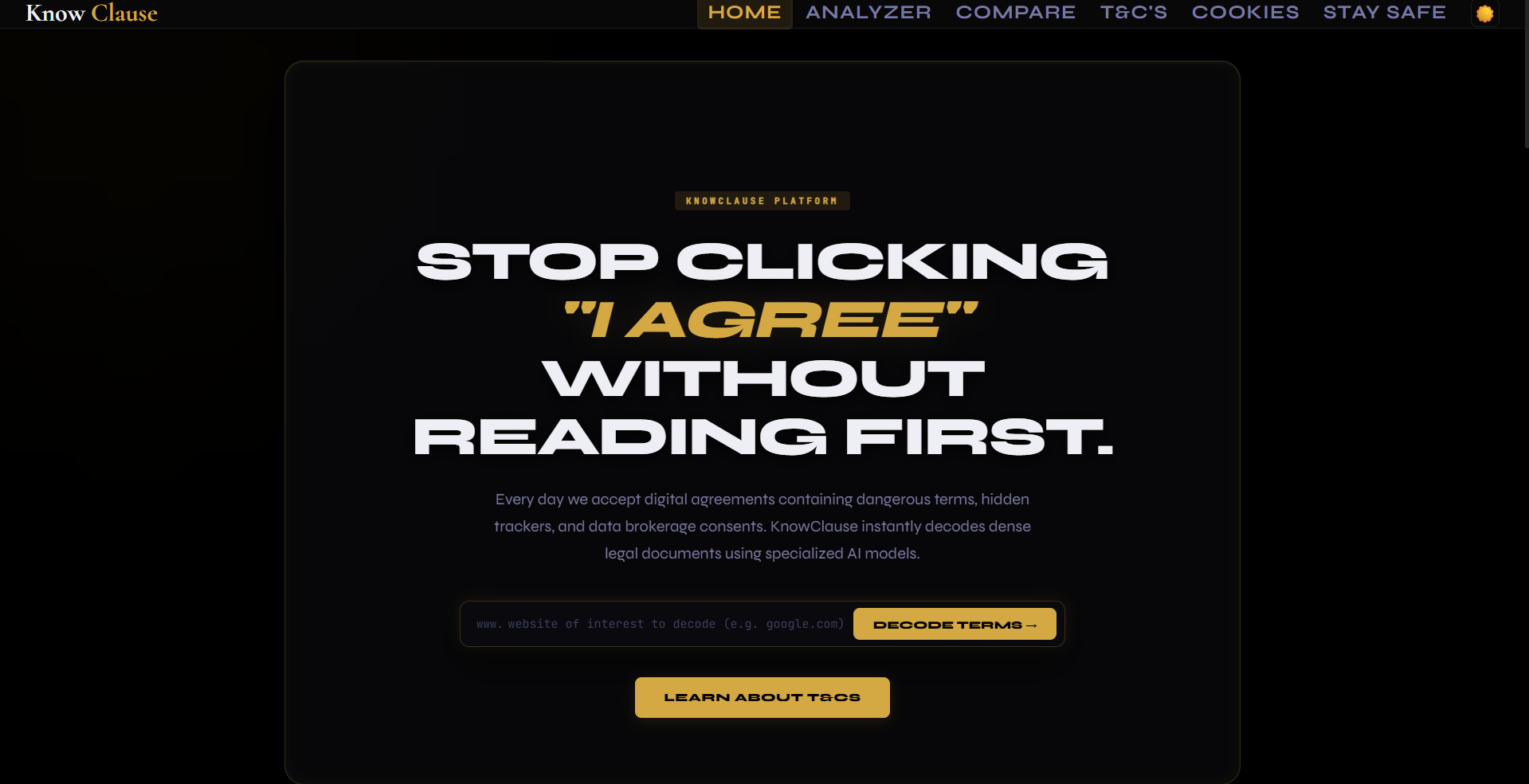
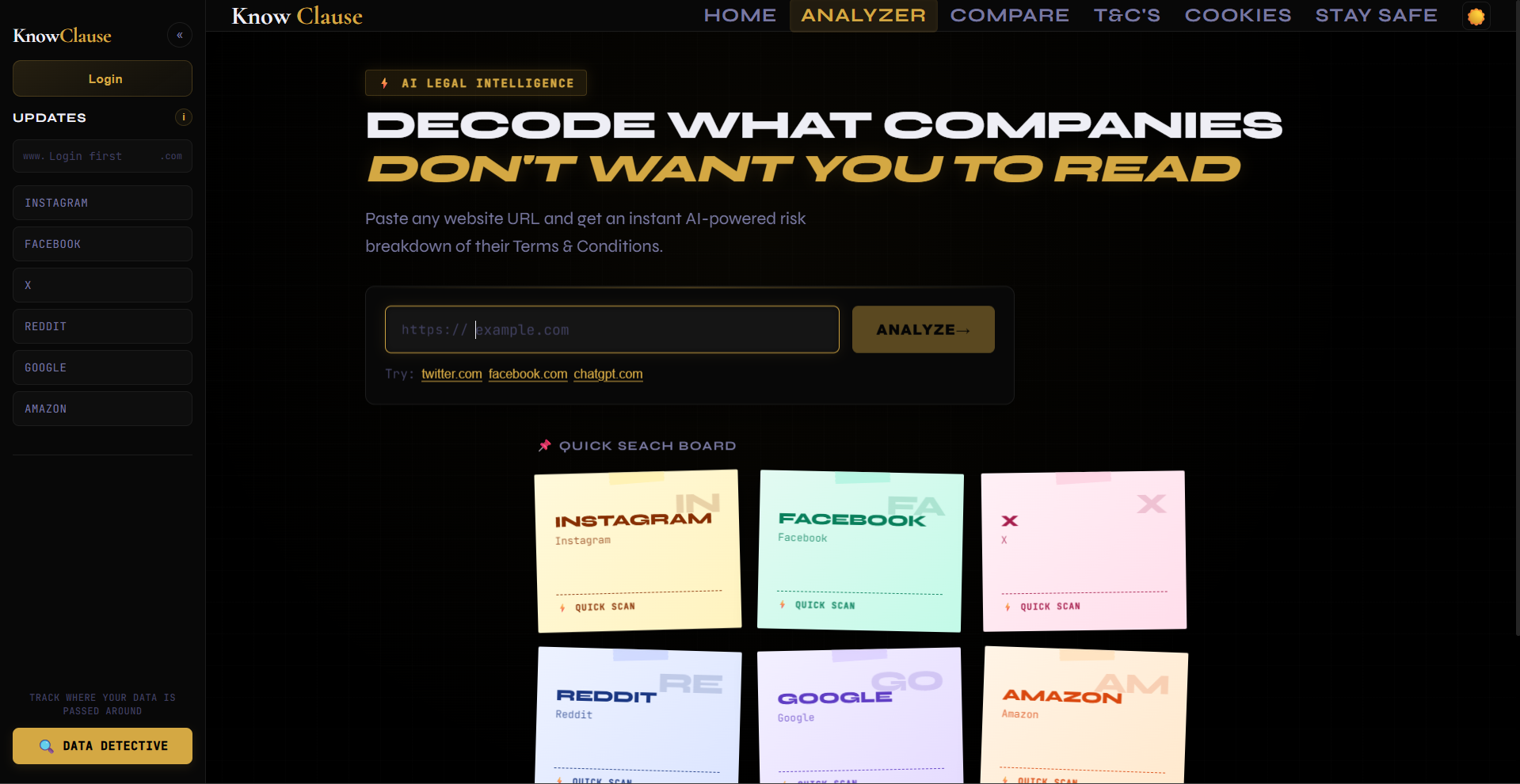
Know Clause is an AI-powered legal transparency platform that transforms dense, unreadable Terms & Conditions into understandable risk insights, policy tracking, and interactive data-flow visualizations.
Most users blindly accept Terms & Conditions without understanding how their data is collected, shared, monetized, or used across hidden digital ecosystems. Our platform solves this by automatically fetching, analyzing, comparing, and visualizing legal policies from websites in real time.
The system combines web scraping, AI analysis, OSINT-style ecosystem mapping, and interactive frontend visualizations to expose:
• risky legal clauses • hidden privacy tradeoffs • behavioral tracking practices • third-party data sharing • AI training usage • advertising ecosystems • silent policy changes over time
Unlike generic summarizers, the platform performs site-specific analysis by understanding the company’s actual ecosystem, monetization model, infrastructure, developer integrations, and publicly known privacy behavior.
The platform is designed especially for non-technical users who struggle to understand complex legal language. Instead of forcing users to read thousands of words of legal jargon, the app converts Terms & Conditions into simple explanations, risk scores, visual graphs, and understandable summaries.
The platform also includes educational sections that teach users:
• what Terms & Conditions actually are • how cookies work • how tracking systems operate • how companies collect behavioral data • how users can stay safer online
This turns the platform into both a legal intelligence engine and a digital privacy awareness tool.
Core Features • Real-Time Terms & Conditions Extraction
The platform intelligently discovers and extracts legal documents using:
• direct legal-path detection • intelligent fallback searching • Cheerio-based scraping • Puppeteer rendering • AI-generated fallback reconstruction
To improve speed and reliability, multiple extraction pipelines run in parallel. If one method fails, another continues instantly without restarting the process.
• AI Legal Risk Analyzer
The extracted Terms & Conditions are analyzed using AI to identify:
• dangerous clauses • privacy-invasive policies • arbitration traps • excessive platform permissions • content ownership risks • aggressive data collection • AI training permissions • auto-renewal systems • moderation powers • consumer-unfriendly terms
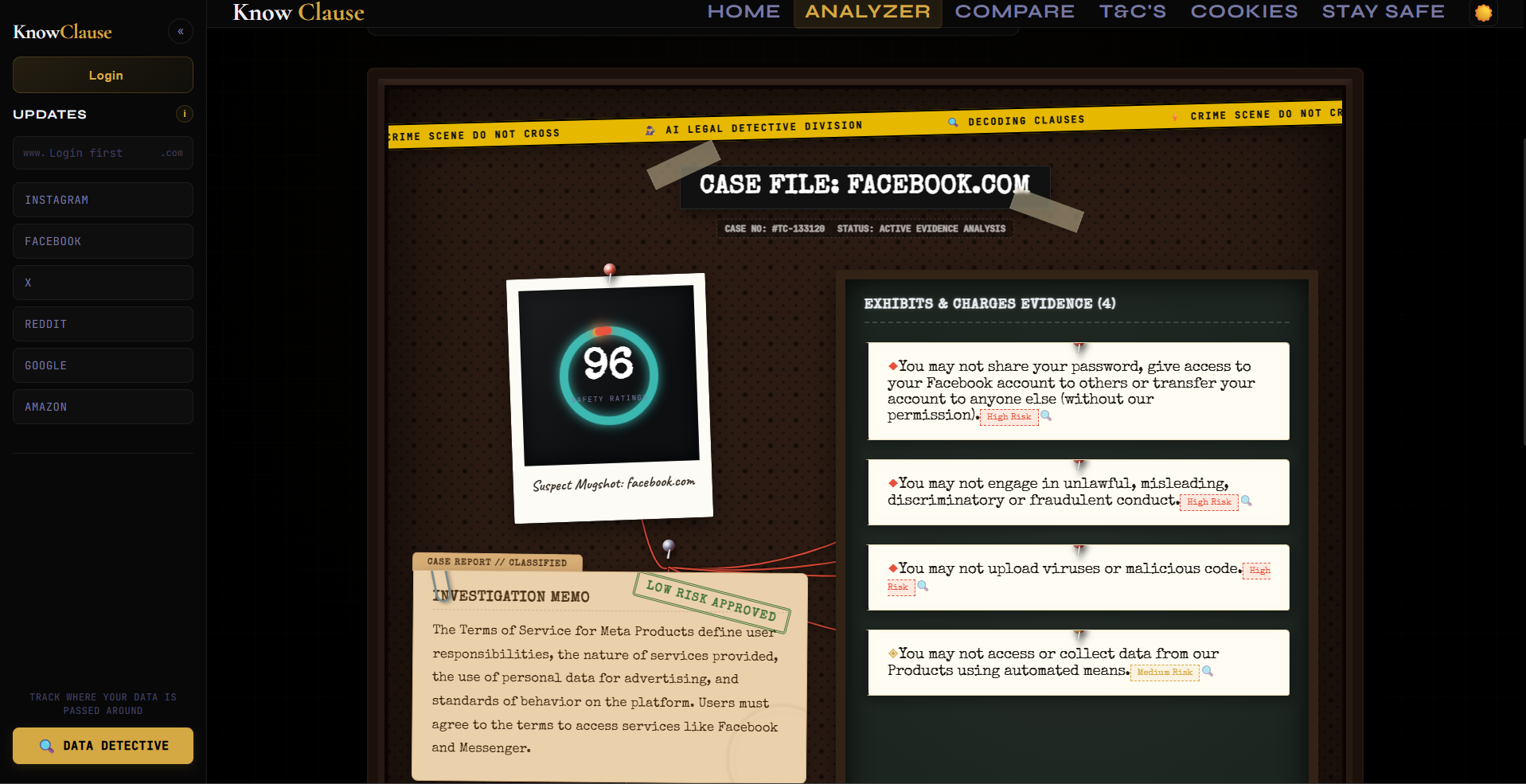
Each clause receives:
• a simplified explanation • severity classification • an overall platform safety score
This helps ordinary users understand complex legal risks in simple language.
• Data Flow Tracker
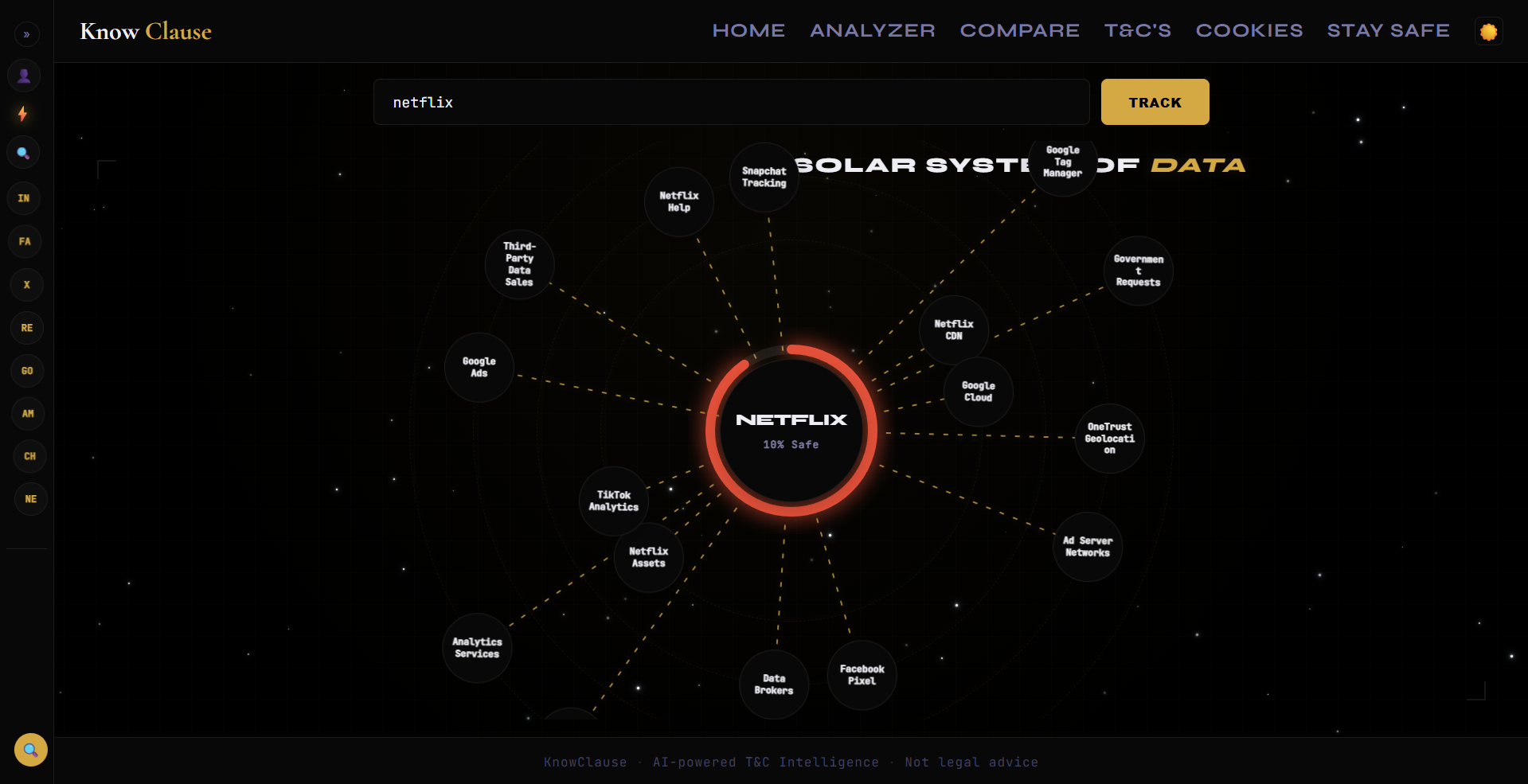
One of the platform’s most distinctive features is the Data Ecosystem Tracker.
Instead of analyzing only official policies, the system investigates realistic data flow across:
• advertisers • analytics providers • cloud infrastructure • SDK ecosystems • AI systems • data brokers • partner companies • governments • third-party integrations
The results are visualized through interactive network graphs showing where user data may realistically travel.
• Policy Change Detection
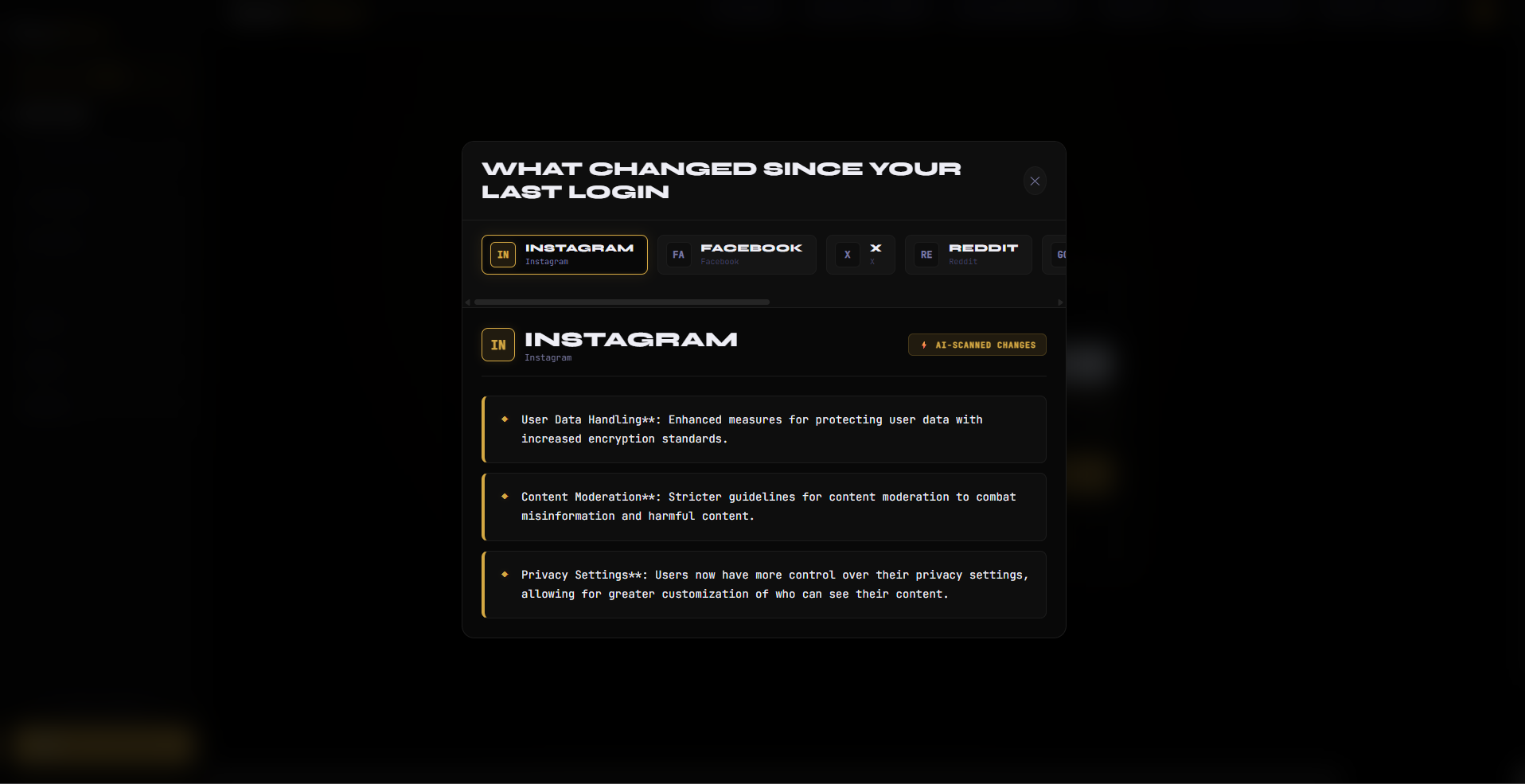
The platform stores historical Terms & Conditions snapshots in MongoDB and compares them against newly fetched versions.
Users can instantly identify:
• newly added clauses • modified legal permissions • changed privacy policies • expanded tracking behavior • newly introduced risks
This exposes silent policy updates that users usually never notice.
• Interactive Risk Visualization
The frontend includes:
• animated ecosystem graphs • safety score rings • legal risk dashboards • interactive clause exploration
Complex legal structures are converted into intuitive visual intelligence.
Tech Stack Frontend
• React.js • Custom CSS animations • SVG-based graph rendering
Backend
• Node.js • Express.js
Database
• MongoDB • MySQL connectivity support
AI & Analysis
• OpenRouter API • GPT-based legal analysis • AI-powered policy comparison
Scraping & Extraction
• Puppeteer • Cheerio • Parallel extraction pipelines
Challenges Faced During Development
Building Know Clause involved several technical and architectural challenges:
• Dynamic Website Scraping
Many modern websites heavily rely on JavaScript rendering, anti-bot systems, and dynamically loaded legal pages. Traditional scraping often failed, requiring fallback rendering using Puppeteer.
• Legal Page Discovery
Different websites store Terms & Conditions under completely different routes and naming structures. Intelligent URL guessing and fallback search systems had to be developed.
• AI Reliability
Large language models sometimes generated inconsistent or malformed JSON responses, causing parsing failures. Additional validation and structured prompting were required to stabilize outputs.
• Performance Optimization
Running scraping, rendering, and AI analysis sequentially created large delays. Parallel extraction pipelines were implemented to significantly reduce waiting time.
• Risk Interpretation
Converting complex legal language into simplified explanations without losing meaning was one of the hardest problems in the project.
• Data Ecosystem Mapping
Tracking realistic data-sharing ecosystems required combining public knowledge, privacy disclosures, advertising infrastructure patterns, and OSINT-style inference systems.
• Visualization Complexity
Creating dynamic graph layouts without overlap while keeping the interface understandable and responsive required multiple frontend rendering optimizations.
Problem Statement
Most users blindly accept Terms & Conditions because:
• legal language is inaccessible • policies are excessively long • privacy implications are hidden • policy updates happen silently
As AI systems, surveillance advertising, and data brokerage ecosystems expand, users increasingly lose visibility into how their personal information is used.
Know Clause bridges the gap between complex legal systems and ordinary users by making legal transparency visual, understandable, educational, and actionable.
Future Prospects • Live Policy Change Alerts
Notify users instantly whenever companies silently modify privacy terms, tracking systems, AI permissions, or data-sharing behavior.
• Trained AI Model for Legal Documents
Develop a specialized AI model trained specifically on legal policies, privacy documents, and compliance systems for more accurate analysis.
• Data Analysis of Policy Evolution
Analyze how Terms & Conditions evolve over time across industries, platforms, and business models.
• Historical Logs & Version Tracking
Maintain complete historical archives and change logs of Terms & Conditions to create transparent legal timelines for companies.

Log in or sign up for Devpost to join the conversation.