Inspiration
Most research dies in the valley of death, the gap between a result and a product someone pays for. The first wall is simple: nobody knows if anyone wants the thing before money gets locked into building it. I built Knos alone from Nigeria, and I wanted that question answered with real taste data before a single backer pays. Qloo sits at that first wall.
What it does
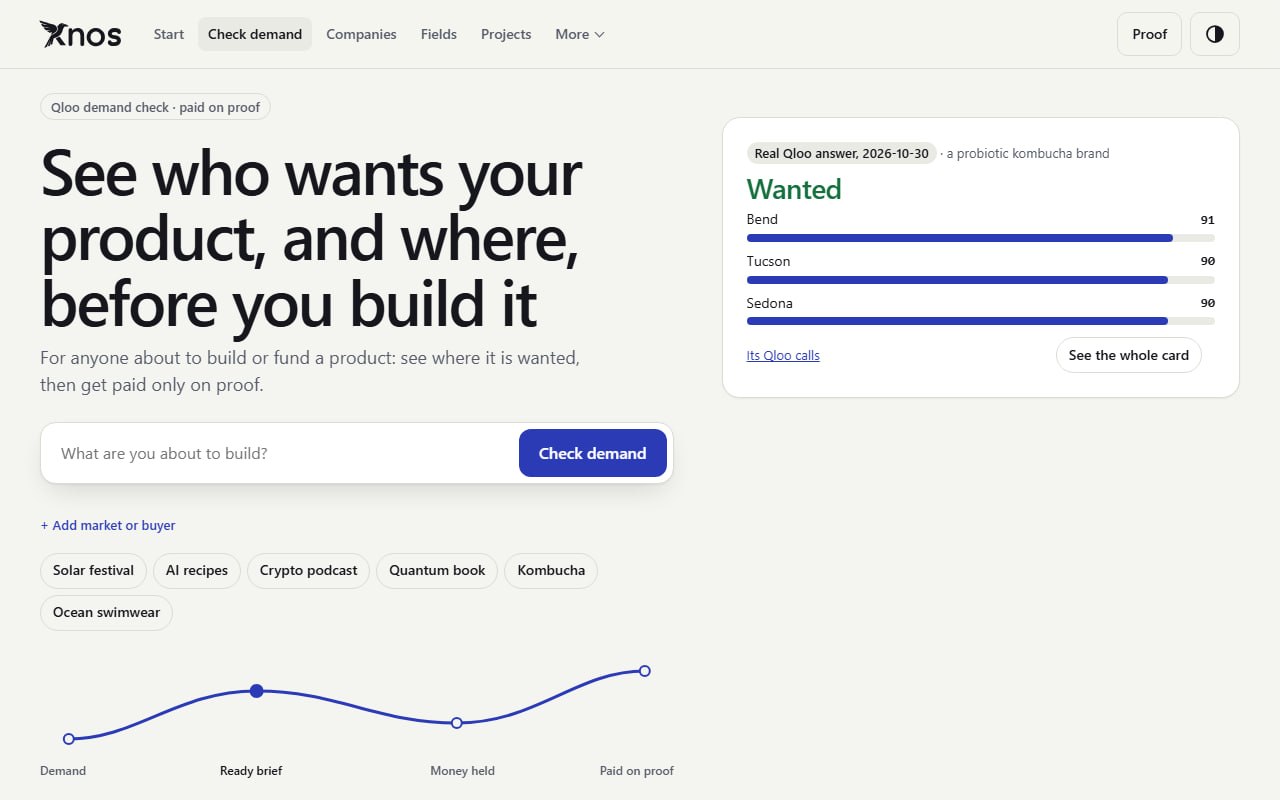
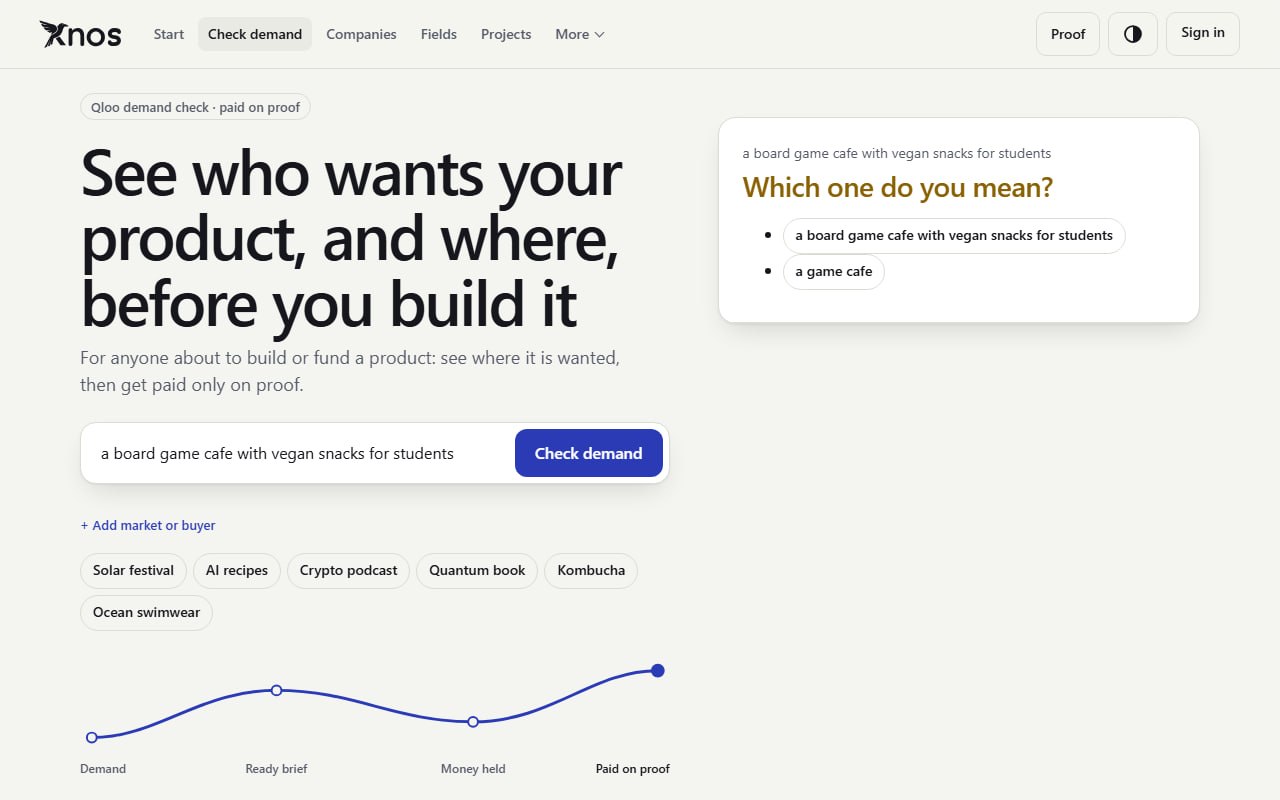
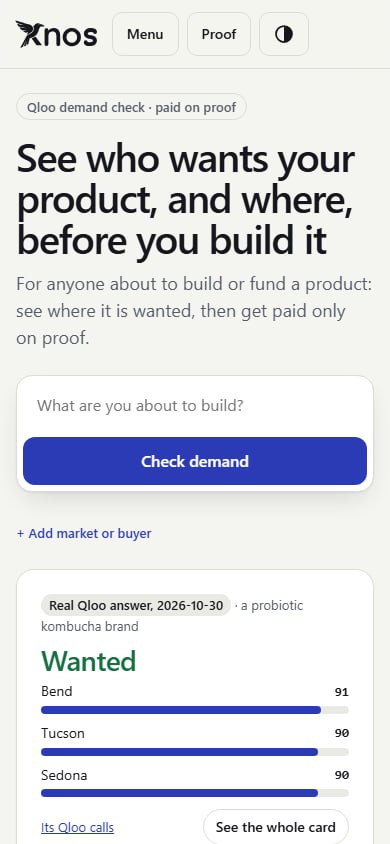
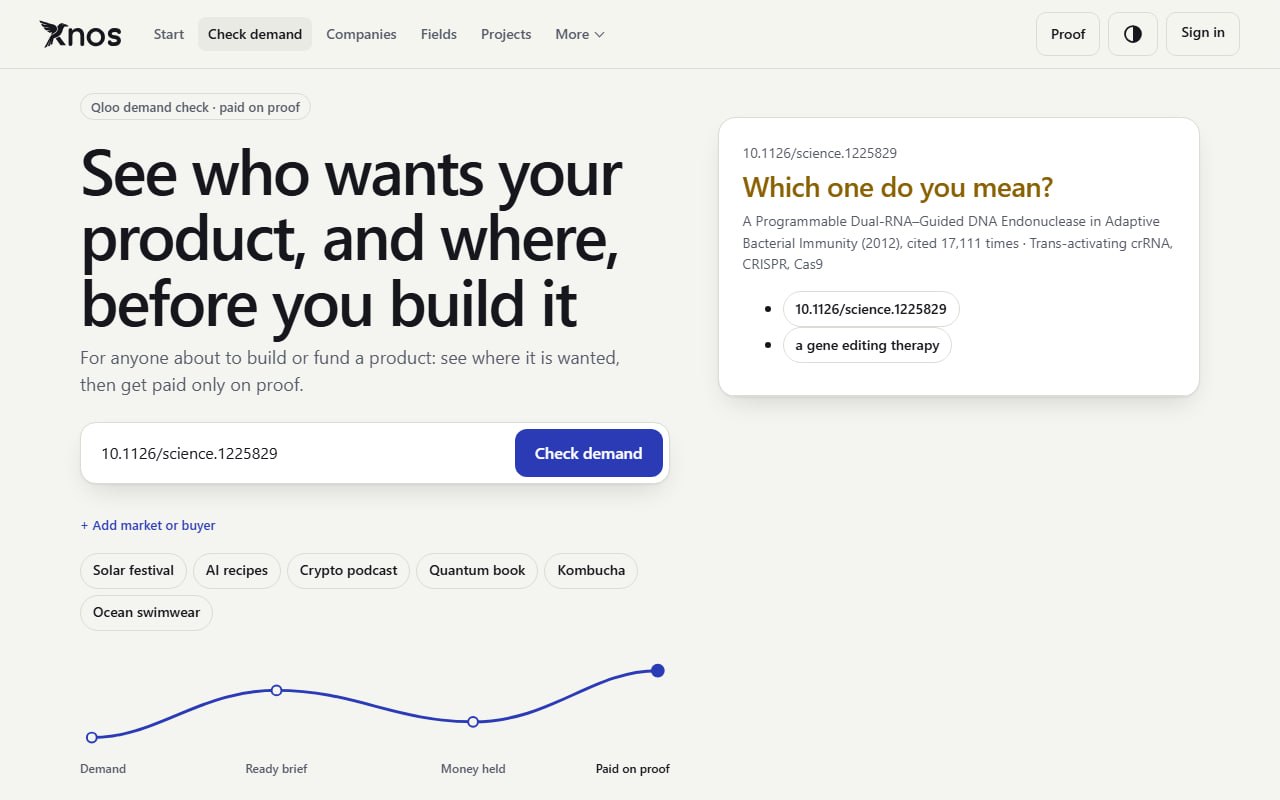
Type an idea or paste a paper's DOI. Knos asks Qloo who wants it and where to launch it, then turns the answer into a Ready brief: milestones with a target, a checker and a deadline, locked by a hash. Backers' money waits in a program on Solana devnet and is paid out only when the proof is verified. Try it at https://drexthealpha.github.io/Knos/ . The first screen already shows a real finished result before you type anything.
On every card, Qloo answers live:
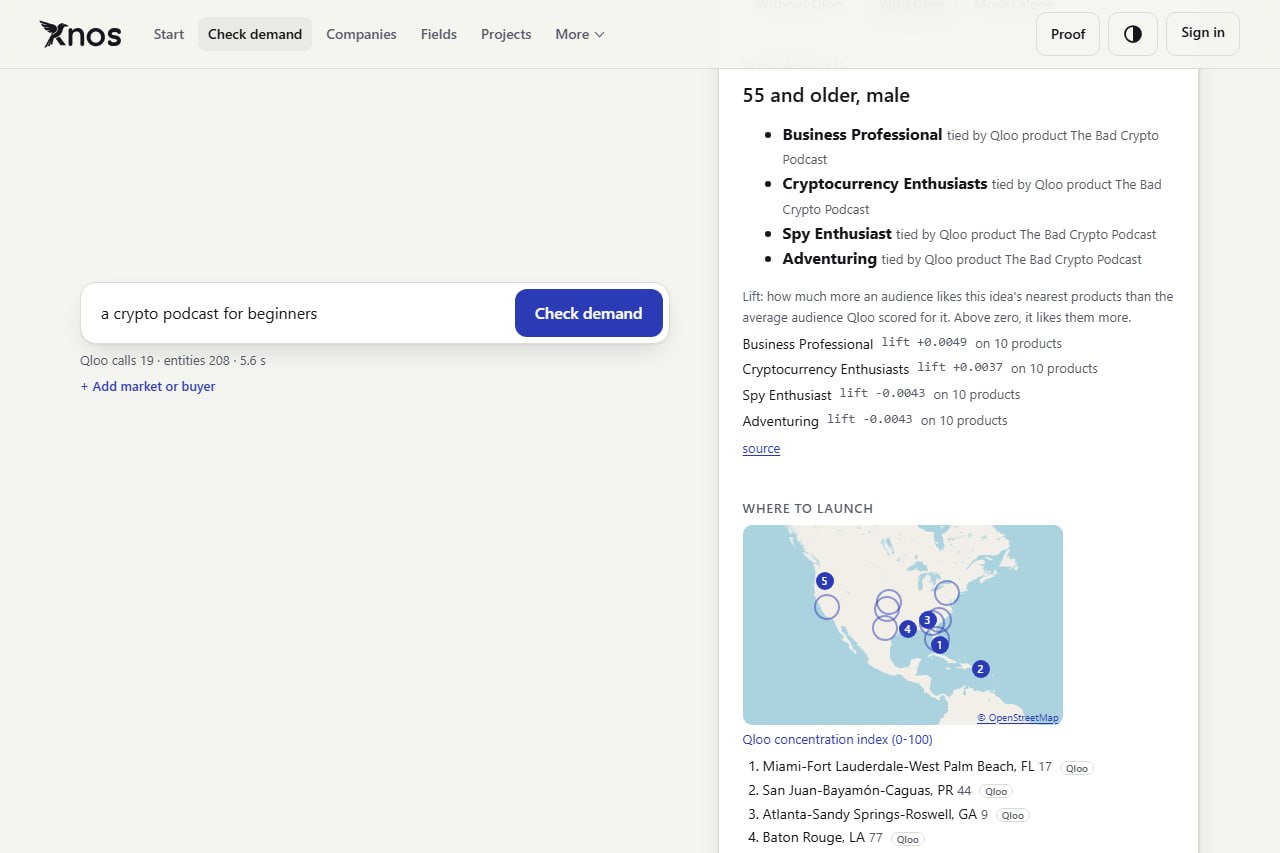
Who buys. Each of the six sample ideas reads Qloo's audience segments live through /v2/audiences, with 0 answers taken from an older check. Audiences that stand above the average come first, with one line saying what lift means. On the crypto podcast idea, Business Professional (+0.0049) and Cryptocurrency Enthusiasts (+0.0037) lead. On 3 of the 6 ideas Qloo moved every audience alike, and the card says so in words.
Papers reach Qloo. Knos reads a paper from OpenAlex and turns it into a product reading. The CRISPR paper (10.1126/science.1225829) becomes "a gene editing therapy" and opens with 25 live Qloo signals. The AlphaFold paper (10.1038/s41586-021-03819-2) opens with 19. The deep learning review (10.1038/nature14539) gets Not yet with 16, and none of the three checks has a single refused Qloo call.
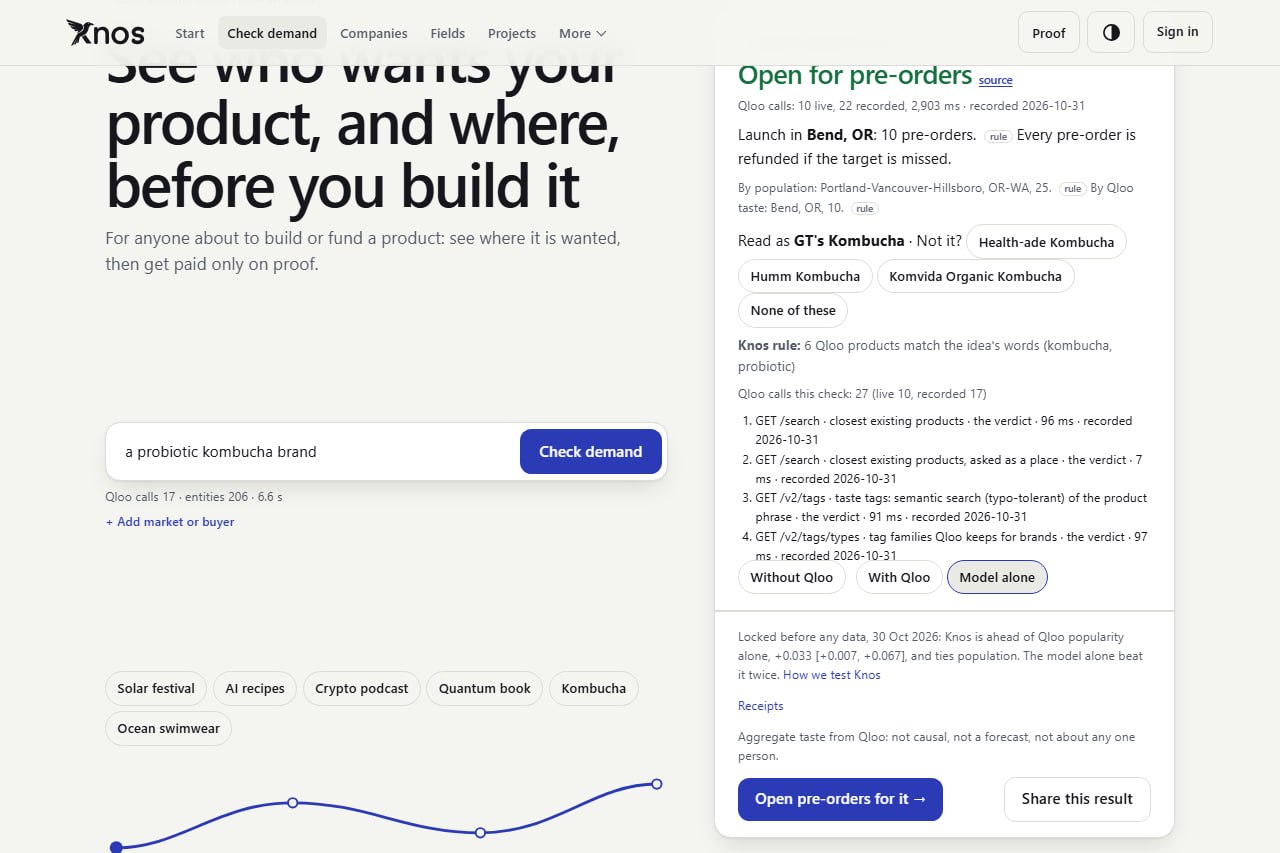
You can switch Qloo off. Every card has its own view buttons, from the card without Qloo to the model alone. On 7 of 7 cards, Model alone shows the model's own launch city beside Knos's, so you can see exactly what Qloo adds.
Watch it count. While a check runs, the card counts its live Qloo calls, the entities they bring back and the seconds. On 3 typed ideas the final count matched the server's own call log exactly: 21 calls carrying 220 entities, then 38 carrying 317, then 38 carrying 339.
How we built it
The app is Python on Render, the front door is on GitHub Pages, and the money runs through Solana programs written in Rust. Qloo powers the demand check through search, insights, audiences and heatmaps. Every Qloo request is checked against Qloo's own docs, and the last 200 calls are listed in the open with their timings. Knos also works from Claude Code with one command, through its MCP server.
Since 30 Sep, Knos changed from a way to pay for verified work into a demand check first, with Qloo at its mouth. Each change links its commit:
- 16 Oct: a research result goes in and a demand decision made by code comes out. https://github.com/drexthealpha/Knos/commit/25bf9721f252eb234901496ea5066ae4c12e3d88
- 19 Oct: money locks only on a brief that is Ready to fund. https://github.com/drexthealpha/Knos/commit/82cd901a200d3790bda0058aeed19603921bf967
- 22 Oct: the front door shows the latest real check at its first paint. https://github.com/drexthealpha/Knos/commit/8cd56786fa63b17808da2f140208a5dde001cec9
- 25 Oct: the launch target comes from the metro's population and Qloo's affinity. https://github.com/drexthealpha/Knos/commit/afa6c9640c6f9ab1609ac053a3b5cfd2a0e90c69
- 26 Oct: every Qloo request is checked against Qloo's docs, and each card can be read with Qloo off. https://github.com/drexthealpha/Knos/commit/b5f985ba92f1f655f29f89d96274e7000a553ec0
- 27 Oct: the model's own answer sits beside Knos's on the card. https://github.com/drexthealpha/Knos/commit/ca1a81513da83d0786cdf2794ae740902dfa7538
- 27 Oct: every Qloo call is in the open, listed with its timing. https://github.com/drexthealpha/Knos/commit/a7fcc50452c745c484c7239996309a86896035ca
- 30 Oct: the baseline test's plan was committed before any data. https://github.com/drexthealpha/Knos/commit/cef5f4c945b51f048cb665cc4f893348cfd3bcdd
- 30 Oct: its result went on How we test Knos, win and tie together. https://github.com/drexthealpha/Knos/commit/d4be710d4235f8000e931af09a5aa6f4791914f3
- 30 Oct: who buys is asked of Qloo live on every check, and a running check counts its calls. https://github.com/drexthealpha/Knos/commit/97902404cb9bc842f27548d1ecc2924c65e9a96a
- 30 Oct: papers reach Qloo with no refused call. https://github.com/drexthealpha/Knos/commit/74e6c9e1033f2b26829b527f8e2eae5b361978f9
Challenges we ran into
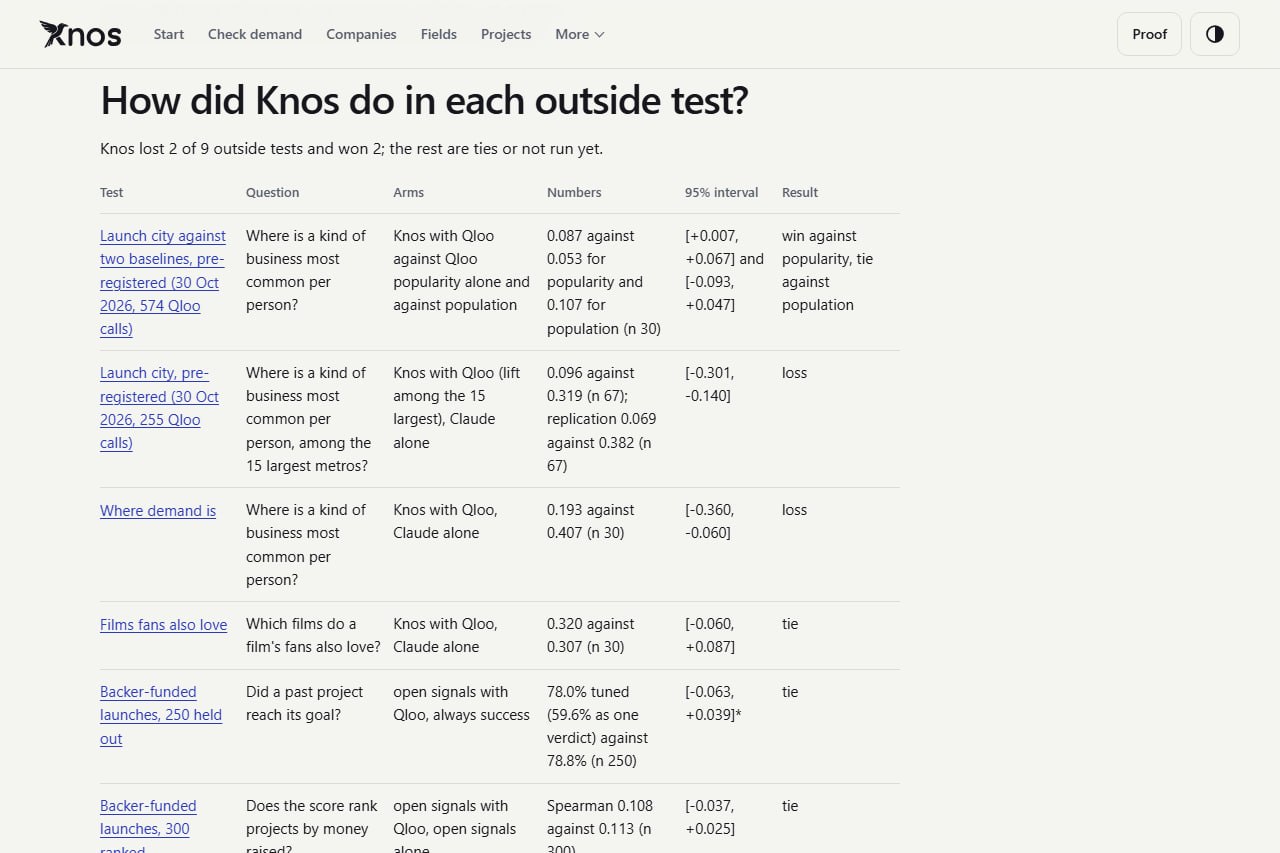
Honest tests are hard to win. Two earlier tests I fixed in advance went against Knos and are published: 0.096 against 0.319 for Claude alone on picking a launch city, and 0.193 against 0.407 on where demand is. Qloo's audience lifts first came back all below zero, because adding any audience lowers every product's affinity, so I had to read each audience against the average one. The deep learning paper kept getting refused calls until I found it was being read as a place. And I built all of this on one 8 GB PC.
Accomplishments that we're proud of
On 30 Oct I committed a test plan, with its sha256 in the commit message, before any Qloo call: rank where 30 kinds of business are most common per person, on the Census answer key, against two rankings that use no model. Knos with Qloo scored 0.087. Qloo popularity alone scored 0.053, so Qloo's taste signal beats Qloo's own popularity by +0.033, 95% interval +0.007 to +0.067. Population alone scored 0.107, and the test can't tell Knos from it: -0.020, interval -0.093 to +0.047. Only 7 of the 30 business types brought Qloo heatmap metros. The run used 574 Qloo calls, and the result is printed on every result card and published at https://drexthealpha.github.io/Knos/how-we-test.html
Proof is checked before money moves: on 60 altered pull requests, Knos's referee caught 60, while a pull request's own CI caught 31. On a phone, Lighthouse gives the front door 1.0 for performance and 1.0 for accessibility.
What we learned
A clear brief changes everything. On tasks run through Claude Code, Ready briefs passed 85% of tasks, and vague or padded briefs 5% each. Vague briefs also cost 2.11 times the output tokens (95% interval 1.37 to 3.75), but padded to the same length they cost 1.59 times (interval 0.99 to 2.90), so the token saving did not hold against that control. I learned to publish the loss next to the win.
What's next for Knos
Real users. The record today holds 2 devnet holds and 10 releases, all my own test runs, and the public counter shows that as it is. Next is the first outside researcher crossing the valley on Knos, then labs whose proof is checked inside their own walls, and mainnet only after an outside audit. Knos is one product because the valley has one shape wherever research comes from, and it works toward Schmidhuber's vision of science that compounds and the Kardashev ladder that needs it, connecting billions of people to the world's money one verified milestone at a time.
Built With
- claude
- github-actions
- javascript
- mcp
- playwright
- python
- qloo
- render
- rust
- sibyl
- solana
- spl-token
