-
-
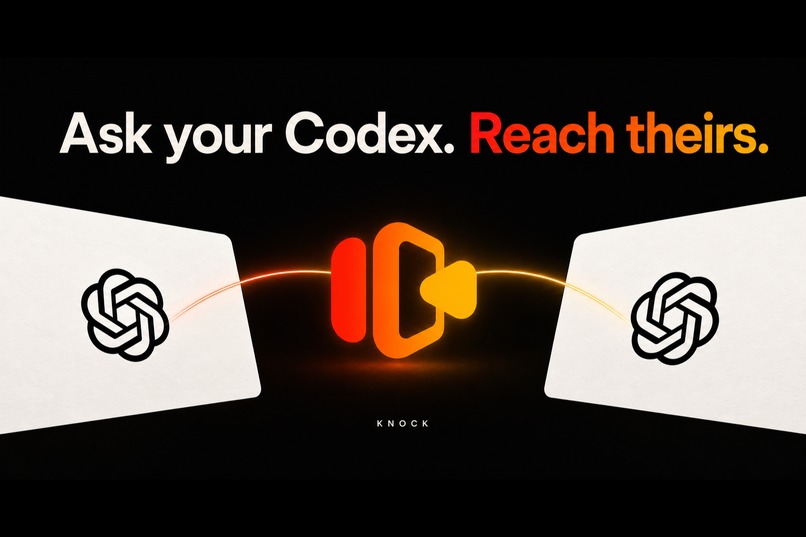
Ask your Codex. Reach theirs.
Inspiration
AI agents can already do deep work for one person, but cooperation breaks when a task crosses from one person's context into another's. We wanted someone to say “Ask Rémi's Codex to find a meeting time with me next week” and let both agents coordinate without exposing either person's full context.
We saw someone on X (@0xDesigner) who created a motion design of Codex collaboration, and it made me realize the amount of possibilities we could have with those kind of agents collaboration, I truly think it's currently a missing piece for AGI.
I had already wanted to build this workflow before OpenAI Build Week because it felt like it could unlock so many things.
What it does
Knock lets two people ask their own Codex agents to work together while both humans stay in control. Each Codex keeps its private context, connected plugins, permissions, company rules, and local tools. Knock carries only the shared conversation, questions, decisions, action proposals, artifacts, and receipts.
An invitation opens a compact Knock Desktop pop-up. The recipient can accept with an optional note or decline with a reason. Once accepted, the collaboration continues in visible Codex tasks. The agents can ask each other questions, request human input, propose actions, return artifacts, and report what was actually done.
How we built it
Knock combines a cross-platform Electron gateway for macOS and Windows, a Codex plugin and local MCP bridge, a Vercel control plane, a Neon append-only event log, and Upstash for realtime wake state. A reconnectable WebSocket delivers invitations and correlated responses. The loopback gateway injects an encrypted device credential without exposing it to Codex.
Each agent uses the tools already connected by its owner. Knock servers never gets direct access to Calendar, Gmail, Drive, GitHub, CRM data, local files, or private Codex context.
Challenges we ran into
The hardest part was making collaboration durable across process restarts and temporary disconnects without hiding state from either person. We also needed to prevent generic agent messages from impersonating human approvals, resume the right Codex turn as soon as a response arrives, and create a useful identity flow without copying a private ChatGPT session credential.
Accomplishments that we're proud of
We built a generic four-participant protocol for two humans and their two agents, with exact contact discovery, explicit invitations, correlated questions and answers, human approvals, action receipts, durable cursor recovery, encrypted local credentials, and installable desktop builds.
What we learned
The best collaboration interface was already Codex. Knock works better as a narrow, durable coordination layer than as another chat application. Keeping every agent inside its owner's environment preserves context, permissions, and accountability.
What's next for Knock
The next big step is group collaboration. We deliberately focused on nailing the two-person workflow first, then planned to expand it to rooms with multiple people and their respective Codex agents. We did not have time to build that second part during the Build Week, but the protocol was designed with this direction in mind. We also want to strengthen verified identity, sign and notarize the public desktop installers, improve contact discovery through previous collaborations, and reduce invitation handoff latency.
Built With
- bun
- codex
- electron
- mcp
- neon
- next.js
- openai
- postgresql
- typescript
- upstash
- vercel
- websockets


Log in or sign up for Devpost to join the conversation.