Inspiration
Most of us started with small tech backgrounds: a little Python, some C and Java, one PyGame project, and a lot of "I'm not really sure yet."
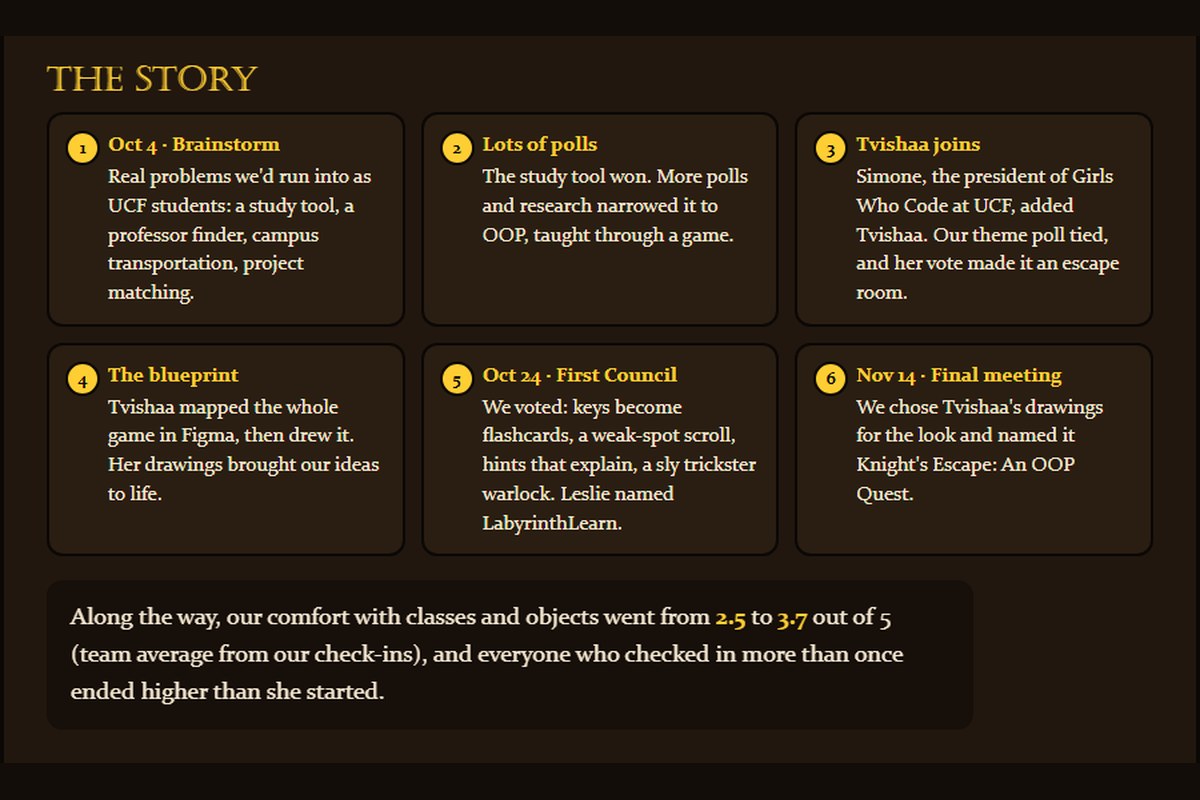
At our first meeting, we didn't start with a game. We started with real problems we run into as UCF students: studying, finding the right professor, getting around campus, and finding project partners. A study tool won our poll, and more polls and research narrowed it down to what confused us most: object-oriented programming. Class, object, new, private: the words don't mean much until something clicks. So we asked: what if learning it felt like breaking out of a castle?
Then Simone, the president of Girls Who Code at UCF, added Tvishaa to our team. Our theme poll was tied, and her vote made it an escape room.
What it does
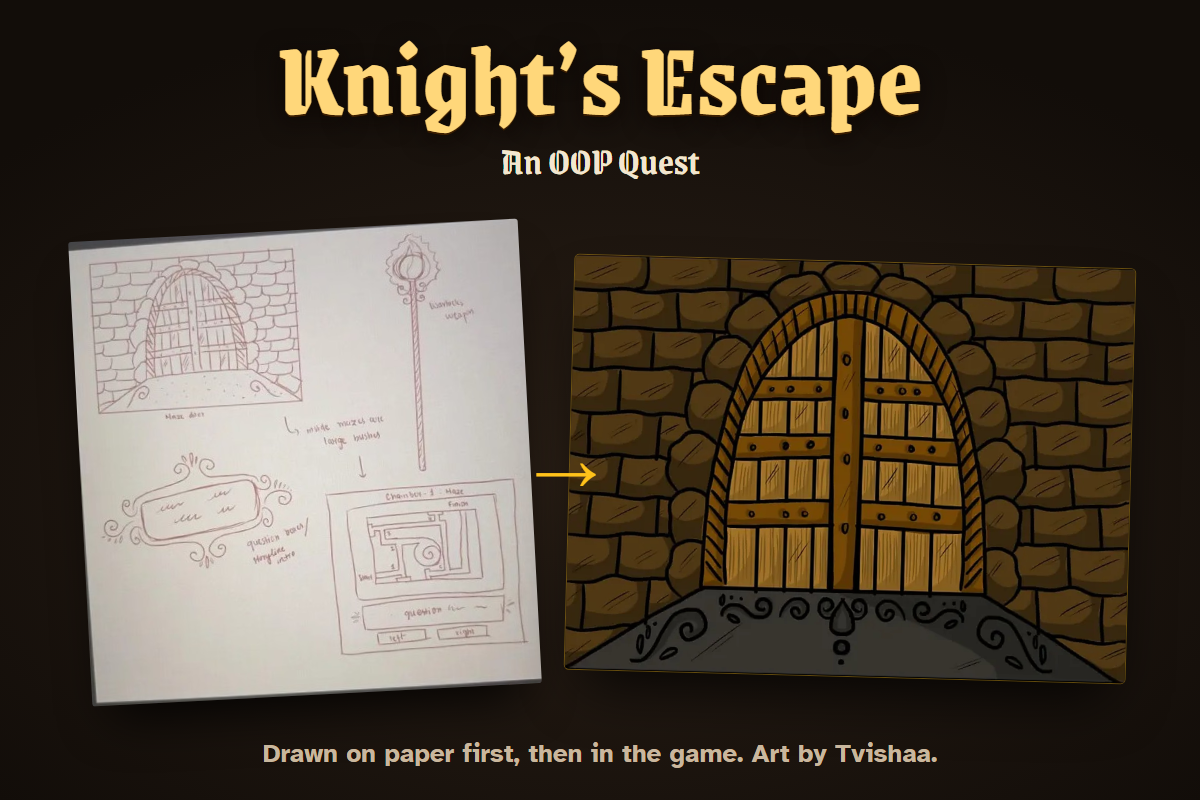
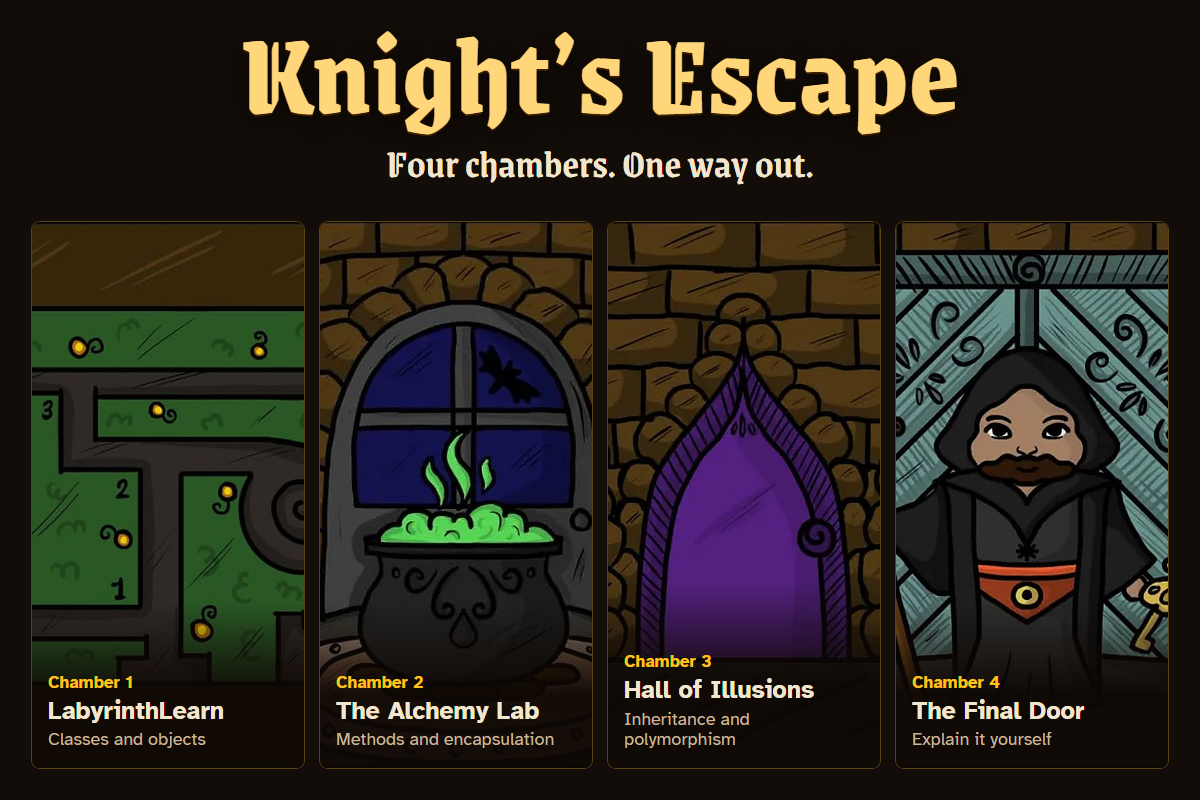
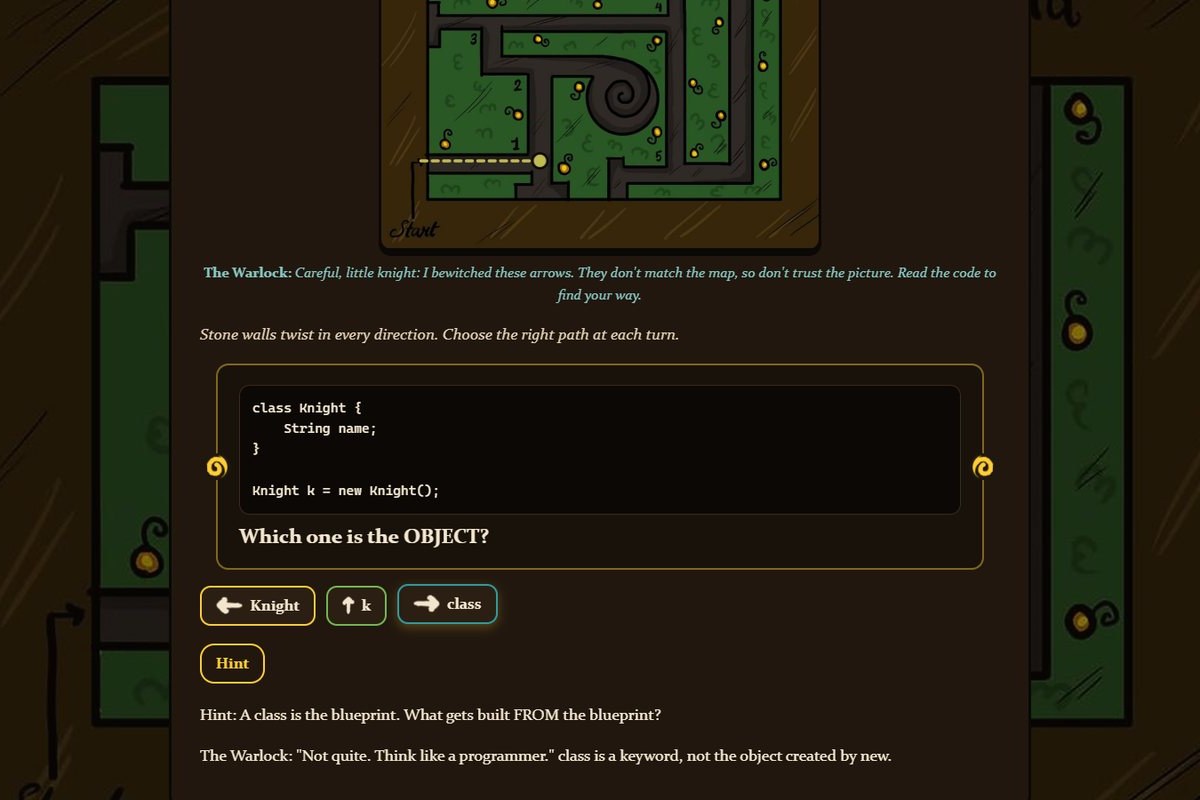
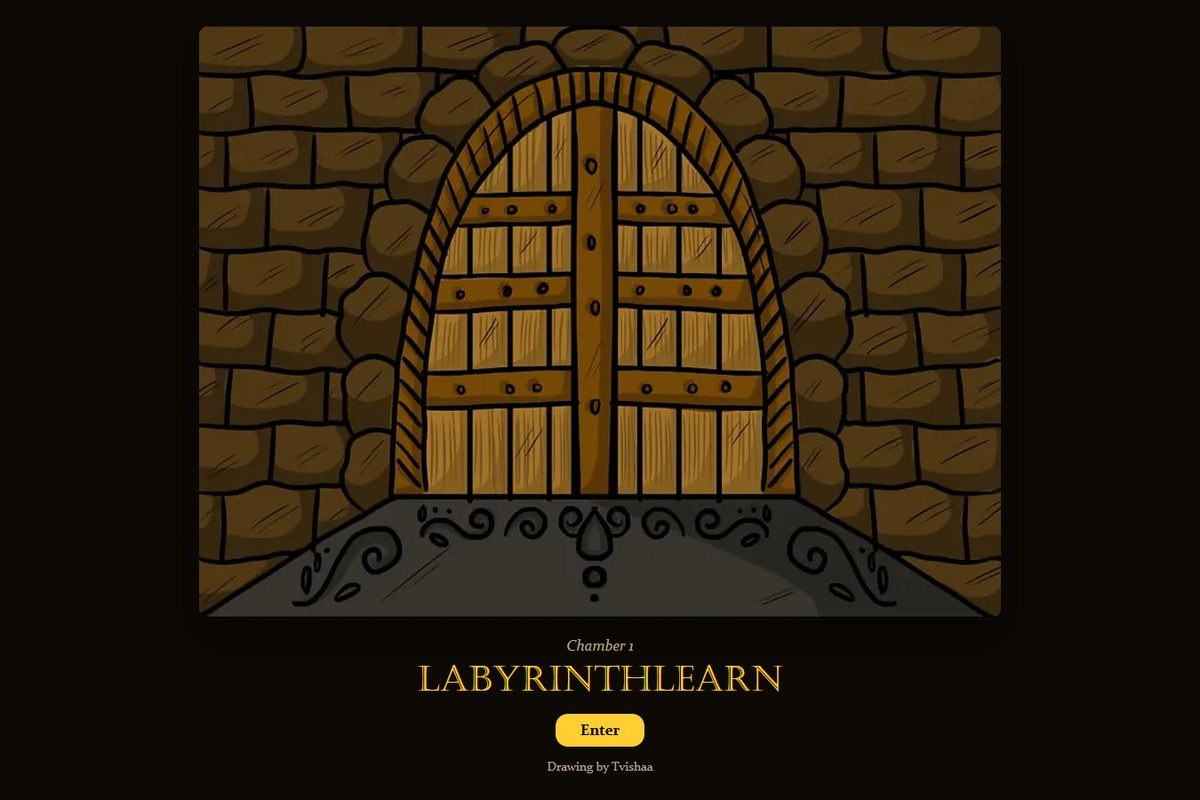
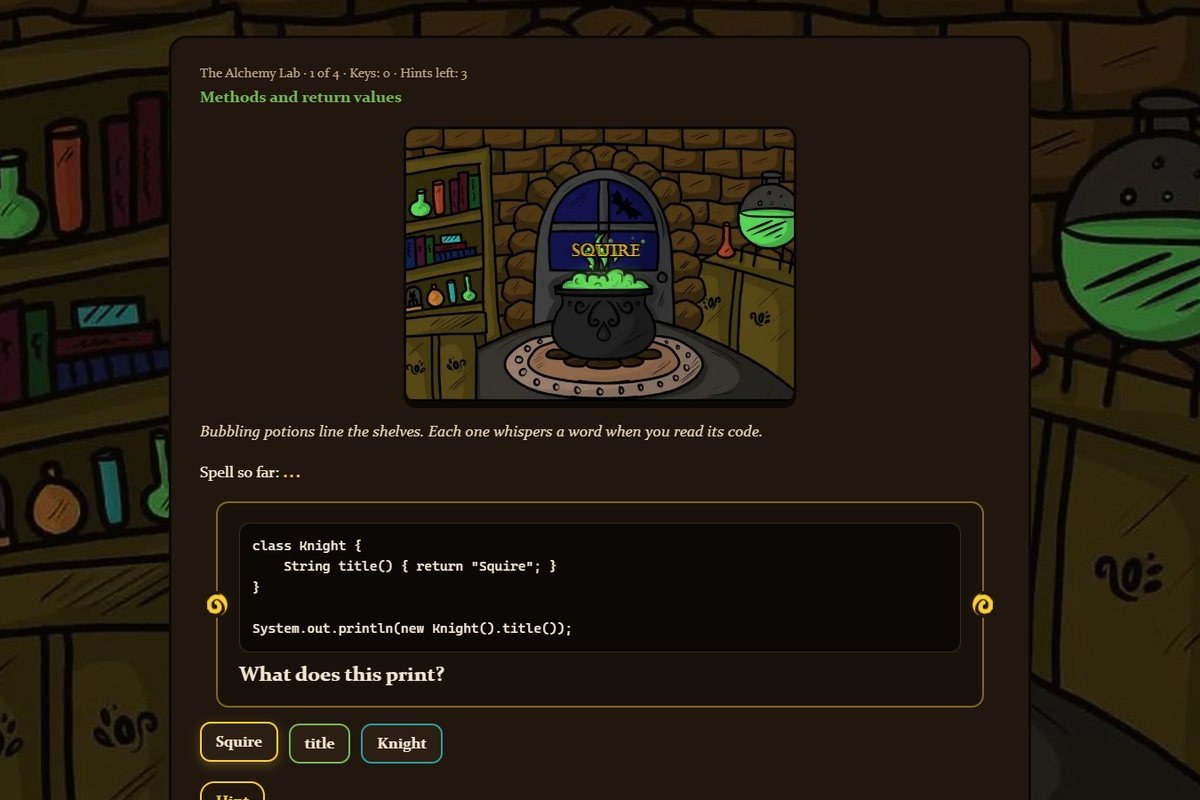
A warlock has locked you in his dungeon. Pick your knight (Sir Byte, Dame Loop, or Sir Null) and a difficulty: Squire, Knight, or Champion. Beginners get more hints. Then escape through four chambers, each one built around a different OOP concept. Every chamber opens with Tvishaa's full drawing, and the puzzle happens directly on the artwork:
- LabyrinthLearn: Classes, objects, and constructors. Your knight is a dot on her maze. Answer the code question correctly, and it moves to the next turn. The arrows are a trick, though: trust the code, not the picture.
- The Alchemy Lab: Methods and return values. Guess what each potion's code prints. Correct answers bubble up in green and spell "Squire doing king's work." The last word is hidden inside a class using
private(encapsulation). - The Hall of Illusions: Inheritance and polymorphism. Three look-alike doors, each with code on it. Pick the wrong one, and it fades into the wall.
- The Final Door: Answer the warlock in your own words. Each answer fills one of three keyholes.
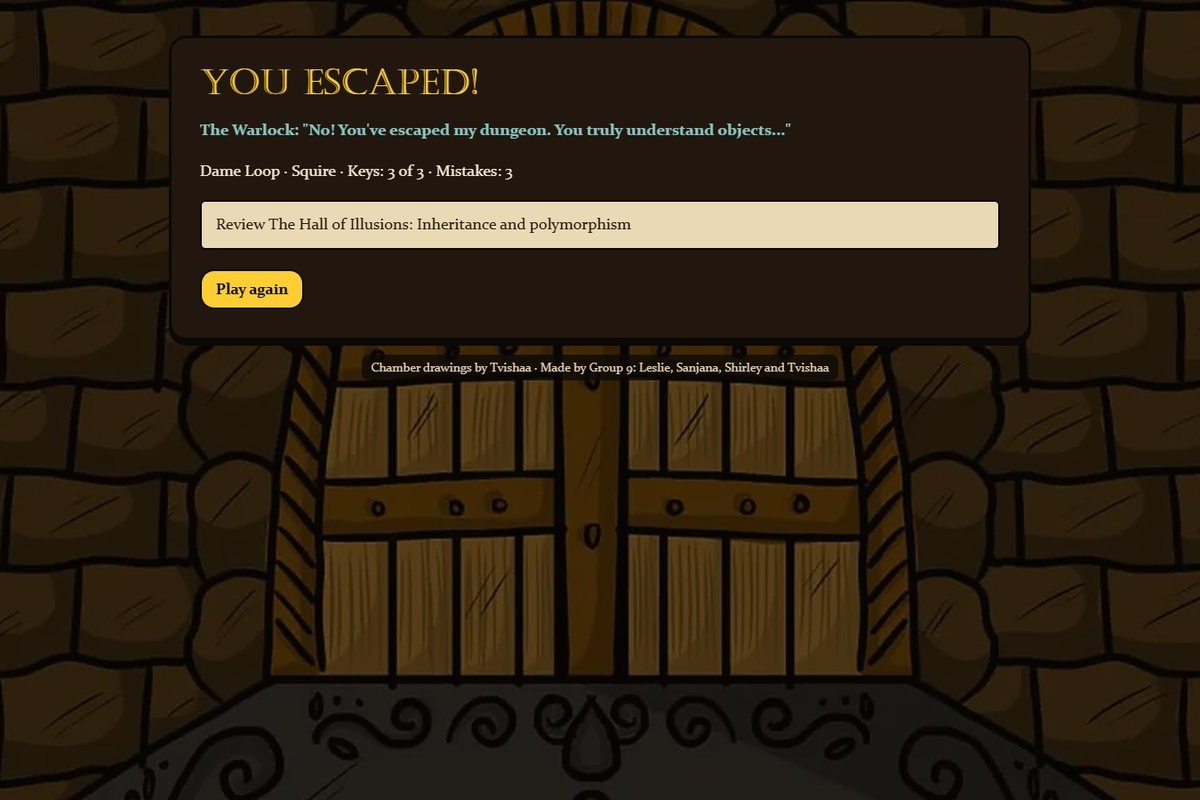
Every puzzle uses real Java. A wrong answer tells you why it was wrong, and every key you earn becomes a flashcard. When you escape, a scroll tells you which chamber gave you the most trouble, so you know what to review. Then you can play again!
It runs in any browser, including on phones, with nothing to install: play it here. A Meet the Creators page (top right or at the end of your quest) introduces the people behind the game.
How we built it
Knight's Escape uses plain HTML, CSS, and JavaScript. No frameworks or build steps: it's live on GitHub Pages, or you can download it and open index.html, even offline. All the puzzles live as data in rooms.js, the game logic is in game.js, and scenes.js places each puzzle on top of Tvishaa's drawings.
We split into a design team and a development team:
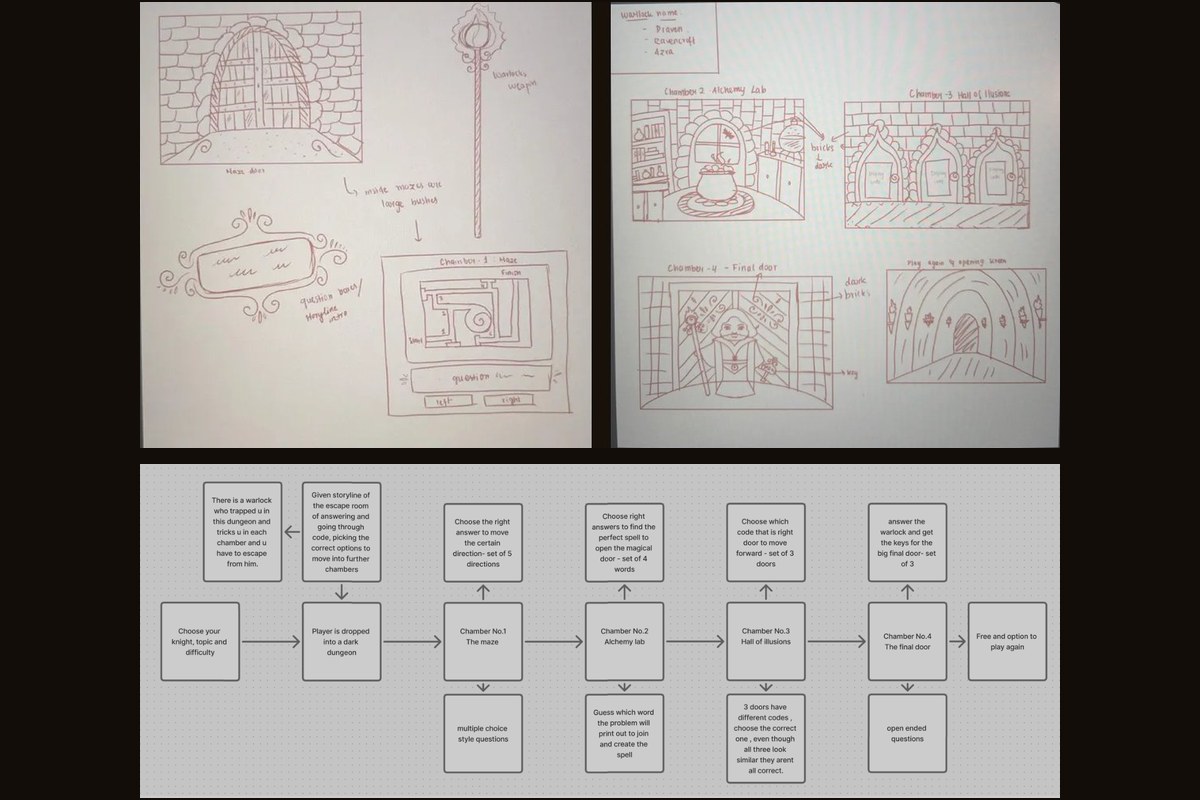
- Tvishaa (Design): Mapped the whole game in Figma, sketched every screen in red pencil, then drew every room: the castle door, maze, Alchemy Lab, three doors, and warlock. The game's colors come from her artwork.
- Shirley (Design): Made the page animations: every button and Hall door lifts when you hover over it. She also designed the light fall look we compared at our final meeting.
- Leslie (Development): Wrote the Alchemy Lab spell and its encapsulation ending, renamed the maze to LabyrinthLearn, and built the mistake counter and weak-spot scroll.
- Sanjana (Development): Researched the OOP concepts used throughout the chambers, wrote LabyrinthLearn turns 3–5, and built the wrong-answer explanations, maze counter, and flashcard keys.
- Katrina (Project Lead and Mentor): Set up the starter code, wrote task guides, and reviewed our code.
Each of us worked on our own GitHub branch before merging everything into one game. We met on Saturdays and kept everything organized on a team board with weekly check-ins and tasks that explained exactly where to start.
We also created The Council, a party game for team decisions. Everyone answers on her phone, and the results are revealed together so every voice counts equally.
Challenges we ran into
- Everything was new at once. GitHub, VS Code, and OOP, all within a few weeks. We broke the work into small tasks with numbered steps.
- Busy schedules. Only two of us made it to each of our first three meetings. The Council's catch-up mode meant missing a meeting didn't mean missing a decision. Half of our Council answers came from teammates catching up afterward.
- Two looks for one game. Tvishaa's dark chamber drawings and Shirley's light fall colors were both good options. We voted 4–0 for the drawings, while keeping Shirley's animations.
- Four branches, one game. We each built on our own branch, so the final step was merging everything into one working game.
Accomplishments that we're proud of
- We went from a brainstorm to a finished, working escape room with four chambers that teach real OOP concepts.
- Every drawing in the game is hand-drawn by one of us.
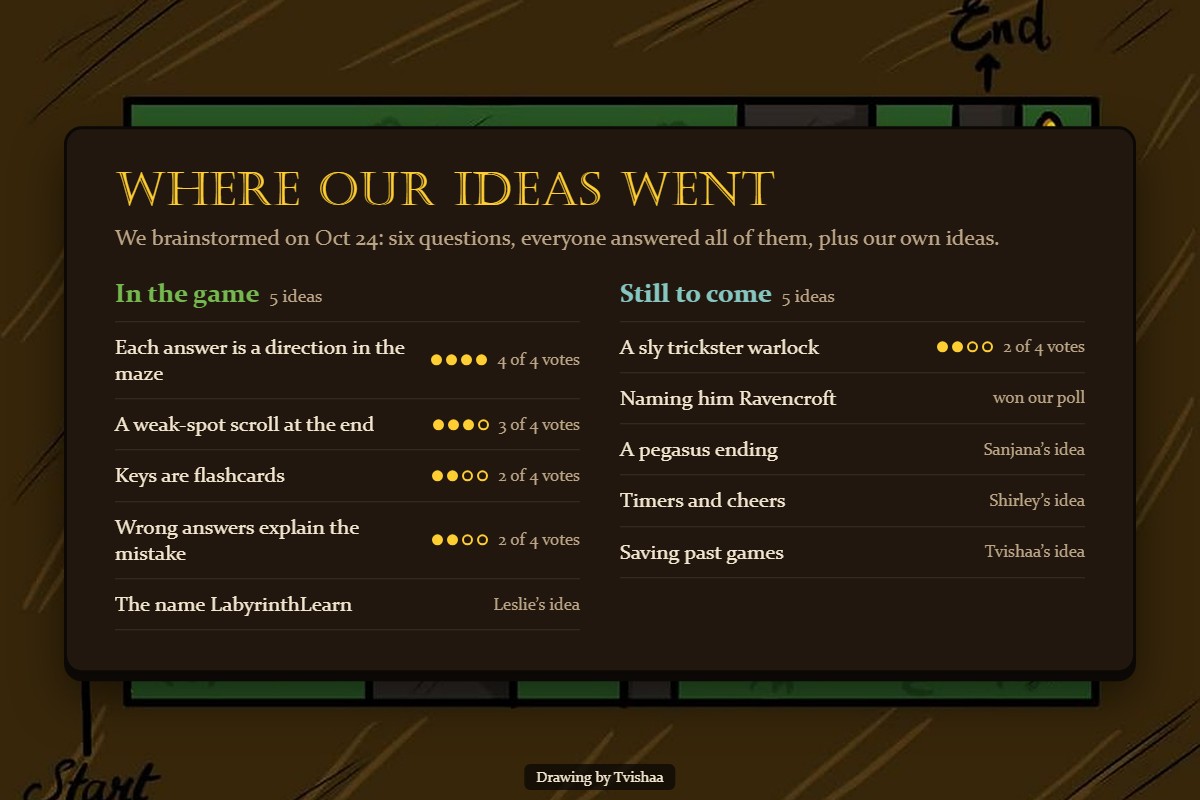
- Our ideas made it into the game: the LabyrinthLearn name, flashcard keys, explanations for mistakes, the weak-spot scroll, and the option to play again all came from our first Council.
In our own words:
"I built the [Alchemy Lab] level using encapsulation and I am proud of learning it." — Leslie
"I'm proud that my outcome was successful." — Sanjana
"Proud of how it all turned out!" — Shirley
What we learned
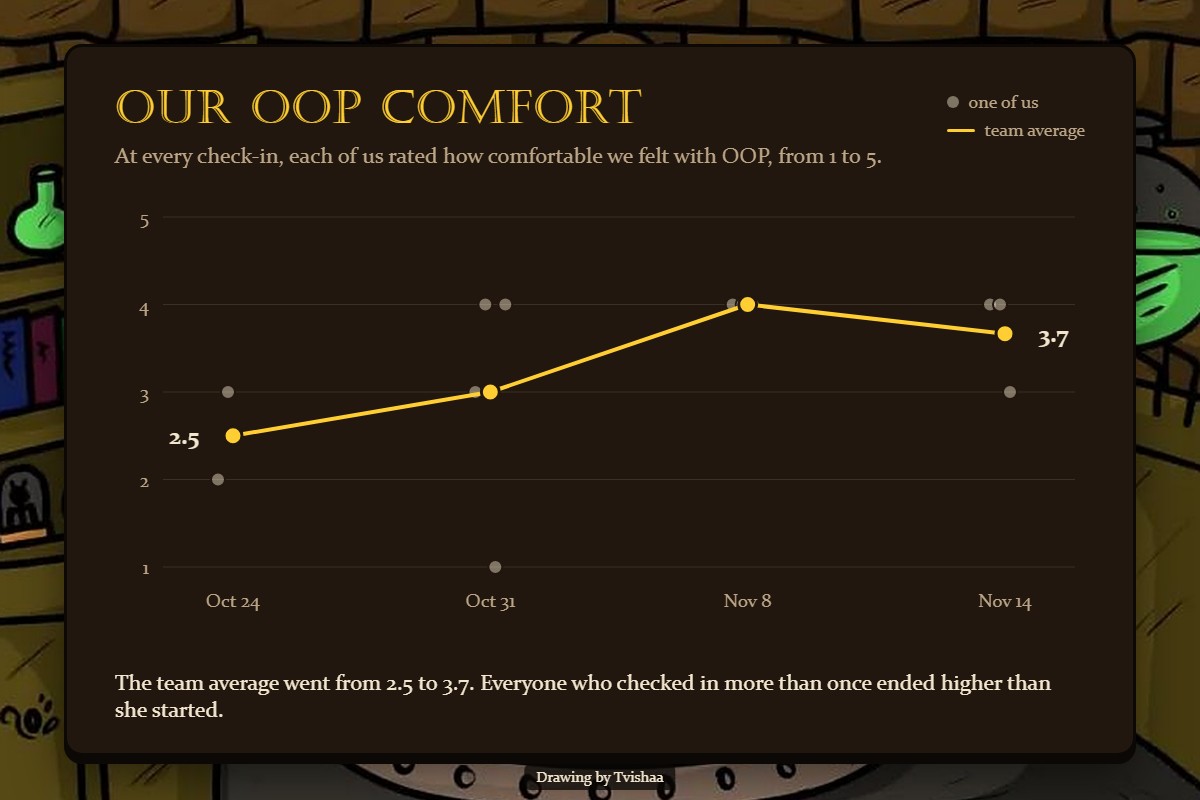
OOP. We rated our comfort with classes and objects at every check-in. The team average went from 2.5 to 3.7 out of 5, and everyone who checked in more than once ended with a higher rating than she started with. The game reflects what we learned:
- A class is a blueprint. An object is something built from it using
new. - A method can return a value, and
privaterestricts direct access to a field. A method likegetTask()can provide access to it. That's encapsulation. extendslets a Wizard reuse features from a Character, and polymorphism means the same method call can run the version belonging to the actual object.
Git and GitHub. We learned branches, commits, pushes, and pull requests, despite most of us never having used them on a team project before.
Working as a team. We learned to communicate when we couldn't make it, check in every week (even when the answer was "meh"), and vote so every voice counts, including those who weren't in the room.
What's next for Knight's Escape: An OOP Quest
- Name the warlock. Tvishaa came up with three names, and Ravencroft won our poll!
- The Pegasus ending (Sanjana's idea): Get enough answers right, and your knight escapes on a pegasus.
- Timers and cheers (Shirley's idea): Add timers that change with difficulty and encouraging messages when you finish a chamber.
- Remember past games (Tvishaa's idea): Save your progress so it's still there next time.
- Playtesting: Have classmates outside our team try the game and give us feedback, now that anyone can play it online.
Built With
- css3
- git
- github
- html5
- javascript
- visual-studio-code
