-
-
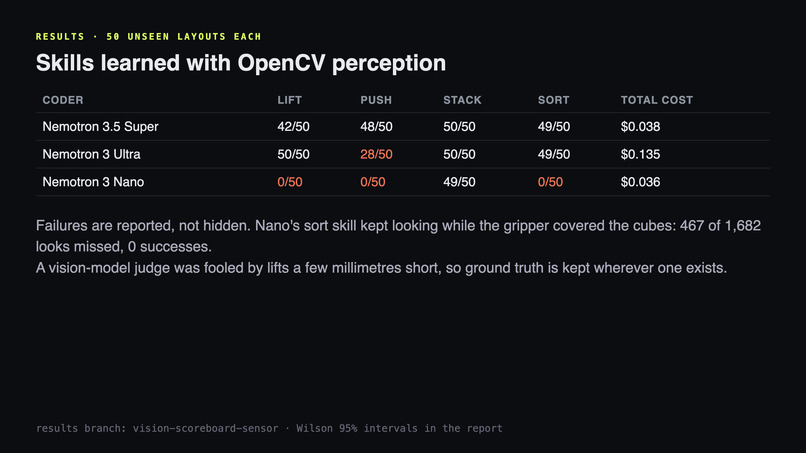
Skills learned with OpenCV perception on 50 unseen layouts, failures included
-
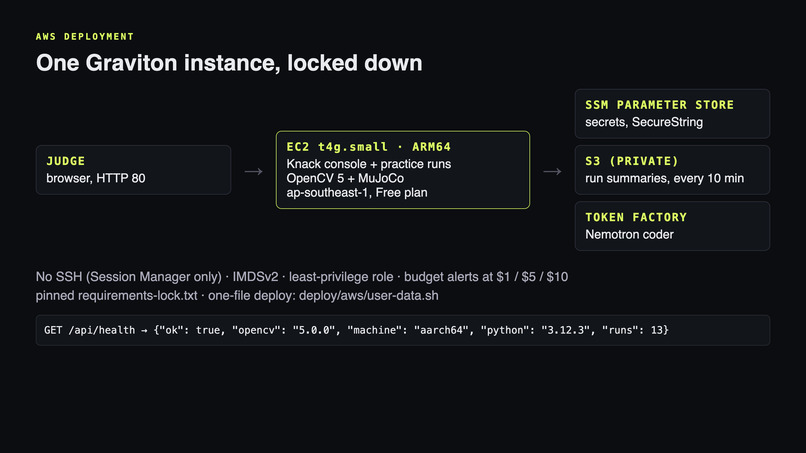
AWS deployment: EC2 t4g.small Graviton, SSM secrets, private S3, no SSH, budget alerts
-
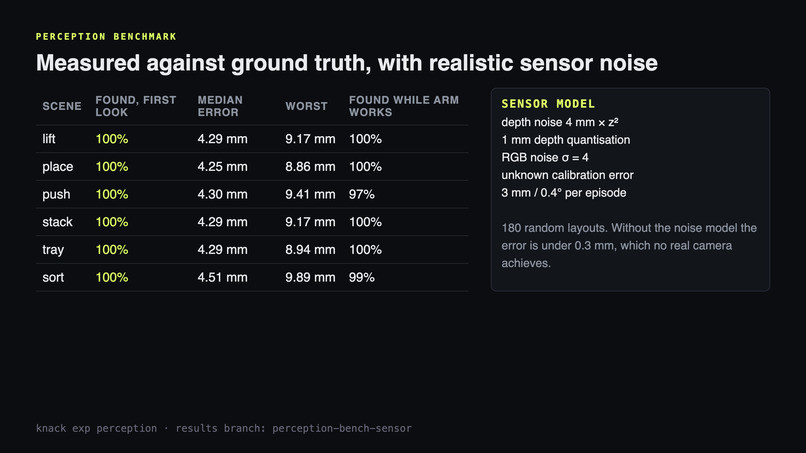
Perception benchmark: 180 layouts, about 4 mm median error, sensor noise model
-
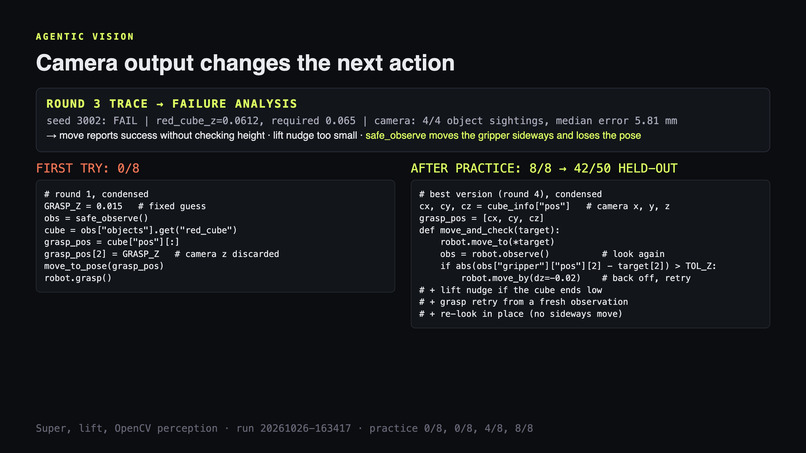
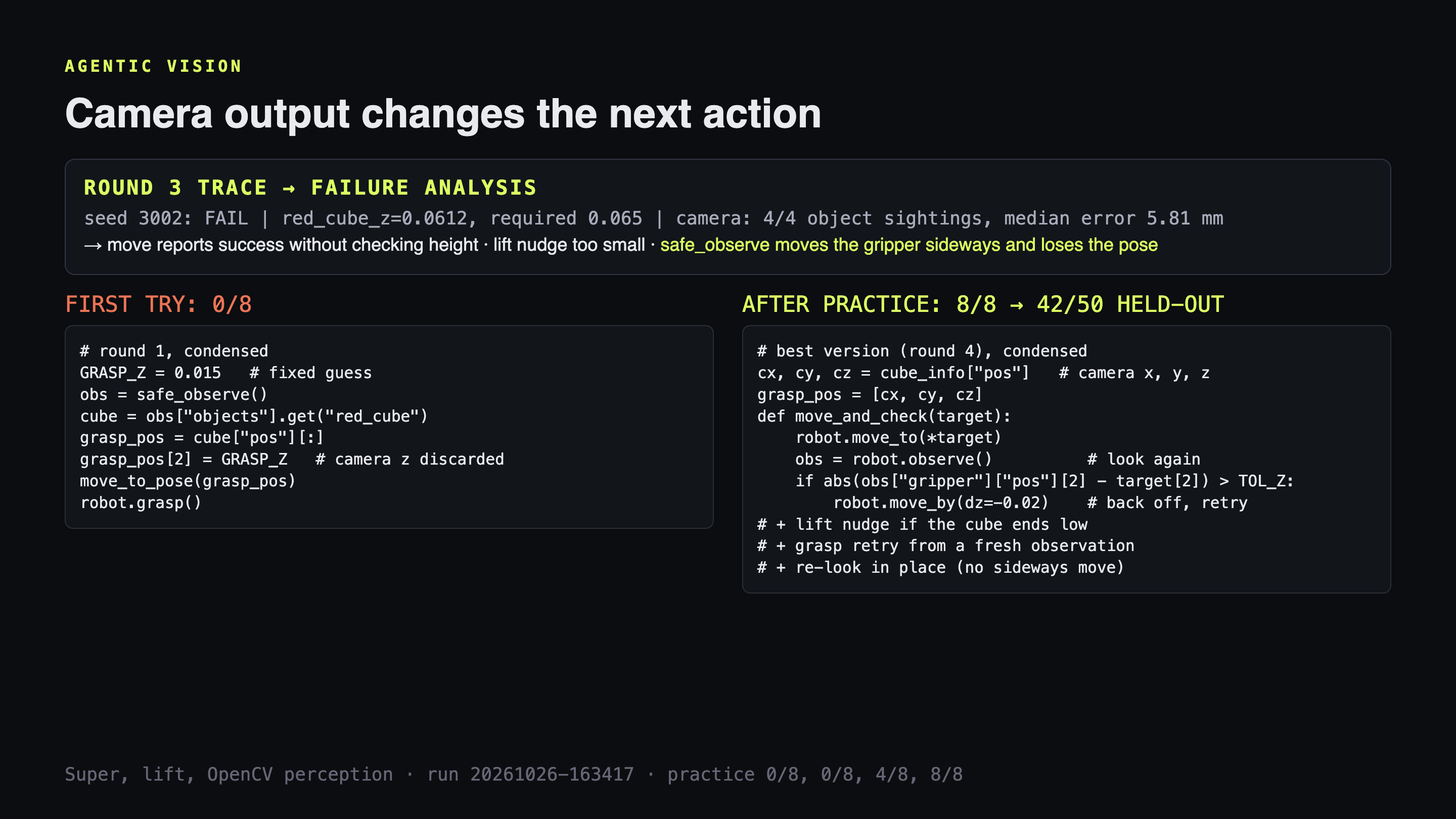
Agentic trace: the camera record in the failure analysis changes the rewritten program
-
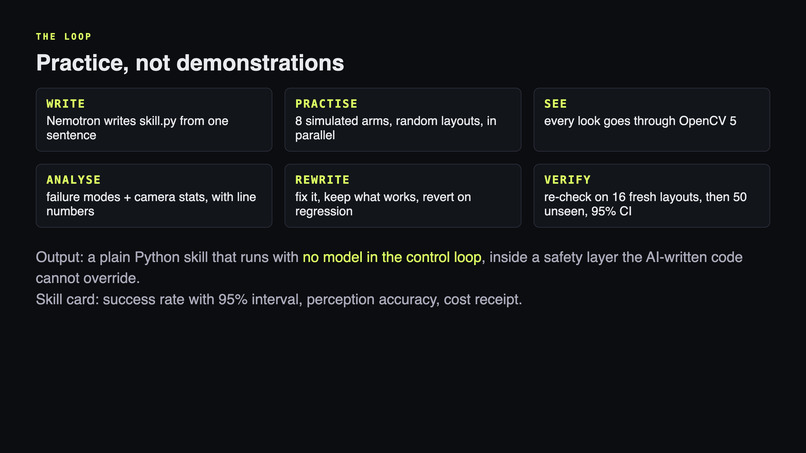
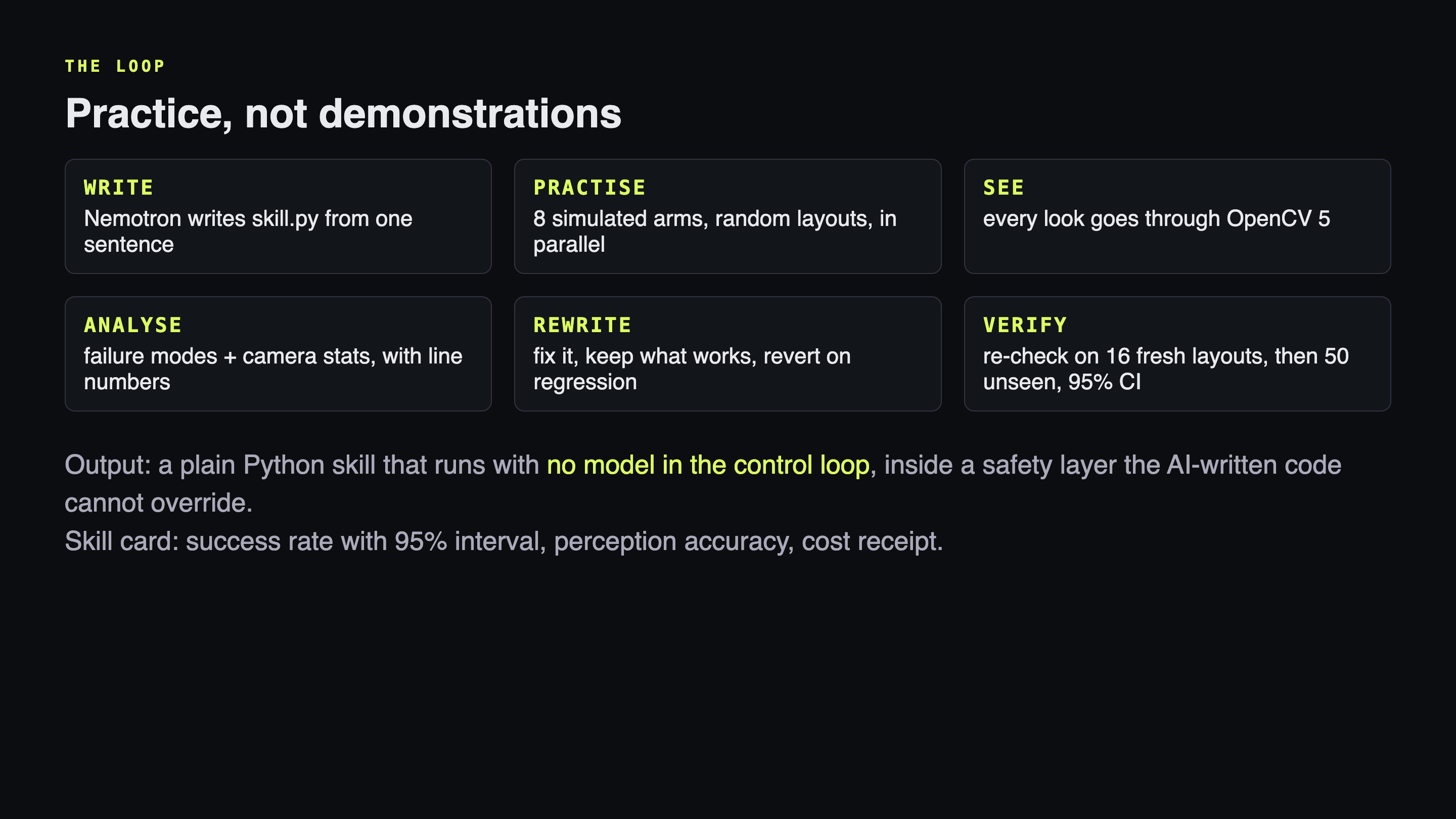
The loop: write, practise, see, analyse, rewrite, verify
-
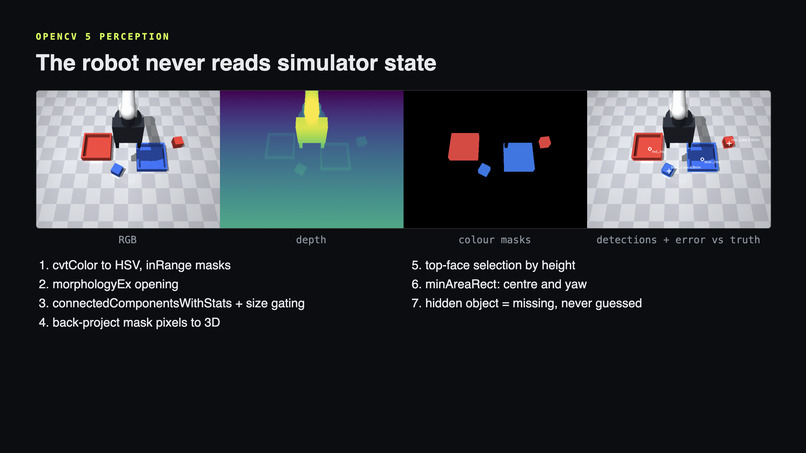
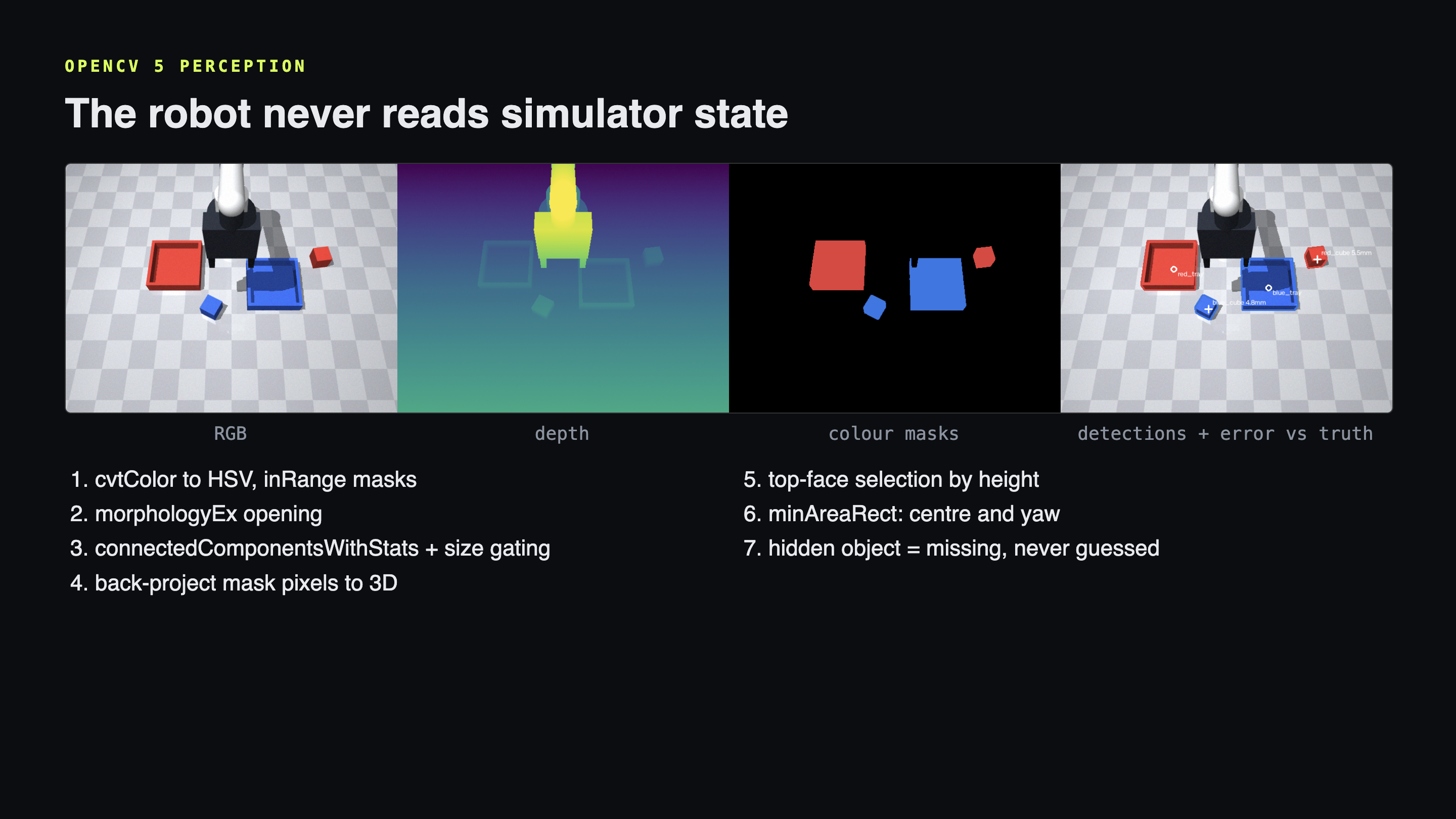
OpenCV 5 pipeline: RGB, depth, HSV masks, detections with error vs ground truth
-
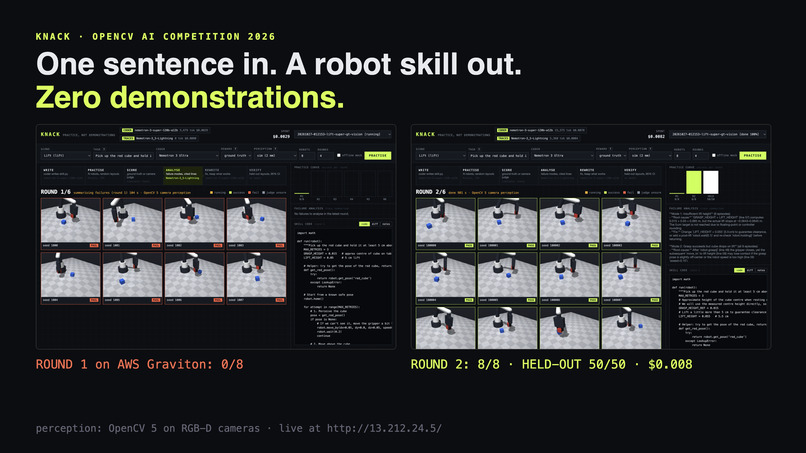
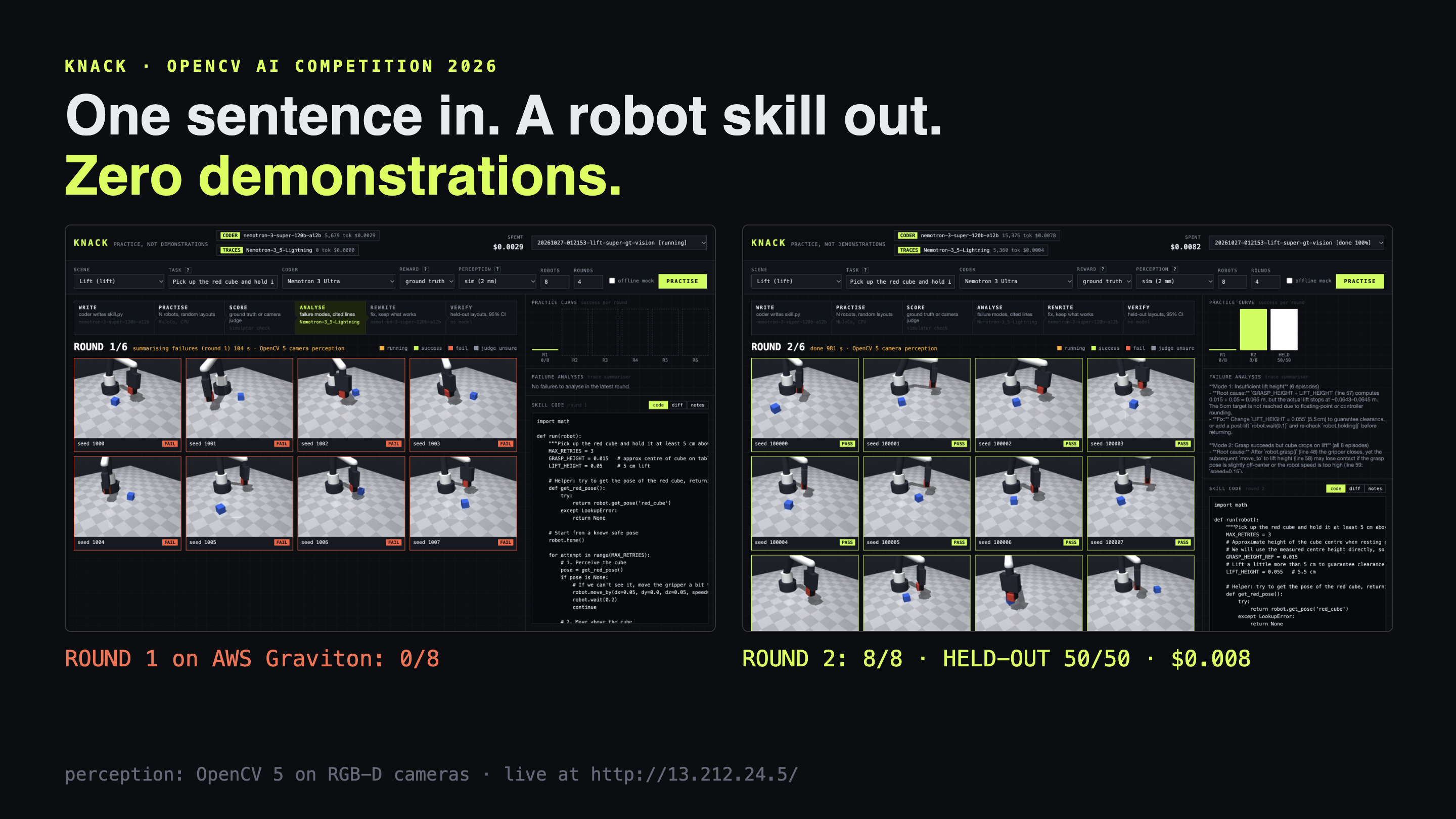
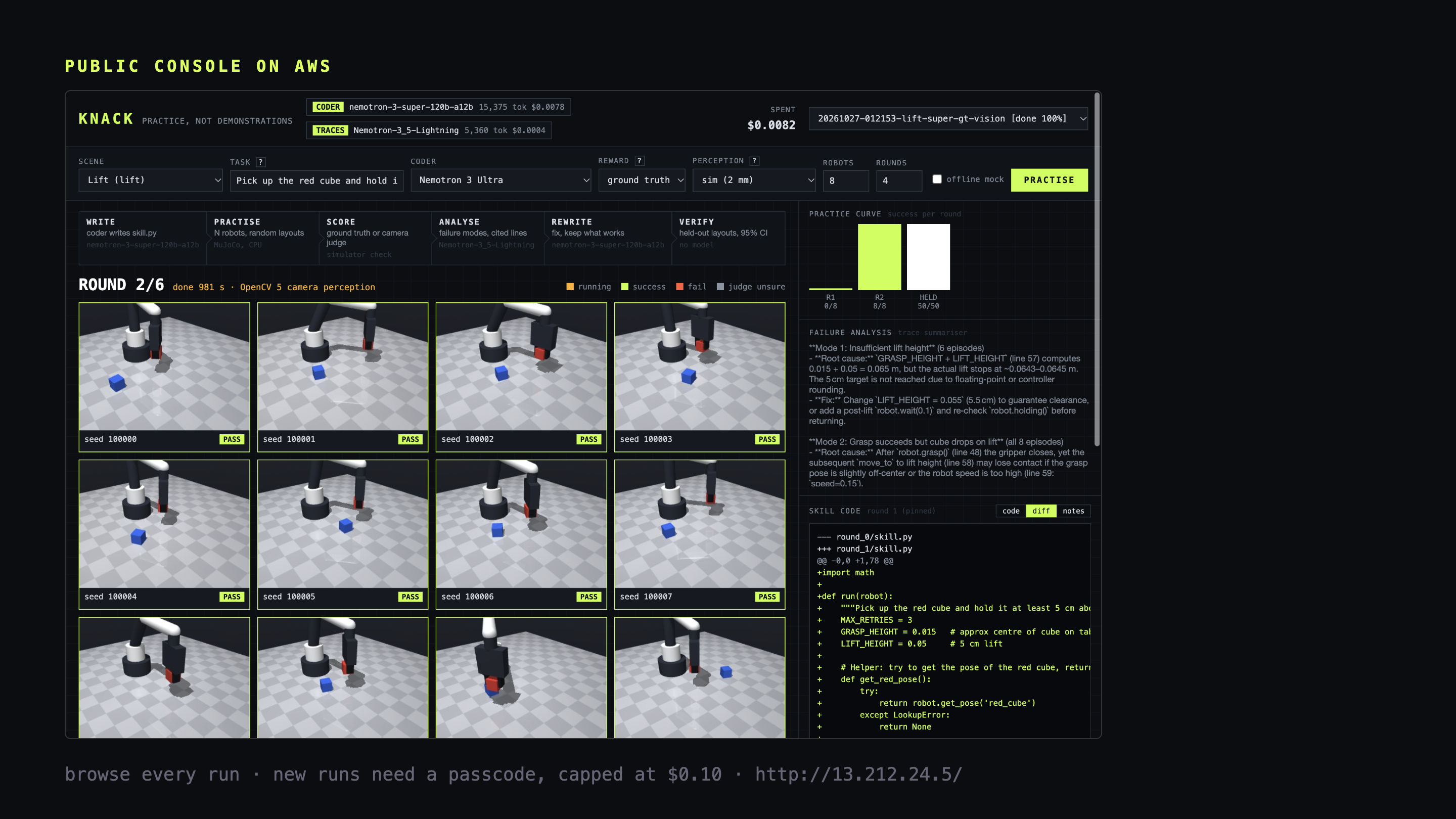
On AWS Graviton: round 1 0/8, round 2 8/8, held-out 50/50, $0.008
-
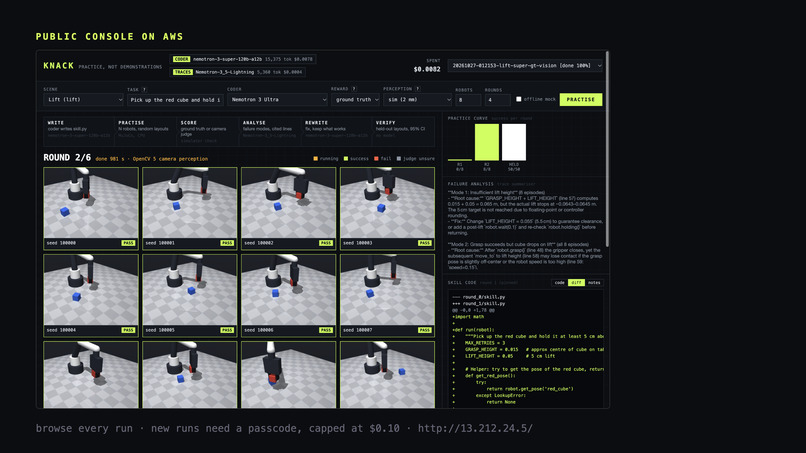
Public console on AWS: code per round, failure analysis, diff, skill card
-
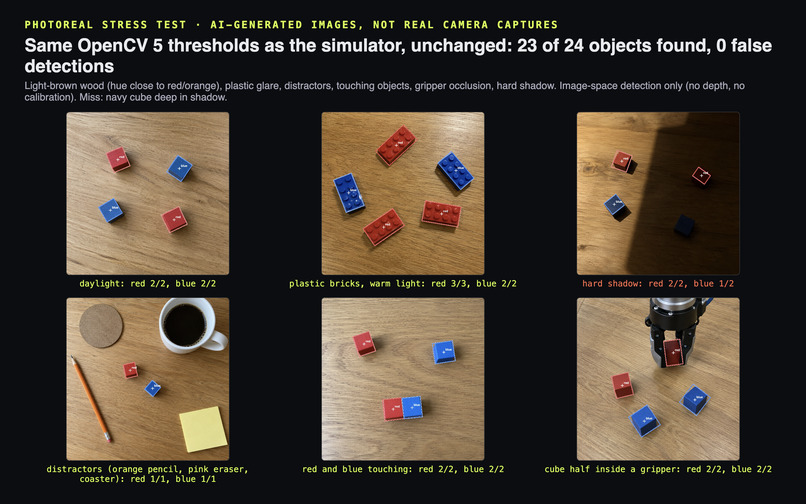
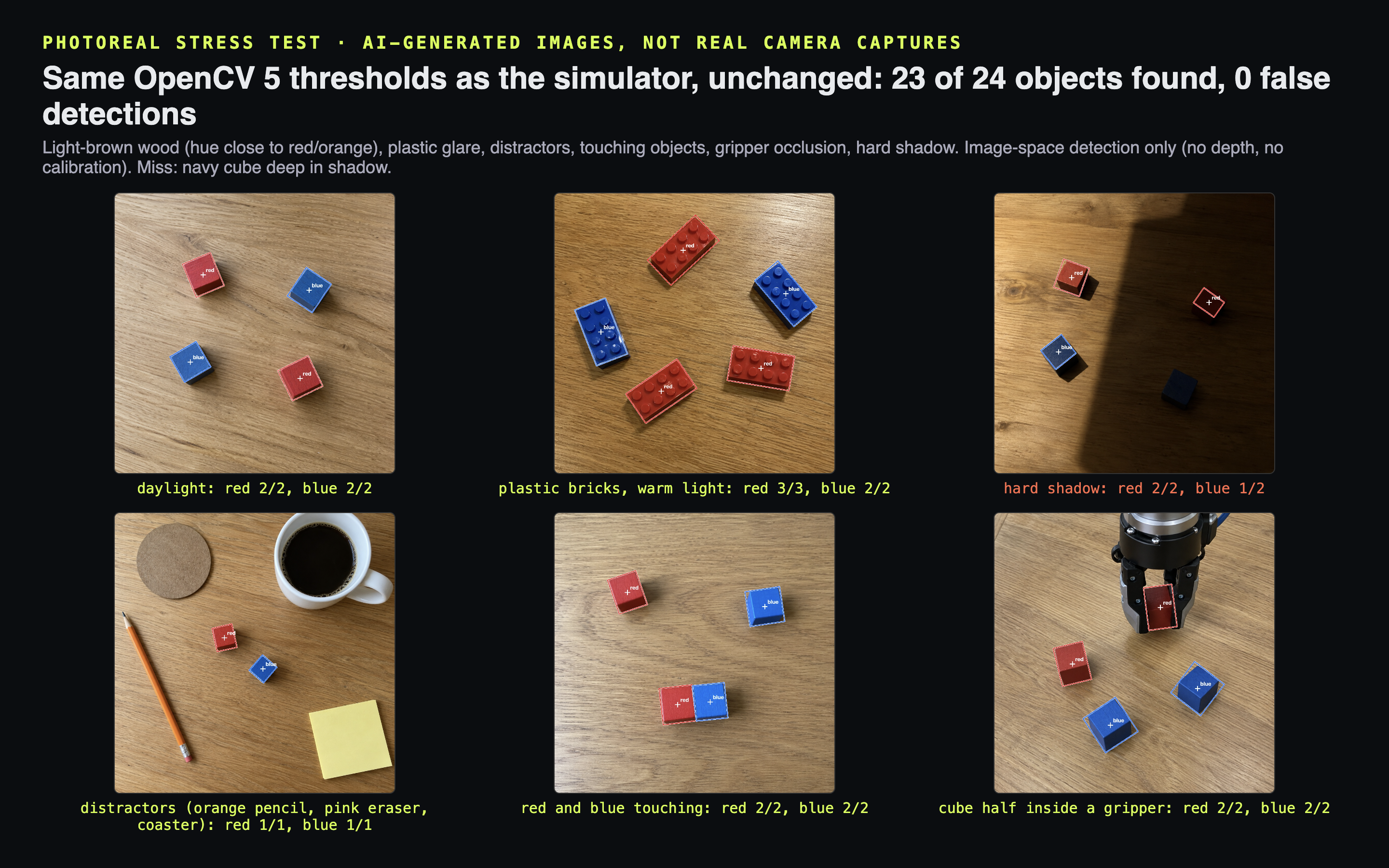
Photoreal stress test (AI-generated images, not real captures): same thresholds, 23 of 24 objects found
TL;DR
Type one sentence. A coding model writes a Python program for a robot arm, eight simulated arms practise it on random layouts, every look goes through an OpenCV 5 RGB-D perception pipeline, failures are analysed with their camera records, the program is rewritten, and the result is measured on 50 unseen layouts with a 95% confidence interval. Zero demonstrations.
On the live AWS Graviton deployment, a lift skill went 0/8, then 8/8, then 50/50 held-out, for $0.008 of model calls.
Live demo: http://13.212.24.5/ (browse every run; passcode for new runs is in the testing instructions)
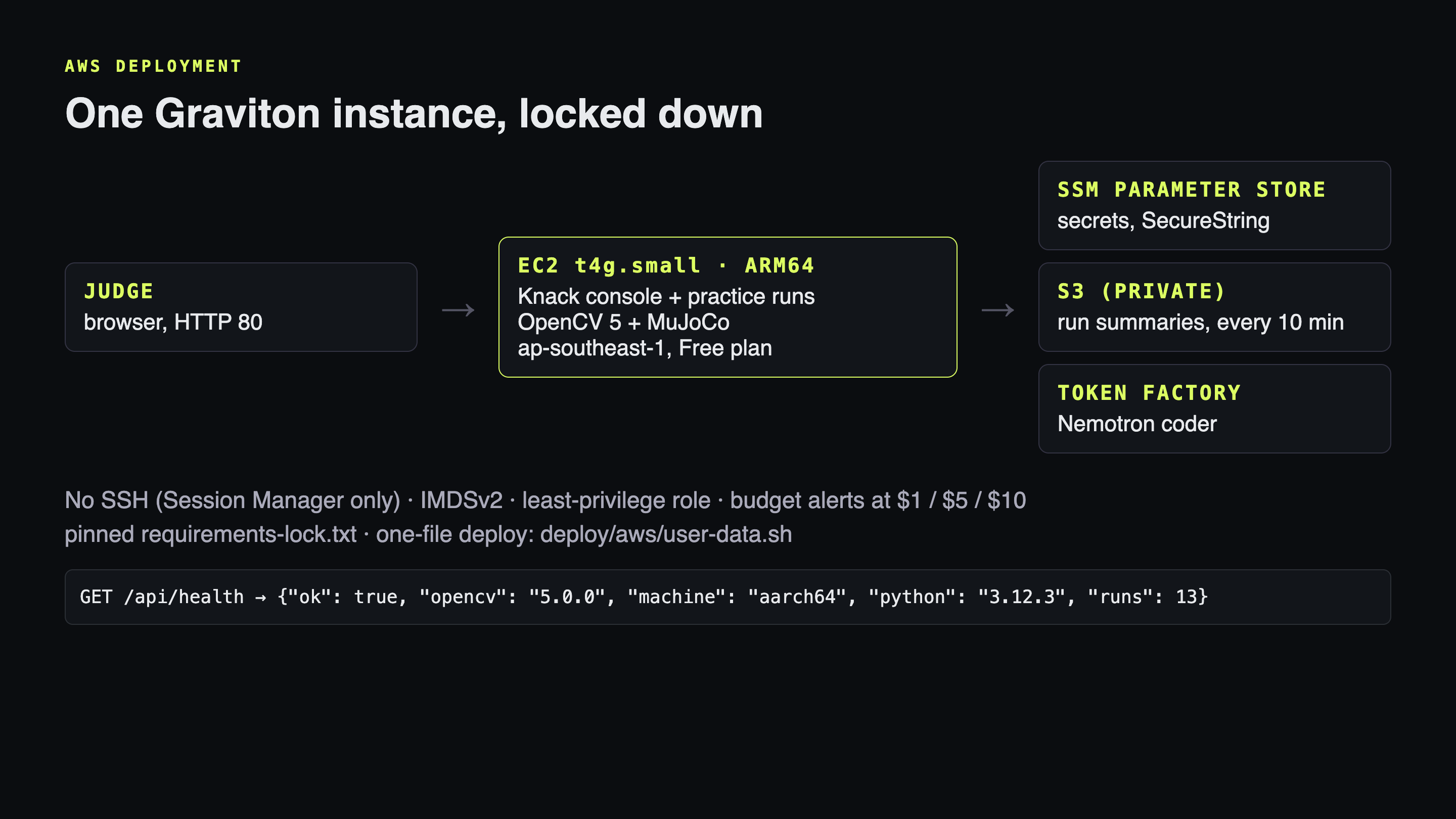
Health check: http://13.212.24.5/api/health returns opencv 5.0.0, aarch64
Problem and users
Teaching a robot arm a new tabletop task means days of hand-written code or 50 to 200 teleoperated demonstrations. Robotics students, small labs, classrooms and makers with a low-cost arm have neither. They also have no way to know how reliable a skill is before trusting it. Knack gives them a working skill plus a measured success rate and a cost receipt.
How OpenCV 5 is used (the robot never reads simulator state)
- Overhead and front RGB-D cameras with a sensor model: depth noise growing with distance squared, 1 mm quantisation, RGB noise, and a per-episode extrinsic calibration error the pipeline does not know about.
cvtColorto HSV,inRangecolour masks,morphologyExopening.connectedComponentsWithStatswith size gating (so a blue tray wall is never mistaken for a blue cube).- Back-projection of every mask pixel to 3D, removal of fixture points, top-face selection by height.
minAreaRectin the table plane for centre and yaw. Fixtures are mapped once per episode.- An object neither camera can see (usually under the gripper) is reported missing and
get_pose()raises, so the program must decide what to do.
Agentic Vision: OpenCV output changes the next action
- Inside an episode: the program observes, acts, re-observes and branches on what the cameras report (object missing, cube not at the commanded height, grasp lost).
- Across practice rounds: each failed episode's trace includes its camera record, for example
seed 3002: FAIL | red_cube_z=0.0612, required 0.065 | camera: 4/4 object sightings, median error 5.81 mm. A trace model turns these into failure modes with line numbers; the coder rewrites the program; the next practice round runs the new program. Real example (Super, lift): version 1 discarded the camera's height estimate and grasped at a fixed 15 mm; its look-again helper moved the gripper sideways and lost the pose. The final version grasps at the camera-measured centre, re-observes after every move to check it arrived, corrects low lifts, and re-looks in place. Practice went 0/8, 0/8, 4/8, 8/8, then 42/50 held-out. - Human control and safety: the learned skill runs inside a deterministic safety layer (workspace box, joint and speed limits, table-force limit) that AI-written code cannot catch or override; AI-written code runs in an AST-allowlisted sandbox, one process per episode, with a wall-clock kill; every run has a hard budget cap; the public console needs a passcode to start a run and caps it at $0.10.
Evaluation (all numbers are in the repo, results branch)
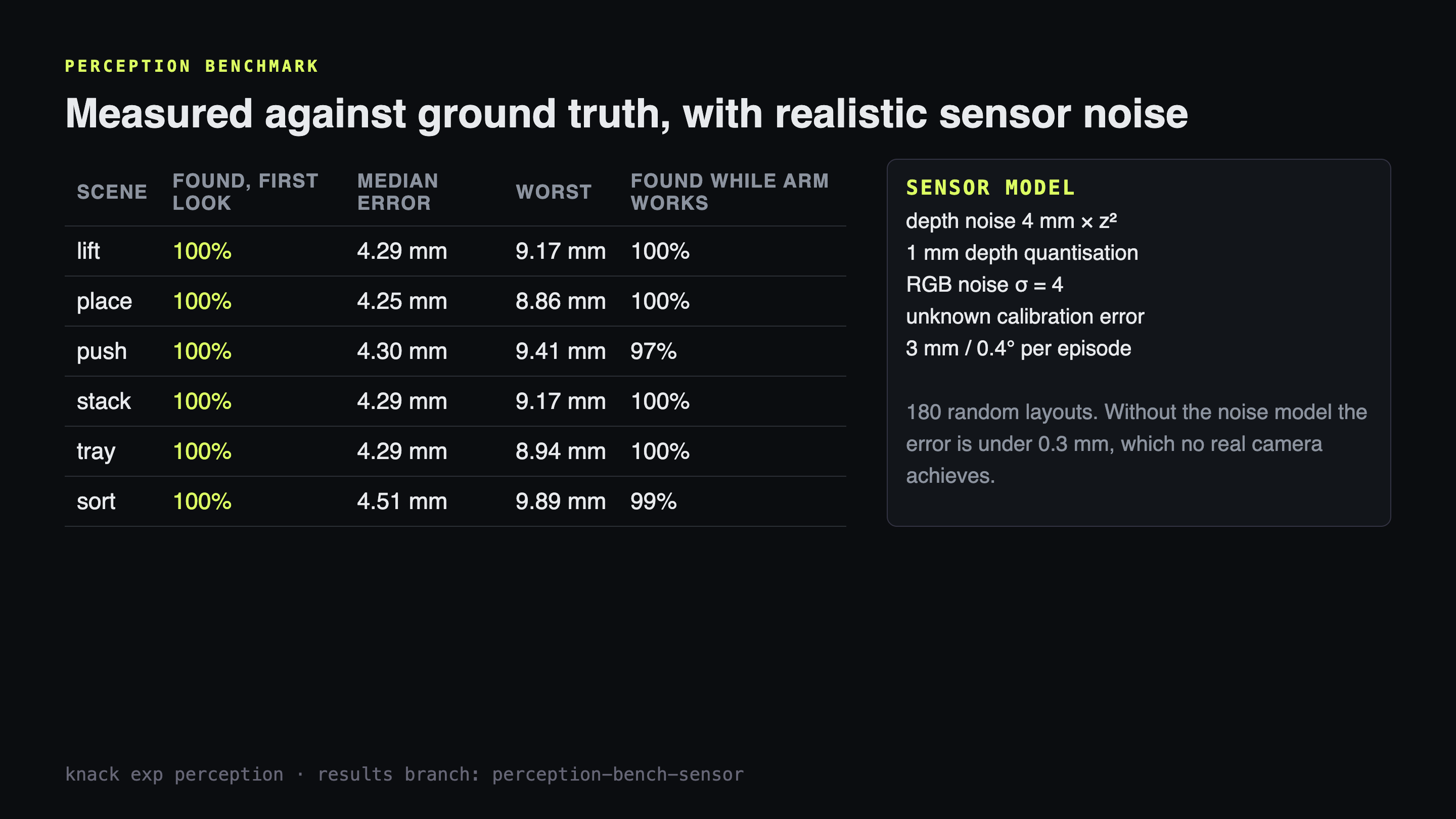
Perception accuracy vs ground truth, 30 random layouts per scene, 180 total, with the sensor model on: | scene | found on first look | median error | worst | found while the arm works | |---|---|---|---|---| | lift | 100% | 4.29 mm | 9.17 mm | 100% | | place | 100% | 4.25 mm | 8.86 mm | 100% | | push | 100% | 4.30 mm | 9.41 mm | 97% | | stack | 100% | 4.29 mm | 9.17 mm | 100% | | tray | 100% | 4.29 mm | 8.94 mm | 100% | | sort | 100% | 4.51 mm | 9.89 mm | 99% |
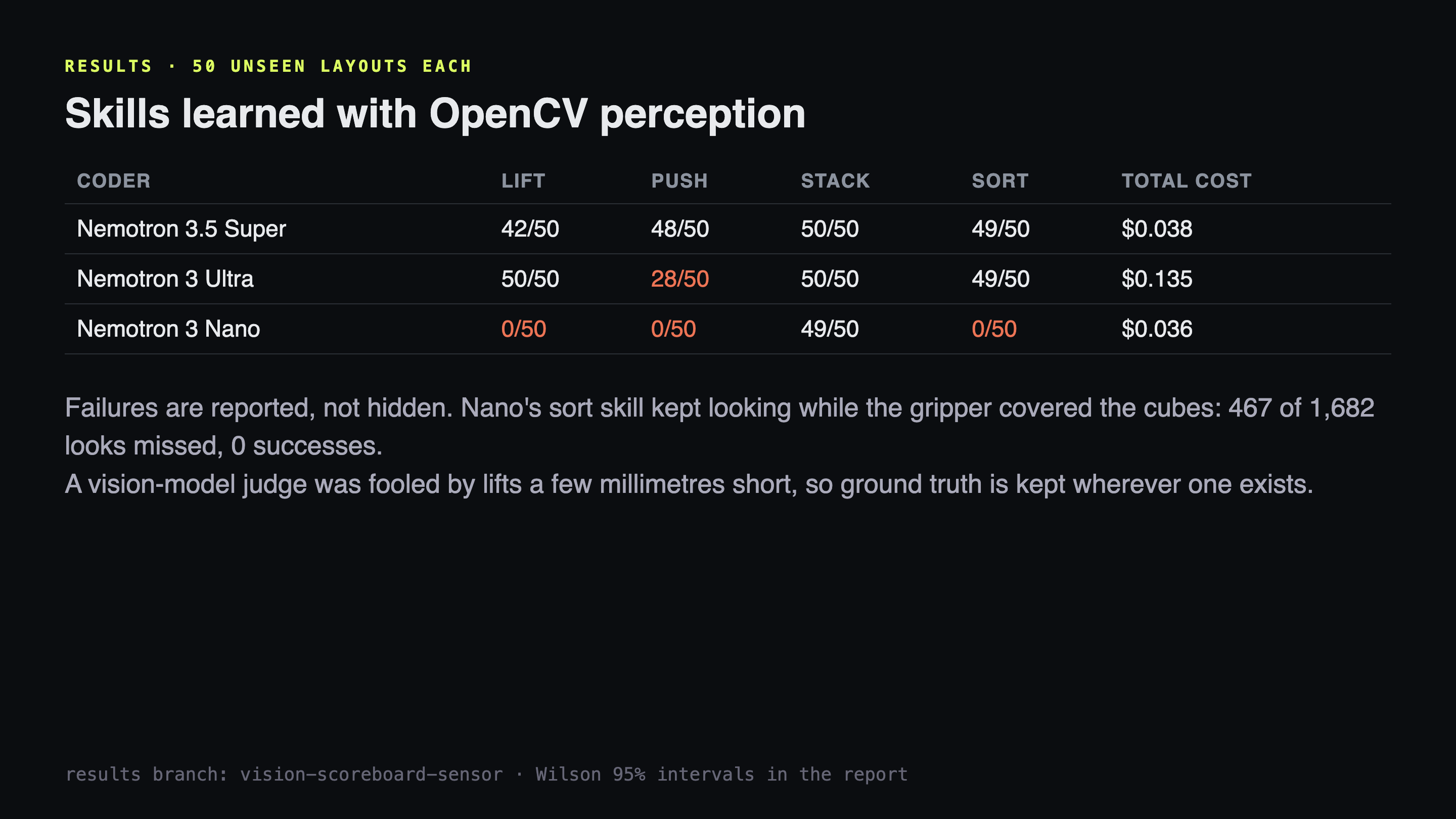
Skills learned with OpenCV perception, 50 unseen layouts each: | coder | lift | push | stack | sort | total model cost | |---|---|---|---|---|---| | Nemotron 3.5 Super | 42/50 | 48/50 | 50/50 | 49/50 | $0.038 | | Nemotron 3 Ultra | 50/50 | 28/50 | 50/50 | 49/50 | $0.135 | | Nemotron 3 Nano | 0/50 | 0/50 | 49/50 | 0/50 | $0.036 |
Failure cases we report: Ultra reaches only 56% on push. Nano never learns lift, push or sort; its sort program kept looking while the gripper covered the cubes (467 of 1,682 looks missed). A vision-language judge we tested as a reward was fooled by lifts a few millimetres short, so ground truth is kept wherever one exists.
Photoreal stress test (AI-generated images, not real captures): with the simulator's HSV ranges unchanged, the pipeline found 23 of 24 red and blue objects across six photorealistic images of a light-brown wooden table (wood hue close to red, plastic glare, hard shadow, distractors including an orange pencil and pink eraser, touching objects, a cube half inside a gripper), with no false detections. The miss is a navy cube deep in shadow, reported as missing rather than guessed. Image-space only (no depth, no calibration). See docs/photo_check/.
AWS deployment
One EC2 t4g.small (Graviton, arm64) in ap-southeast-1 on the Free plan runs the console and the practice episodes (OpenCV 5 and MuJoCo on Arm). Secrets live in SSM Parameter Store (SecureString), run summaries sync to a private S3 bucket every 10 minutes, administration is Session Manager only (no SSH port), IMDSv2 is enforced, the instance role is least-privilege, and AWS Budgets alerts fire at $1, $5 and $10. Reproduce with deploy/aws/user-data.sh and the pinned requirements-lock.txt (taken from the running instance).
Challenges
Same-coloured fixtures needed size gating and geometric rejection. A perfect render made perception look implausibly good (under 0.3 mm), so we added the sensor model. Practice scores on 8 layouts are noisy, so the best version is re-checked on 16 fresh layouts before the held-out evaluation, with revert-to-best on regression.
What we learned
Most first-try failures are not perception failures; they are programs that do not use what the camera tells them. The rewrites that work trust the measurement and check more often.
Limitations and what's next
This is simulation: the cameras are modelled, the photoreal test images are AI-generated, and no real camera or arm has been tested yet. Colour segmentation assumes a known palette. Next: the same OpenCV steps on a real low-cost arm (an overhead-camera path with a homography is in knack/real/), and OpenCV 5's DNN module for objects outside the palette.
Built by Suhas Suren (MSc Robotics, NTU Singapore), solo.
Built With
- amazon-web-services
- aws-budgets
- aws-ec2
- aws-graviton
- aws-systems-manager
- github-actions
- mujoco
- nebius-token-factory
- numpy
- nvidia-nemotron
- opencv
- python

Log in or sign up for Devpost to join the conversation.