KleidiBench
KleidiBench turns "should we run this LLM on Arm — and how?" from a week of engineering into one free CI run that returns a decision, not just a number.
Track Cloud AI (Track 2)
Project overview The real blocker to Arm adoption isn't speed — it's uncertainty. Arm cloud is marketed as 30–40% cheaper per vCPU, but teams don't capture that saving because "will OUR model perform?" costs an engineer-week to answer properly: build variants, quantize, control the variables, chase OOMs, interpret.
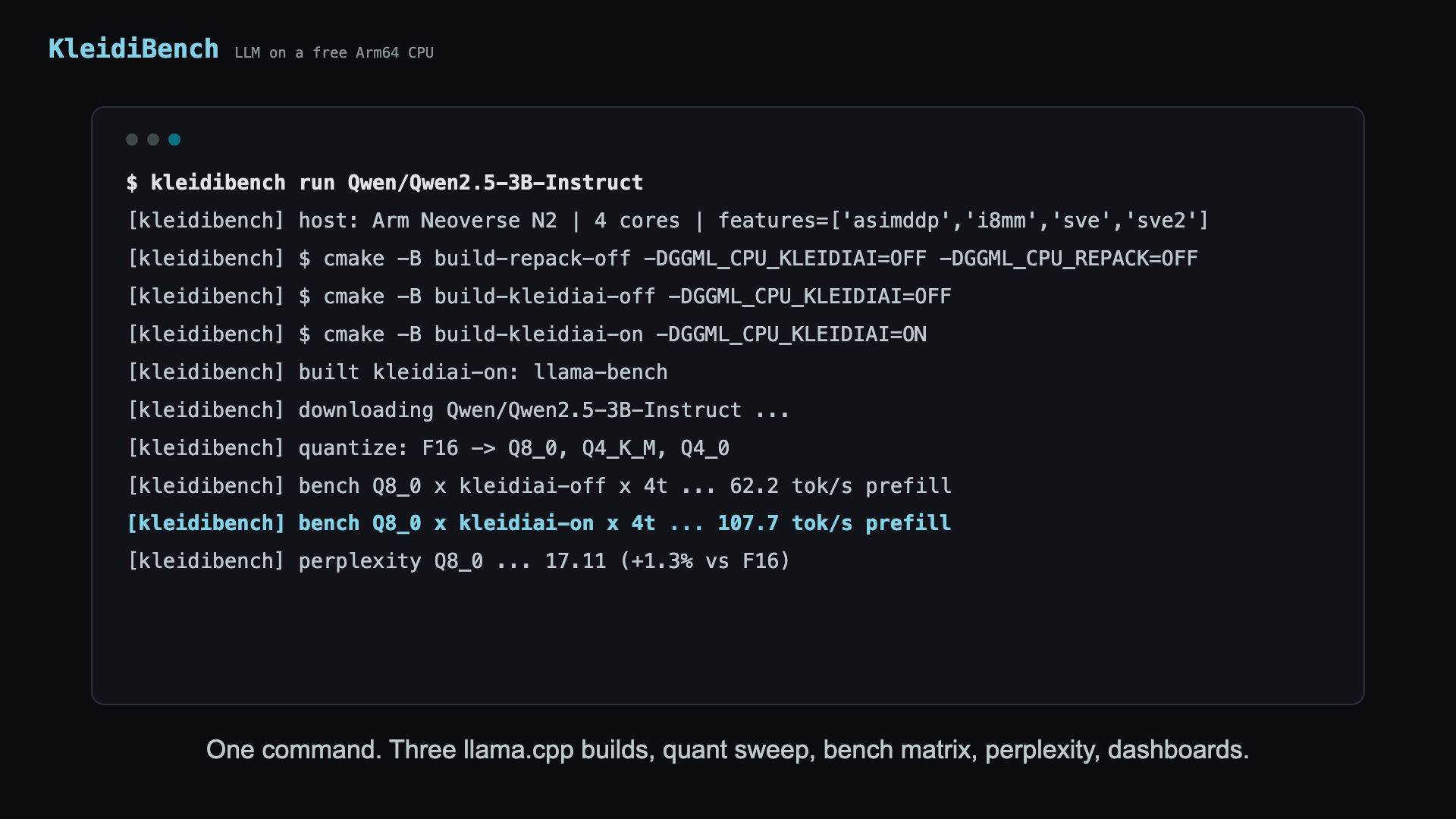
KleidiBench collapses that week into one $0 CI run whose output is a serving decision — which quant, which build flag, how much RAM, what quality cost, what $/million-tokens — not a wall of numbers. Fork the repo, push, and a free GitHub Actions arm64 runner (real Neoverse N2, no cloud account, no quota) hands you the verdict for your model. The benchmark re-runs automatically on every commit.
How it earns the verdict: kleidibench run
builds llama.cpp three ways — naive (no Arm repack), llama.cpp's default Arm path, and KleidiAI (GGML_CPU_KLEIDIAI) — same commit, same flags otherwise converts the model to GGUF and quantizes it (F16 → Q8_0 → Q4_K_M → Q4_0), or fetches pre-quantized GGUFs for day-one/oversize architectures runs llama-bench across every (build × quant × thread-count) combination, plus perplexity per quant emits dashboard-style report.html per model + a combined leaderboard — size, prefill/decode tok/s, TTFT, peak RAM, quality, $/million-tokens Why it should win: it answers the question that decides migrations, and it keeps paying after the decision — day-one coverage of brand-new architectures (we benchmarked Gemma 4 before HF→GGUF converter support existed), an Arm performance-regression watchdog when pointed at llama.cpp nightlies, and a 3-way methodology that structurally prevents the misleading on/off benchmarks common in this space (it's what surfaced the Q8_0 finding below). A benchmark result, a de-risking instrument, and permanent ecosystem infrastructure — in one repo.
Measured results Host: GitHub Actions ubuntu-24.04-arm (Arm Neoverse N2, 4 vCPU, dotprod+i8mm+sve2) · llama.cpp d4cff114c · 3 quants × 3 builds × 1/2/4 threads × 3 reps per model
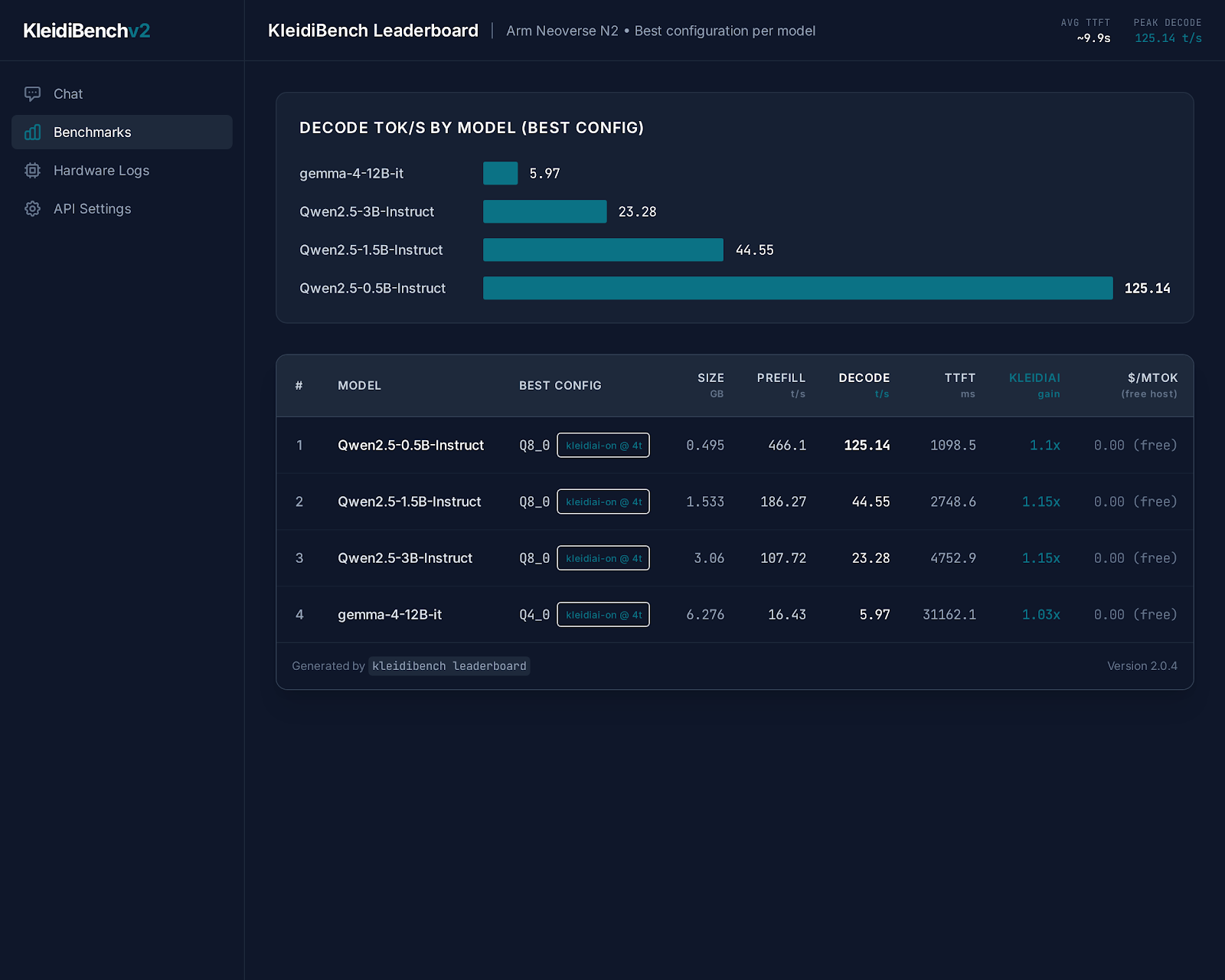
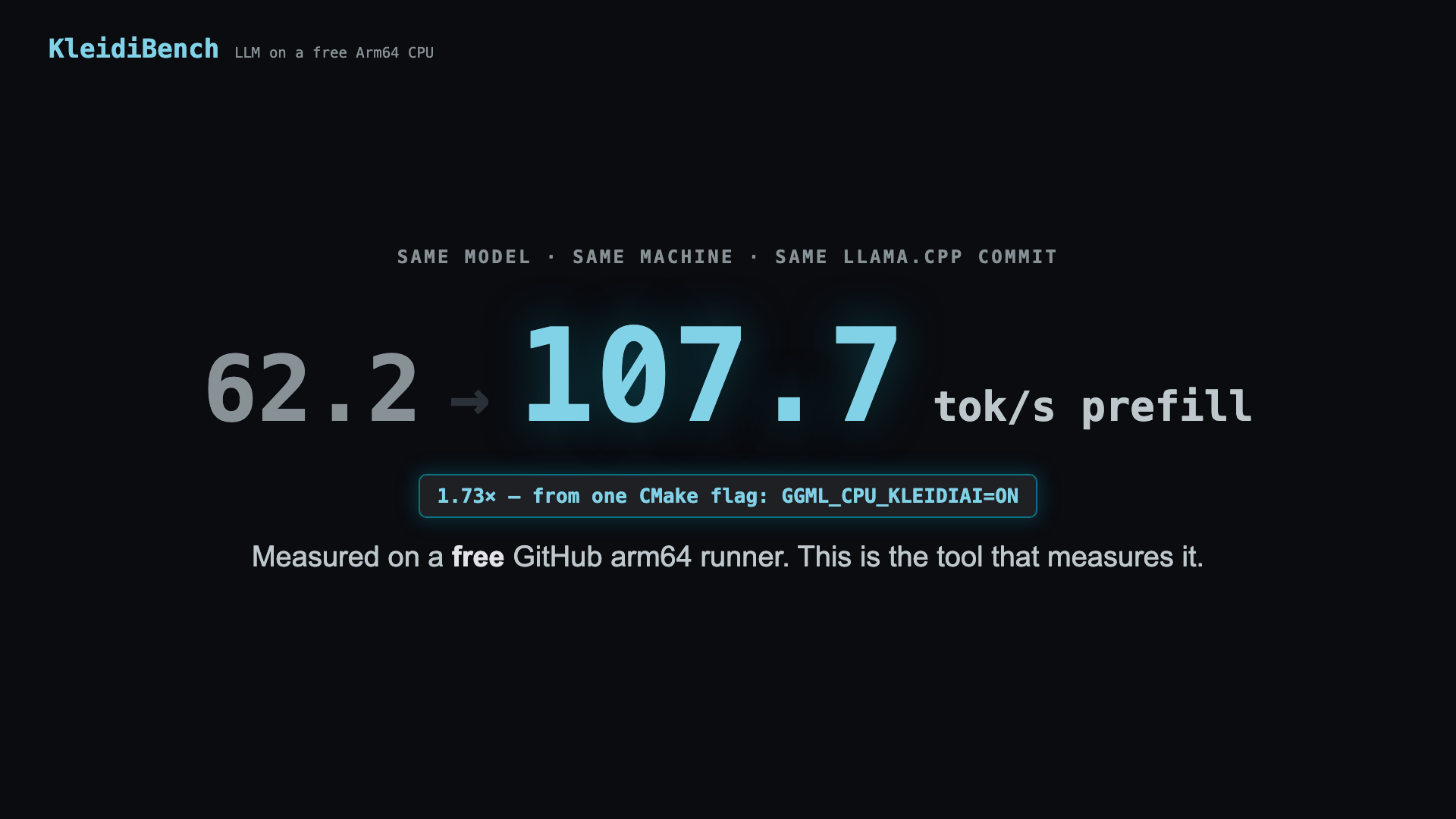
Model KleidiAI vs naive (Q4_0, prefill / decode) KleidiAI direct win (Q8_0 prefill) Best decode tok/s F16 → Q4_0 size Qwen2.5-0.5B ~2.0× / ~1.5× 1.41× 125.1 0.93 → 0.33 GB Qwen2.5-1.5B ~2.4× / ~1.3× 1.60× 44.6 2.9 → 0.9 GB Qwen2.5-3B 2.5× / 1.4× 1.73× (62.2 → 107.7 tok/s) 23.3 5.75 → 1.70 GB Quality is measured too (perplexity, bundled corpus): on the 3B, Q8_0 costs only +1.3% vs F16 while being the fastest config; Q4_0 is 3.4× smaller at +20%. The full size/speed/quality curve is in every report.
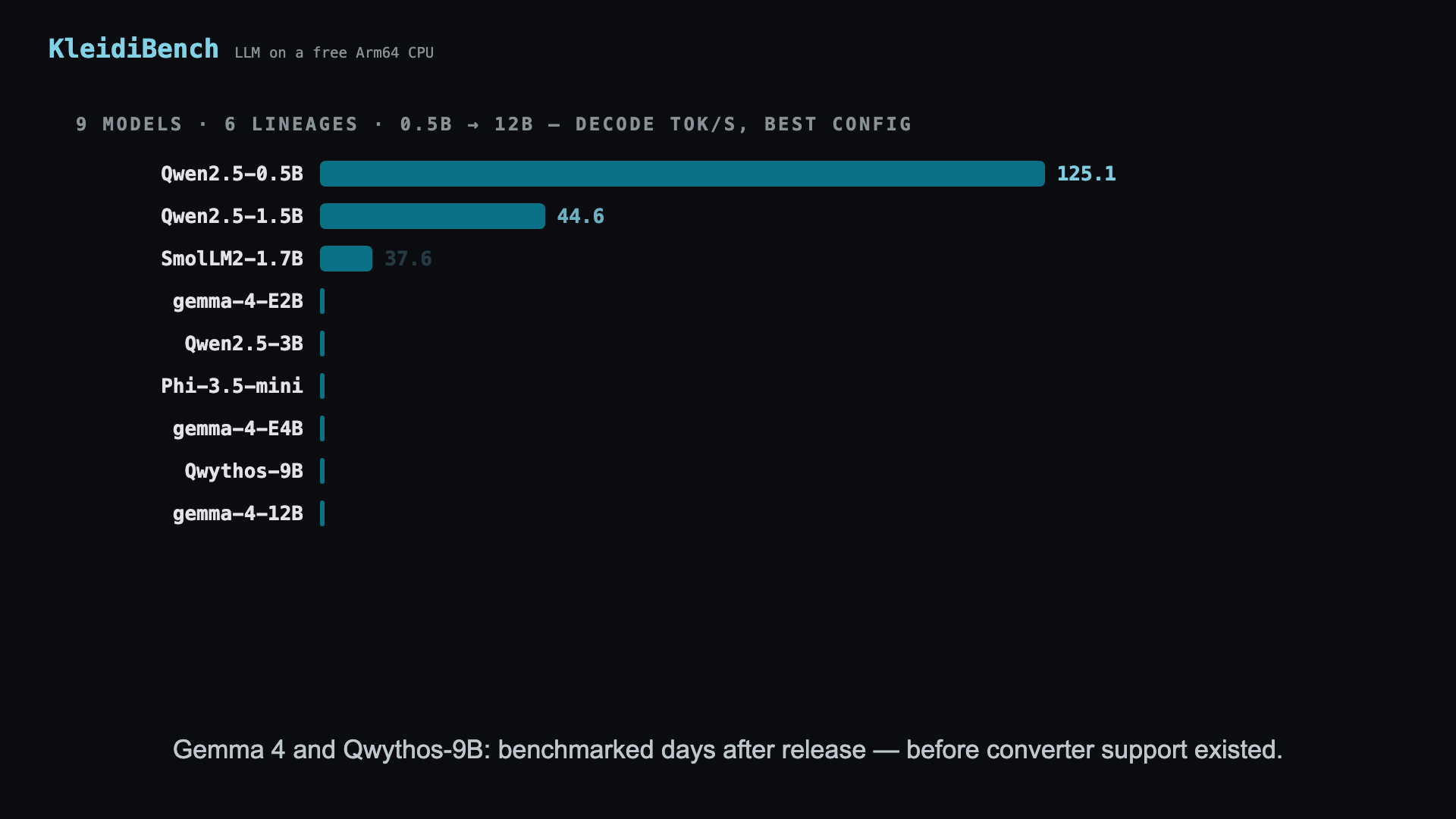
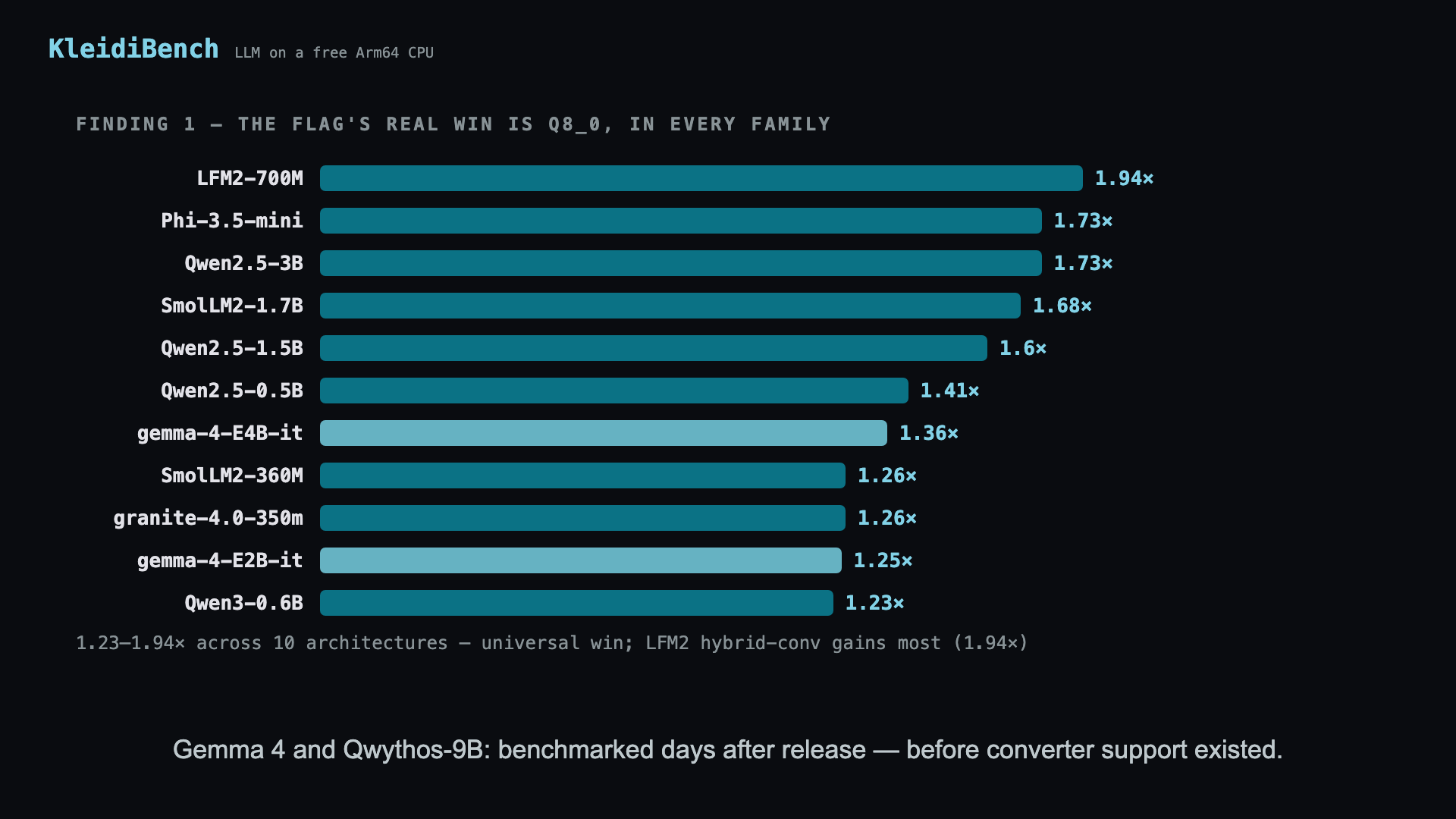
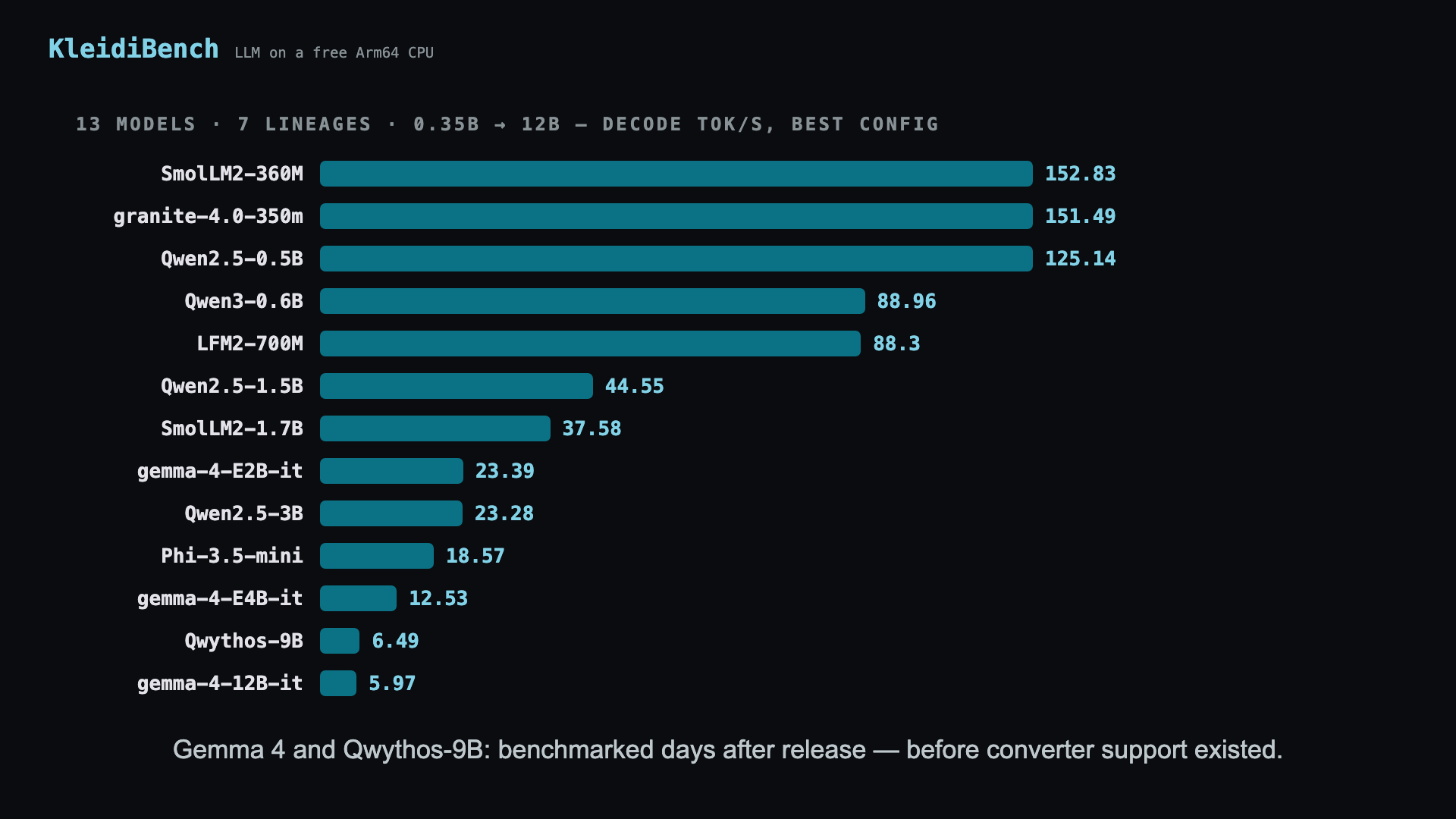
The committed leaderboard now spans 13 models across 7 lineages, 0.35B→12B: the three Qwen sizes above, SmolLM2-1.7B, Phi-3.5-mini, the complete Gemma 4 ladder (E2B / E4B / 12B) — benchmarked days after release, before converter support existed, via KleidiBench's pre-quantized GGUF mode — and Qwythos-9B, the #1-trending model on Hugging Face at time of writing. Plus a same-parameter 0.5B cohort (five architectures at fixed scale): the Q8_0 KleidiAI prefill gain reproduced in all 10 architectures measured (1.23–1.94×) — with Liquid's LFM2 hybrid-conv taking both the biggest gain (1.94×) and the fastest prefill in the dataset (588.8 tok/s).
The nuanced finding most entries won't have: at Q4_0, llama.cpp's default build already ships Arm repack kernels that match KleidiAI within 1% — the real ON/OFF flag win lives at Q8_0 (1.73× prefill), where the default path doesn't repack and KleidiAI's i8mm kernels take over. KleidiBench's 3-way build comparison (naive / default / KleidiAI) is what makes both stories visible and honest.
Full sweep (quant curve, thread scaling, RAM, TTFT) in results/ — committed to the repo, regenerated by CI.
Who it's for
Anyone deciding how to run an LLM on Arm gets their answer as a reproducible report in one command, on hardware that costs nothing.
Teams evaluating Arm migration — "is Graviton/Axion actually cheaper for our model?" Fork, push, and CI returns tok/s, TTFT, RAM, and $/million-tokens on real Arm silicon — the numbers that go in the migration proposal — before renting a single instance. Teams already serving on Arm CPUs — the sweep answers the config question directly. Our own data reduces to a decision tree: serve Q8_0 + KleidiAI if you have ~2× the file size in RAM (fastest, +1.3% perplexity vs F16); Q4_0 if RAM-tight (3.4× smaller, +20%); build with GGML_CPU_REPACK=OFF only when footprint beats speed (halves resident RAM). Model publishers and quant makers — add real Arm numbers to a model card without owning Arm hardware; the CI workflow is a copy-paste template. The Arm ecosystem itself — reproducible third-party evidence of where KleidiAI wins (Q8_0: 1.73×) and where it's already matched by llama.cpp's default path (Q4_0) — pointed at nightly llama.cpp, the same workflow is an Arm performance-regression watchdog. Learners — the cheapest lab there is for "what does quantization actually trade?": a size/speed/quality curve on real hardware for $0.
Functionality / output — three deliverables in one repo
1 · The harness (the reusable artifact) · 2 · The findings (the measured claims) · 3 · The live demo (the numbers, running):
The harness: kleidibench CLI (run, sweep, leaderboard, info) — MIT-licensed Python, dependency-light (PyYAML only), orchestrates upstream llama.cpp binaries rather than reimplementing inference. Includes the pre-quantized GGUF mode (day-one/oversize architectures) and the CI template (.github/workflows/benchmark.yml) that turns any public repo into an Arm benchmark lab — smoke test on every push, full sweeps on dispatch, results committed back automatically.
The findings: committed dashboard artifacts under results/ (per-model reports + combined leaderboard: decode tok/s, KleidiAI gain, $/Mtok) and the six-finding analysis in docs/FINDINGS.md — the Q8_0 1.73× win, the ~3B decode crossover, repack's 2× RAM cost, the 0.54% noise floor.
The live demo: llama.cpp's OpenAI-compatible server running the KleidiAI Q8_0 build (the measured-fastest config) on an arm64 runner, driven by a self-contained browser chat UI (demo/chat.html) showing live TTFT and tok/s per response, or the terminal client (demo/demo_client.py) (demo-session.yml opens the interactive session). Setup instructions See docs/setup.md. Shortest path:
fork/clone, then:
gh repo create /kleidibench --public --source=. --push
-> Actions tab: "benchmark" smoke test runs automatically on real Arm64
-> Actions tab: "benchmark" -> Run workflow -> full sweep, commits results/
Or on any Arm64 Linux box: pip install -e . && kleidibench run .
What's next
More Arm targets, same harness: the tool already decodes Neoverse N1/N2/V1/V2 — running the identical sweep on Graviton4 (i8mm+SVE at scale) and Axion would turn the leaderboard into a cross-cloud Arm buying guide. SME2 tracking: as SME2-capable Arm cores reach servers, the 3-way build comparison is exactly the instrument to measure what KleidiAI's SME2 kernels add — zero harness changes needed. Regression watchdog: the CI smoke test already re-benchmarks on every push; pointing it at nightly llama.cpp master would catch Arm performance regressions upstream before releases ship. Arm Performix integration is already stubbed (--perfix) for deep memory-bandwidth/cache profiling where the toolkit is installed. Built with llama.cpp · KleidiAI (GGML_CPU_KLEIDIAI) · GitHub Actions arm64 runners (ubuntu-24.04-arm) · Python · GGUF quantization (Q8_0 / Q4_K_M / Q4_0) · tmate · Arm Performix (optional deep profiling)
Links
Repo: https://github.com/yannan000/kleidibench (public, MIT) Live leaderboard: https://yannan000.github.io/kleidibench/results/leaderboard.html Live 3B report (charts + thread scaling): https://yannan000.github.io/kleidibench/results/Qwen2.5-3B-Instruct/report.html Findings writeup (learning-ready): https://github.com/yannan000/kleidibench/blob/main/docs/FINDINGS.md
CI runs (live benchmark evidence): https://github.com/yannan000/kleidibench/actions
Built With
- html
- phython

Log in or sign up for Devpost to join the conversation.