-
-
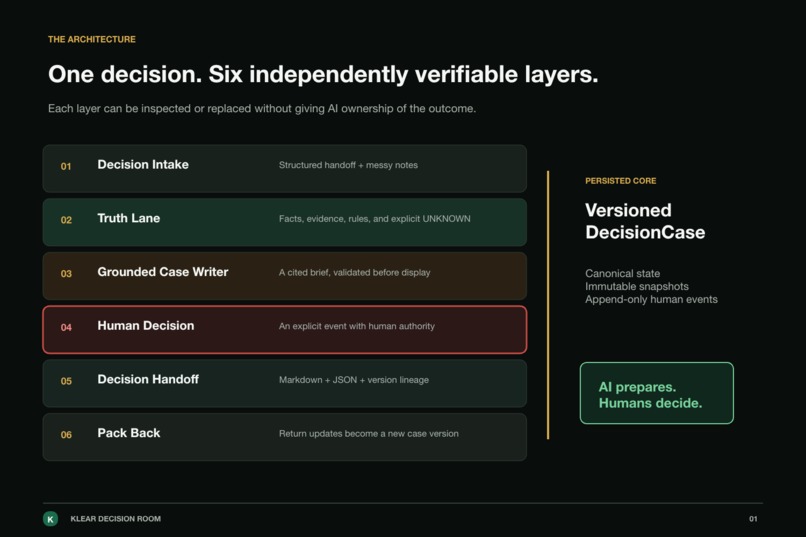
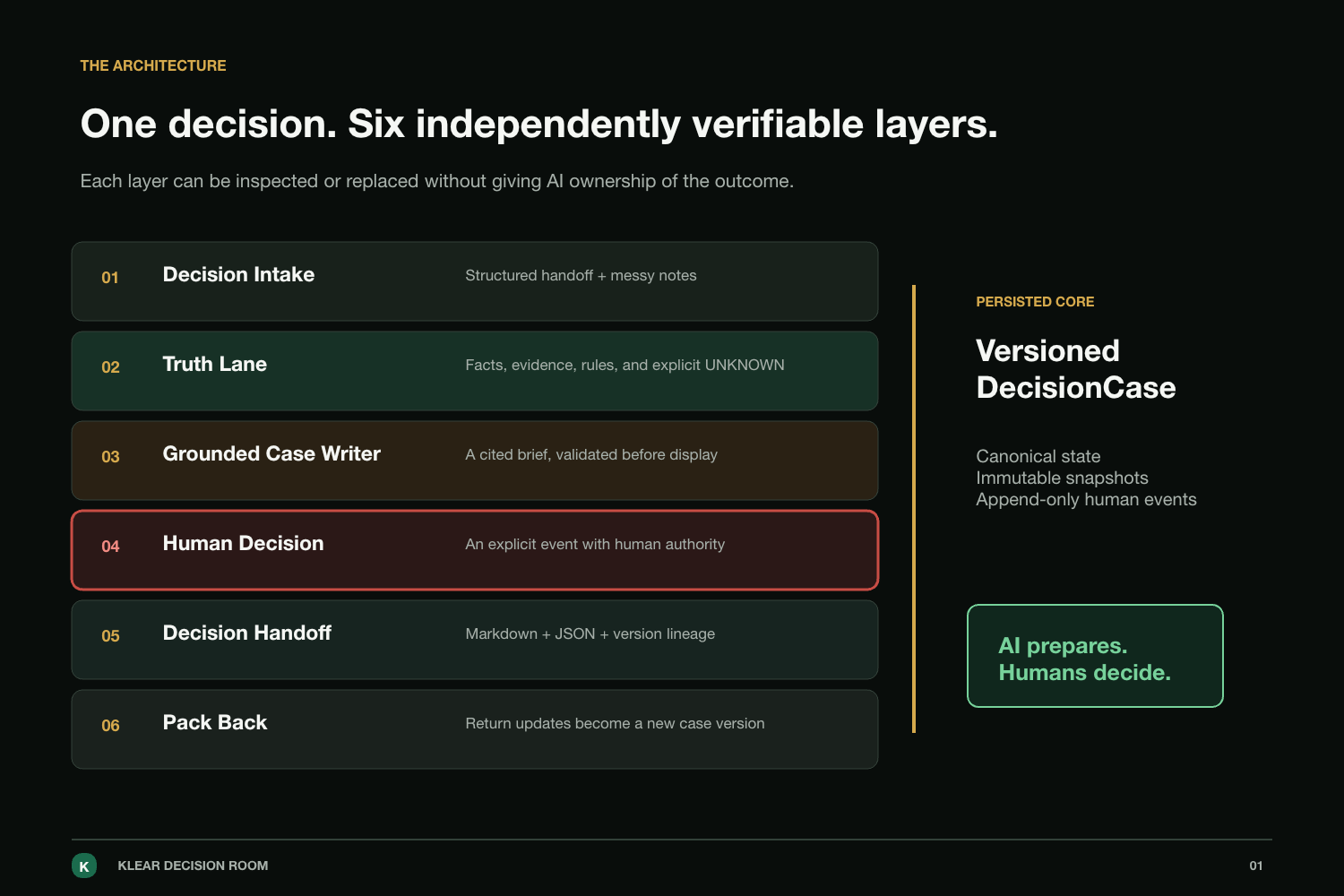
Six independently verifiable layers share one canonical, versioned DecisionCase.
-
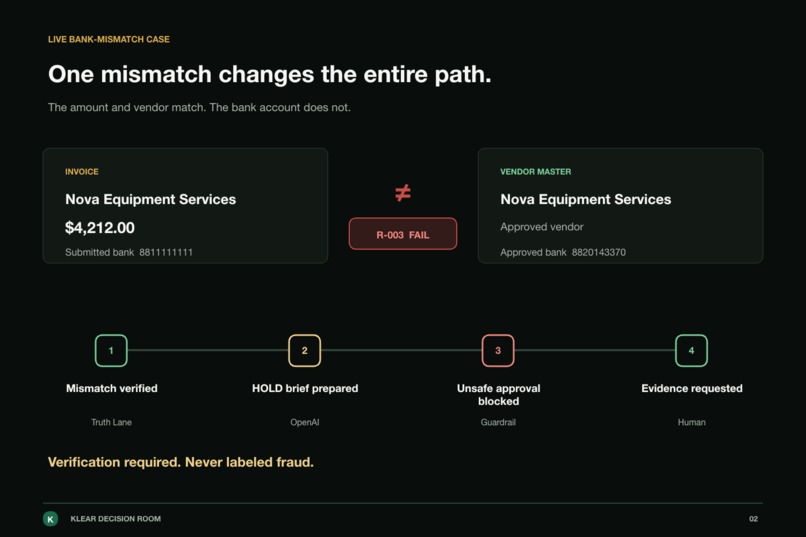
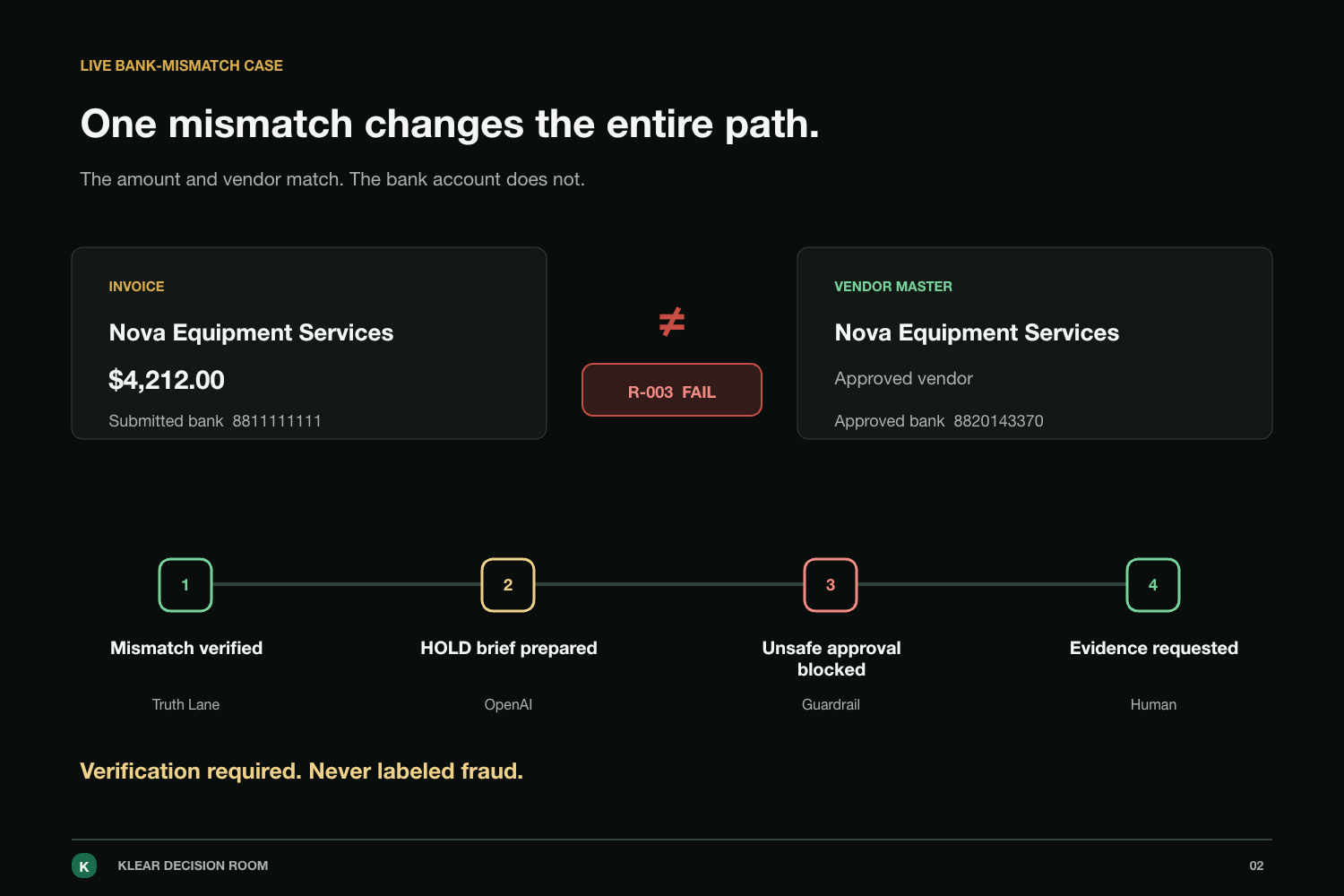
A bank-account mismatch moves from deterministic verification to a human evidence request.
-
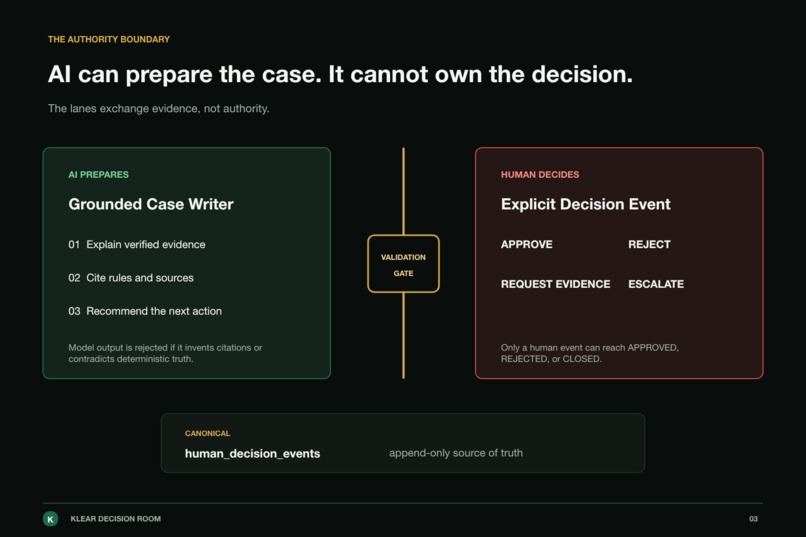
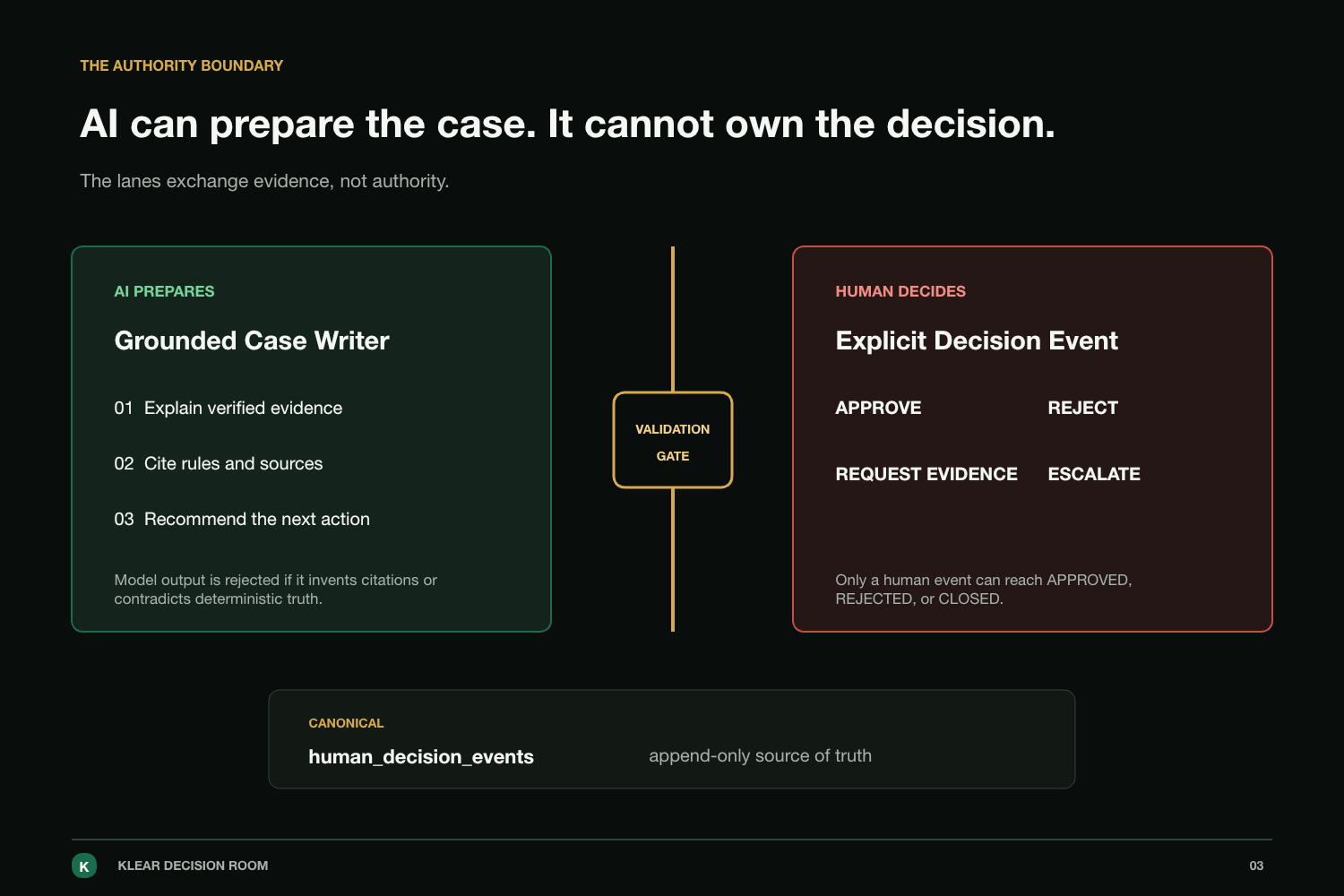
AI prepares a grounded brief; only an explicit human event can own the decision.
-
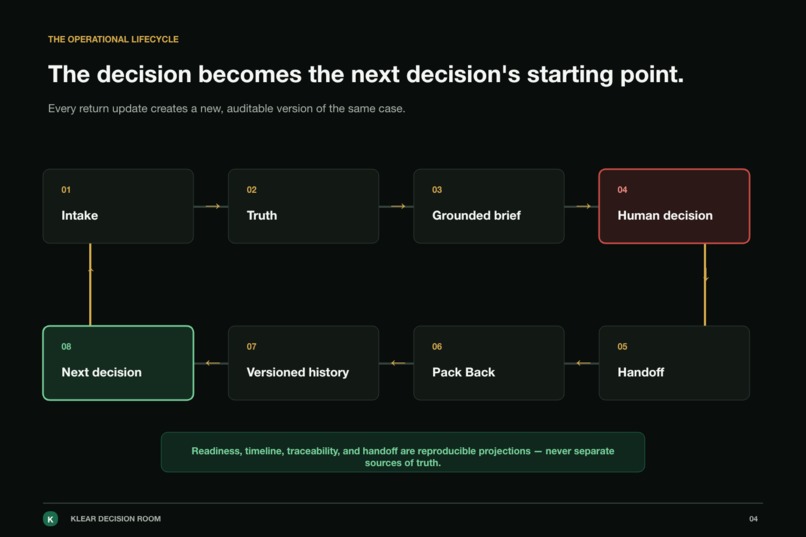
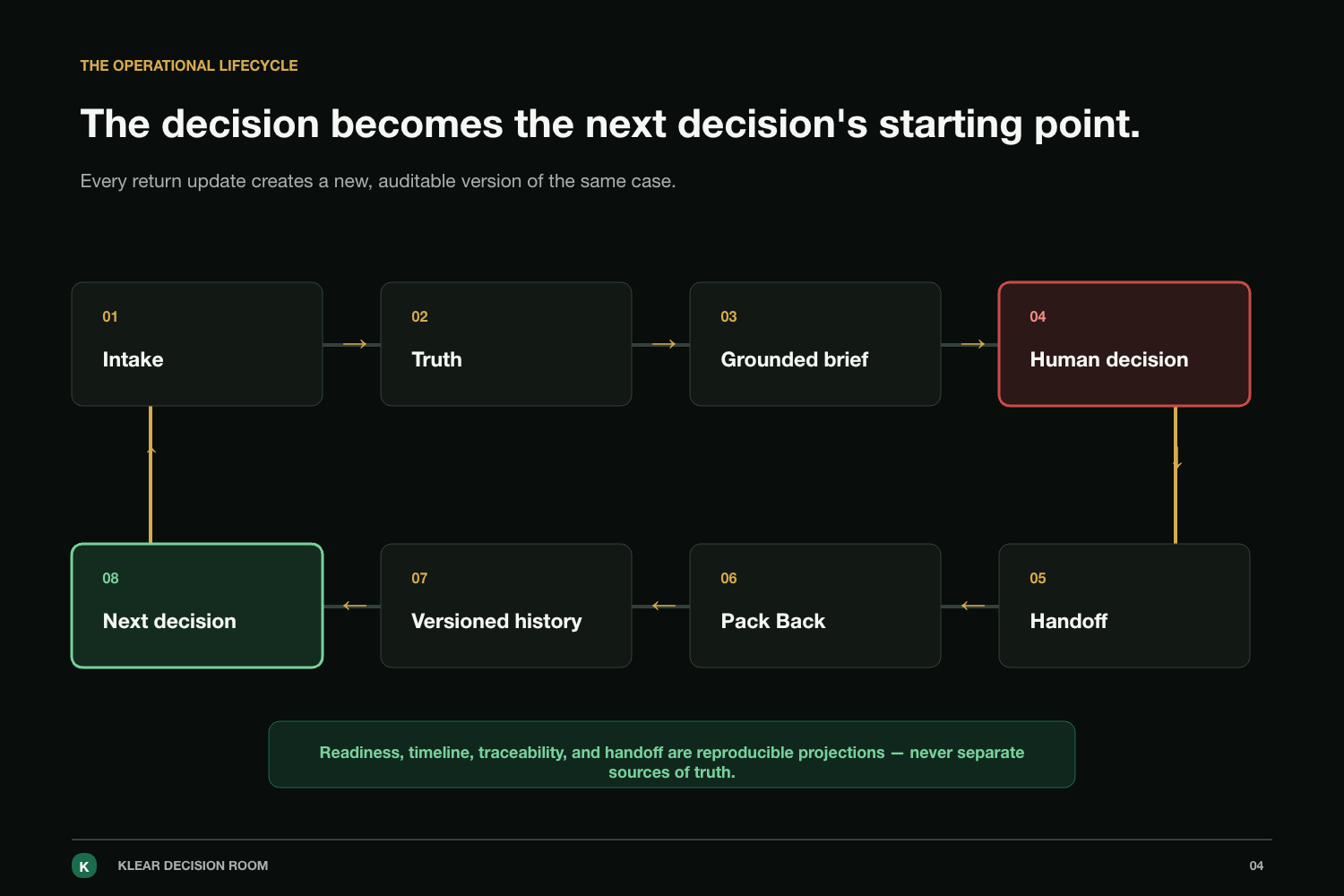
Handoff and Pack Back create immutable history and prepare the case for the next decision.
Inspiration
I started with a problem I already knew from finance review: the information needed for one decision is usually scattered across invoices, vendor records, policies, spreadsheets, emails, and previous actions.
At first, I thought I was building a more detailed AI finance reviewer. Then I realized the real unit was not the invoice or the AI response. It was the decision itself: what was known, what remained unknown, which evidence was trusted, who had authority, and what needed to happen next.
That became KLEAR Decision Room.
What it does
KLEAR turns messy operational evidence into a persistent, versioned DecisionCase.
In the live finance demo, an invoice looks normal except for one detail: its submitted bank account does not match the approved vendor master.
KLEAR then:
- Normalizes the intake and creates stable evidence records.
- Runs deterministic rules before calling any model.
- Preserves missing facts explicitly as
UNKNOWN. - Uses OpenAI to prepare a grounded, cited case brief.
- Validates the model output against real evidence and policy results.
- Blocks an unsafe approval attempt.
- Records an explicit human request for evidence.
- Generates a Decision Handoff with evidence, rules, ownership, and version lineage.
- Accepts Pack Back updates without pretending unfinished work is complete.
AI prepares the case. Systems verify the facts. Humans own the decision.
How we built it
I built KLEAR Decision Room during Build Week using Codex with GPT-5.6.
The application uses Node.js, vanilla JavaScript, HTML, and CSS, with no frontend build system. The backend exposes a REST API and stores versioned DecisionCase records, immutable snapshots, evidence objects, rule results, human decision events, and history.
The grounded case writer uses OpenAI's Responses API. Model output must pass a deterministic validator before it can appear in the case. Invented evidence IDs, unsafe recommendations, and attempts to change human decisions are rejected.
The public demo uses a normal OpenAI API key supplied by the reviewer. KLEAR uses it only for that live run, clears it afterward, and never stores it in the case, history, versions, or handoff.
Earlier Finance Reviewer and KLEAR projects influenced the truth and continuity layers, but no source code was copied. The new DecisionCase architecture and complete reviewer lifecycle were built in a separate repository with documented prior-work boundaries.
Challenges we ran into
The hardest challenge was keeping the three lanes genuinely separate:
- Deterministic truth must not depend on the model.
- The model must not invent evidence or own a decision.
- Human decisions must only happen through explicit, auditable events.
Another challenge was the interface. The architecture contains evidence, rules, readiness, model validation, decisions, handoffs, Pack Back, and immutable history. Showing all of it at once made the product feel flat and overwhelming.
The final interface treats each case as a living decision folder. The reviewer sees the current finding and next action first, while deeper technical and audit layers remain available when needed.
Accomplishments that we're proud of
KLEAR is not a prompt wrapped in an approval screen.
An unsafe approval is rejected server-side. Human decision events are append-only. Historical versions remain immutable. Every failed or unknown rule cites evidence or explains why evidence is unavailable.
The same persisted DecisionCase can reproduce readiness, traceability, timeline, Decision Story, and handoff without creating competing sources of truth.
The project has 51 automated tests and a public one-click reviewer journey that works without cloning or rebuilding the repository.
What we learned
The most useful AI workflow is not always the one where AI does everything.
Once the model became independently replaceable, the architecture became clearer. Facts could be verified without AI. Model output could be validated before display. Human authority could remain explicit. Handoffs could carry the exact state forward instead of summarizing it loosely.
The boundary was not a limitation. It became the product.
What's next for KLEAR Decision Room
The current product stays focused on finance approval because it makes the decision boundaries easy to prove.
Next steps include durable database persistence, configurable enterprise policies, identity and access controls, multi-reviewer approval chains, and stronger Pack Back integrations with operational systems.
The underlying DecisionCase architecture could later support other evidence-heavy decisions in compliance, underwriting, onboarding, maintenance, and quality assurance without turning KLEAR into a generic workflow builder.
Built With
- api
- codex
- css3
- gpt-5.6
- html5
- javascript
- json
- node.js
- openai
- render
- responses
- rest

Log in or sign up for Devpost to join the conversation.