-
-
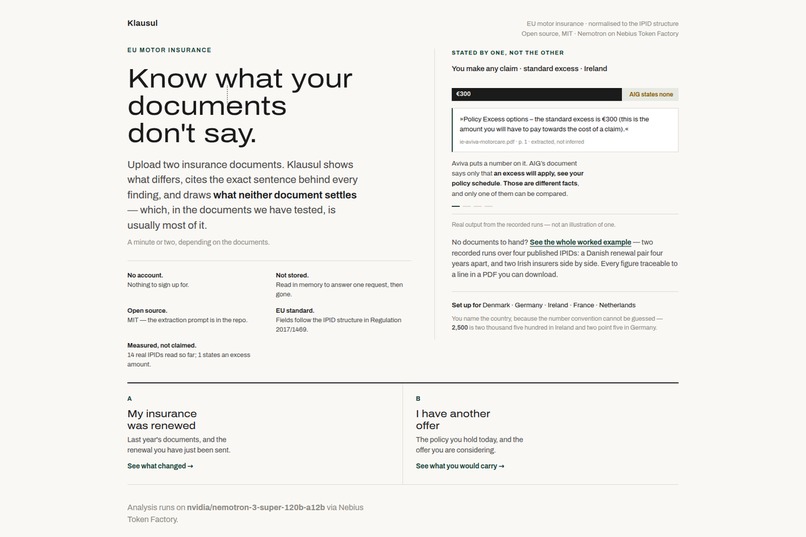
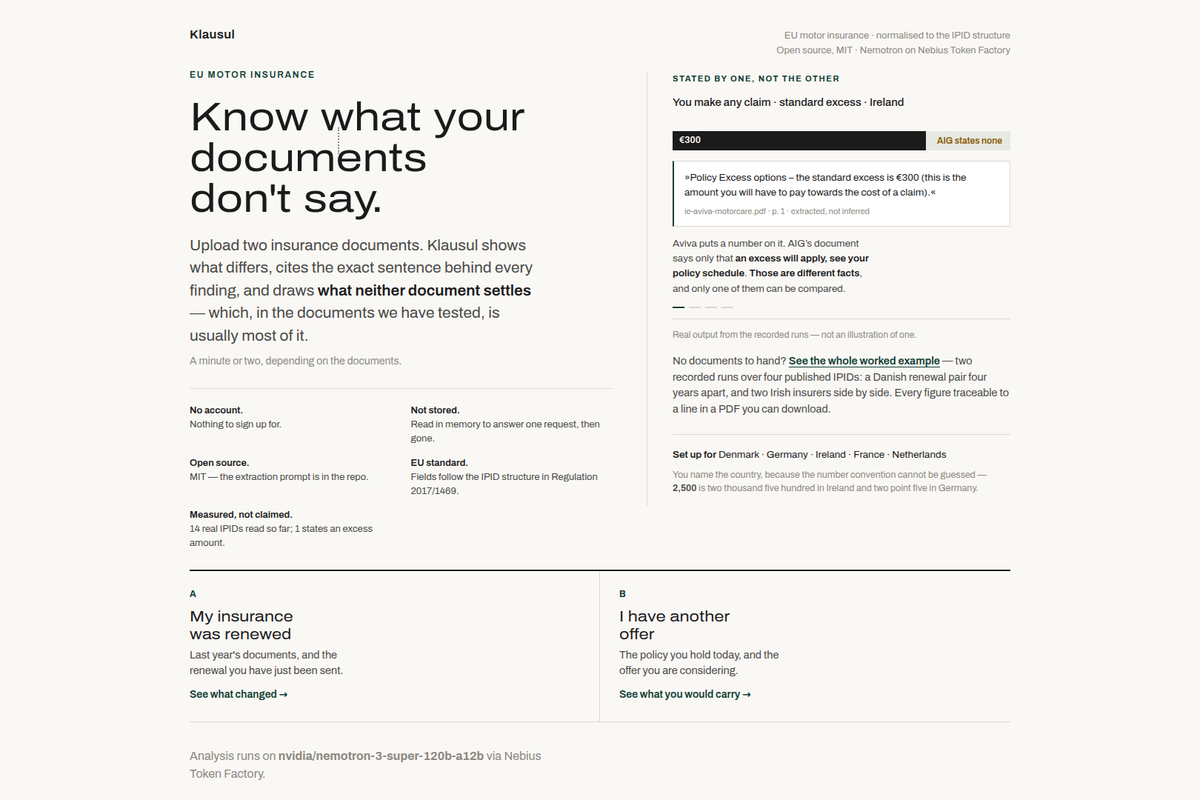
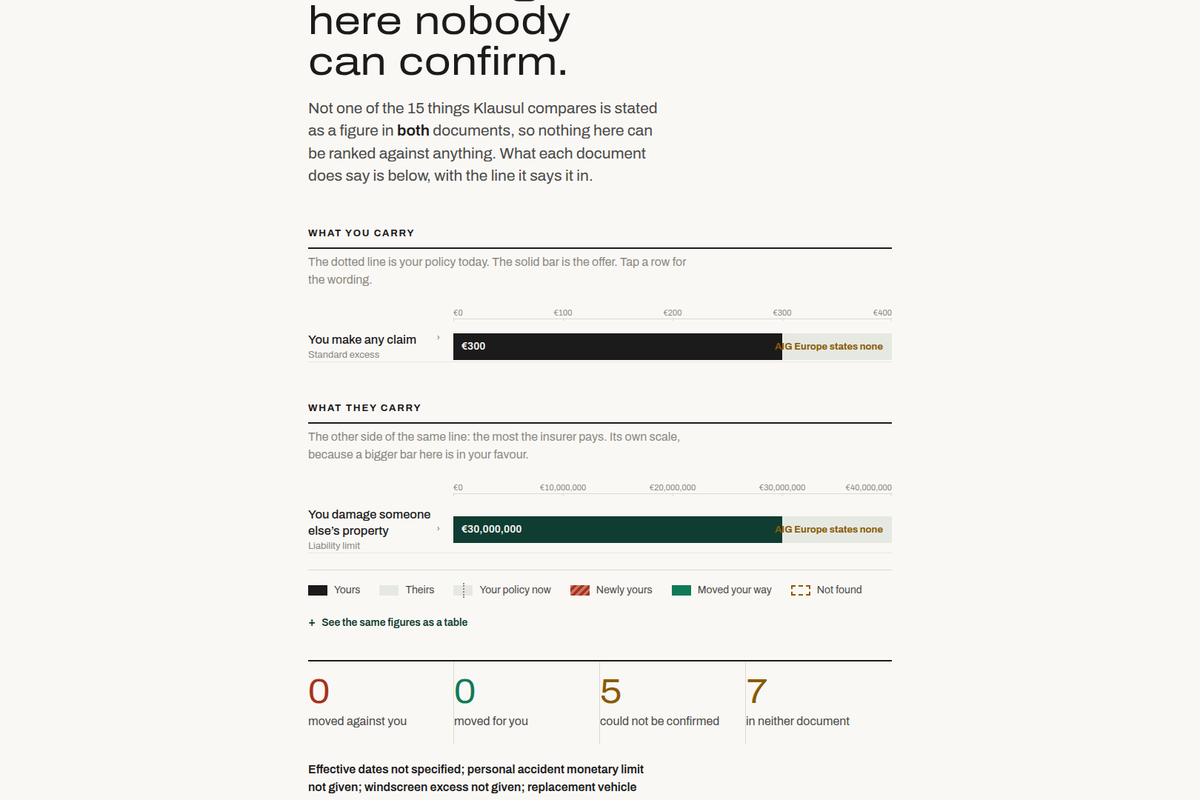
Two documents in, one market. Aviva states a €300 standard excess; AIG states none. No account, nothing stored.
-
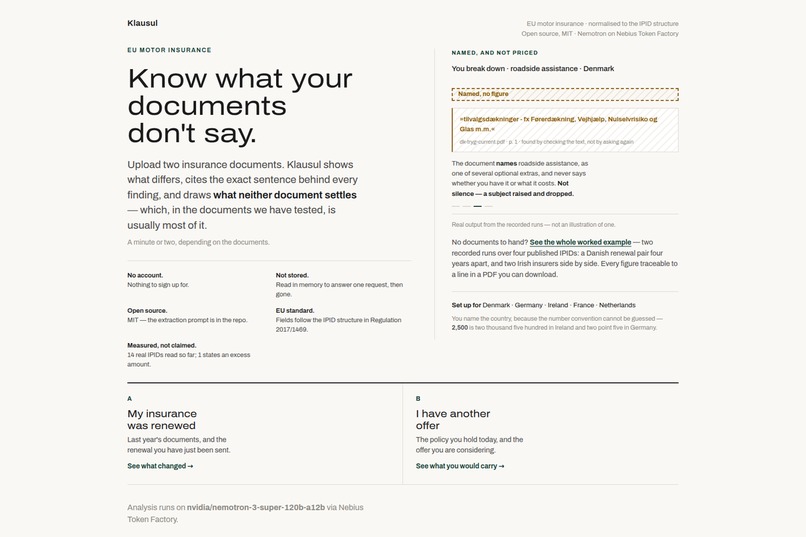
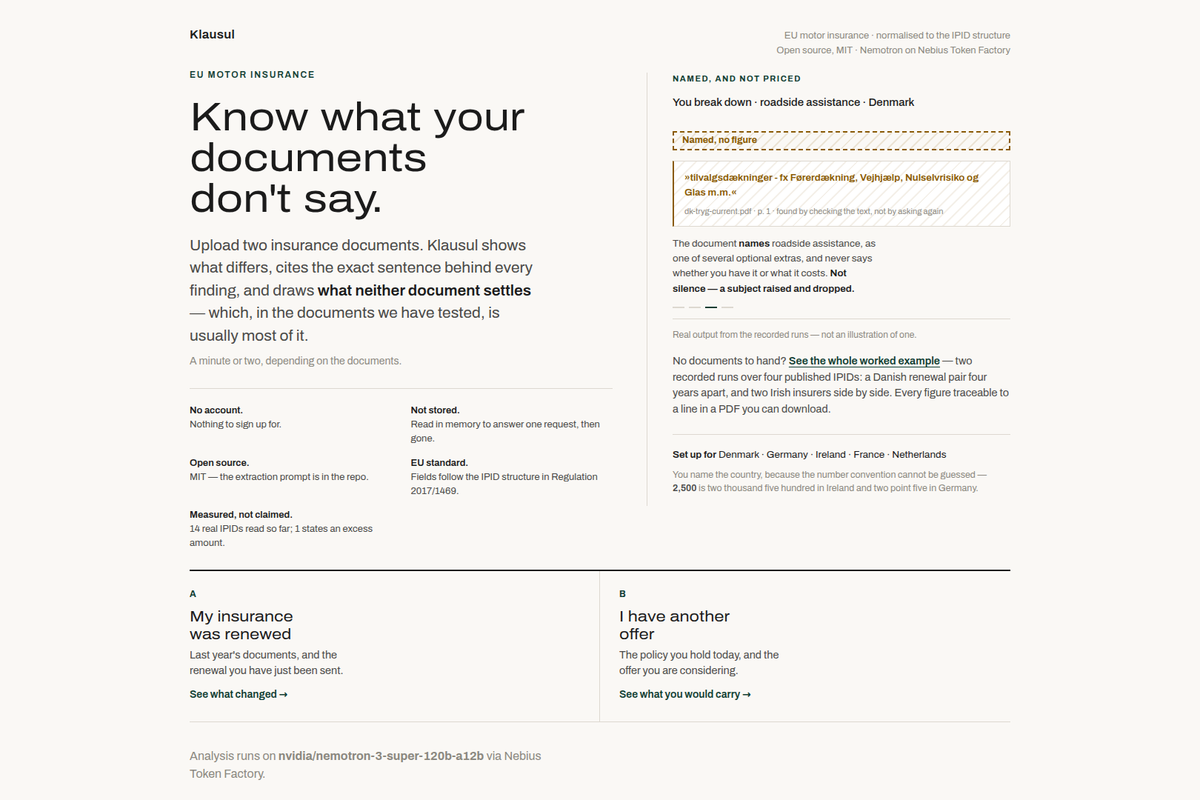
The Danish document names roadside assistance as one of several optional extras and never says whether you have it.
-
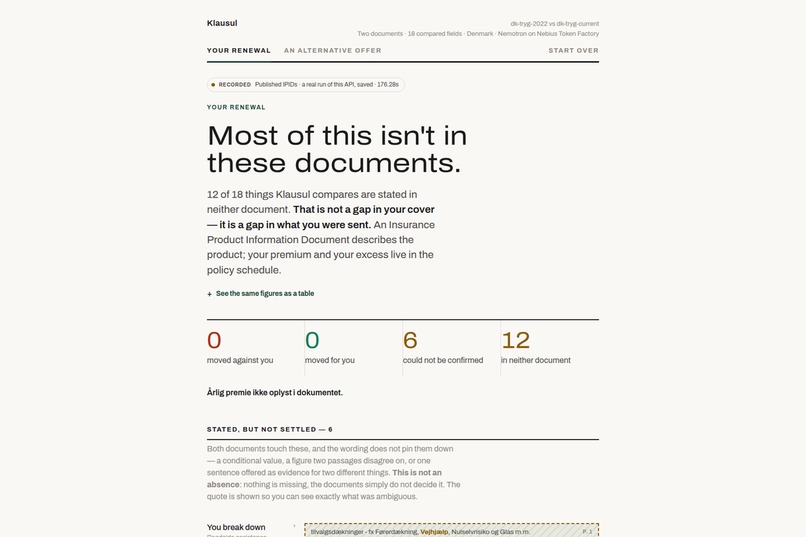
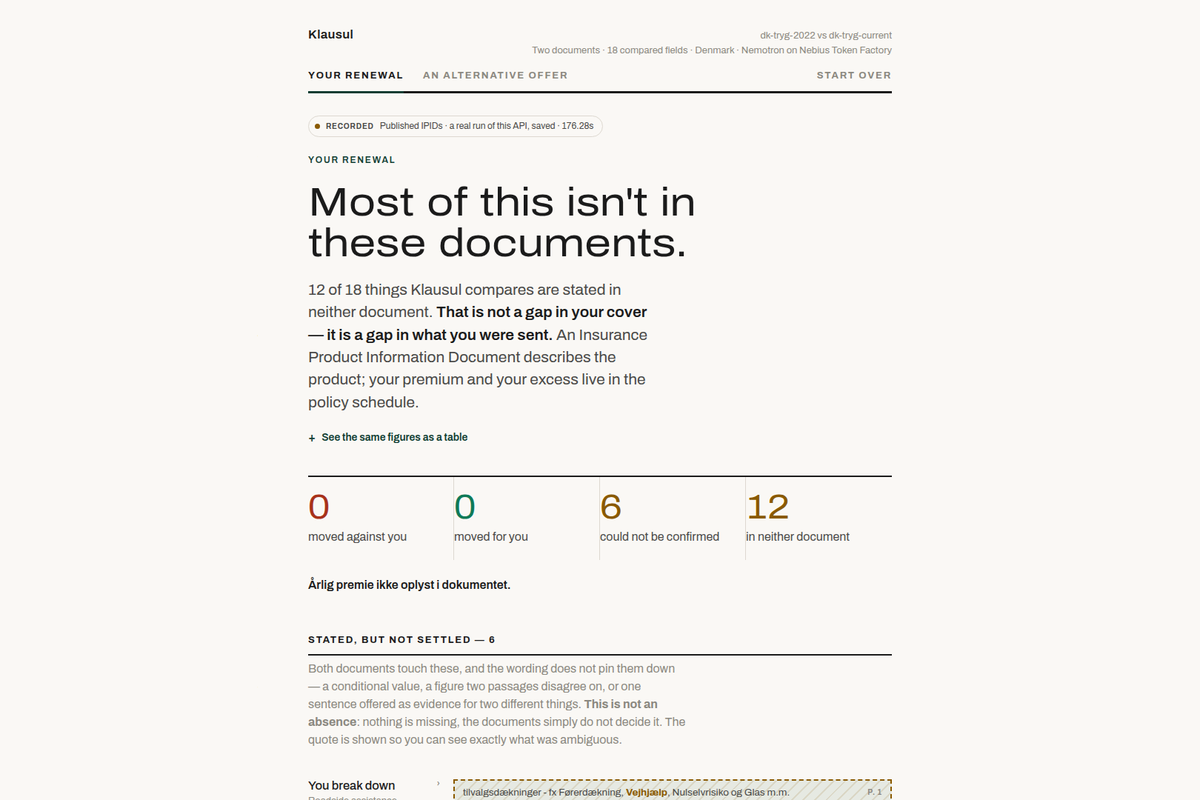
Real Tryg pair, 2022 against 2024: 12 of 18 comparable things are in neither document, 6 named without a figure, 0 moved.
-
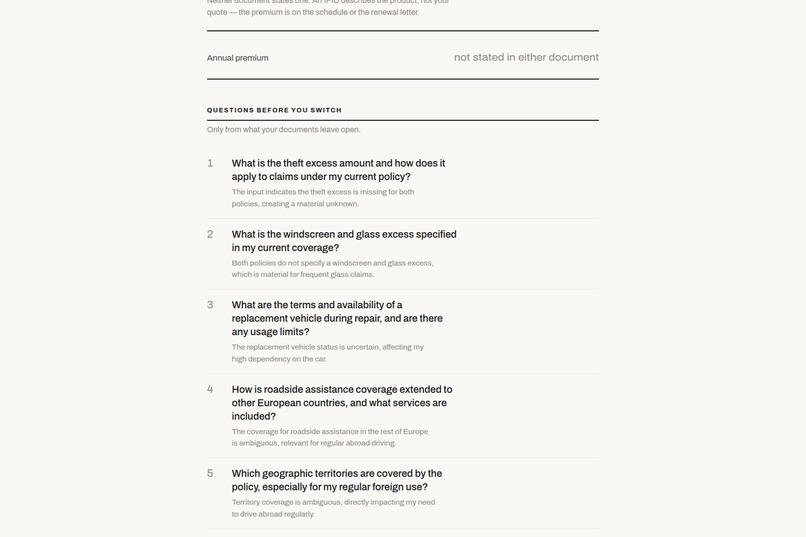
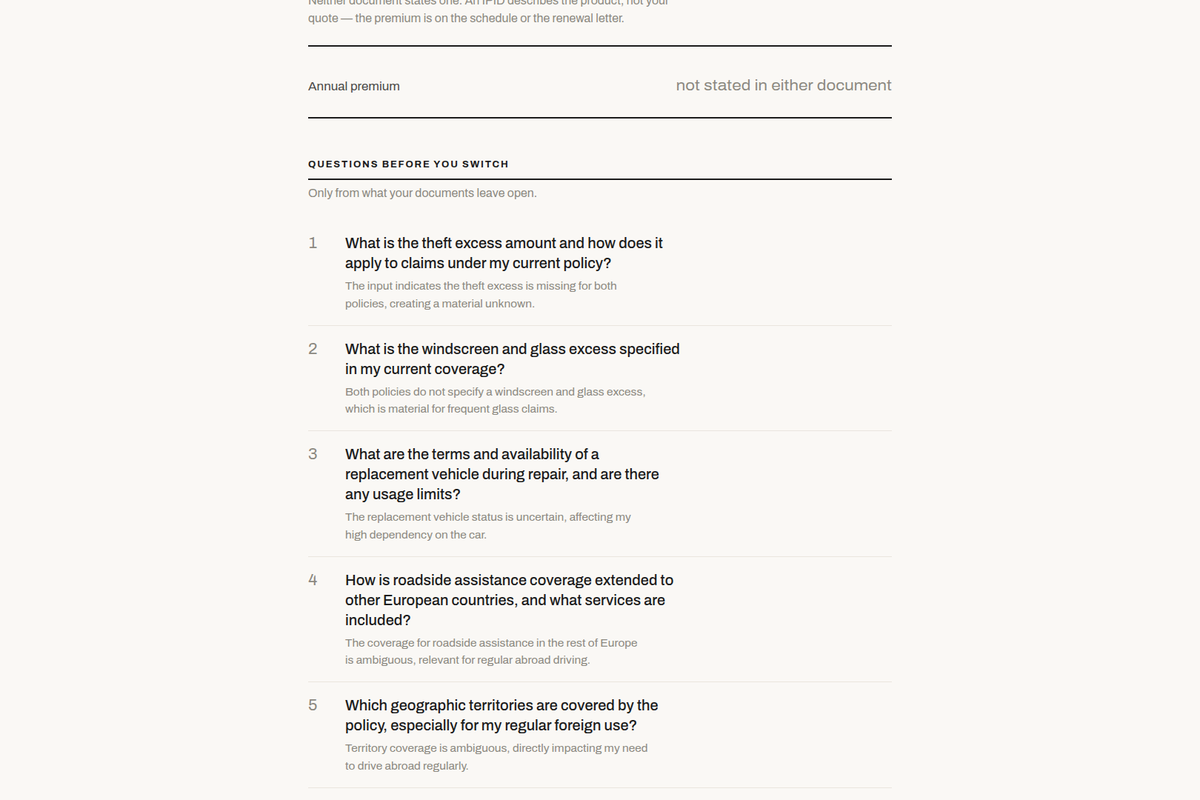
Each finding ends in a question you can send your insurer, generated only from what the two documents left open.
-
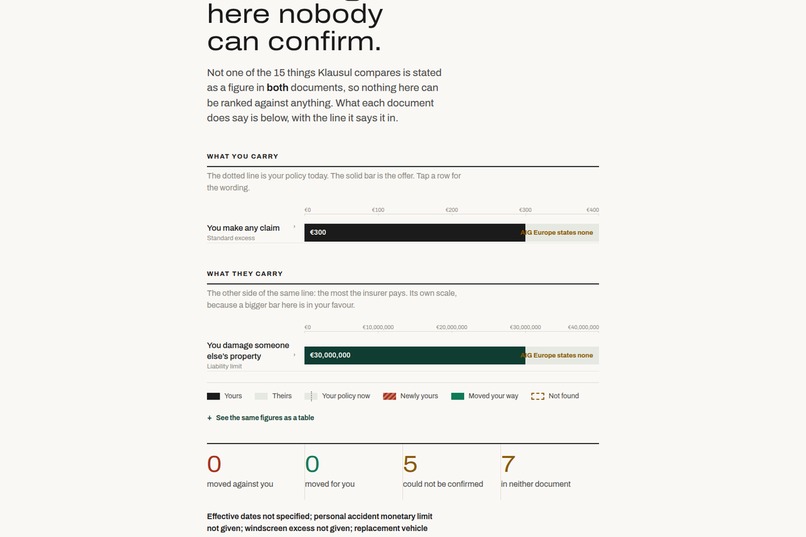
Aviva states a €300 excess and a €30,000,000 liability limit. AIG states neither. Only one of those can be compared.
-
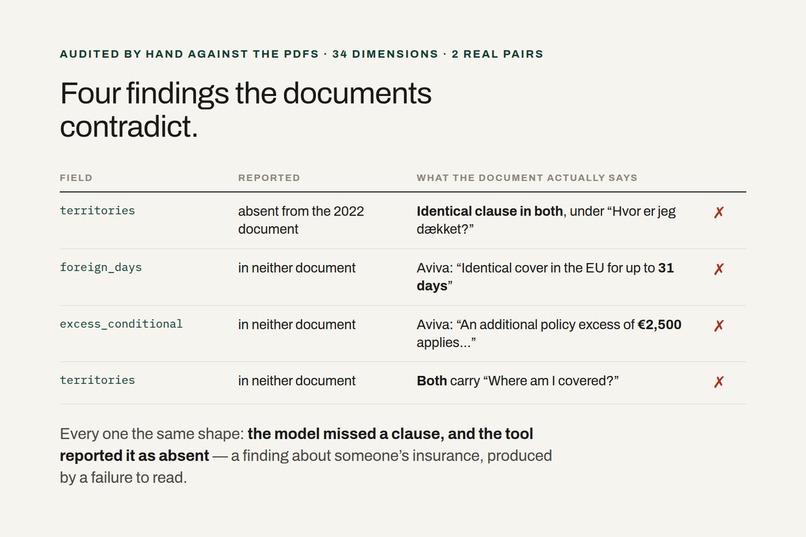
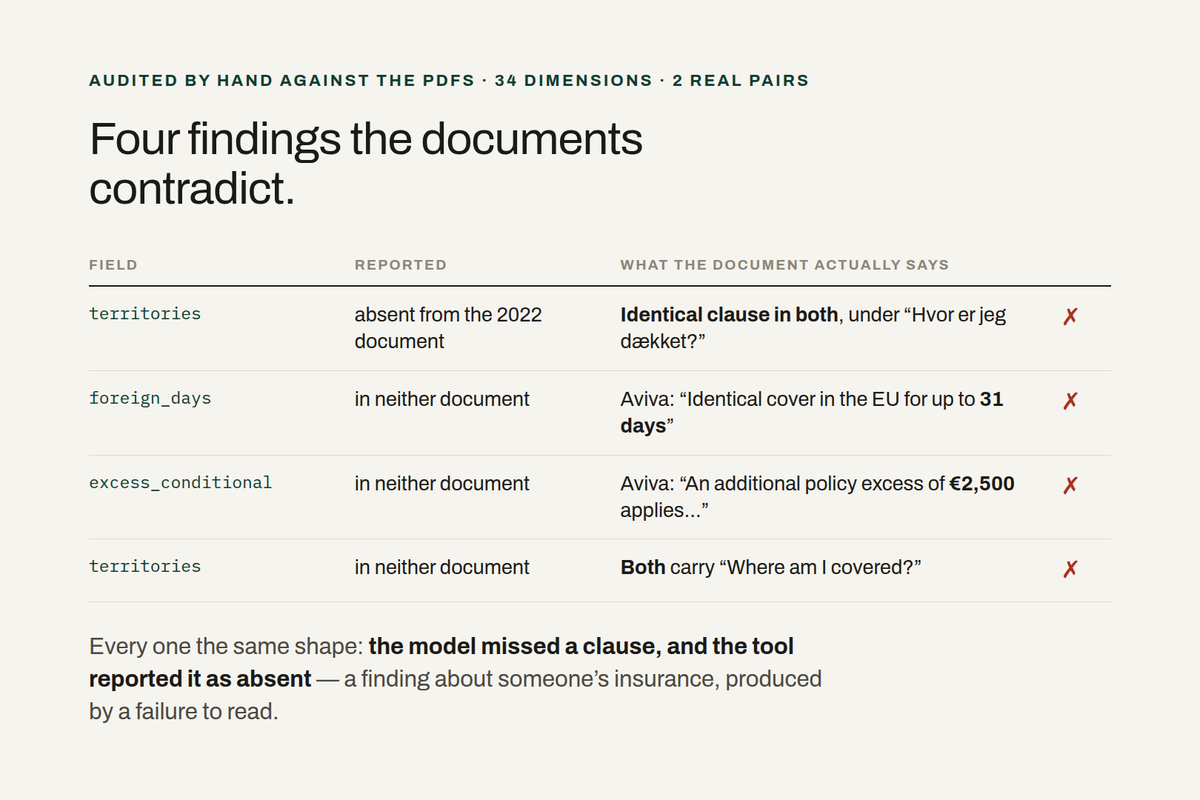
I audited 34 dimensions by hand against the PDFs. Four were wrong — every one a missed clause reported as absent.
-
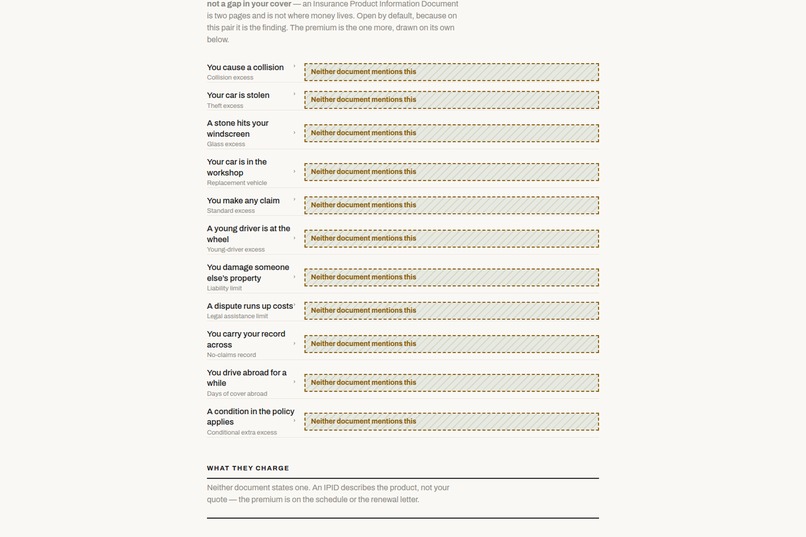
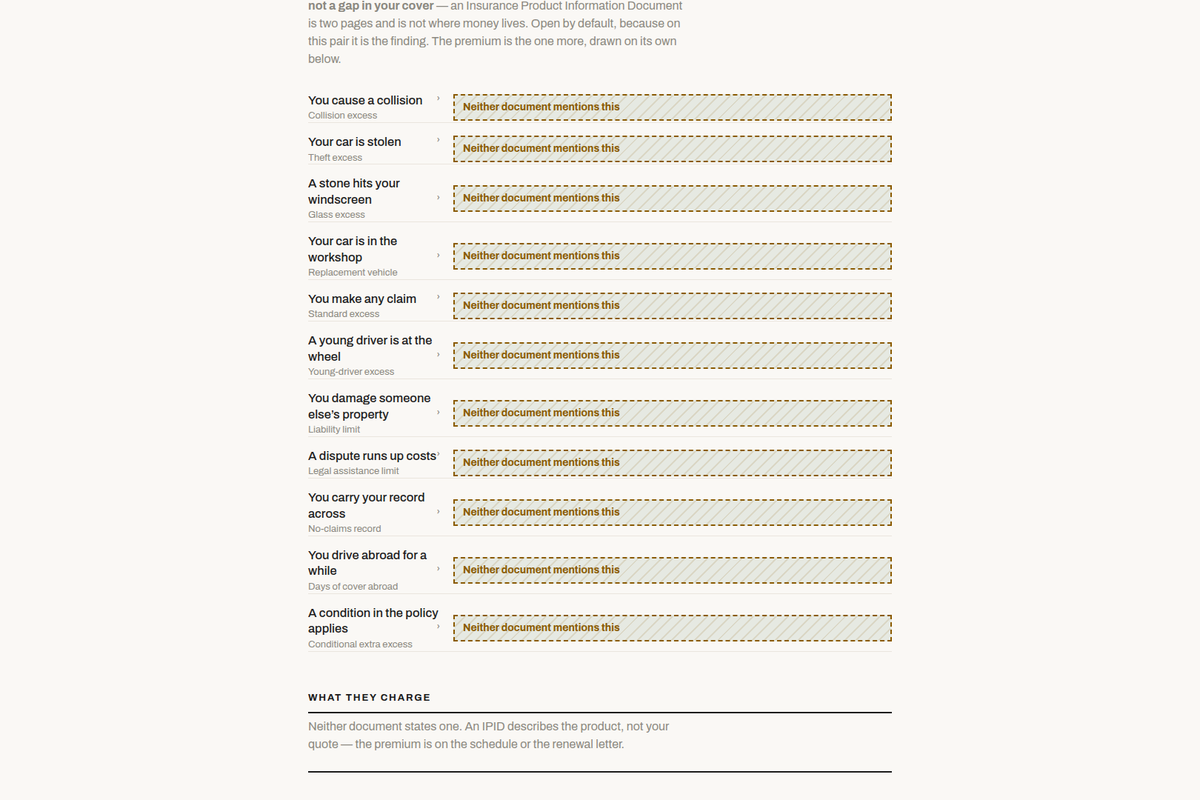
Ordinary situations, row by row. Neither document mentions any of them. An absence is drawn as an absence, not as a zero.
-
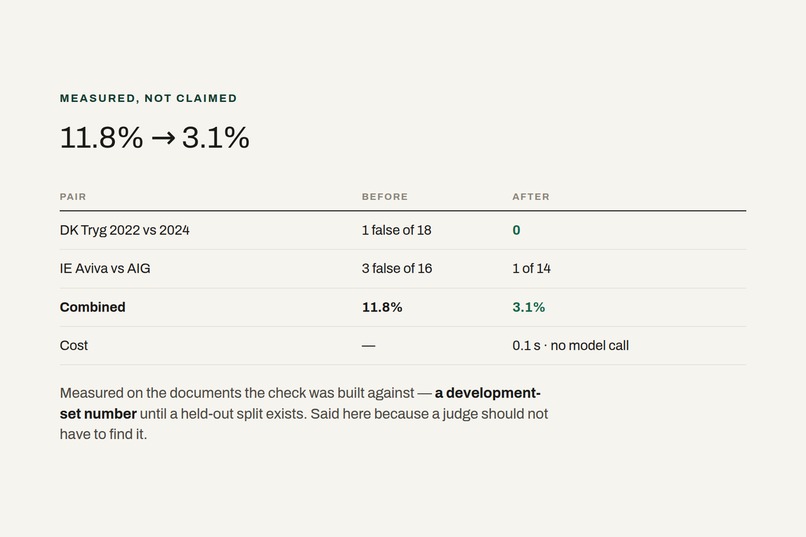
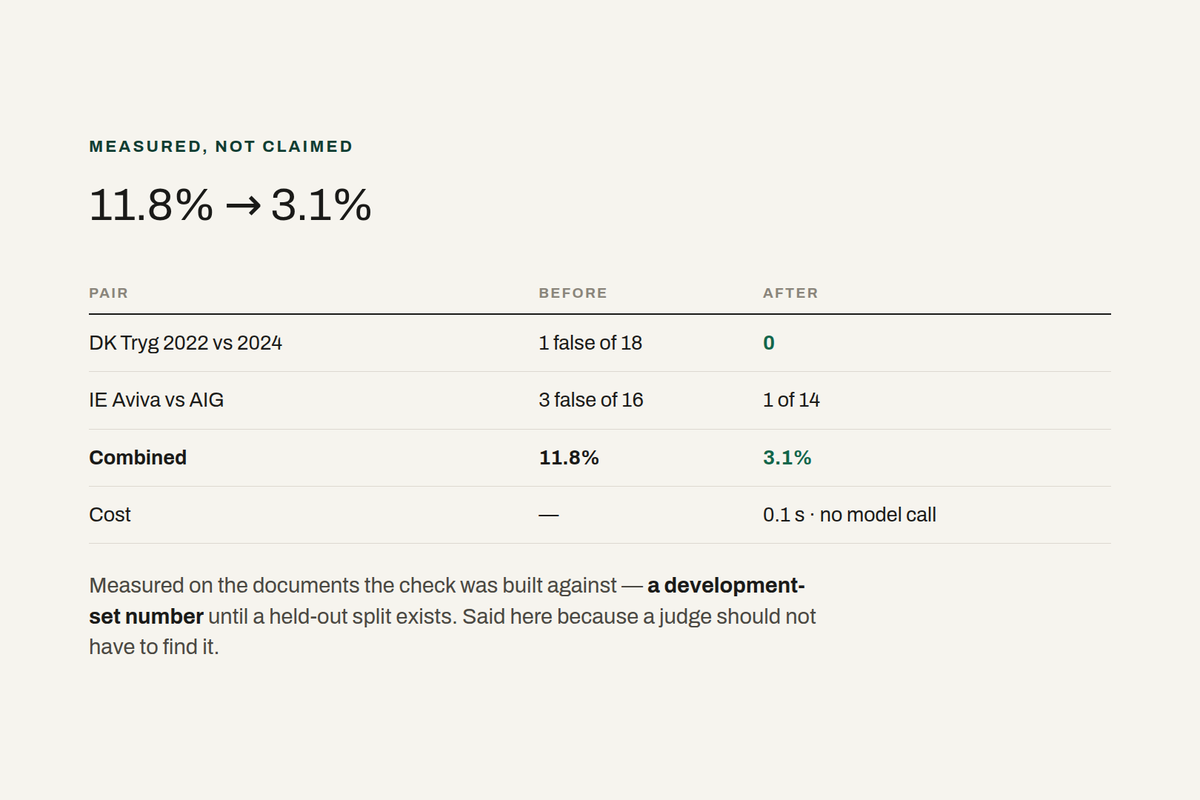
11.8% → 3.1% false findings, zero on the Danish pair, 0.1s and no model call. A development-set number until a split is held out.
Inspiration
I set out to build a renewal-comparison tool for EU car insurance, then collected the documents it would have to read. Fourteen published Insurance Product Information Documents (IPIDs), from Denmark, Germany and Ireland.
One of them states an excess amount. The Danish ones contain no money figures at all. A real Tryg renewal pair — 2022 against 2024 — is 94% identical text with nothing to compare: no premium, no excess, no limits.
My original demo showed a Danish theft excess moving from €300 to €500. That document format does not exist. It had invented it.
So I kept the product and changed the claim. The finding is not usually "this number moved." It is "the document names the cover and never gives you the number." An IPID describes the product; your premium and your excess live on the policy schedule, which is a different document, and nobody compares it.
That is the gap the tool now shows you.
What it does
Upload two insurance PDFs and pick your market. Klausul:
- extracts both into one canonical model, with a verbatim quote, page number and confidence score on every single value;
- verifies every reported absence against the document's own text before it is allowed to become a finding;
- compares the two in ordinary code, with no model involved;
- orders findings by what your circumstances make relevant, without ever changing what is true;
- explains each confirmed difference in plain language;
- ends with questions to send your insurer, generated only from what the documents left open.
It never recommends an insurer. It is decision support, not advice.
How I built it
Extraction runs NVIDIA Nemotron 3 Super (120B) on Nebius Token Factory — six languages, one schema, long documents. Explanation runs Nemotron 3 Nano (30B) on the same endpoint, and is only ever called after a difference has been confirmed by code.
The pipeline is deliberately split:
| Stage | Who | Why |
|---|---|---|
| Text + page map | pdfplumber |
page numbers must survive, or citation is impossible |
| Extract | Nemotron 3 Super | six languages, one schema |
| Provenance validation | code | a value with no quote behind it is demoted |
| Absence verification | code | a negative from one model pass is unverified |
| Comparison | code | a difference in the output appeared in the documents |
| Relevance weighting | code | circumstances change what matters, never what is true |
| Explanation | Nemotron 3 Nano | what does this confirmed difference mean? |
app/compare.py contains no model call. That is the product, not an optimisation. The model is never asked which policy is better — a model asked to rank two policies will produce a confident ranking whether or not the documents support one.
FastAPI, Docker on Render, static page on GitHub Pages so a cold API never blocks a reader. 63 tests, no network required.
Challenges I ran into
The model's silence is not the document's silence.
missing_a / missing_b / missing_both are the only verdicts in the system that assert a negative. Every other verdict compares two things the model found and can be audited by reading two quotes. A negative has no quote by construction — and recall is not 1.0.
I audited 34 dimensions across two real pairs by hand against the PDFs. Four were wrong, all the same shape: the model missed a clause, and the tool reported it as absent — a finding about someone's insurance, produced by a failure to read.
| Pair | Dimension | Reported | The document actually says |
|---|---|---|---|
| DK Tryg | territories |
absent from the 2022 document | Identical clause in both, under "Hvor er jeg dækket?" |
| IE Aviva/AIG | foreign_days |
in neither document | Aviva: "Identical cover in the EU for up to 31 days" |
| IE Aviva/AIG | excess_conditional |
in neither document | Aviva: "An additional policy excess of €2,500 applies…" |
| IE Aviva/AIG | territories |
in neither document | Both carry "Where am I covered?" |
The fix uses no model call. Before a not_found becomes a finding, the document's own text is searched for that field's vocabulary — and, where an IPID section is the dimension, its mandated heading. A hit demotes the absence to "the document raises this and does not settle it", carrying the line it was found on. It can only ever demote, never promote, so it cannot introduce a confident wrong answer.
11.8% → 3.1% false findings. Zero on the Danish pair. Cost: 0.1 seconds, no model call.
Stated plainly: 3.1% is measured on the documents the check was built against. A held-out split is the next piece of work.
Two things I cut after measuring them:
- Mandatory section headings as general evidence. Every IPID carries "When and how do I pay?" by regulation, so it proves nothing about the premium — mapping it that way demoted a true absence on all four documents.
- Limits borrowing their cover's vocabulary. "Legal expenses cover" proves legal cover is discussed; it says nothing about whether a limit is stated, and the amount is the thing the reader came for.
An earlier guard had the same disease in reverse: it demoted any field sharing a quote with another. Measured, it fired six times and was right once — "Fire, theft or attempted theft" is one sentence about two perils, and the guard was eating correct values. Narrowed to quotes stretched across unrelated subjects.
Accomplishments that I'm proud of
Every number in the demo is traceable to a line in a PDF anyone can download. The two recorded runs shipped with the page are verbatim API responses, replayed through the same function a live upload goes through — so the example cannot drift from the product.
And the measurement exists. The honest failure rate is published in the README, with its caveat attached.
What I learned
A fix verified at the unit level is not verified. The false finding I was chasing needed three fixes, not the two I thought — the validator, the comparison precedence, and then the presentation layer, which was restating the same false claim in a different wrapper. I only found the third by rendering the page and reading it.
And the honest answer is often the more useful one. "Neither document discusses roadside assistance" is false and useless. "Your document names roadside assistance as one of several optional extras and never says whether you have it" is true — and it is a better question to put to an insurer.
What's next for Klausul
- A held-out document split, so 3.1% stops being a development-set number.
- Vocabulary for the
coverage_limits.*dimensions, the one class of absence that currently cannot be verified. - France and the Netherlands: registered sources, no documents yet.
- The same shape generalises. A regulator mandates a document to make something comparable, and the document discloses the inputs and stops one step short of the number that decides — PRIIPs KIDs, bank Fee Information Documents, telecom contract summaries, ESIS mortgage sheets. Same pipeline, different vocabulary.
Klausul is Danish, German, Norwegian and Swedish for **clause* — the unit this product works in. No account, nothing stored. MIT licensed.*

Log in or sign up for Devpost to join the conversation.