-
-
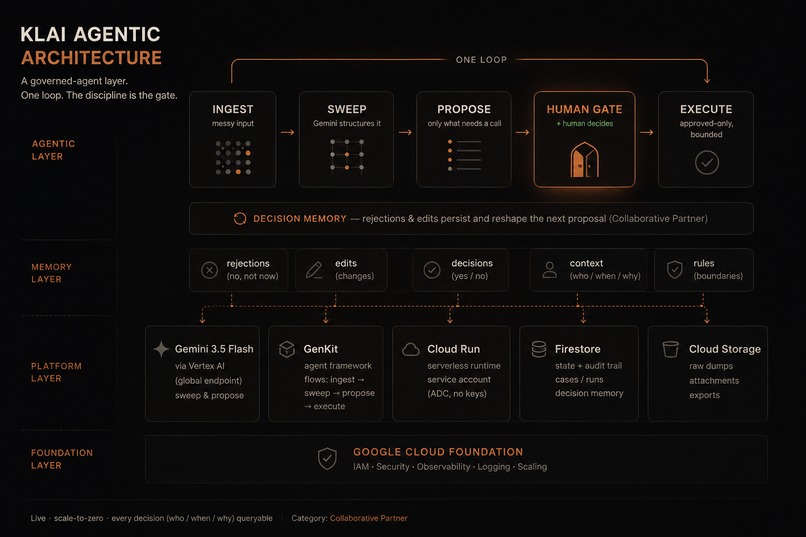
One governed loop: ingest → sweep → propose → [human gate] → execute. Rejections persist as decision memory. Live on Google Cloud.
Inspiration
A week before this hackathon, my own always-on agent made a decision for me. It read a thread, decided it was handled, and marked it CLOSED — while I still didn't know what the thing even was. Nobody approved it. It just decided.
The model wasn't wrong because it was dumb. It was wrong because nothing made it stop and ask. That was the gap I kept hitting — not intelligence, but discipline. KLAI Agentic makes that discipline structural: an agent that prepares everything, and refuses to close the loop without a human decision.
What it does
KLAI Agentic is a governed-agent layer for messy operational workflows. One loop:
ingest → sweep → propose → [ human gate ] → execute
It turns unstructured input into structured state, proposes only the things that actually need a decision, waits at a human gate, and executes only what you approve — bounded, logged, and tied to a person, a reason, and a time. Rejections and edits persist as decision memory and reshape the next proposal, so the collaboration is operational, not just conversational.
It isn't tied to one industry. The demo uses a marketing-campaign coordination thread as one concrete example, but the deployed app accepts messy operational input of many kinds — a meeting, an inbox, a project channel, a launch. Open the live URL and paste your own messy input; no local setup or personal API key required (it runs on our Cloud Run backend and service account).
How we built it
- Gemini 3.5 Flash via Vertex AI (global endpoint) — sweep & propose
- GenKit — agent framework; flows
ingest → sweep → propose → gate → execute - Cloud Run — serverless runtime on a scoped service account (ADC, no keys in the repo)
- Firestore — state + audit trail (
cases/runs) and decision memory - Cloud Storage — raw dumps
Challenges we ran into
- Gemini 3.5 wasn't on the regional endpoint. It 404'd on
us-central1and only answered on the Vertex global endpoint — so the LLM call runs global while Firestore and Cloud Run stay regional. - The older Vertex plugin rejected the global location, so we moved the integration to
@genkit-ai/google-genai. - Making "decision memory" real, not decorative. We wired rejections and edits into Firestore and fed them back into the next proposal — and proved live that a rejected action changes the agent's next behaviour: it stops proposing that move and surfaces it as blocked instead.
- Claim discipline. We banned words like "learns / autonomous / production-ready" until the demo actually showed them.
Accomplishments that we're proud of
- A full gated loop live on Google Cloud, end to end, on real messy input.
- Decision memory that visibly changes the next proposal — captured live from the deployed app, not staged.
- A no-setup hosted demo: judges just open the URL and paste their own input.
- We found a real operational failure and built the loop that fixes it — live on Google Cloud, fast.
What we learned
The hard part of an agentic system isn't the model's intelligence — it's the structure that makes it stop and let a human decide. The leverage was never the model; it's the discipline around it. Intelligence is everywhere. Discipline isn't.
What's next for KLAI Agentic
Run the same engine on more surfaces (a personal daily-digest skin, more input connectors), keep the human gate as the invariant, and grow decision memory into a durable operating record that future agents can plug into.
Built With
- express.js
- firestore
- gemini-3.5
- genkit
- google-cloud
- google-cloud-run
- javascript
- node.js
- vertex-ai

Log in or sign up for Devpost to join the conversation.