-
-
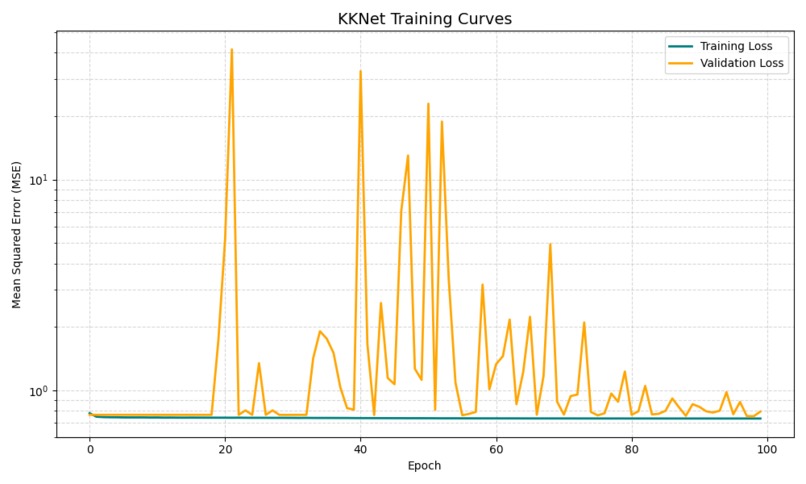
Training Curves
-
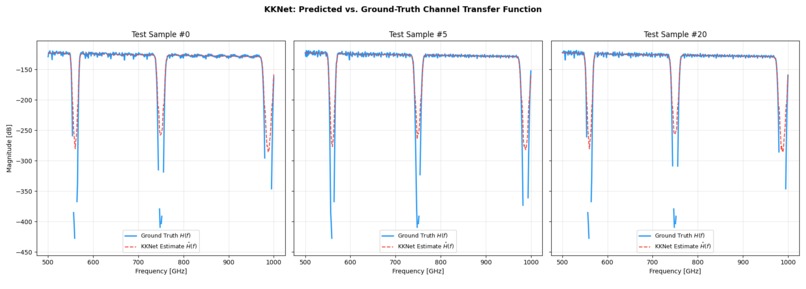
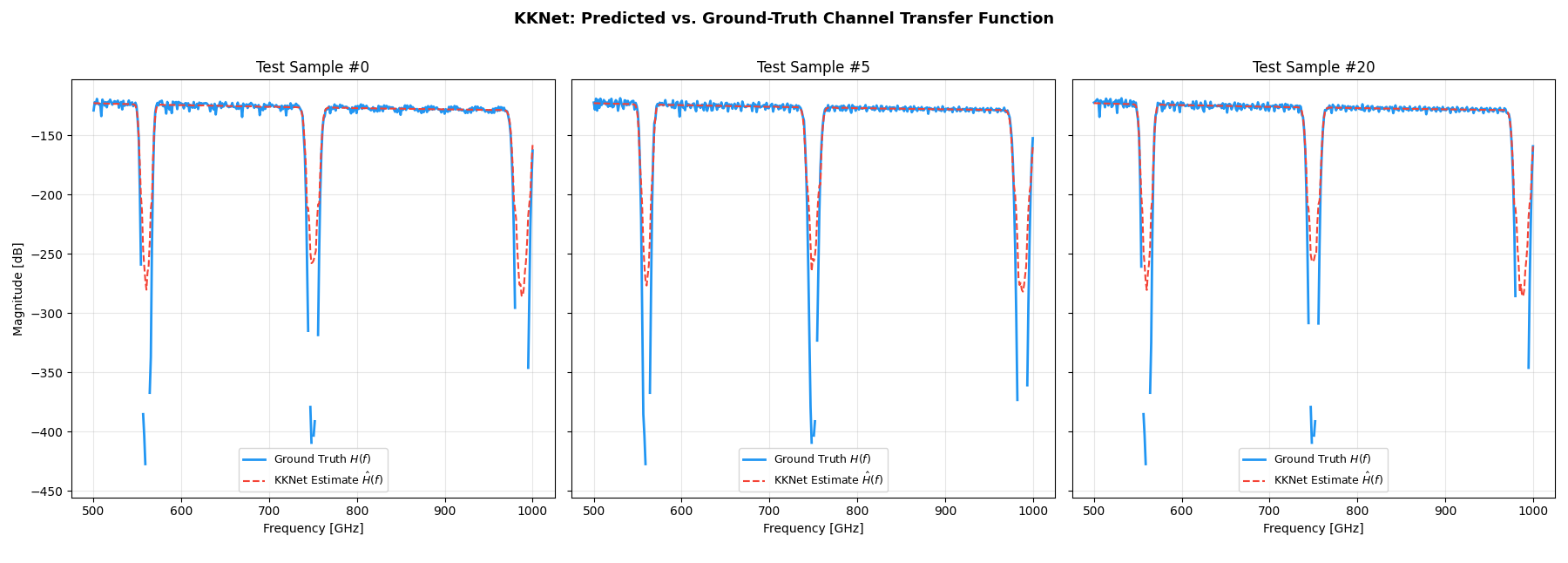
Predicted vs. Ground Truth (The 3 sub-plots)
-
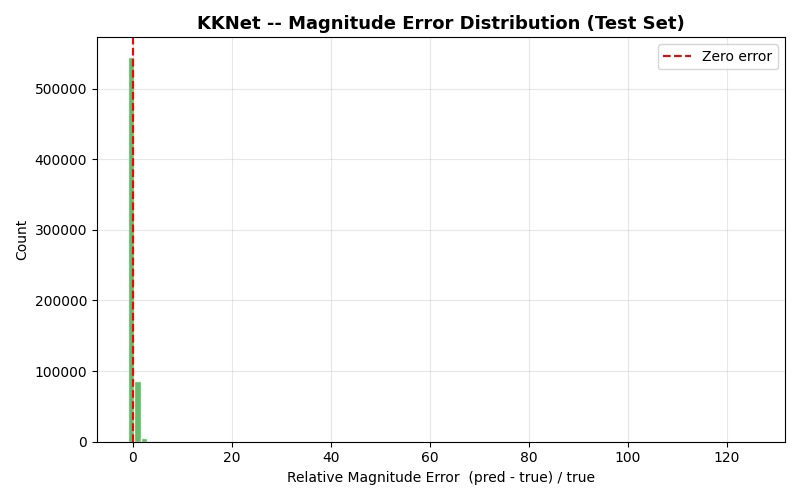
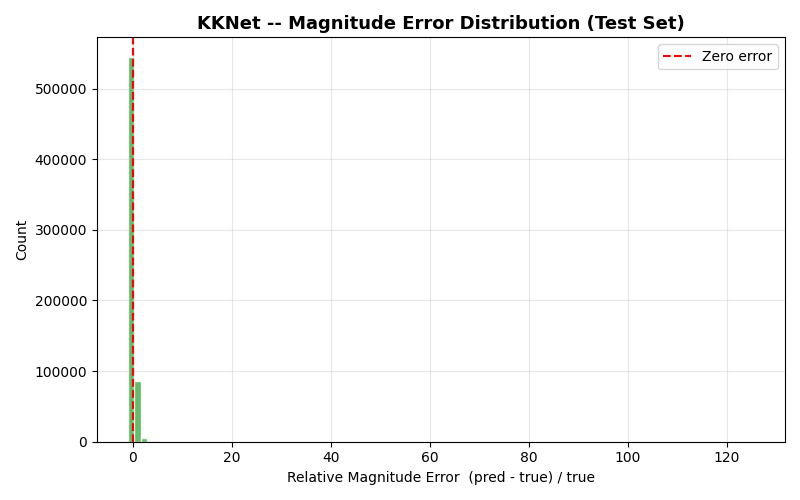
Error Distribution Histogram
Inspiration
As we transition from 5G to 6G, the Terahertz (THz) band \(0.1–10\ \mathrm{THz}\) is the final frontier for unlocking ultra-fast, terabit-per-second communication. However, THz waves are notoriously fragile. They suffer from:
- Extreme free-space path loss
- Heavy molecular absorption by water vapor in the atmosphere
- Severe scattering from rough surfaces
Traditional mathematical channel estimation techniques are simply too slow and computationally heavy to track these rapidly fluctuating channels.
We were inspired by the potential of Deep Learning to bypass these hardware limitations. We wanted to build an AI that could "see" through physical distortions and instantly predict channel characteristics, making real-time 6G a reality.
What it does
KKNet-6G: HyperChannel Intelligence
KKNet-6G is an interactive, AI-driven physics lab and inference engine for next-generation wireless networks.
Our project simulates the brutal physical conditions of the THz spectrum on the fly. Users can interactively adjust:
- Communication Distance
- Atmospheric Humidity
- Wall Roughness
As the physical environment changes, our pre-trained neural network instantly processes the raw received time-domain intensity pulse:
$$ I(t) $$
and successfully reconstructs the complex frequency-domain channel response:
$$ H(f) $$
"It achieves stunning accuracy in real-time, completely bypassing traditional, slow mathematical estimators."
How we built it
The project was built in three main phases:
1. The Physics Simulator
We built a deterministic simulator capable of generating realistic THz fading channels.
The simulator incorporates complex physics equations covering:
- Line-of-Sight attenuation
- NLoS multipath reflections
- Molecular absorption peaks
2. The Deep Learning Engine
We trained KKNet, a 1D Convolutional Neural Network (CNN).
The model learns to map:
- A noisy 1000-point intensity vector
- Into a high-fidelity 400-point frequency vector
3. The Interactive Dashboard
We used Streamlit to integrate the physics simulator and the PyTorch inference engine together.
We built:
- Dynamic Plotly visualizations
- Real-time spectrum graphs
- Effective CQI evaluation metrics
This allows users to visually inspect:
- Frequency notches
- Absorption peaks
- Multipath fading behavior
in real time.
Challenges we ran into
One of our biggest hurdles was evaluating the model's accuracy correctly.
In wireless communication, signal power drops exponentially with distance according to the Free Space Path Loss (FSPL) equation:
$$ \mathrm{FSPL} = \left( \frac{c}{4\pi d f} \right)^2 $$
Where:
\(c\)= speed of light\(d\)= communication distance\(f\)= carrier frequency
When testing the AI across different distances, we discovered that the raw prediction error was unfairly skewed by absolute amplitude loss — even when the AI perfectly reconstructed the shape of the channel.
To solve this, we implemented an Automatic Gain Control (AGC) normalization step, similar to real wireless receivers.
AGC Normalization
# AGC Normalization to correct scalar path loss

gain_factor = torch.sqrt(
    torch.sum(torch.abs(H_f_true)**2) /
    torch.sum(torch.abs(Y_pred)**2)
)

Y_pred = Y_pred * gain_factor
Built With
- 1d-convolutional-neural-networks-(1d-cnn)
- automatic-gain-control-(agc)-normalization
- batch-normalization
- deep-learning
- dropout-regularization
- frequency-domain-channel-estimation
- github
- line-of-sight-(los)-&-non-line-of-sight-(nlos)-propagation-modeling
- machine-learning
- matplotlib
- neural-network-inference
- numpy
- pandas
- plotly
- python
- pytorch
- residual-blocks-(resnet-architecture)
- rf-signal-processing
- scientific-computing
- scipy
- signal-to-noise-ratio-(snr)-modeling
- streamlit
- terahertz-(thz)-multipath-fading-simulation
- wireless-channel-modeling
- yaml
- z-score-standardization

Log in or sign up for Devpost to join the conversation.