Inspiration
Our project is based on the ideas outlined in Track 2: Local Community. We started by searching up the main issues that Seattle is currently facing. We wanted to address homelessness in the Seattle area and found that many individuals had little knowledge about finances, especially after job loss.
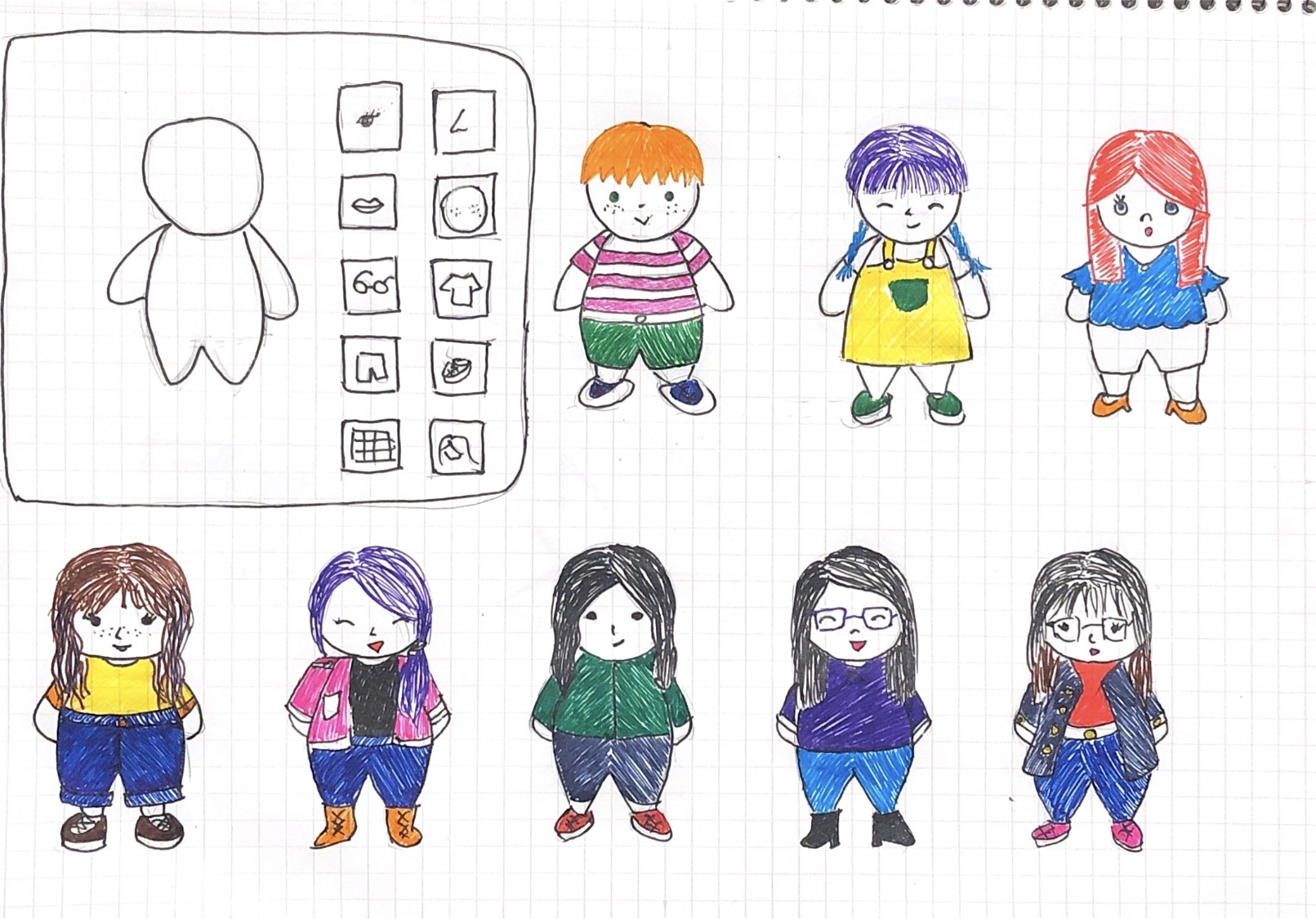
Our aim is to educate middle school students in financial literacy through a class with similar requirements to a public school health class. Half of the class period would be a lecture or presentation on a financial topic, such as budgeting or loans. The latter half of the class would be time spent using the educational game we designed that teaches skills through a life game with personalized avatars, tasks, and virtual banking accounts.
The goal of the game is to better equip students of all backgrounds to manage their money responsibly in the future. A positive effect on the local community would be a decrease in the homeless population of Seattle, which struggles with access to affordable housing and a large homeless population.
What it does
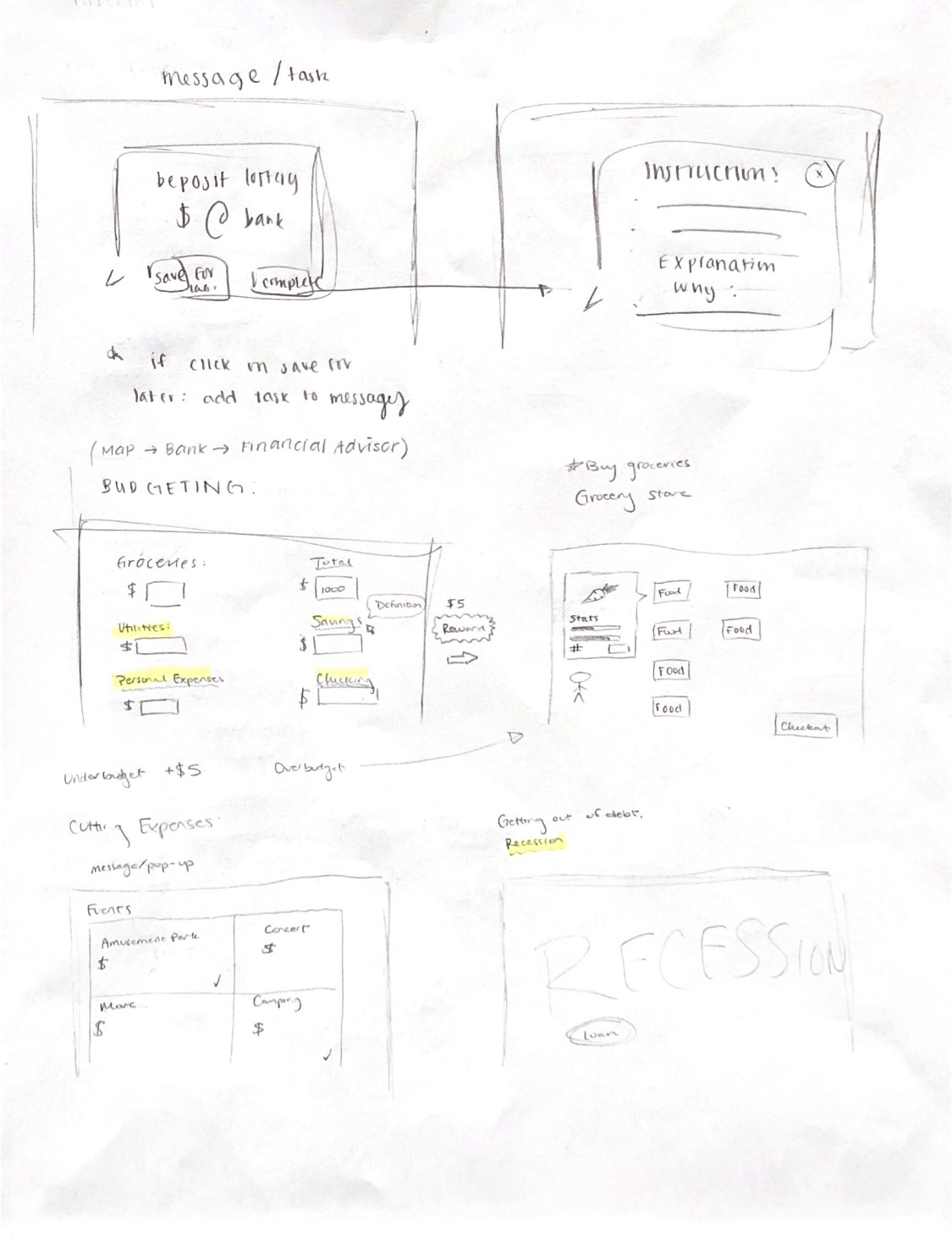
Our project is a web-based game that aids primarily middle schoolers on advancing their financial literacy. Our prototype game is a simplified stimulation of real life in which a student can choose and avatar, a job, and most importantly, how to manage their money. The product has four main levels: 1) budgeting, 2) cutting expenses, 3) getting out of debt, 4) and retirement. Students will advance to the next level by completing tasks, managing their money well, and completing end-of-level quizzes. Throughout each level, terms and their definitions will be displayed and students will be tested on them in the aforementioned quizzes.
How I built it
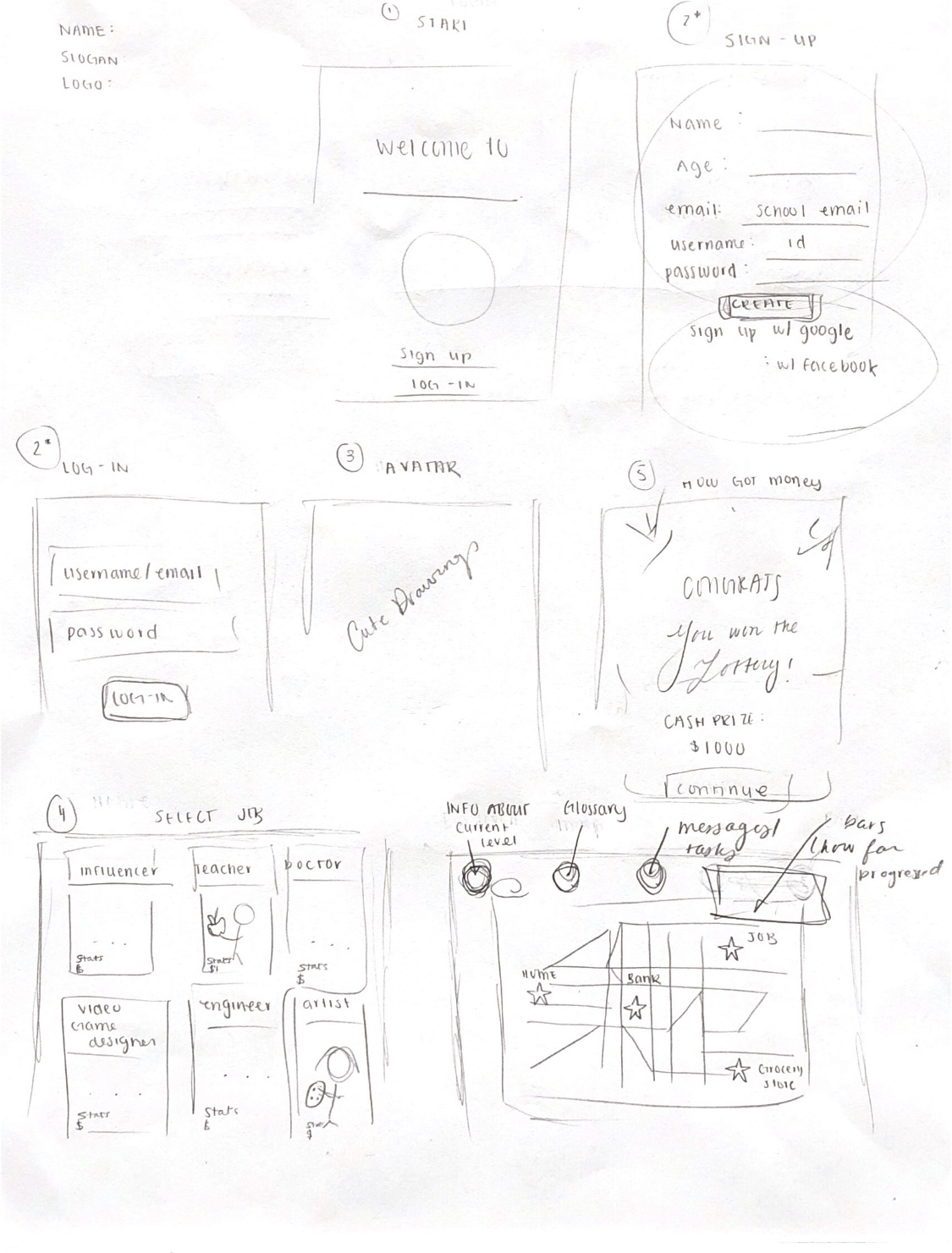
Our process of development started with ideation on a shared Google doc of various issues in Seattle and potential ideas that would alleviate these problems. After deciding on financial literacy and education for middle school students, we drafted an interaction flow of how the user would play the web-game on paper. Finally, we created a prototype of the game (Money Matters) using Figma, including drawn-up visuals and graphic interfaces.
Challenges I ran into
Initially, we struggled to pick a topic that was feasible to work through in roughly 7 hours. We originally wanted to address Track 1: Gender Equality in the Workforce. We found a lot of issues we were passionate about; however, we couldn’t feasibly create a fully thought-out product in our time constraint. Many of our ideas were too broad and too prone to personal bias.
It is the first hackathon for all of us, so we were surprised by how many ideas we had and how little time was available. We don’t have the coding experience necessary to implement a working product or even a rough draft. We could only produce a prototype, so we strove to design a high fidelity prototype with an in-depth consideration of a diverse user group.
Accomplishments that I'm proud of
We are proud of the work we accomplished in one day and the new skills we acquired. We had very limited experience with Figma and were excited to use the design skills and process learned in HCDE classes. We’re proud that we collaborated on a project we are passionate about. Not only did we create a game, we created a virtual environment that can give students a pathway into real life situations. Many of us still have little to no understanding in financial education even to this day, so we knew that education students at a younger age would eventually project to a greater impact later on in their lives.
What I learned
We learned to use Figma and through our research on issues in Seattle, we are all more aware of current social problems in the Seattle area. Not only did we learn about homelessness and education in Seattle, but we also learned about financial planning and the basic knowledge that would be useful for our audience.
What's next for Kkapa
We discussed future work, including expanding the scope of our game to educate high school students, collegiates, and general adults. People of all ages could benefit from versions of our game and learn about how to manage their finances. The high school version would include aspects of student loans, saving for college, working concurrently with classes, and part-time jobs. The college version would introduce living expenses, more student loans, insurance, and financial plans for after college. The adult version would incorporate an in-depth guide through retirement planning, options to plan for a family, and investments. Each version of the game would be tailored for that specific age group and their needs.
Built With
- figma

Log in or sign up for Devpost to join the conversation.