-
-
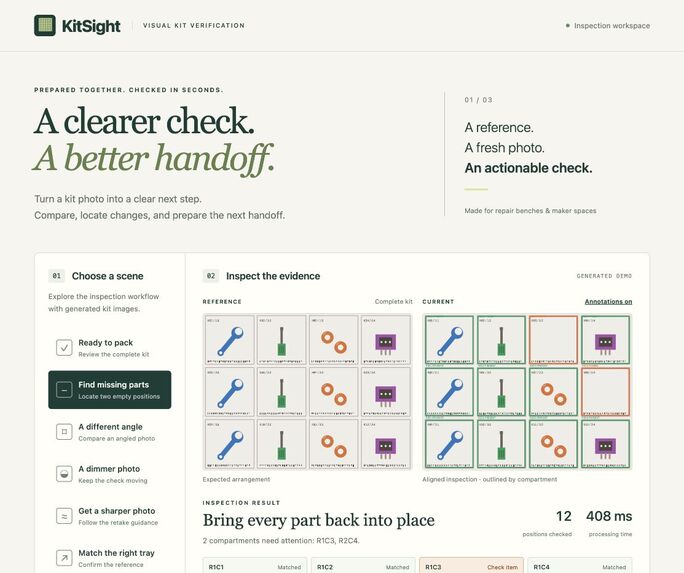
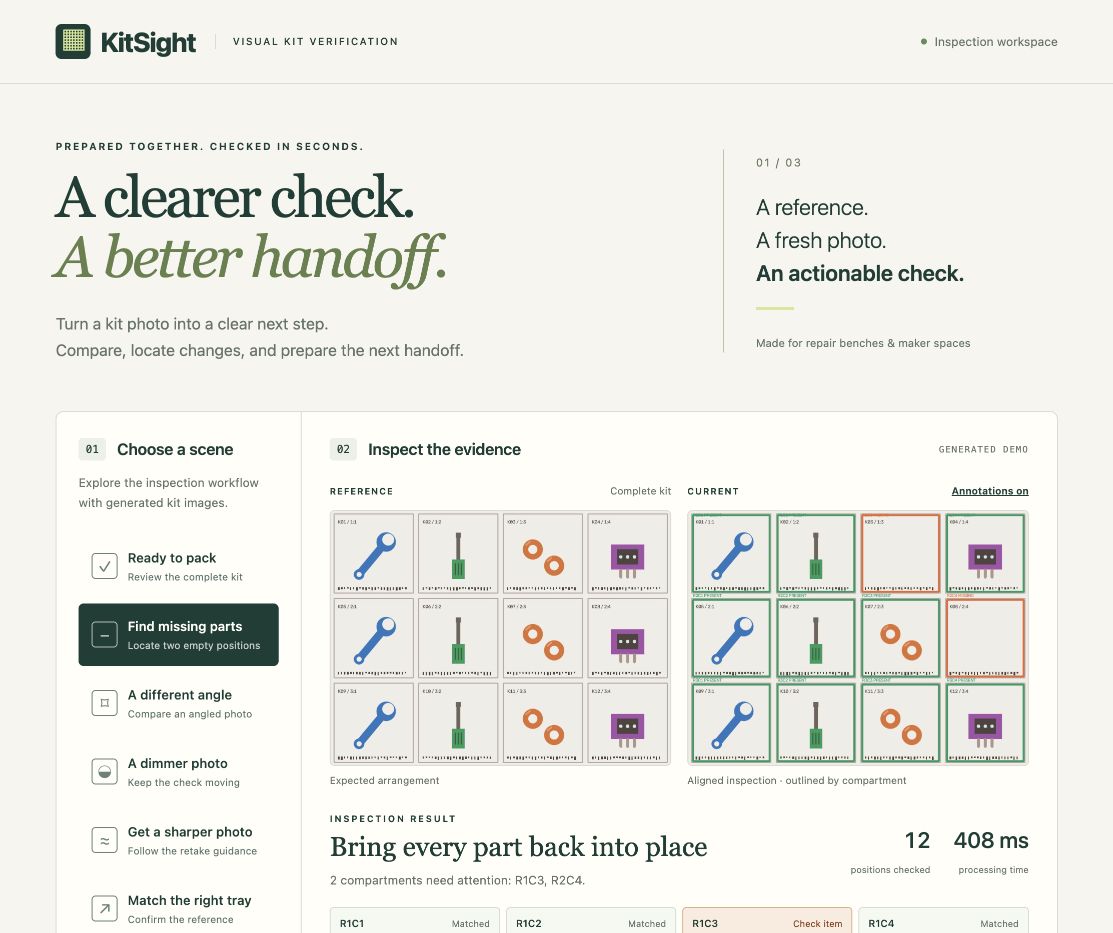
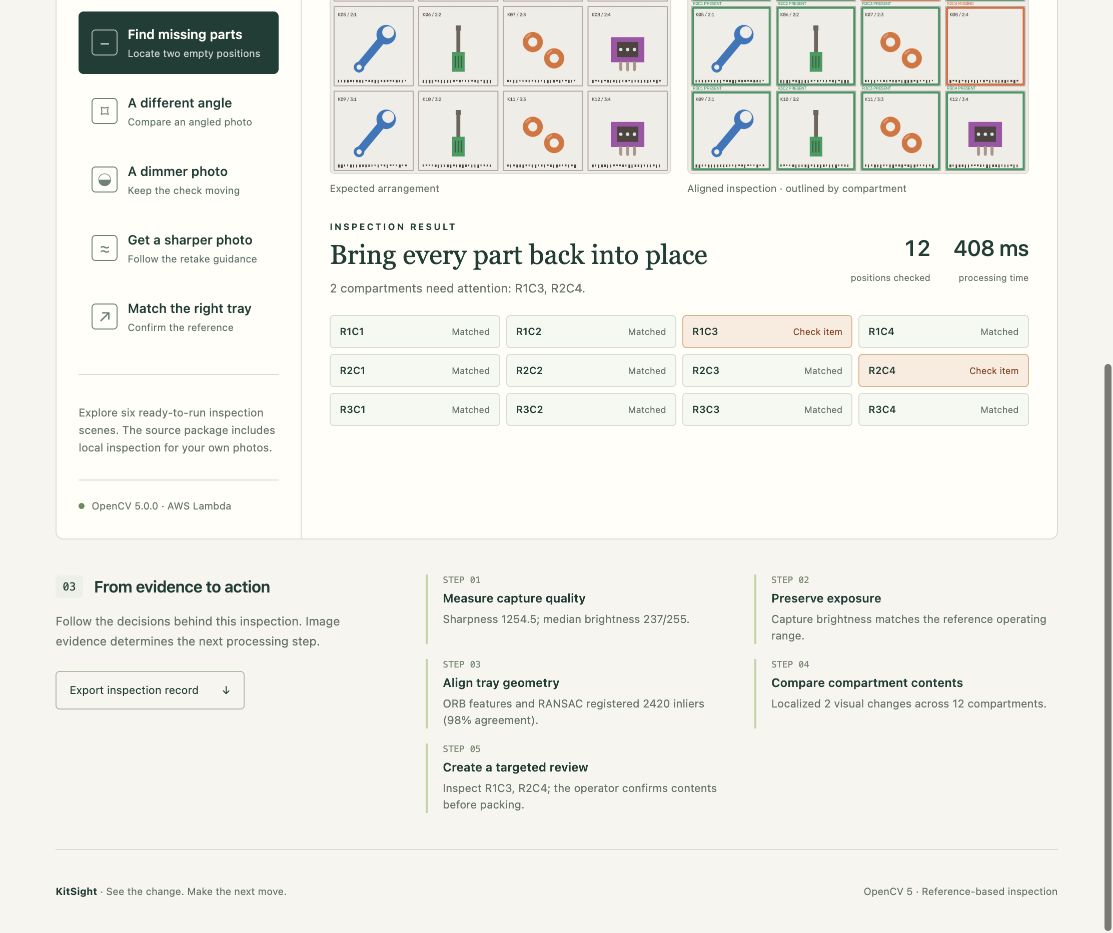
A live AWS inspection pinpoints two missing positions across a 12-compartment kit.
-
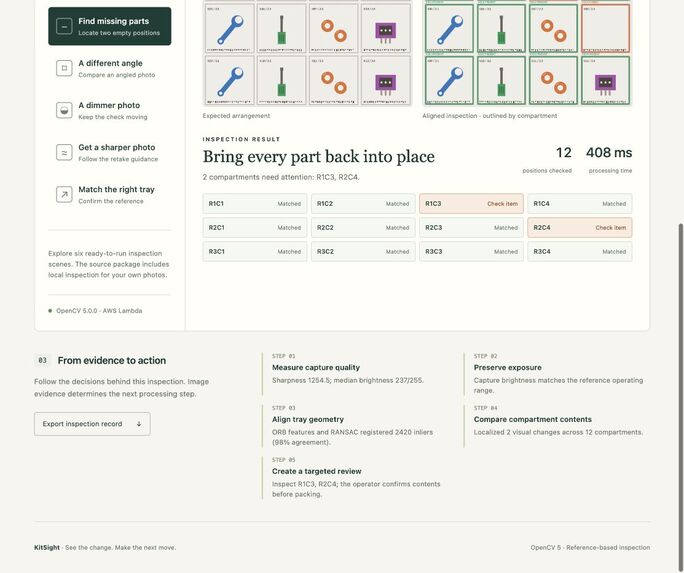
OpenCV 5.0.0 on AWS Lambda: each result includes a complete, reviewable decision trace.
-
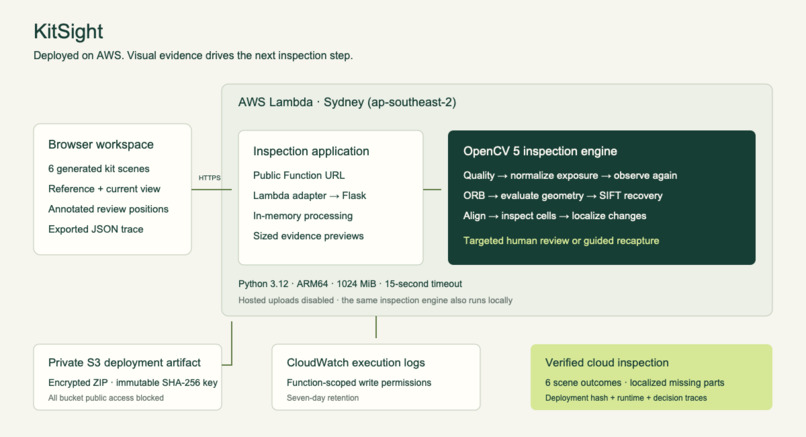
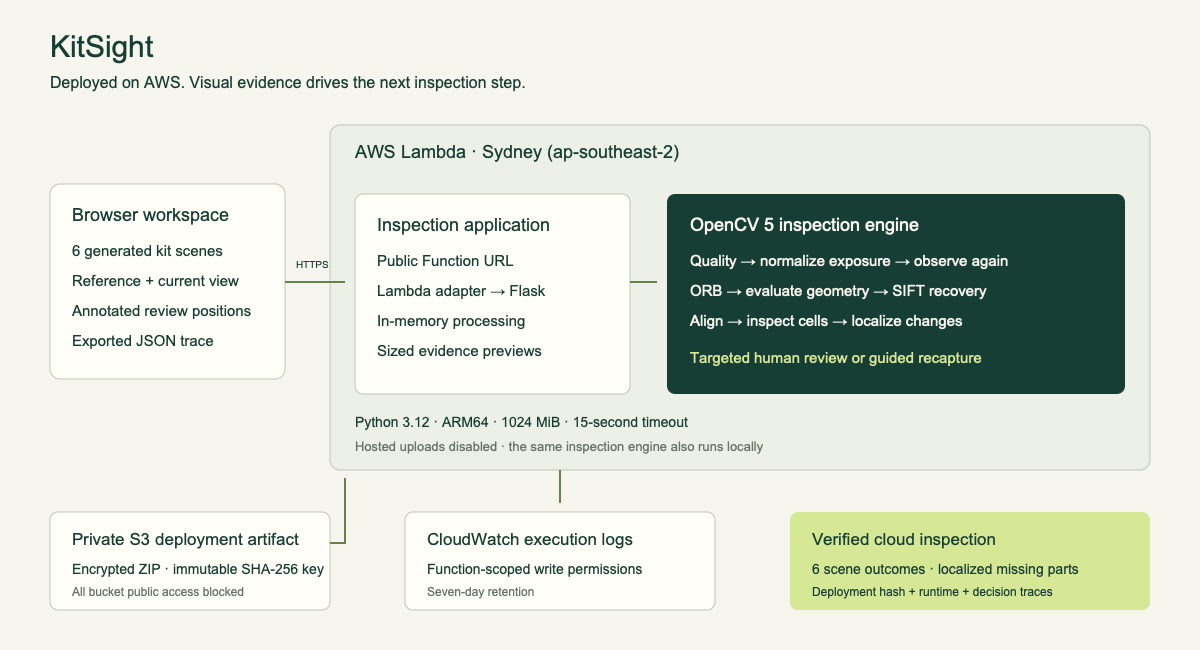
The deployed architecture connects the browser to an OpenCV 5 inspection workload on AWS Lambda ARM64.
-
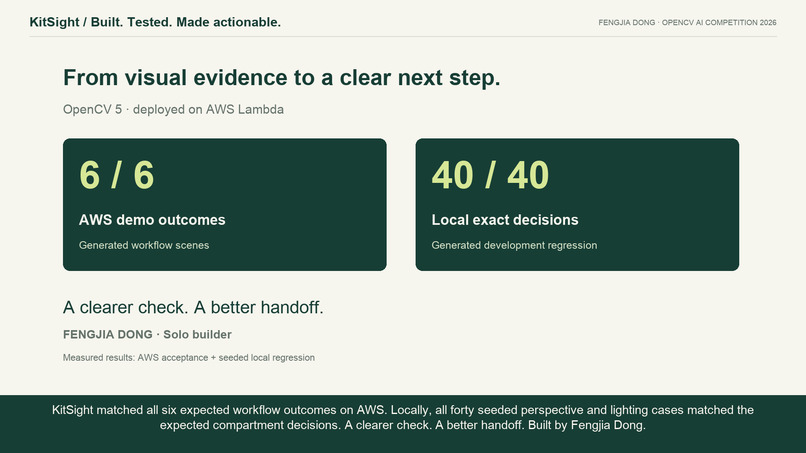
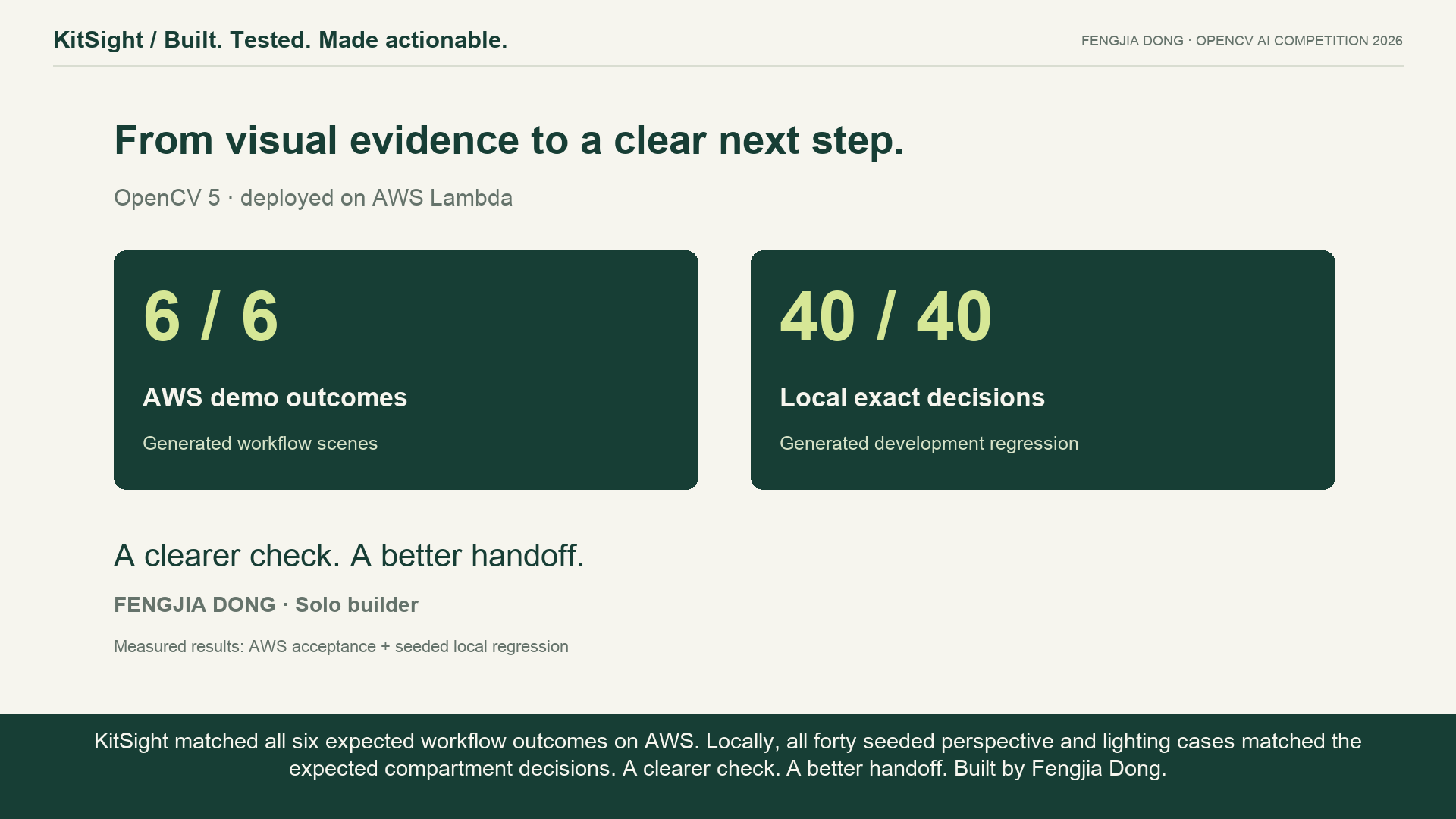
Verified outcomes: 6/6 generated AWS demo scenes and 40/40 seeded local development regression cases.
Inspiration
A shared repair kit should be ready for the next person. KitSight turns the reference photo into a practical handoff tool: compare the returned kit, highlight the compartments that deserve attention, and give the operator a clear next action. The goal is a focused, repeatable check for repair kits and makerspace supplies.
What it does
KitSight compares reference and return images of a compartment tray. The browser interface brings together both inputs, the marked result, compartment findings, and an actionable decision trace.
The public AWS demo offers six generated inspection scenes. The local application accepts your own image pairs.
It localizes visual changes, corrects exposure, aligns camera perspectives, and requests a new capture when image quality or geometry calls for one. In the missing-parts demonstration, it pinpoints the two deliberately altered compartments, R1C3 and R2C4, for a physical check.
How we built it
OpenCV 5.0.0 powers a reference-based comparison pipeline in Python. ORB registration provides the first alignment attempt; geometric evidence selects a SIFT fallback when needed. Exposure correction precedes alignment, while changed-area and compact-component analysis identify compartment differences. Flask and a JavaScript interface turn those observations into a visual review workflow.
The public demonstration executes the OpenCV 5.0.0 workload on AWS Lambda ARM64 with Python 3.12 in Sydney. All six online scenes returned their expected outcomes, and the deployed code fingerprint was verified against the packaged build.
Challenges
Three focused improvements strengthened the inspection. Compact-component analysis captured a small change that a whole-compartment average could dilute. Expanded comparison regions brought tested edge changes into view. Evidence-triggered exposure correction and ORB-to-SIFT registration handled the evaluated lighting and perspective variations. Independent review also led to bounded image previews and image-dimension checks before decompression.
Accomplishments
- Delivered a working browser inspection flow locally and on AWS, with visual overlays and a recorded perception-decision-action sequence.
- Matched 6/6 expected workflow outcomes locally and on AWS across generated complete, missing-part, perspective, dim-light, blurred, and unrelated-scene cases.
- Matched 40/40 expected localized decisions in a fixed-seed generated regression set combining perspective and illumination changes.
- Passed 28 local automated tests spanning vision processing, HTTP behavior, and the deployment adapter.
- Verified a focused review for a removed 16-pixel-diameter marker in a generated 1000 × 750 image.
The 40-case evaluation uses reproducible local development fixtures. The six named generated scenes were also exercised through the public AWS endpoint, with case definitions, outcomes, and cloud acceptance preserved in the project evidence.
What we learned
Useful visual inspection connects image evidence to a concrete next step. Capture quality, exposure, and geometric agreement each became a decision in the processing flow. Iterative review strengthened both the implementation and its explanation: show the changed region, record why processing took that path, and make the operator's next check clear.
What's next
Expand evaluation with photographed repair kits and additional tray layouts. Use the recorded traces to refine capture guidance, compartment setup, and the operator's review experience.


Log in or sign up for Devpost to join the conversation.