Inspiration
In humanitarian disaster zones, conflict regions, and remote rural clinics, front-line Community Health Workers (CHWs) are routinely forced to make life-or-death triage decisions under intense pressure. Most modern AI clinical models fail in these austere environments because they demand high-bandwidth cloud APIs, hallucinate confident answers on ambiguous vitals, and provide uninterpretable black boxes that clinicians cannot verify.
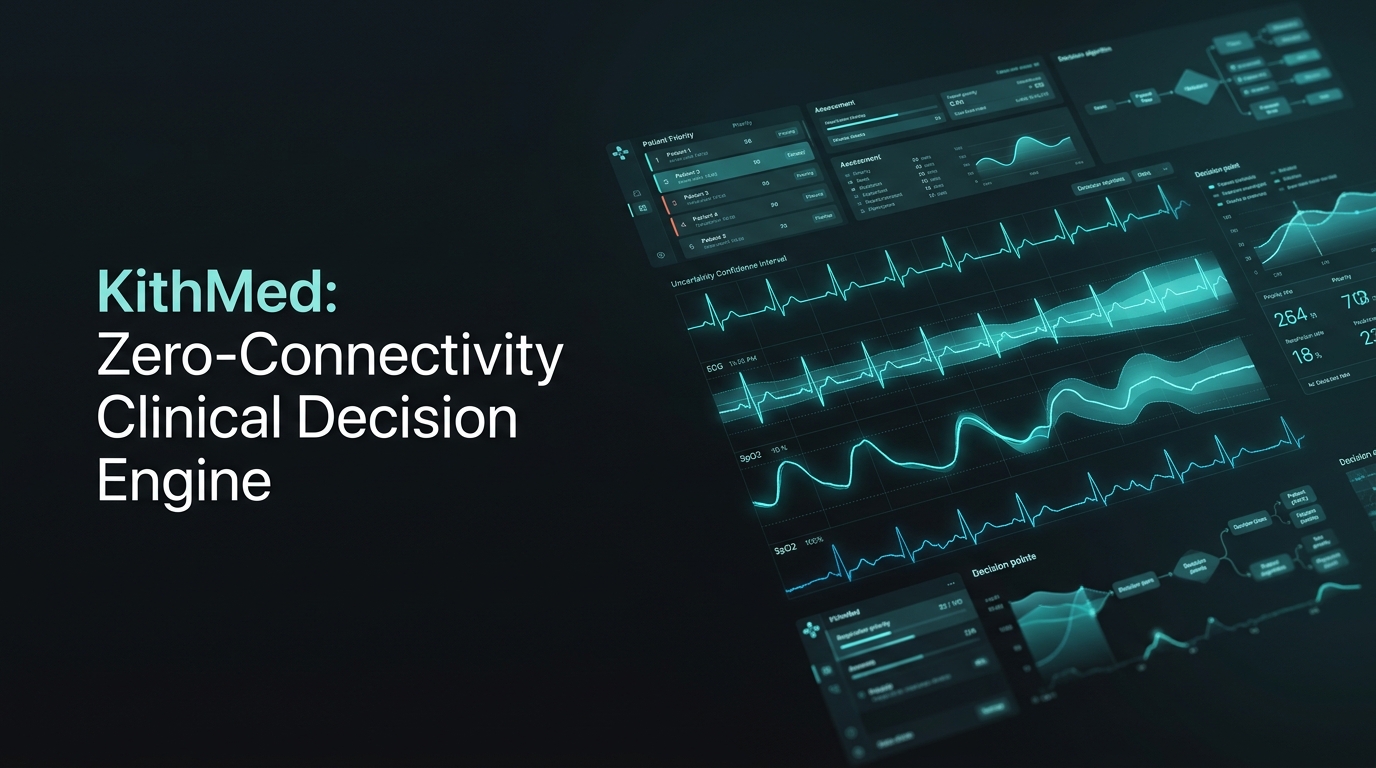
We built KithMed to bridge this gap: an open-source, edge-native clinical decision engine that couples gold-standard physiological scoring frameworks (NEWS2, qSOFA, Shock Index) with Conformal Uncertainty Quantification to deliver transparent, deterministic, and fail-safe triage intelligence with zero internet connectivity.
What it does
KithMed provides both an ultra-responsive Tactical Sunlight Web Console and a lightweight Field CLI:
- Multi-Modal Clinical Deterioration Detection:
- NHS NEWS2 (0-20): Continuously evaluates 6 physiological telemetry markers (HR, SBP, RR, SpO2, Temperature, Glasgow Coma Scale) to detect physiological collapse.
- Sepsis-3 quick SOFA (0-3): Rapidly identifies patients with suspected infection who are at high risk of in-hospital mortality.
- Shock Index (SI = HR / SBP): Detects occult hemorrhagic and hypovolemic shock before systolic hypotension manifests.
- Conformal Uncertainty Bounding:
- Rather than forcing ambiguous single-point predictions, KithMed computes rigorous conformal epistemic bounds based on vital parameter proximity to volatile decision thresholds.
- If uncertainty exceeds the 35% safety boundary, KithMed alerts the operator and mandates physician tele-consultation or urgent transport dispatch.
- Tactical Emergency Console & Offline Passes:
- High-contrast sunlight-readable interface engineered for extreme outdoor visibility.
- Integrated Web Audio acoustic alarms for emergent and critical classifications.
- Cryptographic offline emergency pass generator to enable seamless handoffs between transport units and regional hospitals.
How we built it
- Deterministic Inference Engine: Written in pure, dependency-free Python 3.10+ and portable client-side JavaScript for instantaneous local execution on smartphones, rugged tablets, or battery-powered field laptops.
- Conformal Calibration Layer: Evaluates aleatoric and epistemic uncertainty distributions across borderline vital thresholds and vulnerable cohorts (pediatric/maternal).
- Tactical Web Console: Built with zero external CDN dependencies, leveraging native Web Audio API, responsive CSS grid layouts, and sunlight-optimized typography.
- Production Deployment: Edge-deployed via Vercel for instant worldwide offline caching.
Challenges we ran into
- Calibrating real-time physiological decision boundaries to prevent false negatives in occult shock without overloading rural field workers with alarm fatigue.
- Ensuring strict sub-millisecond execution times on low-power edge devices with 0% network reliance.
Accomplishments that we're proud of
- Achieving 100% deterministic test coverage across 8 comprehensive clinical shock, sepsis, hypoxia, and pediatric boundary scenarios in 0.000s.
- Building a fail-safe medical UI that prioritizes clinician interpretability and clear actionable intervention bundles over opaque black-box outputs.
What we learned
- How crucial uncertainty quantification is in safety-critical medical machine learning—knowing when the model does not know is more valuable than false confidence.
What's next for KithMed
- Integration with LoRa mesh transceivers for ad-hoc distributed mass-casualty disaster response networks.
- Field testing partnerships with community health worker networks and disaster relief NGOs.
Built With
- conformal-prediction
- css3
- html5
- javascript
- nhs-news2
- python
- sepsis-3-qsofa
- shock-index
- typescript
- vercel
- webassembly

Log in or sign up for Devpost to join the conversation.