-
-
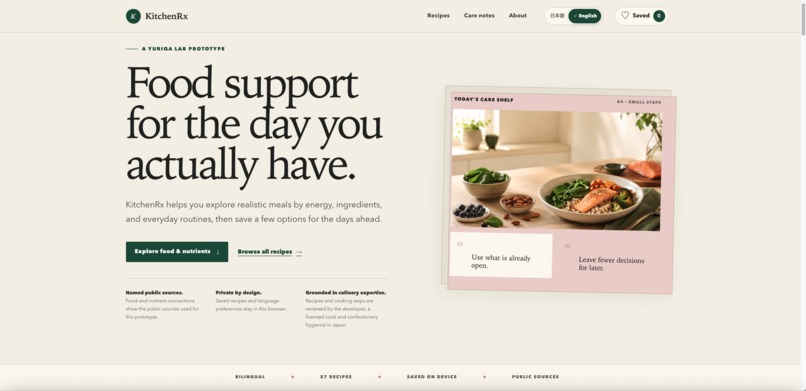
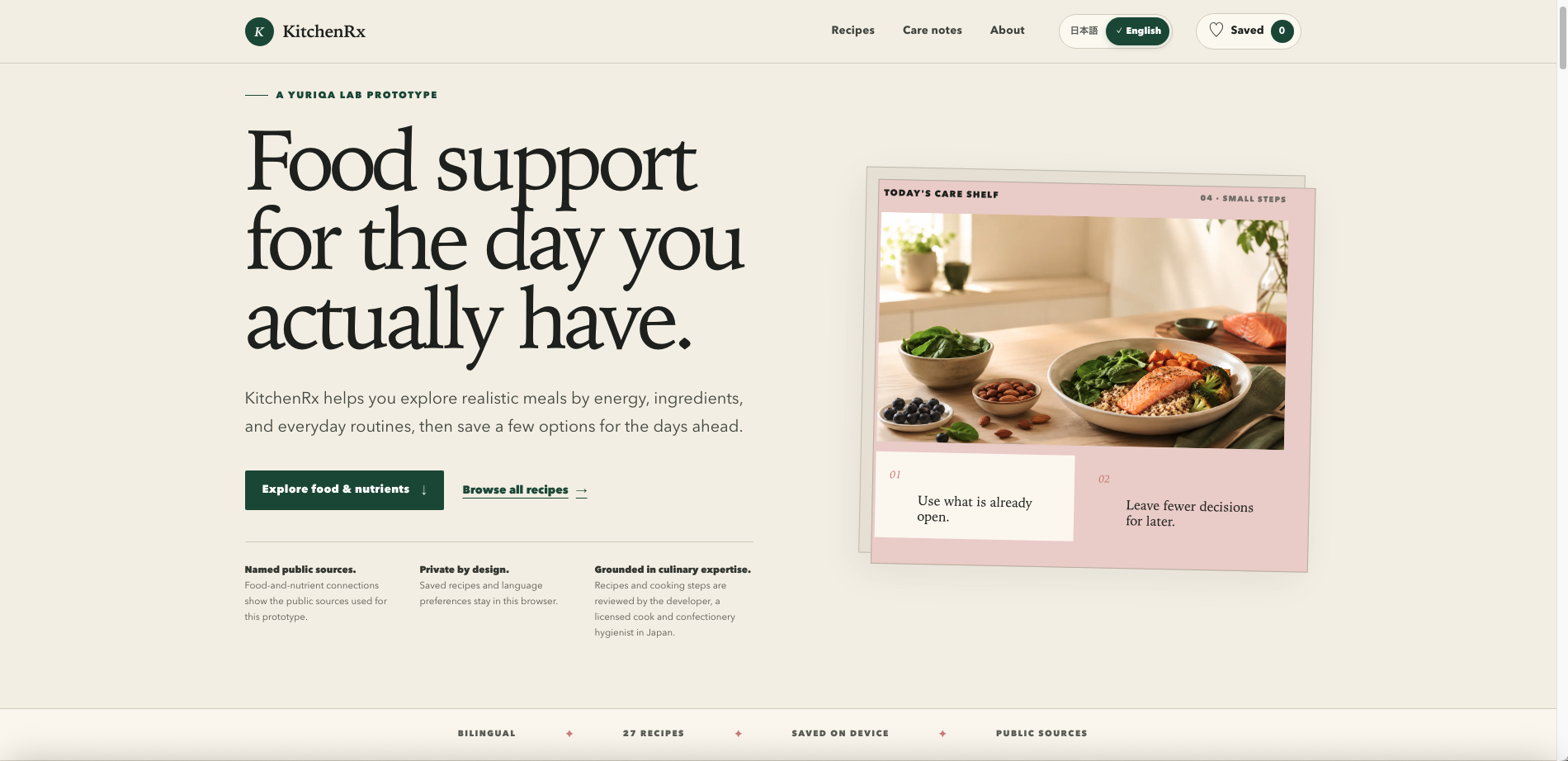
KitchenRx’s bilingual home page introduces practical meal support grounded in everyday energy, ingredients, and routines.
-
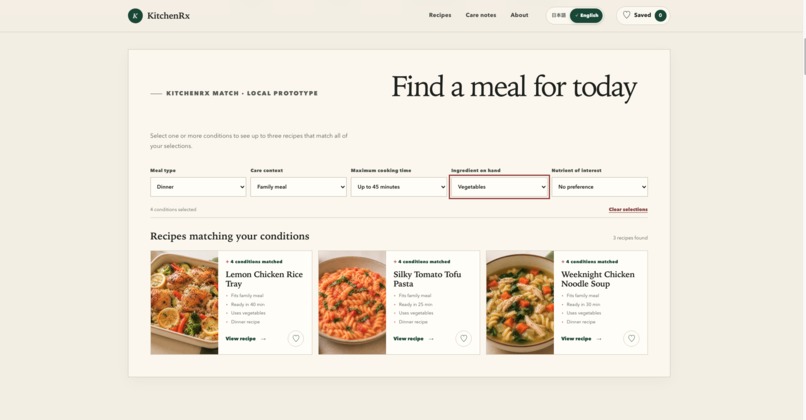
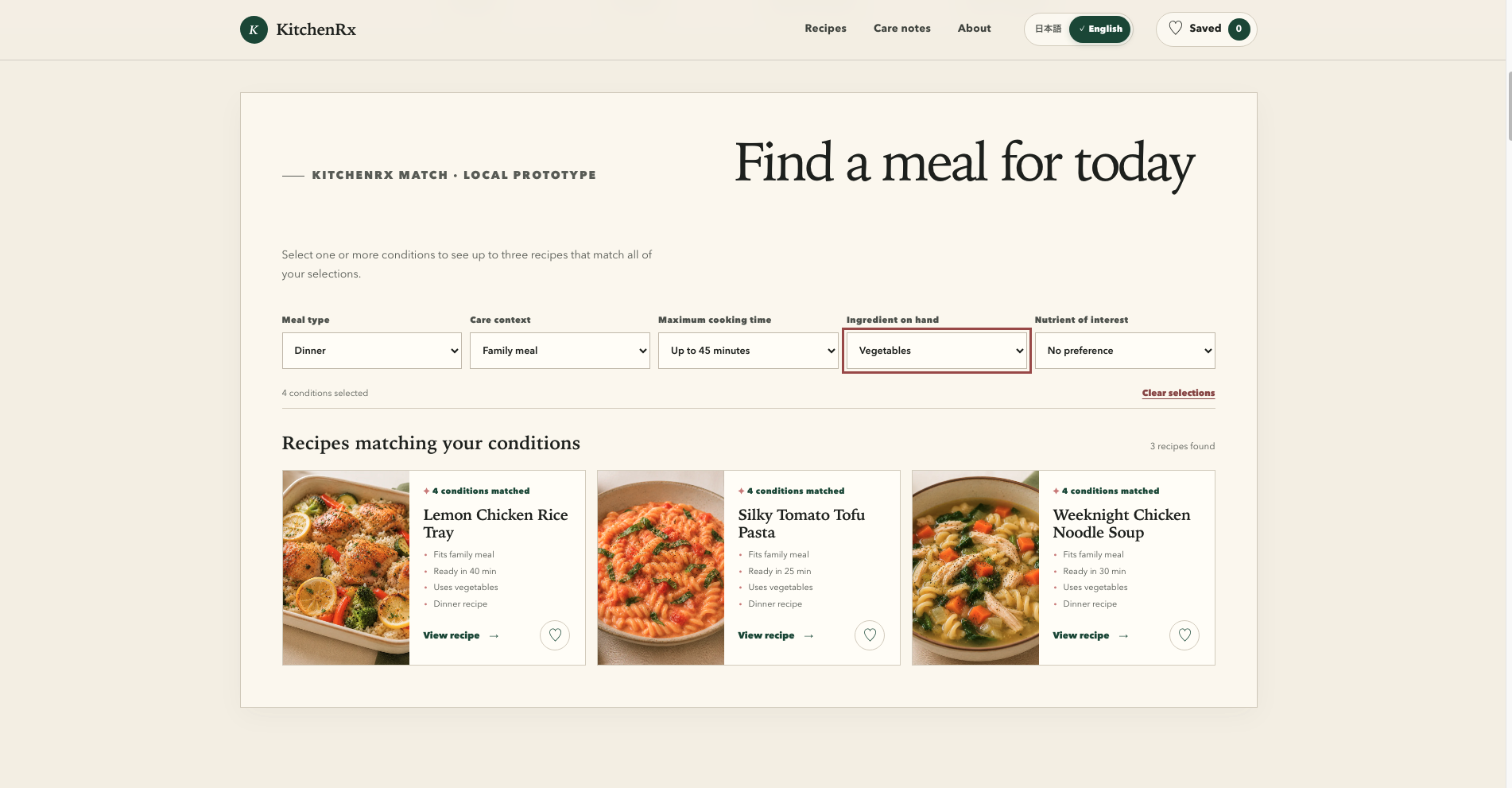
KitchenRx Match combines every selected condition with AND logic and returns only recipes that satisfy all of them.
-
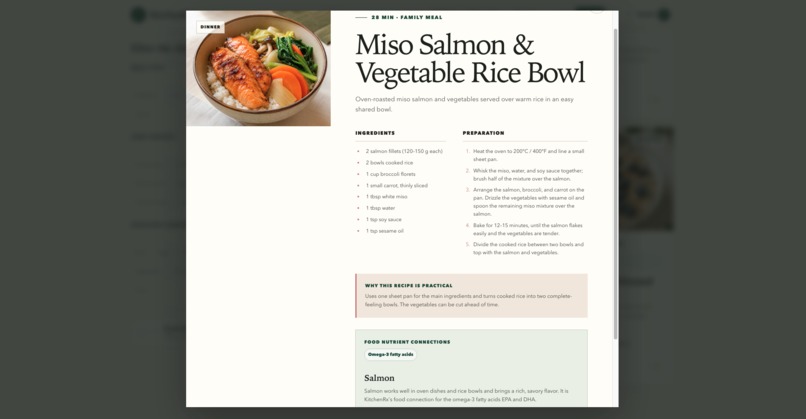
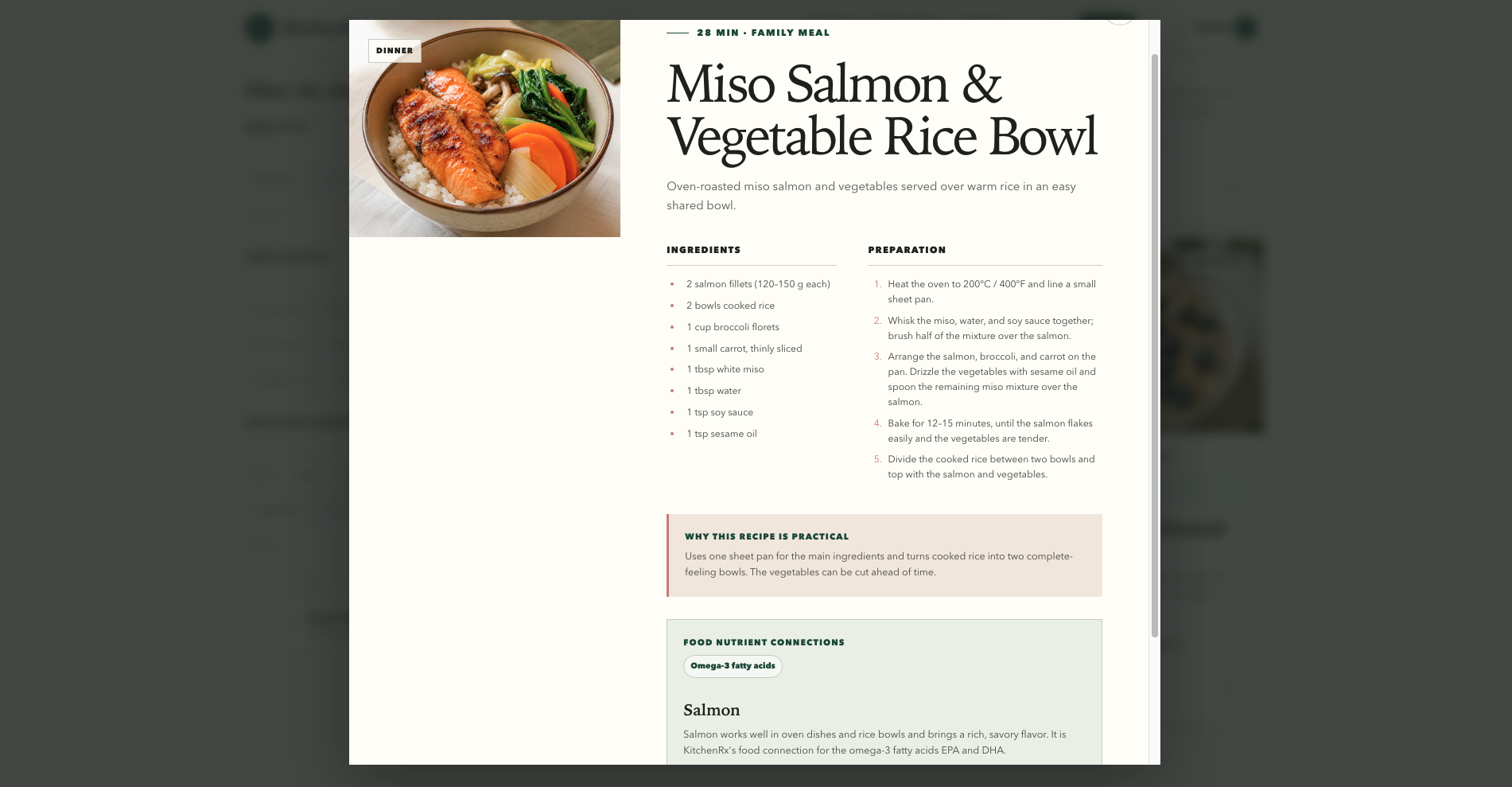
A bilingual recipe detail page connects practical cooking instructions with clearly framed food-and-nutrient context.
Inspiration
KitchenRx began with my mother.
She has age-related macular degeneration (AMD), and I wanted to make everyday meal decisions more manageable for her. There is a great deal of information about nutrients discussed in relation to eye health, but knowing the names of nutrients is not the same as knowing what to cook for breakfast, lunch, or dinner.
That gap became the starting point for KitchenRx.
With professional experience in culinary arts, pastry, food coordination, and hospitality, as well as cook and confectionery-hygienist qualifications in Japan, I understand how to turn ingredients into meals that people can realistically prepare and enjoy.
I created KitchenRx to connect carefully framed food-and-nutrient information with practical home cooking.
What it does
KitchenRx is a bilingual Japanese-and-English meal-support web application that helps people find realistic recipes based on their current situation.
Its main feature, KitchenRx Match, allows users to select:
- meal type
- care context
- maximum cooking time
- an ingredient already on hand
- a nutrient of interest
Every selected condition is required. KitchenRx combines the selections using AND logic and returns up to three recipes that meet all of them.
It does not add unrelated recipes when fewer than three exact matches exist. When there is no exact match, it presents an honest zero-result state instead.
Each result explains why it matched using factual information derived from the selected conditions and the recipe data.
KitchenRx also includes:
- 27 bilingual recipes
- detailed ingredients and cooking instructions
- food-and-nutrient context
- named public information sources
- Japanese and English interface switching
- browser-based recipe saving
- a plain-text meal-list feature
- responsive desktop and mobile layouts
The application highlights food sources of lutein, zeaxanthin, vitamin E, and omega-3 fatty acids. It helps users move from abstract nutrient information toward approachable everyday meals.
KitchenRx is not a diagnostic or treatment tool. It provides food and meal-planning information and is not a substitute for professional medical or dietary advice.
How we built it
I built KitchenRx through iterative collaboration with Codex and GPT-5.6.
The application uses:
- React 19
- TypeScript
- a Next-compatible App Router through Vinext and Vite
- plain CSS
- Cloudflare Workers
- local recipe and nutrition data
- browser localStorage
- Node.js testing tools
Codex helped translate my product decisions into a working application. It supported implementation of the typed bilingual data model, deterministic matching logic, responsive interface, accessibility improvements, automated tests, documentation, and deployment preparation.
GPT-5.6 supported the reasoning and review process through Codex. It contributed to product and data-model decisions, matching-logic review, Japanese and English wording, food-information claim safety, interface critique, test planning, and final review.
My role was to define the problem, establish the culinary and product logic, review the experience on desktop and mobile, set the evidence and safety boundaries, and make the final decisions.
One important decision was that every selected Match condition must be satisfied. I chose not to fill empty result spaces with recipes that failed the user's conditions.
Codex and GPT-5.6 were development tools, not runtime features. The published application does not call a generative AI API. KitchenRx Match runs deterministically over recipe data stored within the project.
Challenges we ran into
One of the biggest challenges was translating food-and-nutrient evidence into language that is useful without overstating what food can do.
Nutrition information is often presented as isolated nutrient names, supplement formulas, or broad lists of foods. A person still has to decide which ingredients work together, how to cook them, and whether the resulting meal is realistic for everyday life.
Another challenge was balancing several needs at once:
- responsible food-and-nutrient wording
- practical home cooking
- transparent matching logic
- clear Japanese and English content
- an approachable interface
- accessibility and responsive design
- user privacy
- development within a short Build Week timeline
The bilingual experience also required more than translating individual words. Recipe titles, ingredient explanations, cooking instructions, interface labels, and matching reasons all needed to remain natural and understandable in both languages.
Because this project was inspired by a real member of my family, accuracy and usability were not optional. The experience needed to remain practical while clearly presenting KitchenRx as food support rather than medical treatment.
Accomplishments that we're proud of
I am proud that KitchenRx became a complete, deployed bilingual prototype rather than remaining only a concept.
The final Build Week version includes 27 Japanese-and-English recipes, transparent deterministic matching, detailed recipe pages, public-source links, saved recipes, meal-list copying, and responsive desktop and mobile interfaces.
I am especially proud of the decision to keep KitchenRx Match honest. Every selected condition is combined using AND logic, and the app never pads its results with unrelated recipes simply to make the page appear fuller.
I am also proud that the application provides a useful experience without collecting personal or health data. It has no user accounts, database, analytics, tracking, or generative AI API at runtime.
The project was successfully built, tested, documented, deployed to Cloudflare Workers, and made publicly available during the Build Week timeline.
What we learned
Building KitchenRx taught me how domain expertise and AI-assisted development can strengthen each other.
Codex helped me turn product decisions into working software much faster than I could have done alone. At the same time, the project showed me that AI-generated implementation and wording still require careful human judgment, especially when food, nutrition, care, and health-related contexts overlap.
I also learned that explainability does not require a generative model at runtime.
For KitchenRx Match, deterministic logic was the more appropriate product choice. It makes the relationship between a user's selections and the resulting recipes transparent, repeatable, testable, and honest.
I learned that bilingual product development is also a design problem. Both languages need to provide the same information and functionality while still sounding natural to the people using them.
Most importantly, I learned that a useful care-oriented product can begin with a simple daily question:
“What can I cook today?”
By answering that question thoughtfully, KitchenRx can make food-and-nutrient information more actionable for individuals and families.
What's next for KitchenRx
My next goals for KitchenRx are:
- expanding the bilingual recipe collection
- adding more flexible ingredient matching
- providing ingredient substitutions
- improving meal-plan organization and printable lists
- conducting formal accessibility and usability testing
- adding languages beyond Japanese and English
- exploring optional offline-first support
- expanding reviewed public-source coverage
- improving support for users with reduced vision
KitchenRx began as a way to help my mother, but the underlying problem is much broader. Many people receive food-related guidance and then struggle to translate it into meals they can confidently prepare.
I want KitchenRx to help close that gap—one practical recipe at a time.
Built With
- accessibility
- bilingual
- cloudflare
- codex
- css
- gpt-5.6
- localstorage
- meal
- next.js
- node.js
- nutrition
- openai
- react
- typescript
- vinext
- vite
- workers


Log in or sign up for Devpost to join the conversation.