-
-
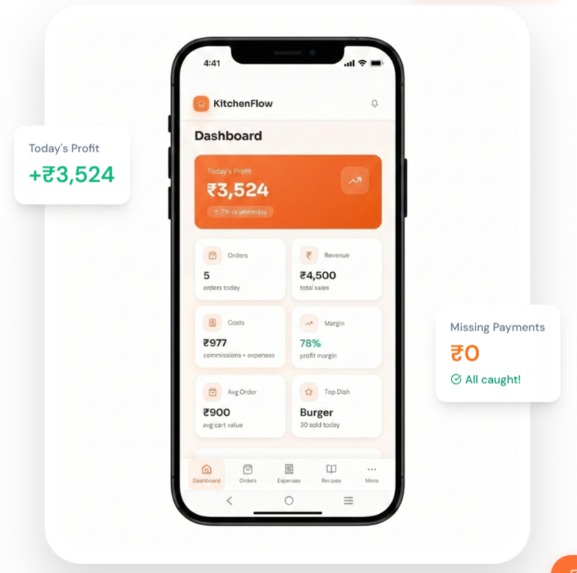
kitchen flow India's First AI-Powered Cloud Kitchen OS
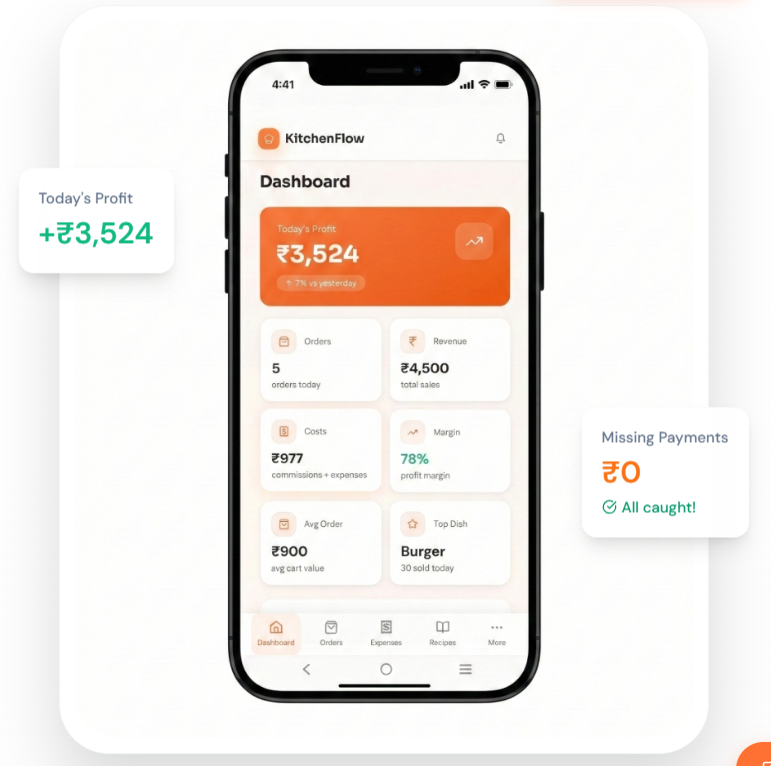
KitchenFlow was inspired by a problem I repeatedly observed in the Indian food and beverage industry: small cloud kitchen owners work long hours but often do not know whether they are actually making a profit.
Most existing restaurant management and POS products are designed for larger restaurants. They can be expensive, complicated, and overloaded with features that small operators do not need. Meanwhile, cloud kitchen founders still depend on spreadsheets, notebooks, platform dashboards, and manual calculations to understand their businesses.
A typical owner must account for ingredients, packaging, gas, discounts, taxes, commissions, refunds, and platform deductions. Even after completing all of this work, they may still discover that a Zomato or Swiggy payout does not match their order records.
I wanted to create a simple and affordable operating system designed specifically for these price-sensitive micro-businesses.
I had no previous programming background, so KitchenFlow also became a personal experiment: could one person use AI-assisted development tools to identify a real market problem, design a complete SaaS product, and deploy a functional application?
Six months later, KitchenFlow became a live B2B SaaS web application.
KitchenFlow is an AI-powered Cloud Kitchen Operating System that helps Indian cloud kitchen owners track every rupee, identify financial discrepancies, and make better business decisions.
Instead of switching between notebooks, spreadsheets, bank statements, and multiple delivery-platform dashboards, owners can manage their core operational and financial data from one place.
Its key capabilities include:
Real-time profit tracking: Calculates revenue, expenses, margins, and daily profit so owners can understand whether the business is truly profitable. AI Business Assistant: Allows users to ask questions such as: “What was my profit this week?” “Which platform gives me better margins?” “Am I losing money on Swiggy?” “Which dishes should I promote?” Automated daily summaries: Provides a daily overview of orders, revenue, profit, margins, top-performing dishes, and useful business insights. CSV payout reconciliation: Compares delivery-platform order records with expected and received payouts to detect missing payments, incorrect commissions, and unexplained deductions. Dispute tracking: Helps owners record and follow payment discrepancies from identification through resolution. Recipe costing: Calculates the actual cost and profit margin of each menu item. Inventory management: Tracks stock levels and helps predict when important ingredients may run out. Menu analytics: Identifies profitable, popular, and loss-making dishes. Order and expense management: Creates a central record of daily business activity. GST calculator and shopping lists: Simplifies recurring administrative and operational work. Founder community: Gives cloud kitchen operators a space to exchange vendor recommendations, operational advice, polls, and practical knowledge.
KitchenFlow is designed to convert fragmented operational data into clear actions. Rather than simply showing numbers, it helps an owner understand what those numbers mean.
For example, the system may reveal that direct orders generate a 52% margin while marketplace orders generate only 34%, or that a popular ₹180 dish is actually losing ₹12 per order after ingredients and commission.
I built KitchenFlow over six months using AI-assisted development tools despite starting with no coding background.
The process began with market and workflow analysis. I broke the daily operations of a cloud kitchen into individual problems, including order tracking, recipe costing, expense management, payout verification, inventory planning, and profitability analysis.
I then converted these problems into small product modules rather than attempting to build the entire platform at once.
The development process followed an iterative workflow:
Identify a specific operational problem. Map the user journey and required data. Create the interface and business rules. Use AI-assisted tools to generate and understand implementation code. Test the feature with realistic cloud kitchen scenarios. Fix calculation, usability, and data-flow issues. Integrate the module into the wider KitchenFlow system. Deploy and test the application in a live environment.
The application was designed around a four-tier product architecture:
Entry tier: Essential features at the lowest possible price for small operators. Growth tier: Advanced analytics, integrations, and usage-based capabilities. Full OS tier: A complete operational system with staff and business-management tools. Vertical tier: A specialized version for customer segments with unique workflows.
The user experience was heavily influenced by my understanding of cashier and operator workflows. Every screen was designed to minimize unnecessary steps, reduce cognitive load, and make important information immediately understandable.
The AI assistant was designed as a business-analysis layer over the user’s own operational data. Its role is not simply to generate generic advice, but to answer practical questions using the kitchen’s orders, costs, margins, inventory, and platform performance.
The payout-reconciliation workflow was built to support both manual entry and CSV-based audits. The system compares expected payouts with actual received amounts and highlights the difference:
[ \text{Discrepancy} = \text{Expected Payout} - \text{Received Payout} ]
Dish-level profitability is calculated using the major costs associated with each order:
(\text{Ingredient Cost} + \text{Packaging Cost} + \text{Platform Commission} + \text{Other Variable Costs}) ]
This allows KitchenFlow to expose losses that are often hidden behind high sales numbers.
Building without a programming background
The biggest challenge was learning how a production web application works while simultaneously building one.
AI tools could generate code, but generating code was only part of the process. I still had to understand how features connected, how data moved through the application, why errors occurred, and whether the generated solution was reliable.
I learned to divide large problems into smaller components, provide better context to AI tools, inspect outputs carefully, and test every workflow rather than assuming generated code was correct.
Translating messy business operations into software
Cloud kitchen operations are not always clean or standardized. Owners may record expenses differently, receive payouts on different schedules, or use different commission structures across platforms.
The accomplishment I am most proud of is turning an industry problem into a deployed, functional B2B SaaS application within six months, despite beginning with no programming experience.
KitchenFlow is not only a landing-page concept. It includes working product flows for financial tracking, AI-assisted analysis, reconciliation, inventory, menu performance, and operational management.
Other accomplishments include:
Identifying an underserved market overlooked by many established POS and restaurant-software providers. Designing a product specifically for small and price-sensitive Indian cloud kitchen operators. Building an AI assistant that translates business data into understandable, actionable answers. Creating a CSV reconciliation workflow that can reduce hours of manual payout checking to a much faster audit process. Combining financial, operational, inventory, menu, and community features into one platform. Designing a scalable four-tier business model for different stages and types of operators. Deploying the application in a live environment and developing the complete product through AI-assisted learning. Proving that AI can help a non-programmer move from problem discovery to product design and real software execution.
Most importantly, KitchenFlow focuses on measurable outcomes: protecting margins, detecting missing money, reducing manual work, preventing stockouts, and helping owners understand whether they are building a profitable business.
The most important lesson was that AI-assisted development does not remove the need for problem-solving. It changes where the effort is spent.
Instead of memorizing every syntax rule before beginning, I was able to focus on understanding the problem, defining workflows, evaluating generated solutions, testing edge cases, and improving the product through iteration.
I learned that effective AI-assisted development requires:
Clear and detailed prompts. Breaking complex features into smaller tasks. Understanding the purpose of generated code. Testing calculations with realistic examples. Providing the AI with sufficient business context. Maintaining consistency across independently generated components. Treating AI output as a starting point rather than an unquestionable answer.
I also learned that product simplicity is difficult to achieve. Adding features is easy; deciding which information matters to the user at a particular moment is much harder.
From the business side, I learned that small cloud kitchen owners do not necessarily need more dashboards. They need answers.
They need to know:
How much profit they made today. Which platform is costing them the most. Whether a payout is missing. Which dish is reducing their margin. What inventory they need before the next rush. What action they should take next.
This insight shaped KitchenFlow into an operating and decision-support system rather than only a record-keeping tool.
Finally, I learned that a lack of traditional technical experience does not have to prevent someone from creating software. With strong domain understanding, persistence, structured experimentation, and responsible use of AI, it is possible to turn an idea into a working product.
The next stage is to validate KitchenFlow with more cloud kitchen founders and improve the product using their real operational feedback.
Planned developments include:
Direct integrations with food-delivery and payment platforms. Multi-location management for growing cloud kitchen brands. Advanced profitability and cohort analytics. Improved payout-discrepancy classification. Automated dispute documentation and evidence generation. Smarter demand and inventory forecasting. Team accounts with role-based access. Staff and operations-management tools. Custom alerts for unusual expenses, falling margins, and delayed payouts. More personalized AI recommendations based on each kitchen’s historical performance. Additional regional and multilingual support for Indian operators. Specialized product versions for related food-business segments.
The long-term vision is to make KitchenFlow the financial and operational intelligence layer for small food businesses.
A cloud kitchen owner should not need an accounting background, a data analyst, or several disconnected software products to understand their business.
KitchenFlow aims to give every operator a simple answer to the most important question:
“Am I actually making money, and what should I do next?”
Built With
- antigravity
- lovebel


Log in or sign up for Devpost to join the conversation.