PantryPilot: The Full Story Inspiration The idea for PantryPilot came from a few different places, mostly born out of the daily headache of just trying to eat. We talked to friends and classmates and realized we were all dealing with the same loop of kitchen failures:
The "Science Experiment" Fridge: "I constantly forget what’s in there. I’ll buy a head of lettuce, it gets buried, and two weeks later I’m throwing out a bag of slime. It’s a total waste of money and feels terrible."
Grocery Store Amnesia: "I’m standing in the dairy aisle trying to remember if I have eggs. I usually guess wrong—either I buy a second carton I don't need, or I get home and realize I can't make dinner because I'm missing that one ingredient."
The Recipe Wall: "I’ll find a great recipe online, but I'm always missing a few items and I just give up. I don't know enough about cooking to swap things out, so I end up ordering takeout when I have a kitchen full of food I don't know how to use."
The Student Budget Crunch: "Inflation is hitting hard. I live near several grocery stores but I have no idea which one to go to for which items to save me money. I need my dollar to go further, but I don't have time to shop-hop for every single item."
Information Overload: "I have recipes saved everywhere—Instagram, bookmarks, physical notes. I just want one place to catalog everything that actually works with what I have at home."
What it does PantryPilot is a "second brain" for your kitchen that manages the logistics so you can just focus on cooking.
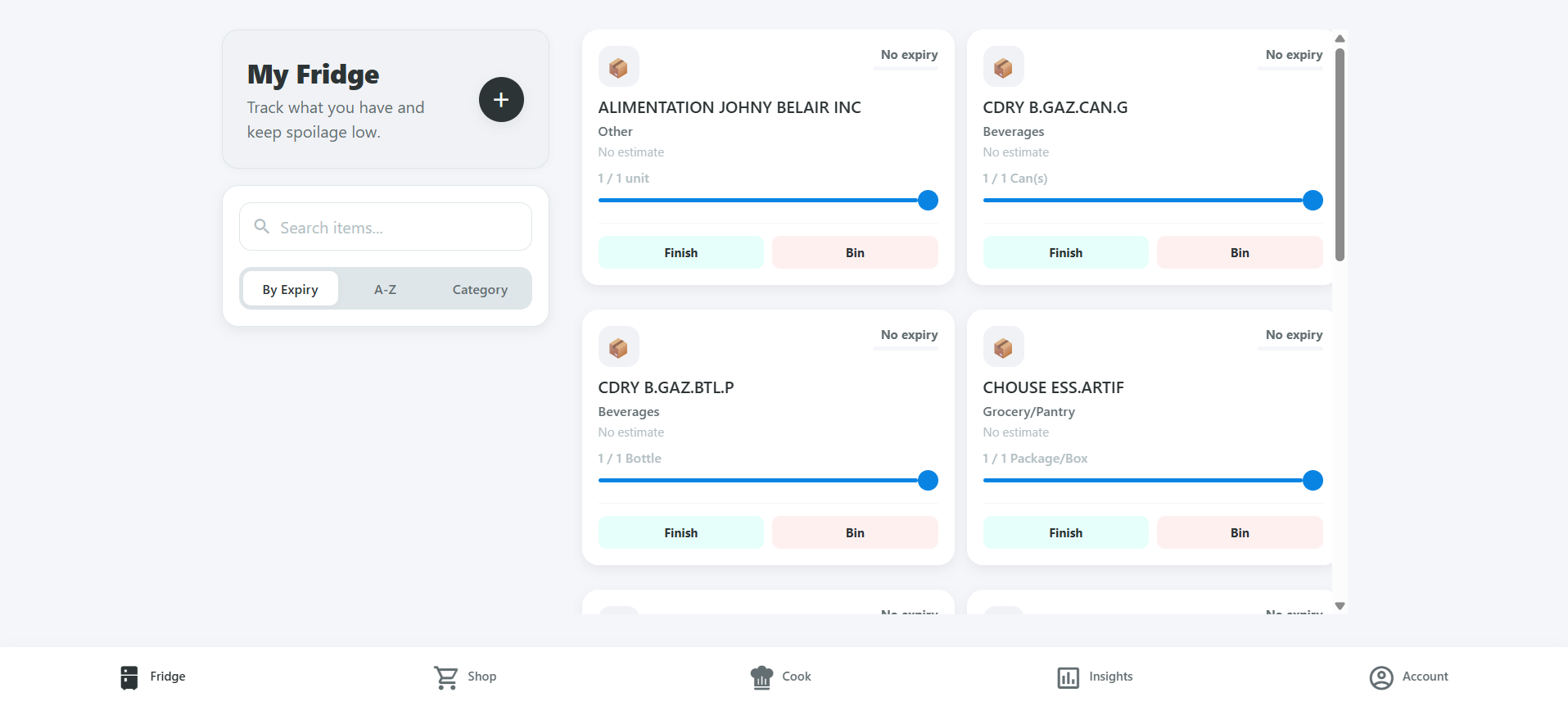
Visual Inventory: A clean, color-coded dashboard that tracks what’s in your fridge, how much is left, and exactly how many days you have before it spoils.
Instant Logging: No manual typing. Snap a photo of your receipt, and our pipeline identifies the items, the store, and the prices to populate your inventory instantly.
The AI Chef: Our "Cook with Gemini" feature scans your current fridge—prioritizing items about to expire—and builds a custom recipe so you never have to ask "what's for dinner?" again.
Household Sync: Whether you live with roommates or family, the pantry and shopping lists sync in real-time. If someone buys milk, everyone knows.
Price Comparison: Tracks where you’re getting the best deals across different local stores so you can shop smarter, not harder.
How we built it We went with a modern, scalable stack to keep the experience snappy across all devices.
Frontend: Built with React Native and Expo. We used react-native-reanimated for smooth UI and expo-router for a seamless, file-based navigation experience.
Backend: A Node.js and Express server handles the heavy lifting, from household logic to user data synchronization.
Database: We used MongoDB to store our flexible item catalogs and user preferences.
AI Pipeline: We built a Python-based vision pipeline using Gumloop for OCR and data extraction from receipts.
Recipe Generation: We integrated the Gemini API to act as the "brain," generating recipes that are strictly grounded in the user's real-time inventory.
Challenges we ran into The biggest hurdle was definitely the "real world" data. Receipts are incredibly messy—stores use cryptic abbreviations like "ORG BK CLV" for organic garlic. We had to build custom logic to sanitize these names and map them to actual database items.
We also hit some major roadblocks with GitHub merge conflicts. Having multiple people working on the same files led to a massive loss of time and progress that we had to grind through to get back on track.
Accomplishments that we're proud of We’re stoked that we actually closed the loop. It’s one thing to have a list app; it’s another to have a system that knows you bought spinach on Tuesday, warns you it's wilting on Friday, and gives you an AI-generated recipe to use it up before Saturday.
What we learned We learned that the best tech is the tech that gets out of the way. If a user has to manually type in every single item, they won't use the app. That’s why we prioritized the Gumloop OCR and "Quick Add" features to reduce friction as much as humanly possible. We also learned that MongoDB is great for this, though we ended up treating it more like a relational DB to keep our household logic tight.
What's next for PantryPilot The next step is making it even more automated. We're looking at barcode scanning for items without receipts and adding a "Waste Analytics" dashboard to show users exactly how much money they're saving each month by cutting down on food waste.


Log in or sign up for Devpost to join the conversation.