-
-
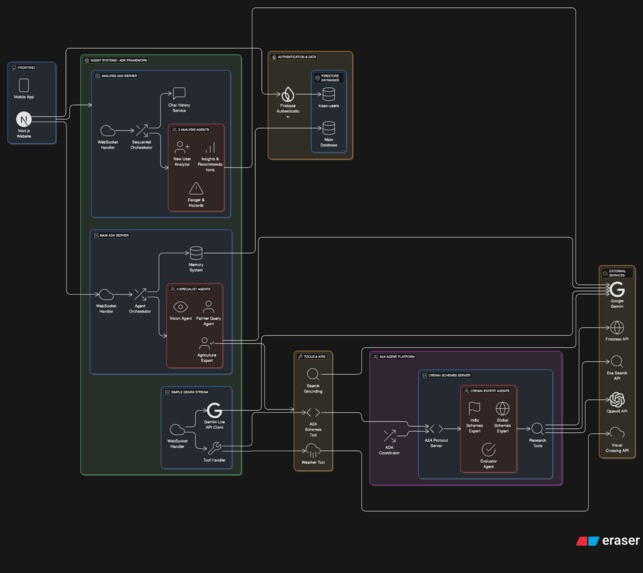
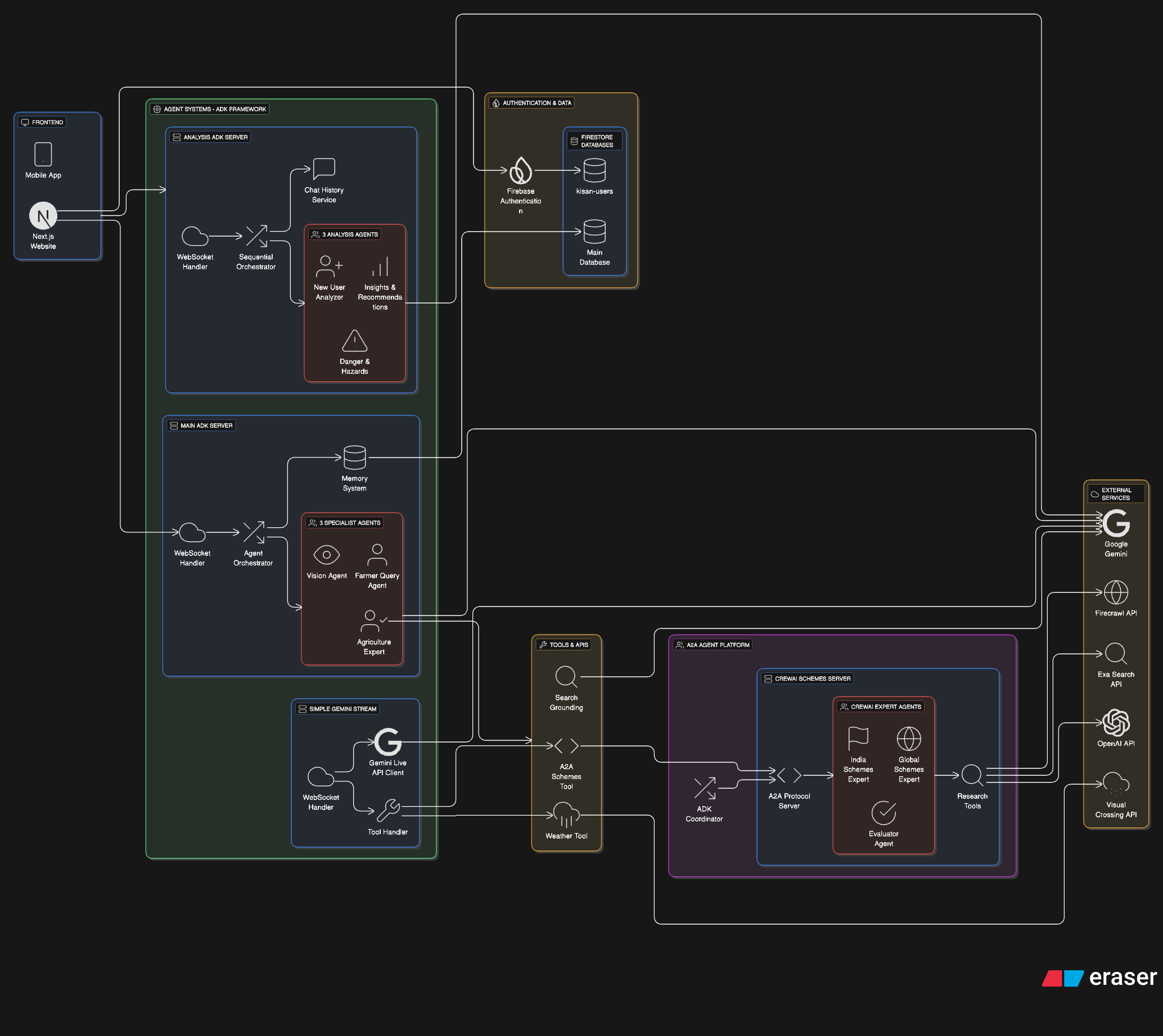
full System Architecture of Kisan
The Idea :
People in rural areas rarely get to experience the benefits of AI in a way that truly impacts their lives. Most AI tools today are built for urban users, focusing on convenience or productivity, but for those in villages, this technology often feels distant or irrelevant. We wanted to change that by building something relatable and genuinely useful for rural communities. And since agriculture is the main livelihood for most people in these areas, that’s where our idea began. To create an AI system that actually helps farmers in their everyday decisions.
That’s how we built Kisan, an AI-powered agricultural assistant designed to bring the power of advanced AI directly to farmers. Kisan helps them:
- Access reliable information
- Government benefits and schemas
- Personalized farming insights through a simple, conversational interface.
The system combines multiple intelligent agents that work together seamlessly. It can answer questions, analyze images of crops for diseases, give real-time weather updates, and most importantly, find and explain relevant government and international agriculture schemes that a farmer can benefit from.
Solution
Kisan is built as four connected subsystems that work together to provide comprehensive agricultural assistance:
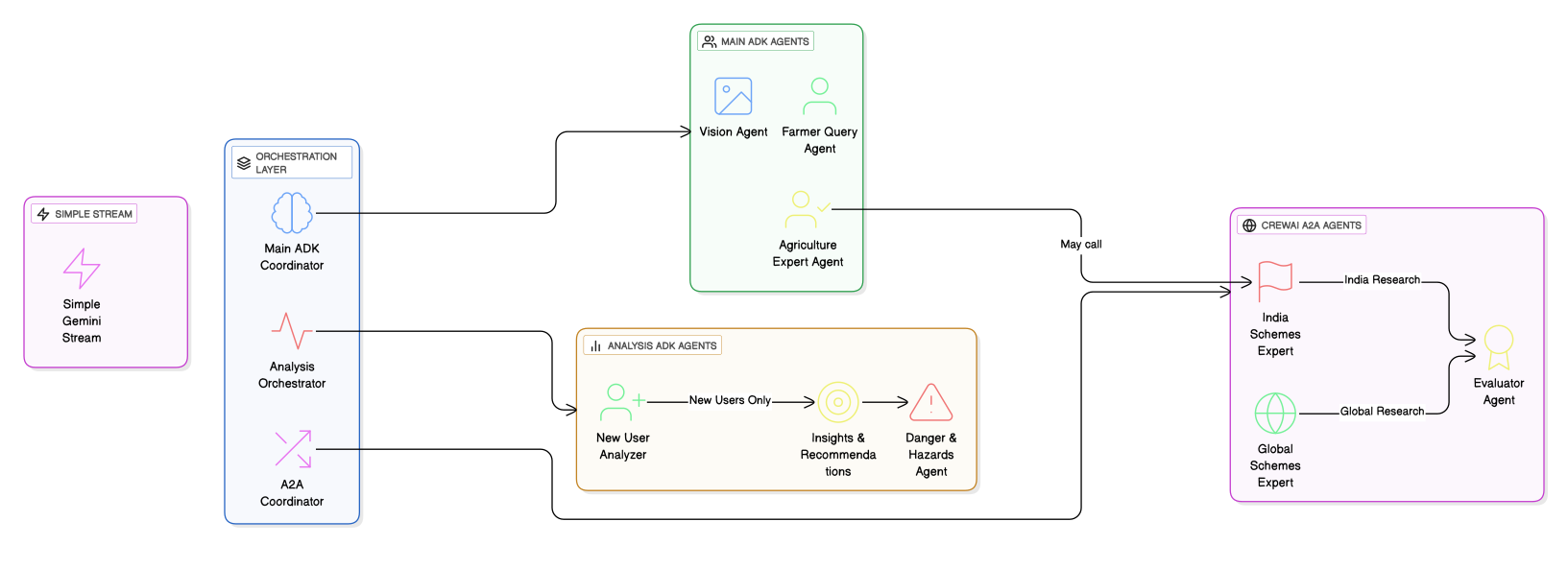
1. Gemini Live API (Real-Time Voice & Vision Interface) : A streamlined WebSocket-based streaming server for instant farmer interactions. Farmers can talk naturally through voice, upload crop images for disease detection. No complex workflows just direct, conversational assistance powered by Gemini 2.0's multimodal capabilities with real-time audio and visual responses.
2. Main ADK Agentic Platform (Multi-Agent Orchestration Hub) : The central intelligence layer that handles complex queries requiring reasoning, memory, and coordination. Uses Google ADK with specialized agents that automatically route questions, maintain conversation history across sessions in Firestore, and provide contextual answers by remembering past interactions. Supports text and image analysis through WebSocket connections, making it the brain that orchestrates everything together.
3. A2A CrewAI & Weather Tools (External Intelligence Layer) : The supporting infrastructure that powers the above two systems with real-world data. CrewAI Government Schemes Platform uses A2A protocol with specialized agents (India Schemes, Global Schemes, Evaluator) to research and compare agricultural subsidies worldwide through web search (Exa). Weather Tools integrate Visual Crossing API for current conditions, 7-day forecasts, and agricultural alerts. This layer provides the external intelligence schemes, weather, and market data that the main systems need to give accurate, actionable advice.
4. Analysis ADK (Deep Farm Analysis System) : A comprehensive ADK-based three-agent system that provides in-depth farm assessments and safety monitoring. Automatically adapts based on whether the farmer is new or returning. Uses Firestore for memory and mandatory weather checks to provide prioritized recommendations with safety alerts for proactive farm management.
Together, these agents create a complete ecosystem where a farmer can simply ask a question by text, or even image and get back practical, localized, and verified information. Like asking “What subsidies am I eligible for?”, “What disease is on my paddy crop?”, “Will it rain this week?”, and getting intelligent answers and instantly.
How Kisan Helps Farmers at Every Stage :
A farmer’s work is never just one task, it’s a complete cycle, from choosing what to grow to finally selling the harvest. Each stage brings its own challenges and decisions. Our platform guides the farmer through every step, acting like a personal AI companion that’s available 24/7.
Kisan helps farmers at every stage of their agricultural journey through eight intelligent, connected modules:
(Please zoom in for clarity)

Stage 1 – Crop Selection : An AI-driven system that analyzes soil type, regional climate, and past yield data to recommend the most profitable and suitable crops for the upcoming season.
Stage 2 – Soil Health : A vision and data-based AI tool that evaluates soil quality, identifies nutrient deficiencies, and suggests fertilizers or treatments, along with estimated improvement costs.
Stage 3 – Financial Aid & Schemes : A CrewAI-based agentic system that searches, compares, and summarizes government and global agriculture schemes, subsidies, and financial benefits available to the farmer.
Stage 4 – Smart Sowing : An intelligent module that monitors real-time weather, temperature, and humidity data to suggest the optimal sowing time for maximum yield.
Stage 5 – Crop Care & Monitoring : A continuous support agent that provides daily weather forecasts, pest/disease alerts, and emergency action plans for floods or droughts, ensuring crop protection.
Stage 6 – Harvest Optimizer : Uses data on crop maturity and upcoming weather patterns to determine the ideal harvesting time, preventing losses from premature cutting or unexpected rain.
Stage 7 – Market Price & Selling : Tracks both government and private market prices to help farmers choose the best place and time to sell their produce for maximum profit.
How We Built Kisan
Kisan brings together multiple intelligent agents that operate collaboratively to deliver a complete agricultural support experience. From answering farmers’ everyday questions and detecting crop issues through images, to explaining relevant government and international farming schemes, every part of the system plays a specific role in assisting the user.
The four seamlessly connected subsystems of Kisan are:
- Government & Global Schemes Finder
- Main ADK Agentic Platform
- A2A CrewAI & Weather Tools
- Analysis ADK
Let’s discuss each of these subsystems in detail to understand them better:
1. Government & Global Agriculture Schemes Finder – CrewAI Agentic System
This subsystem powers Kisan’s ability to research and explain agricultural schemes from India and around the world. Built using CrewAI, it operates as a self-contained multi-agent research engine that connects to the Main ADK through the A2A (Agent-to-Agent) Protocol.
The system combines GPT-4o-mini for reasoning and synthesis, Exa for high-precision web searches, and Firecrawl for structured data extraction. This makes it capable of conducting real-time research on verified government and global agricultural databases, and converting that information into clear, farmer-friendly explanations.
The CrewAI subsystem is composed of three highly specialized AI agents, each responsible for a distinct part of the research and analysis process:
1. India Agriculture Schemes Expert
Dedicated to identifying and analyzing Indian government agriculture programs such as PM-KISAN, PMFBY (Fasal Bima Yojana), and KCC (Kisan Credit Card).
This agent exclusively searches trusted government sources, mainly .gov.in and .nic.in domains to extract accurate information on scheme objectives, eligibility criteria, benefit amounts, application steps, and official helpline numbers.
2. International Agriculture Expert
Focuses on researching agricultural development and subsidy programs from leading international bodies and countries such as the USDA (USA), EU CAP (Common Agricultural Policy), FAO, OECD, World Bank, Australia, Brazil, and China. It identifies funding programs, target beneficiaries, and innovation frameworks, providing comparative insights on how other nations support farmers.
3. Senior Agriculture Schemes Evaluator
Acts as the synthesizer and decision-maker. It consolidates findings from the India and International Agents, compares policy strengths, and provides actionable recommendations. It also matches eligibility details to the user’s context (e.g., type of crop, region, or scale of farming), calculates potential financial benefits, and outlines clear next steps, from document preparation to application links.
Adaptive Query Handling
Before launching any agents, the subsystem uses GPT-4o-mini’s intelligent query classification to determine the type of research needed. It dynamically selects the most relevant workflow:
- INDIA_ONLY: For India-specific questions like “PM-KISAN eligibility”
- GLOBAL_ONLY: For queries mentioning international entities like “USDA farmer grants”
- COMPARATIVE: For broader or analytical questions like “Compare India and EU crop insurance programs”
A2A Protocol – The Communication Bridge
The A2A (Agent-to-Agent) Protocol enables this CrewAI subsystem to interact seamlessly with Kisan’s Main ADK and other external systems. It standardizes agent communication using JSON-RPC over HTTPS, making the service interoperable, secure, and language-agnostic.
Through A2A, external applications can:
- List available agents (
GET /a2a/agents) - View an agent’s capability card (
GET /a2a/agents/{agent}/card) - Invoke an agent (
POST /a2a/agents/{agent}) - Track task status (
GET /a2a/tasks/{task_id})
Integration with the Main Agentic Structure
Within Kisan’s architecture, the CrewAI–A2A subsystem acts as an external intelligence module. When a farmer asks about a government or subsidy program, the Main ADK forwards the query through A2A, triggering the appropriate CrewAI agents. After the agents complete their research and evaluation, the summarized results are sent back through A2A and seamlessly presented to the farmer as part of the ongoing conversation.
(Please zoom in for clarity)

Key Benefits of A2A Integration
- Separation of Concerns: Scheme research is isolated in a specialized sub-system
- Interoperability: Any application (Python, JavaScript, etc.) can use the A2A client
- Scalability: A2A server can be deployed independently and scaled horizontally
- Modularity: Main system doesn't need to know CrewAI internals, just A2A protocol
- Reusability: Multiple main systems can use the same scheme research agents
Cloud Run Deployment
The Agriculture A2A Platform is deployed as a CrewAI-based A2A microservice on Google Cloud Run, offering a fully serverless, auto-scaling, and containerized architecture. It manages agent execution, task orchestration, and secure API communication for external systems.
Each container runs with 1 GiB memory and 1 vCPU, scaling automatically from 0 to 10 instances based on workload. The service is deployed in us-central1 (Iowa, USA) and configured with secure IAM-based authentication for inter-service calls.
This deployment ensures scalability, modularity, and reliability, enabling the A2A system to function as a plug-and-play intelligence layer within Kisan’s larger agentic ecosystem, capable of handling intensive data research without impacting the main conversational flow.
2. Main ADK Agent System - Multi-Agent Agricultural Assistance Platform
This is a multi-agent AI system built with Google ADK (Agent Development Kit) that provides comprehensive agricultural assistance through intelligent agent orchestration. It uses WebSocket for real-time communication and integrates with Firestore for persistent memory, external weather APIs, and the A2A-based Government Schemes platform, making it the central coordination hub for farmer queries.
Farmers can interact naturally by typing, or sending crop images, and the system responds with context-aware, data-backed recommendations. Powered by Gemini 2.0 Flash, it understands text, audio, and images, ensuring smooth and meaningful communication every time. Additionally, it integrates with Visual Crossing Weather API and the CrewAI A2A Government Schemes service.
System Overview
Imagine a farmer interacting with an AI assistant that can:
- Answer crop-related questions
- Check weather forecasts
- Analyze plant health from an image
- Guide them through government schemes
All in one place, that’s what the Main ADK Agent System achieves through seamless agent coordination and real-time data integration.
(Please zoom in for clarity)
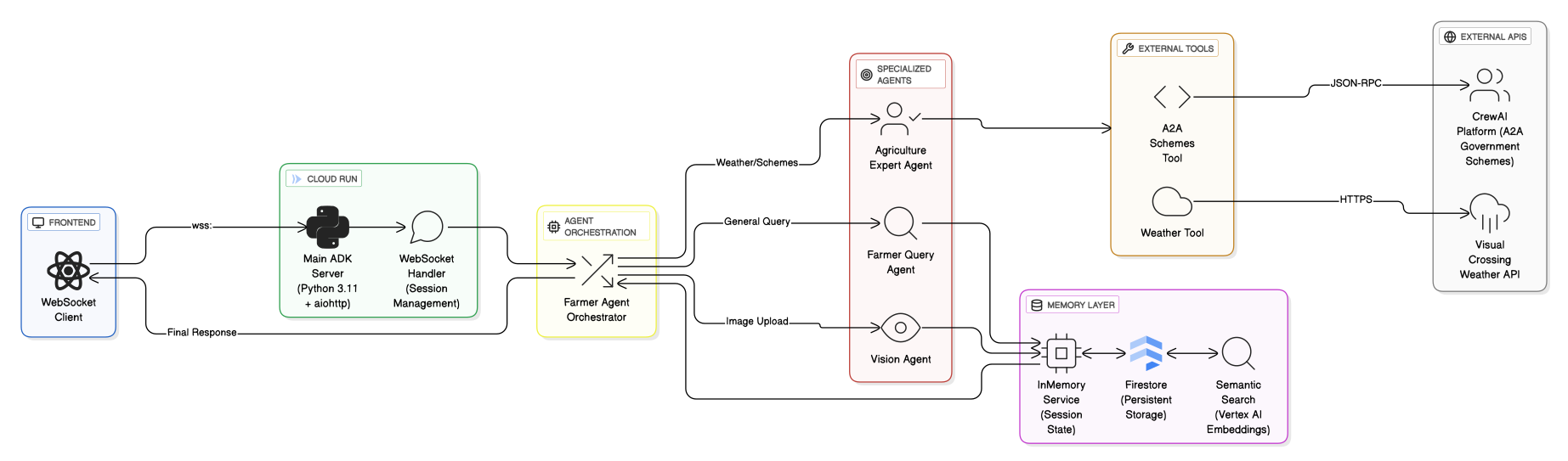
The system consists of four main components:
1. Farmer Query Agent: This is the first point of contact for the farmer. It handles everyday questions like “Which crop should I grow this winter?” and gives clear, contextual responses.
- Maintains contextual awareness across ongoing sessions, preserving conversation flow.
- Automatically routes specialized questions to the appropriate expert or vision agent when needed.
2. Agriculture Expert Agent: This agent provides practical, data-driven recommendations using real-time weather, government scheme data, and stored farmer profiles. For example, if a farmer asks "Am I eligible for the PM-KISAN scheme?”, it checks the latest eligibility rules and benefits, and explains how to apply.
- Connects to the A2A-based government platform to explain schemes, eligibility, and benefits.
- Stores and recalls user profiles and previous advice in Firestore, offering continuity across sessions.
3. Vision Agent: Farmers can upload pictures of their crops, and the Vision Agent instantly analyzes them to detect diseases, pests, or soil issues. It identifies visible symptoms, and suggests next steps, helping farmers take action quickly.
- Identifies pests and their life stages, recommending organic or chemical control methods.
- Assesses soil texture and color to give early indications of soil health.
4. Farmer Agent Orchestrator (The Coordinator): The Orchestrator ensures everything runs smoothly. It understands each query, routes it to the right agent, merges multiple responses into one clear message, and keeps memory synced across sessions.
- Classifies and routes incoming queries to the most relevant agent based on type and context.
- Merges responses from multiple agents to provide a single, well-organized answer.
Memory System
Kisan implements a sophisticated dual-layer memory architecture that enables persistent, personalized conversations across sessions with intelligent context retrieval capabilities.
Main Memory Implementation
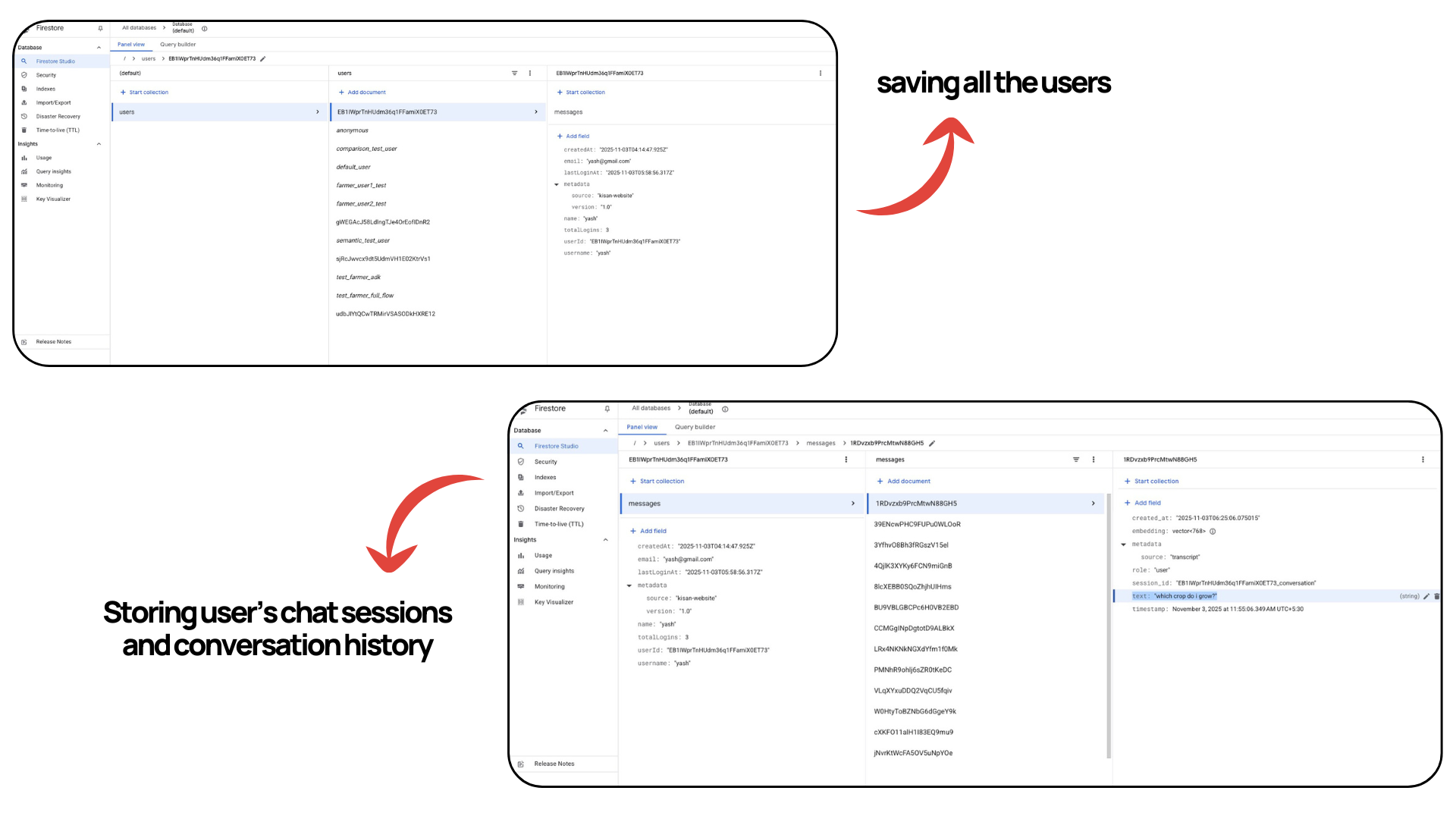
The platform uses Firestore + ADK InMemory hybrid architecture for conversation persistence. ADK's InMemoryMemoryService handles active session context, while Firestore provides cross-session storage with automatic synchronization. Every conversation is automatically saved to users/{user_id}/messages/ after each query completes, storing text content, role, session ID, timestamp, and complete interaction metadata (agent used, tools called).
Context Loading: During any chat session, the system automatically includes the previous queries and messages from the ongoing conversation as context for each new query. This allows the chatbot to maintain a clear understanding of the discussion, keeping track of farm conditions, crop issues without the user needing to repeat details. When a farmer starts a new chat, a fresh session is created, ensuring clean context separation between different interactions.
User Isolation & Security: Each farmer's conversations are completely isolated using Firebase UID as the unique identifier. Sessions use persistent IDs like {user_id}_conversation, ensuring data privacy and seamless continuation across WebSocket reconnections. All Firestore operations are scoped to user-specific paths with zero cross-contamination.
Vector Embeddings: Every message is automatically processed through Vertex AI's text-embedding-004 model, generating 768-dimensional semantic embeddings stored alongside the text in Firestore. This infrastructure enables future meaning-based search capabilities where queries can find relevant past conversations by semantic similarity rather than keyword matching.
Ready to Integrate (Built & Tested)
The platform includes a fully implemented semantic search system using Firestore vector similarity search with cosine distance measurement. The semantic_search() function supports configurable similarity thresholds, top-k results, and intelligent fallback to keyword search when needed. This allows queries like "what's affecting my crop?" to automatically find past conversations about diseases, pests, and symptoms even when exact words don't match.
Comprehensive Testing Complete: We already storing users chat sessions as embeddings, and the semantic search functionality has been thoroughly validated through multiple test suites demonstrating vector similarity search, threshold-based filtering, and multi-user isolation. Please Refer to our test implementation for details:
- Semantic Search Testing: main-adk/server/test_full_semantic_search.py – Validates vector search, similarity scoring, and meaning-based retrieval
- Memory Service Testing: main-adk/server/test_firestore_memory.py – Confirms save/load operations, user isolation, and cross-session persistence
- End-to-End Flow Testing: main-adk/server/test_full_agent_flow.py – Validates complete agent workflow with memory integration
Integration Status: The semantic search engine is production ready with all infrastructure deployed. Full integration into the live orchestration query flow (replacing chronological context loading with semantic retrieval) is scheduled for the next development phase. Time
(Please zoom in for clarity)

Cloud Run Deployment
The Main ADK Server runs as the core orchestration hub on Google Cloud Run, managing all multi-agent workflows within Kisan. It coordinates specialized agents like the Farmer Query Agent, Agriculture Expert, and Vision Agent, each powered by Gemini 2.0 Flash. The server is configured for high availability with 2 GiB memory, 2 vCPU per instance, and auto-scaling up to 10 instances to handle concurrent farmer sessions. Integrated with Firestore memory and Vertex AI embeddings, it delivers intelligent, context-aware responses across sessions while staying lightweight and cost-efficient under Cloud Run’s managed infrastructure.
3. Gemini Live API – Real-Time Voice & Vision Interface
This module integrates Gemini 2.0’s real-time multimodal capabilities into the system, enabling farmers to interact naturally through voice and vision. They can simply speak their questions or show crop images to receive instant, context-aware responses. The entire setup runs on a lightweight WebSocket-based streaming server, ensuring low latency and a seamless conversational experience that feels human and responsive rather than mechanical. Instead of relying on multiple background agents, this setup focuses on direct streaming, allowing Gemini to process both audio and image inputs in real time. So when a farmer asks a question aloud or shares a photo of their crop, the model instantly interprets it and provides practical, data-grounded advice, sometimes even responding with a synthesized voice for a fully conversational experience.
- Enables two-way live voice interaction for smooth, natural dialogue.
- Supports image-based crop analysis for detecting diseases or soil issues.
- Integrates with agricultural tools for accurate, data-backed insights.
To enhance the usefulness of these interactions, the system integrates two specialized tools: the Weather Tool and the Government Schemes Tool:
1. Weather Tool : The Weather Tool integrates the Visual Crossing API to deliver precise, location-based weather data and forecasts. Farmers can ask about the current temperature, humidity, wind, or upcoming rainfall to plan irrigation, fertilization, and harvesting activities more effectively. The data provided by this tool keeps Gemini’s responses reliable and locally relevant, turning every conversation into actionable guidance.
2. Government Schemes Tool: The Government Schemes Tool connects to the CrewAI A2A server to fetch verified information about government programs, subsidies, and crop insurance. It allows farmers to easily discover ongoing schemes and benefits through natural, conversational queries. By simplifying access to such complex information, this tool helps ensure that farmers are aware of and can make use of the support available to them.
(Please zoom in for clarity)
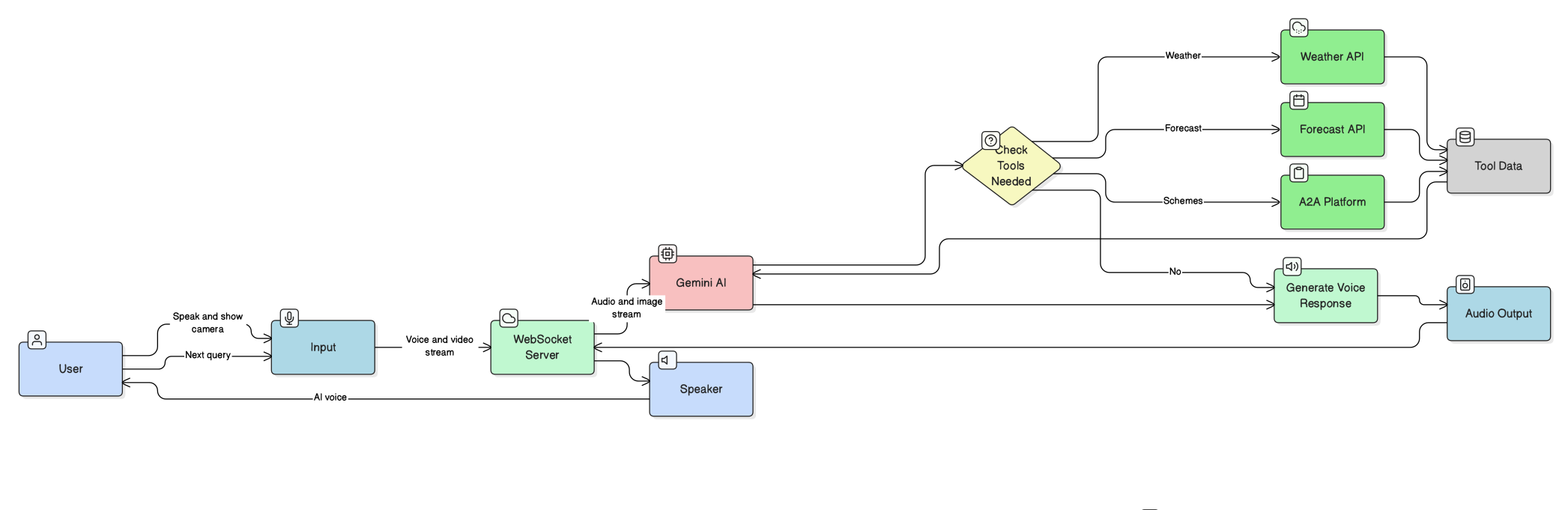
Cloud Deployment
The Gemini Live API system is fully deployed on Google Cloud Run, ensuring high scalability, availability, and real-time performance. It operates as one of the four microservices in the overall Kisan architecture, each built for specific workloads and deployed under the same GCP project.
Simple Gemini Stream Server (Real-Time Interface)
This service powers the real-time voice and vision interactions, providing direct access to Gemini 2.0 Flash’s multimodal API. It handles bidirectional audio streaming and live webcam image capture at 1 fps, enabling instant conversations and crop analysis without any orchestration delay. The server runs on a minimal infrastructure of 1 GiB memory and 1 vCPU, with auto-scaling from 0 to 10 instances to maintain fast performance during peak usage.
It securely uses Google Secret Manager to handle environment variables like the Gemini API key, Visual Crossing API key, and CrewAI A2A server endpoint. The service remains publicly accessible for voice-based client connections through a WebSocket endpoint.
4. Analysis ADK — Sequential Three-Agent Farm Analysis Platform
The Analysis ADK is the intelligence core of our system, a specialized multi-agent platform built with Google ADK that provides complete farm insights in a single click. When a farmer selects “Get Insights,” the system automatically retrieves their chat history, analyzes it, and runs a sequence of three specialized agents to generate a detailed report, including personalized recommendations, soil-crop suitability, and early hazard warnings. It’s powered by Gemini 2.0 Flash, using live weather data from the Visual Crossing Weather API and past conversation context to make every analysis relevant and data-driven. Whether a farmer is new or returning, the system adapts automatically, ensuring each report feels personalized, contextual, and precise.
(Please zoom in for clarity)
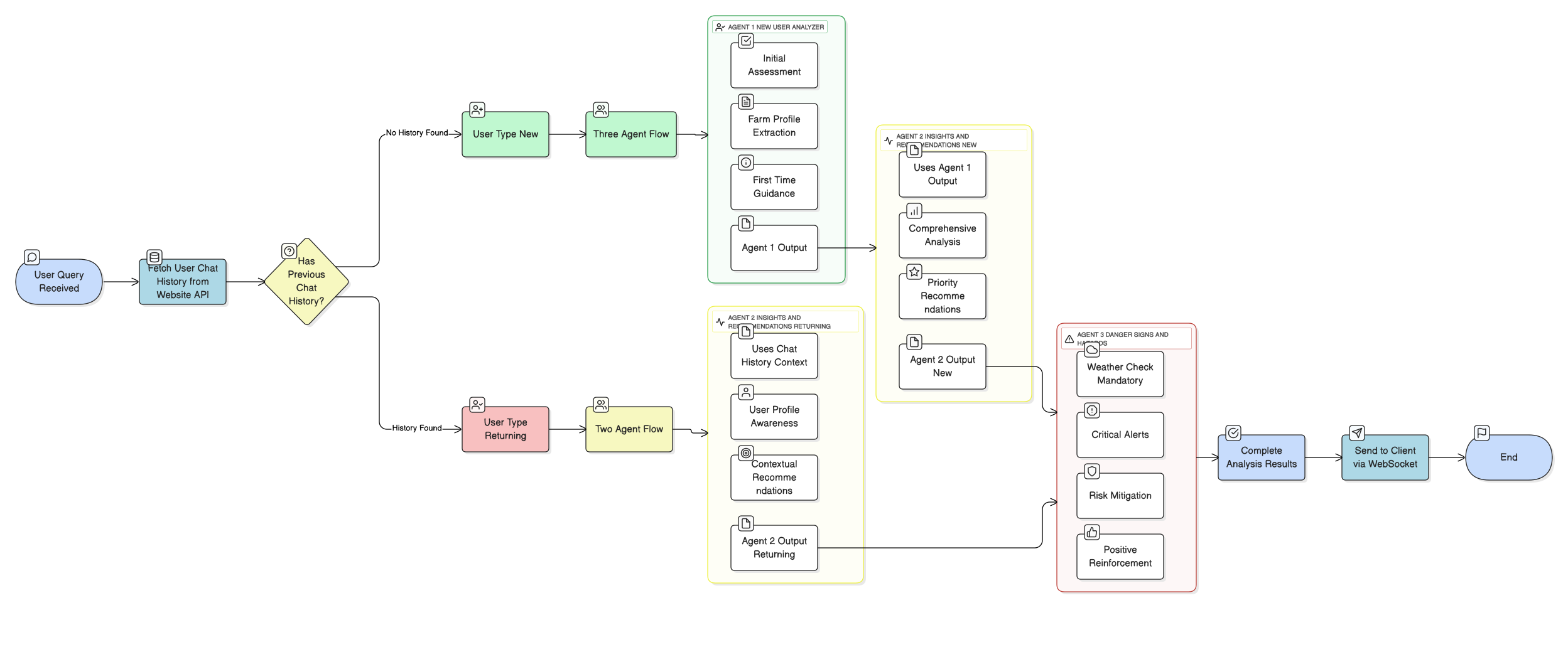
Agent 1 — New-User Analyzer: This agent activates only for first-time users. It acts as the farmer’s first digital assistant, learning about their farm setup, soil type, and crops, and creating an initial assessment report. The report provides a quick overview of their current situation, identifies key areas to focus on, and suggests actionable next steps.
Agent 2 — Insights & Recommendations: This is the core analytical agent that runs for all users. It processes all available information including chat history, farm details, weather data, and previous agent outputs to create a detailed insights report. The report includes soil-crop compatibility checks, prioritized recommendations (High, Medium, Long-term), and practical best practices for improving farm performance. It also highlights positive aspects, helping farmers see what they’re doing right and where they can improve.
Agent 3 — Danger-Signs & Hazards: The final agent focuses exclusively on risk detection and safety. It must call the Weather Tool every time to analyze upcoming weather patterns and identify any hazards such as heatwaves, heavy rainfall, or crop stress conditions. It classifies risks as:
- Critical (24–48 hrs)
- Warnings (within a week)
- Cautions (monitor)
and provides clear, step-by-step mitigation advice. When no issues are found, it simply confirms an “All Clear,” giving farmers peace of mind.
Orchestration & Flow
The orchestrator ensures smooth agent coordination:
- New users: Agent 1 → Agent 2 → Agent 3
- Returning users: Agent 2 → Agent 3
It fetches chat history, formats context, identifies mentioned crops or locations, and passes relevant details between agents. Each result builds on the previous step, creating a comprehensive, coherent report by the end of the sequence.
Cloud Run Deployment
The Analysis ADK Server is deployed on Google Cloud Run as a dedicated, always-on system for deep farm analysis. It runs a three-agent ADK architecture that performs sequential assessments, generates personalized recommendations, and detects weather-based hazards. Configured with 2 GiB memory, 2 vCPU, and a minimum of one active instance, it eliminates cold starts and ensures instant responses. Integrated with Firestore for user session tracking and the Visual Crossing Weather API, it adapts dynamically to new or returning farmers. This deployment ensures scalable, real-time analytical intelligence while maintaining consistent performance and fault isolation within the broader Kisan ecosystem.
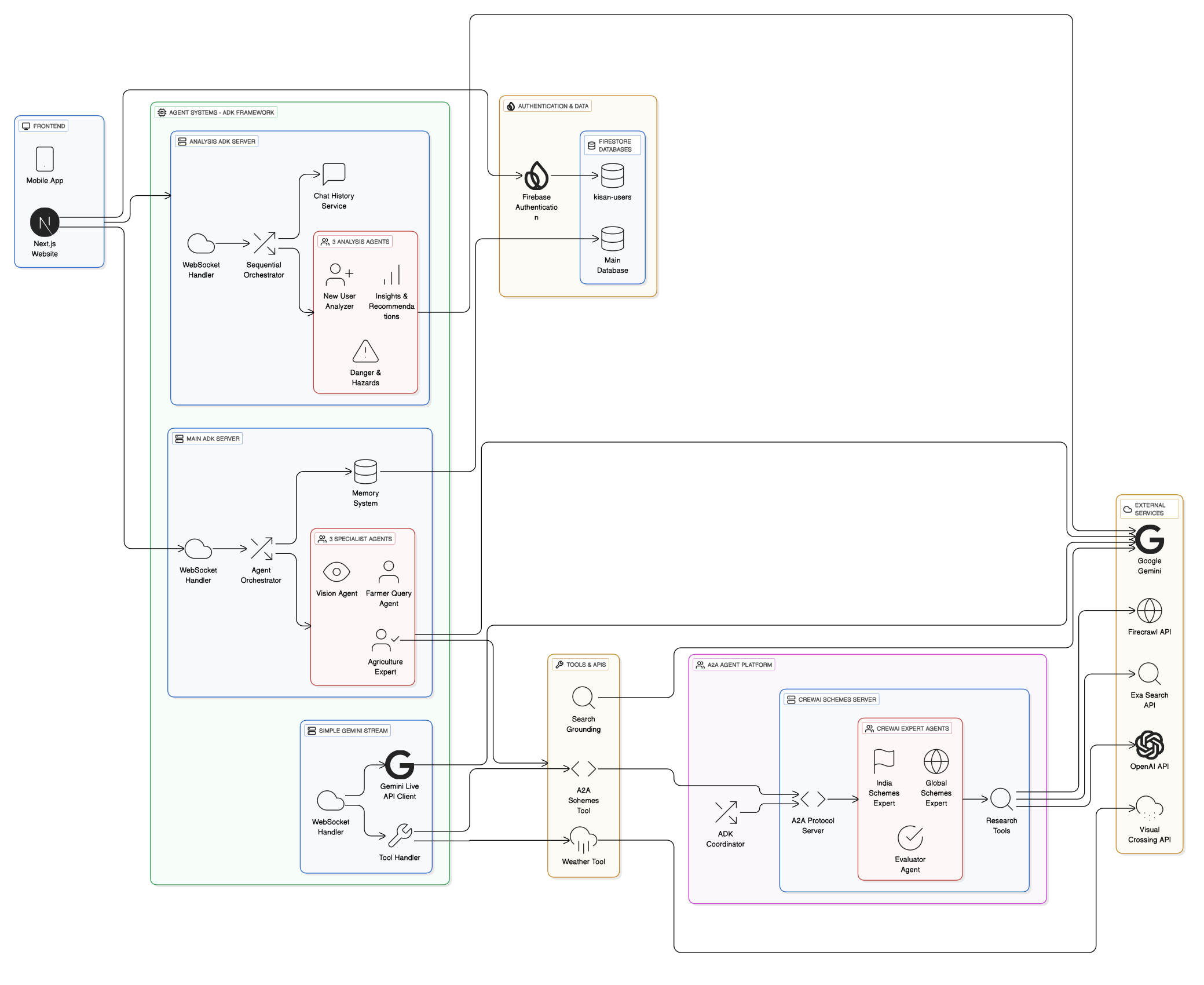
Below is the full System Architecture of Kisan, a single diagram that maps the frontend, ADK agent servers, CrewAI A2A platform, tool integrations, and external services end-to-end. Agent coverage: 11 agents total : 3 Main ADK (Farmer Query, Agriculture Expert, Vision), 3 Analysis ADK (New-User Analyzer, Insights & Recommendations, Danger-Signs & Hazards), 3 CrewAI A2A (India, Global, Evaluator), plus 2 orchestrators (Main Coordinator, Analysis Orchestrator).
Frontend Interface
The frontend of the system is built to make interactions simple and intuitive while handling complex AI operations in the background. It connects farmers and AI agents through a unified interface that supports voice, text, and image-based interactions. Each page has a clear purpose, ensuring users can naturally engage with the system while understanding how the AI works behind the scenes.
AI Voice Chat (Simple Gemini Live API)
This is a real-time conversational dashboard that allows farmers to interact simply by speaking or through a live cam. With one tap, they can ask questions like checking the weather, asking about crop health, or exploring farming schemes. They can also use the live camera to show a crop or soil image and get instant visual analysis. On the right, there’s a logs panel showing what the system is doing behind the scenes, like connecting to the backend, detecting the user’s input, or fetching data from tools.

- Real-time speech recognition and instant query handling
- Live activity log showing active agents and A2A connections
- Live cam support for quick crop or soil diagnosis
AI Text Chat (ADK Agents)
The Chat page runs on the Main ADK Agent System, enabling rich text and image-based conversations. It’s ideal for users who prefer typing or need detailed insights that go beyond quick queries. Farmers can upload images, ask follow-up questions, and receive structured, context-aware responses generated collaboratively by multiple agents.
During any chat session, the system automatically includes the previous queries and messages from the ongoing conversation as context for each new query. This allows the chatbot to maintain a clear understanding of the discussion, keeping track of farm conditions, crop issues without the user needing to repeat details. When a farmer starts a new chat, a fresh session is created, ensuring clean context separation between different interactions.
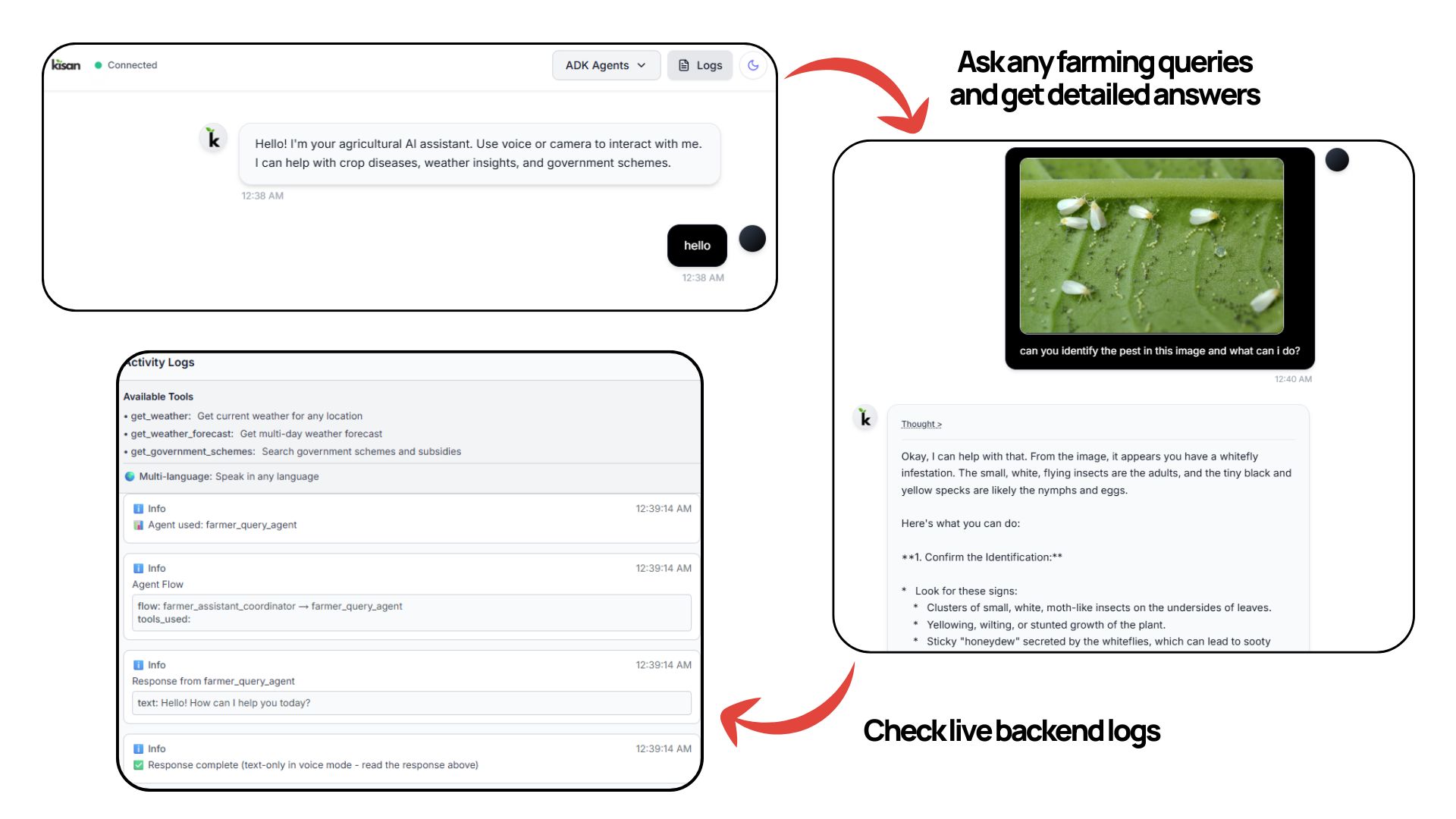
- Transparent display of which backend services or agents handled each query
- Firestore-powered memory that restores past 10 messages for context continuity
Get Insights / Analysis Page
The Insights page runs the Analysis ADK system, which provides detailed farm analysis and safety evaluations. When users start an analysis, it first collects farm details such as location, size, soil, and crops. Using this data, the system checks real-time weather and seasonal conditions, then generates personalized insights and recommendations tailored to the user’s farm. Alongside this, it performs a Safety & Hazard Assessment, identifying potential risks based on current weather and environmental conditions, and marks them as Critical, Warnings, Cautions, or All Clear.
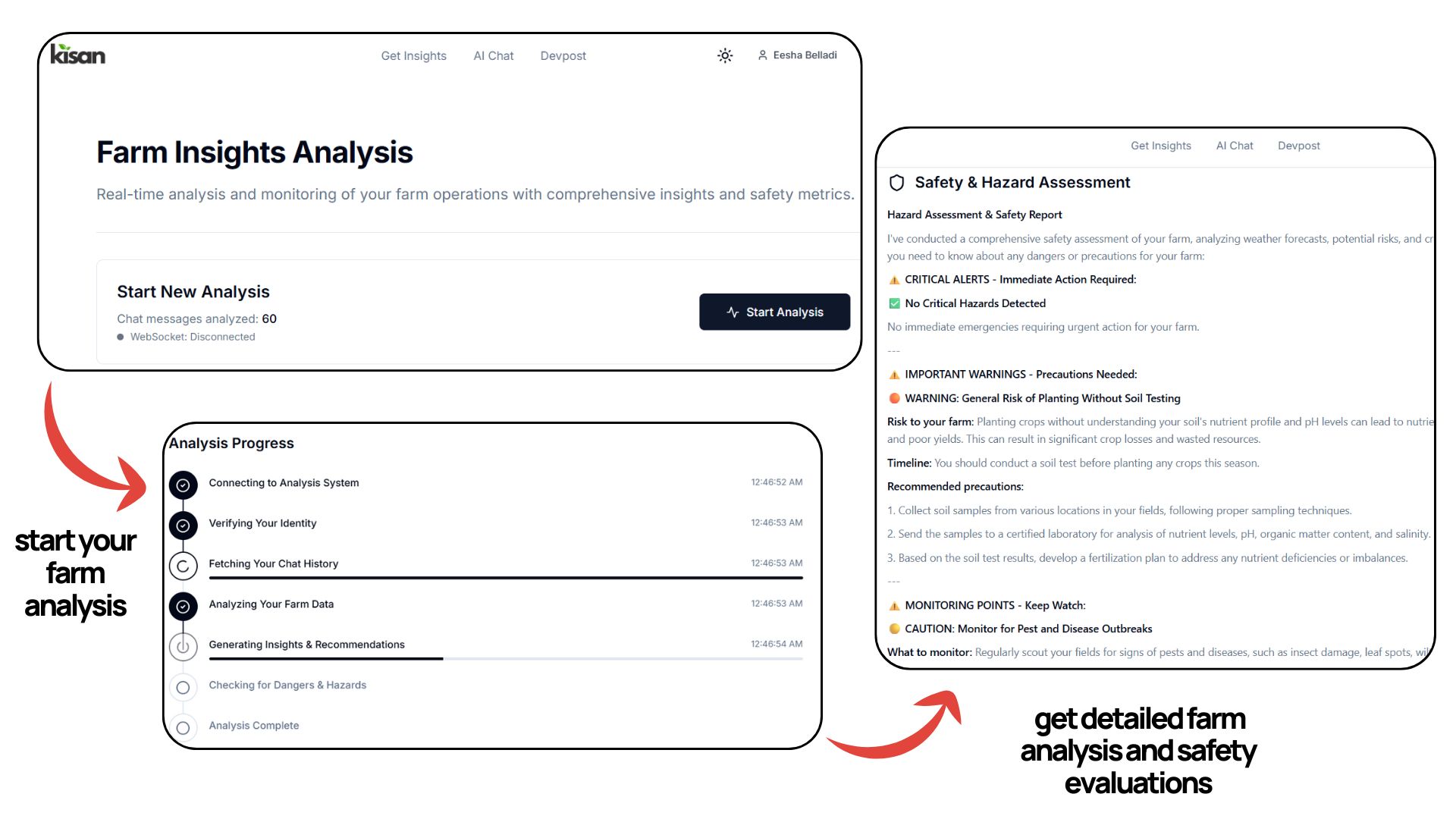
- Real-time analysis of farm data with dynamic updates through WebSocket
- Automated weather-based safety checks for proactive hazard alerts
- Time-stamped report generation for consistent monitoring and tracking
Authentication System:
The platform includes a secure and streamlined authentication system that manages user access and personalized experiences. It supports both email/password login and Google sign-in. Once authenticated, each user’s session is securely linked to their unique Firebase UID, allowing private data storage and isolation across all features. This authentication layer is directly integrated with Firestore memory, enabling the system to recall previous chat sessions and farm analyses for returning users.
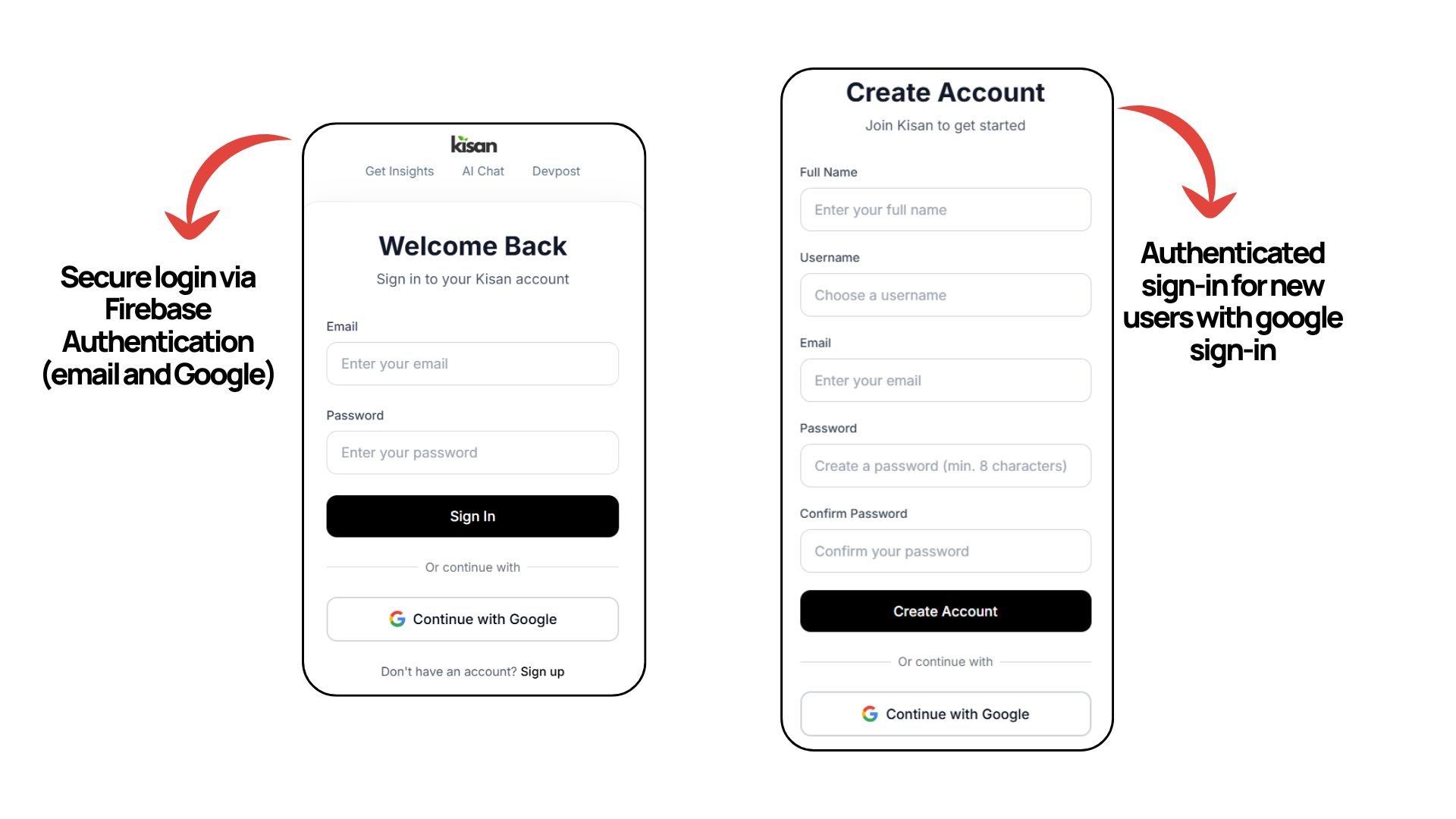
- Secure login via Firebase Authentication (email and Google)
- Persistent user sessions with automatic context restoration
- Encrypted data handling and role-based access for enhanced security
Google Services We Used
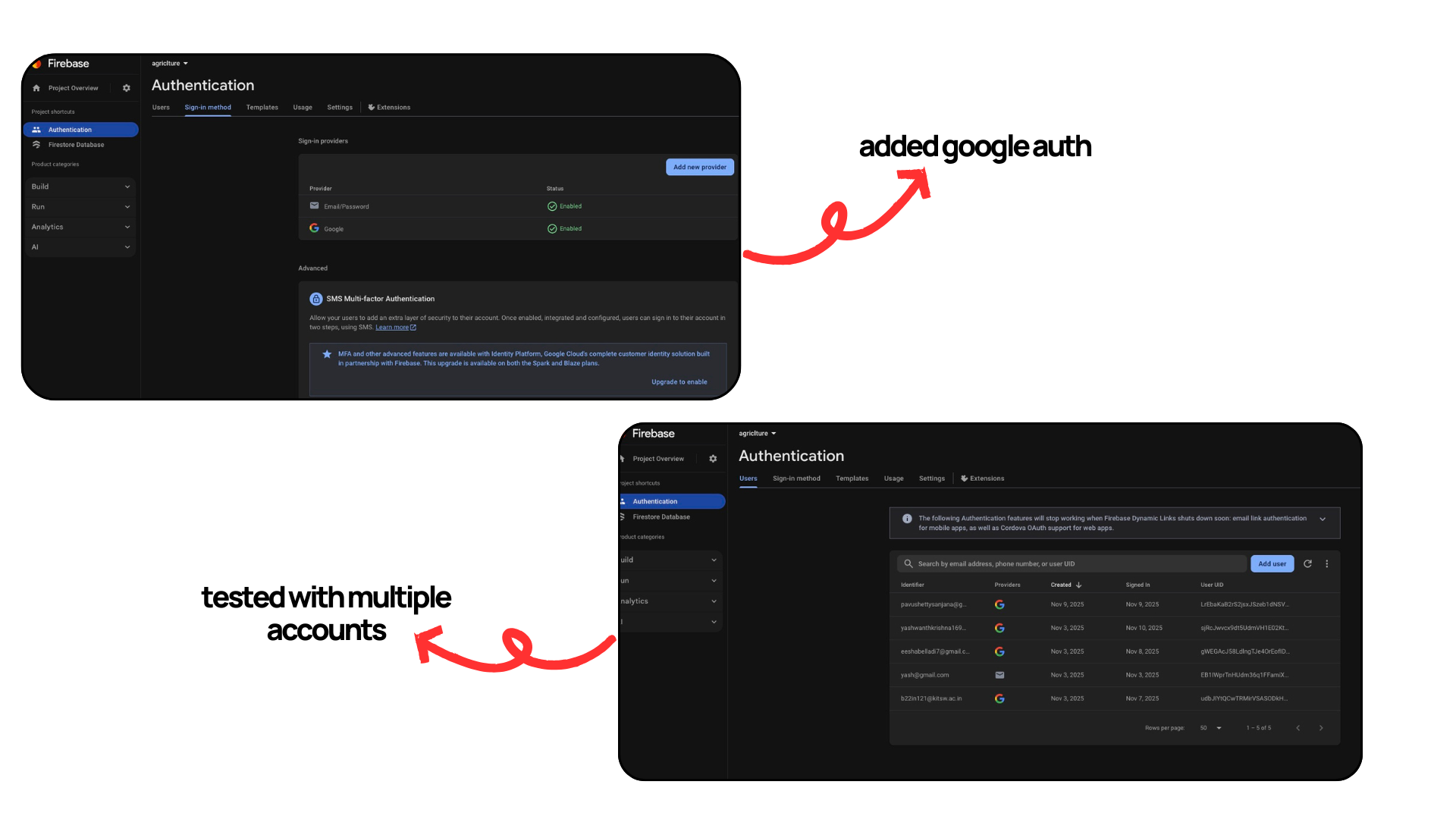
We used Google Firebase, Firestore and Cloud Run to manage authentication, data storage, conversation memory and host our AI microservices across the Kisan ecosystem.
Firebase Authentication handles secure user sign-in using both Google and email/password login, linking each session to a unique Firebase UID for data isolation.
Cloud Firestore serves as the central database for storing user profiles, chat sessions, and AI conversation history. It also stores vector embeddings (via Vertex AI) to enable semantic search and long-term contextual memory.
Cloud Run We deployed six Cloud Run services as a containerized, microservice architecture powering the complete Kisan ecosystem:
- Main ADK Server
- Analysis ADK Server
- Simple Gemini Stream Server
- Agriculture Schemes A2A Server
- Weather Tool Service
- Next.js Frontend Website
Cloud Run Deployment summary
Kisan is deployed as a containerized, microservice architecture on Google Cloud Run . We deployed six Cloud Run services powering the complete Kisan ecosystem:

- Main ADK Server – Multi-agent orchestrator
- Analysis ADK Server – Deep farm analysis
- Simple Gemini Stream Server – Real-time voice and vision processing
- Agriculture Schemes A2A Server – CrewAI research layer
- Weather Tool Service – Fetches and analyzes weather insights
- Next.js Frontend Website – User-facing interface for the Kisan platform
Each service is sized and configured for its workload (1–2 GiB RAM, 1–2 vCPUs) and uses auto-scaling (typically 1 → 10 instances; the Analysis ADK keeps a minimum instance to avoid cold starts) to balance cost and responsiveness.
Content We Posted
1. LinkedIn Video: Kisan’s Gemini Live API feature
Platform: LinkedIn
Description: A short video showcasing Kisan’s real-time multimodal interaction using the Gemini Live API.
Link: View here
2. Medium Blog: Building Kisan - How we used Google Cloud Run to bring AI closer to farmers
Platform: Medium
Description: Walkthrough of how Kisan was built on Google Cloud Run, covering architecture, deployment, and how cloud run enabled scalable, low-latency AI access for farmers.
Link: Read Here
Conclusion
Kisan brings multimodal AI into practical use for farmers by combining fast, conversational interfaces with deep, multi-agent reasoning and verified external data. It solves the real problem of accessibility: farmers can speak, show, or ask and receive actionable, localized guidance, from crop health and weather-aware recommendations to eligibility and application guidance for government schemes. Architecturally, the system is modular and production-ready: each component can scale independently, sensitive keys are secured, and the platform preserves user privacy while providing context-aware assistance.
We built Kisan to be both useful today and extensible tomorrow, while the modular design makes it straightforward to add features like multilingual voice, TTS, IoT sensor inputs, advanced market forecasting, and deeper semantic retrieval. It lays the foundation for a future where every farmer has a personal AI assistant to guide, analyze, and empower better farming decisions.
Built With
- a2a
- cloud-run
- crew-ai
- firebase
- firestore
- gemini-2.0
- google-adk


Log in or sign up for Devpost to join the conversation.