-
-
Comparison Visualisation
-
Architecture Visualisation
-
Life cycle Visualisation
-
Benchmark Visualisation
-
Tools Visualisation
-
Inspiration
Ask a voice assistant to do five things at once, and it answers "Done!" Often, it isn't.
People using Alexa+ describe the same pattern: the wrong light gets switched, a routine quietly skips a step, a reminder never fires, or something they taught the assistant is forgotten a few days later. When that happens at home, it isn't a technical problem. It's a trust problem. If you can't tell whether the coffee maker is really on, or whether tonight's dinner is safe for a child with an allergy, you stop relying on the assistant.
So we asked a simple question: what if "done" had to be proven?
What Custos does
Custos is an open-source MCP server that sits between an assistant and your home. It does three things:
- Remembers. Household rules ("Maya is allergic to beef", quiet hours, device limits) are stored as typed, inspectable records, not as a sentence the assistant may forget.
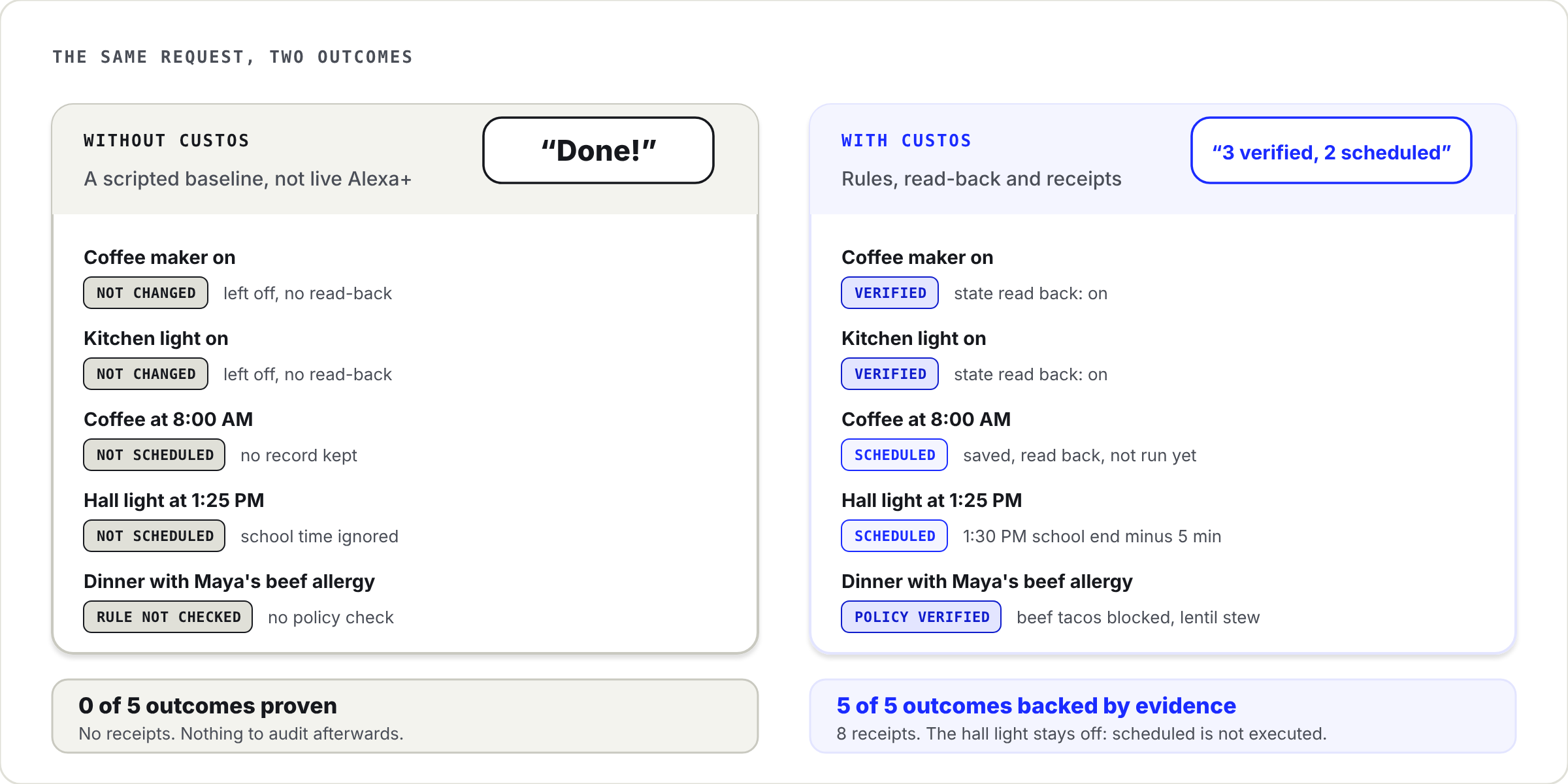
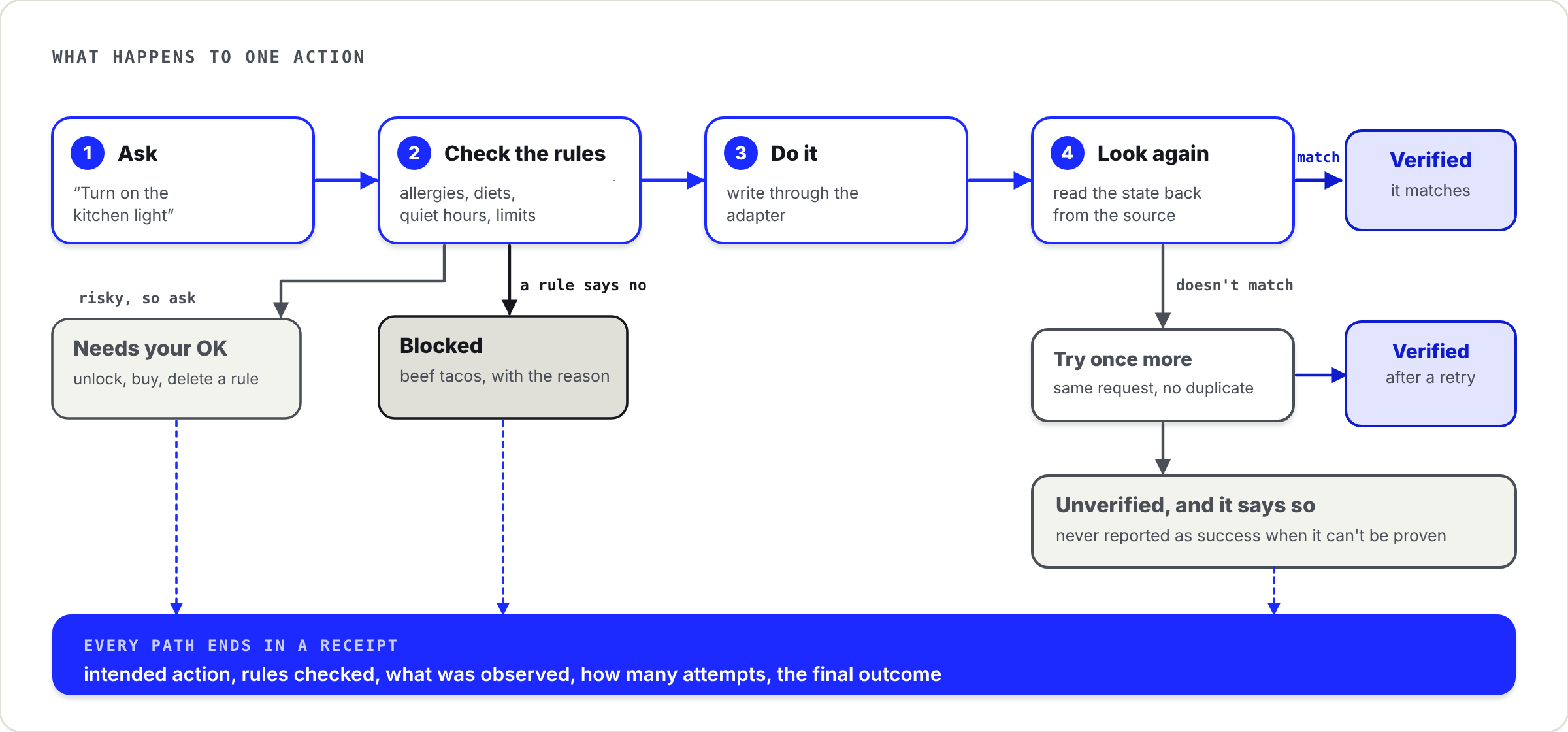
- Checks. Before any action runs, the rules are checked in code. Beef tacos are blocked and lentil stew is chosen.
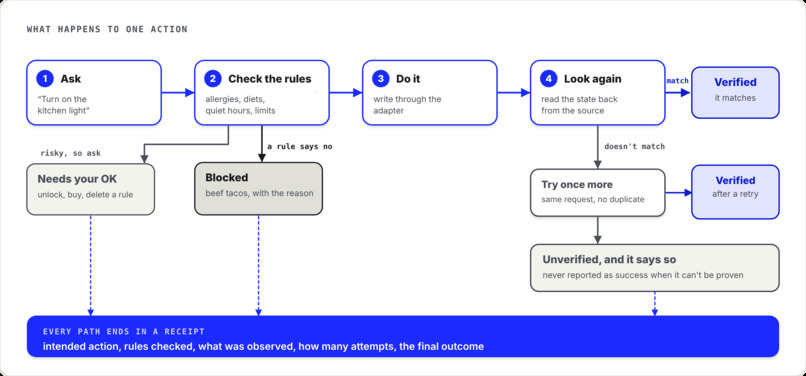
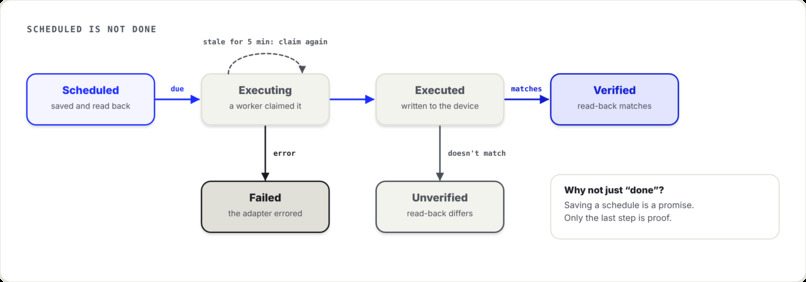
- Proves. After every action, Custos reads the device state back, retries once if it doesn't match, and writes a receipt. You can ask "what did you just do?" and get the evidence. If something can't be proven, it says so instead of claiming success.
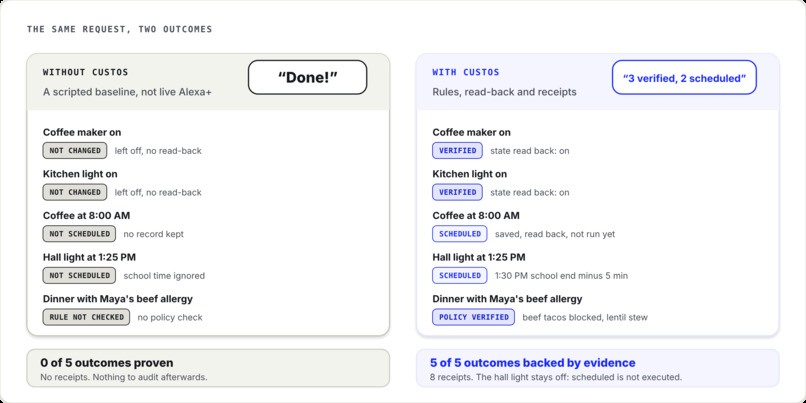
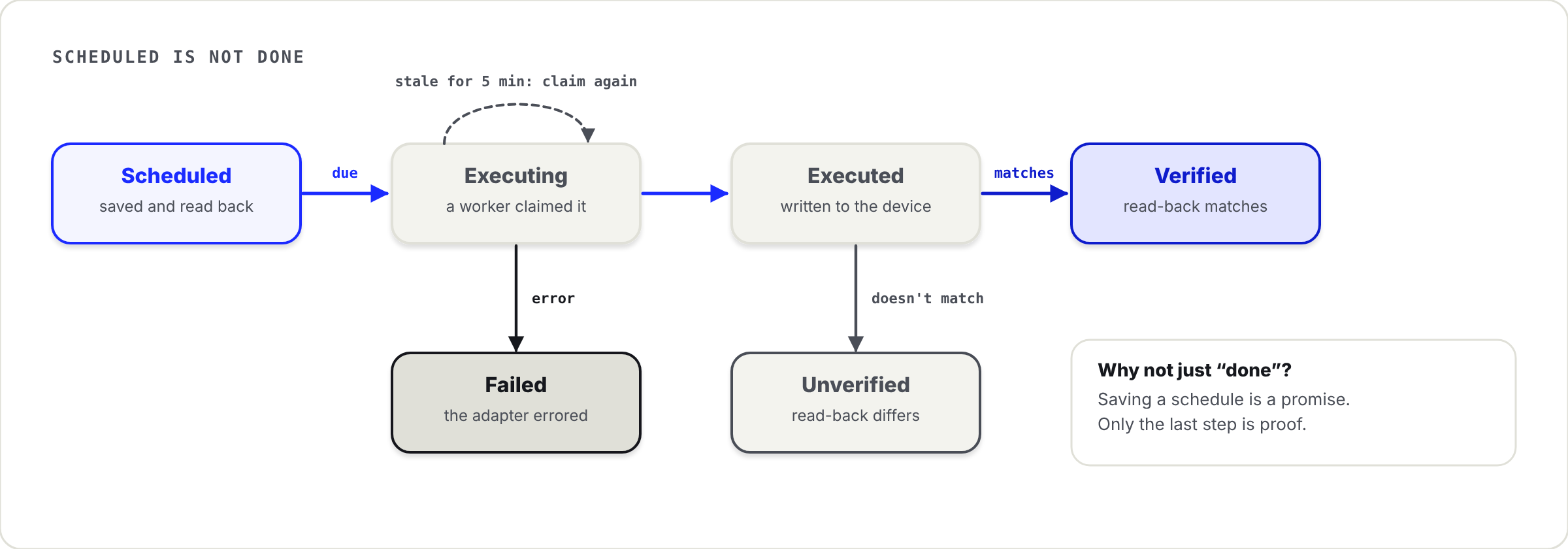
In our side-by-side simulator, one request ("coffee maker and kitchen light on, coffee at 8, hall light before my daughter gets home, and dinner for us") produces "Done!" with 0 of 5 outcomes proven without Custos, and 5 of 5 backed by evidence with it. Custos also keeps scheduled and executed as separate states, so a saved schedule is never reported as a completed action.
How we built it
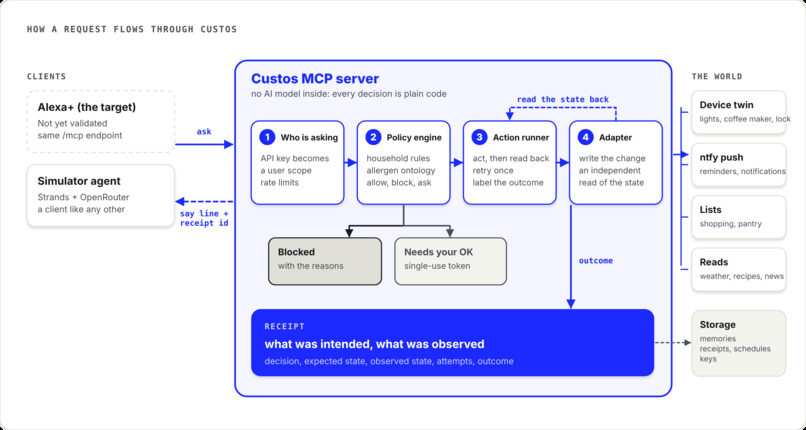
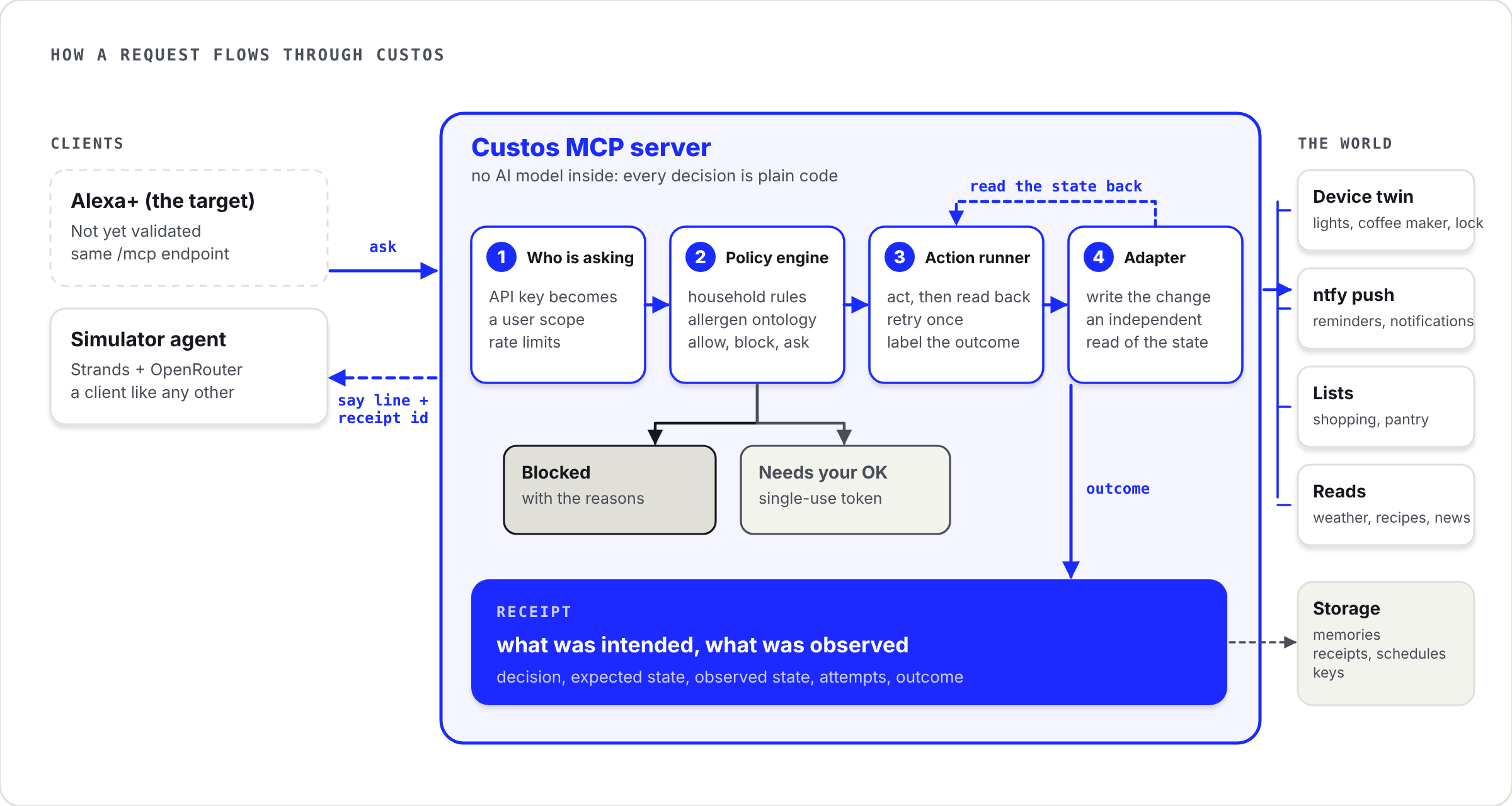
- Server: TypeScript, FastMCP and Hono. Streamable HTTP, stateless, MCP spec 2025-11-25, with Bearer-key authentication. There is no language model inside the server: every decision is deterministic code.
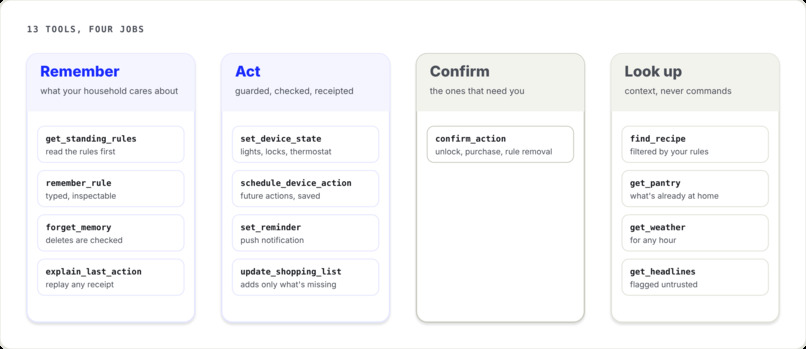
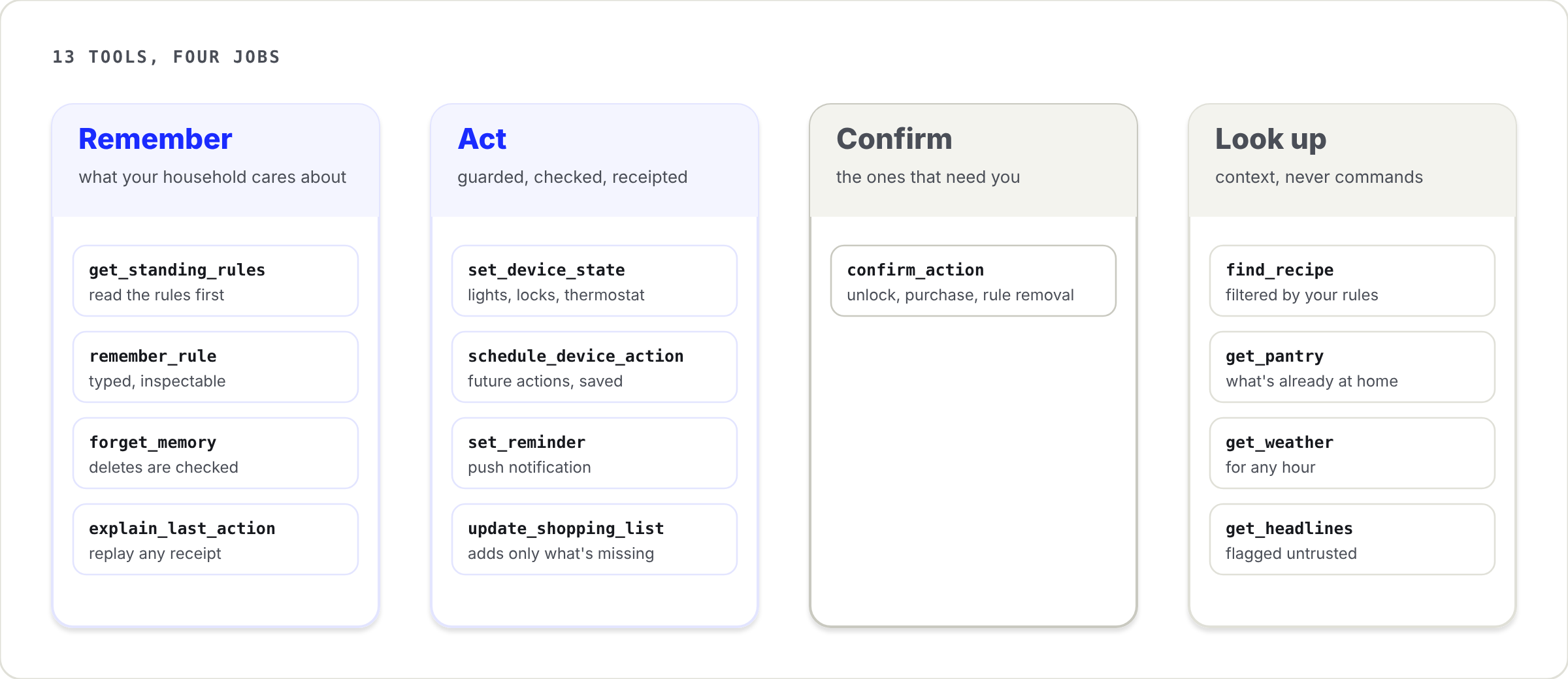
- 13 tools in four groups: memory, actions, confirmation and reads. Every action goes through guard, act, read back, retry once, receipt.
- Policy engine with typed rules and an allergen ontology covering 15 allergen keys and 7 diets.
- Adapters: a simulated device twin with injectable faults (lost acknowledgement, delay, offline, flaky), ntfy push notifications, Open-Meteo, TheMealDB and Supabase.
- Simulator: React and Vite comparison UI, with a Strands Agents SDK agent (AWS) calling the same
/mcpendpoint any other client would use. Hosted on Vercel and Render. - Benchmark: seeded fault injection with committed raw results.
What the benchmark shows
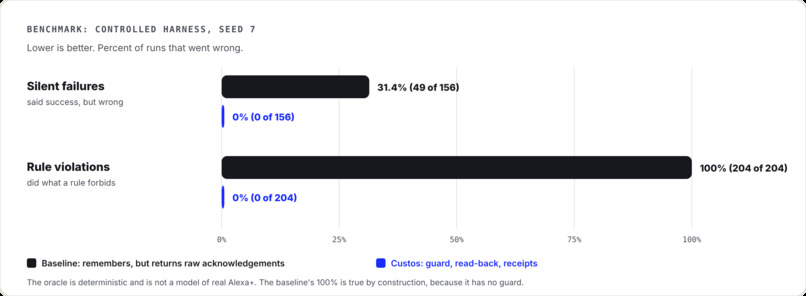
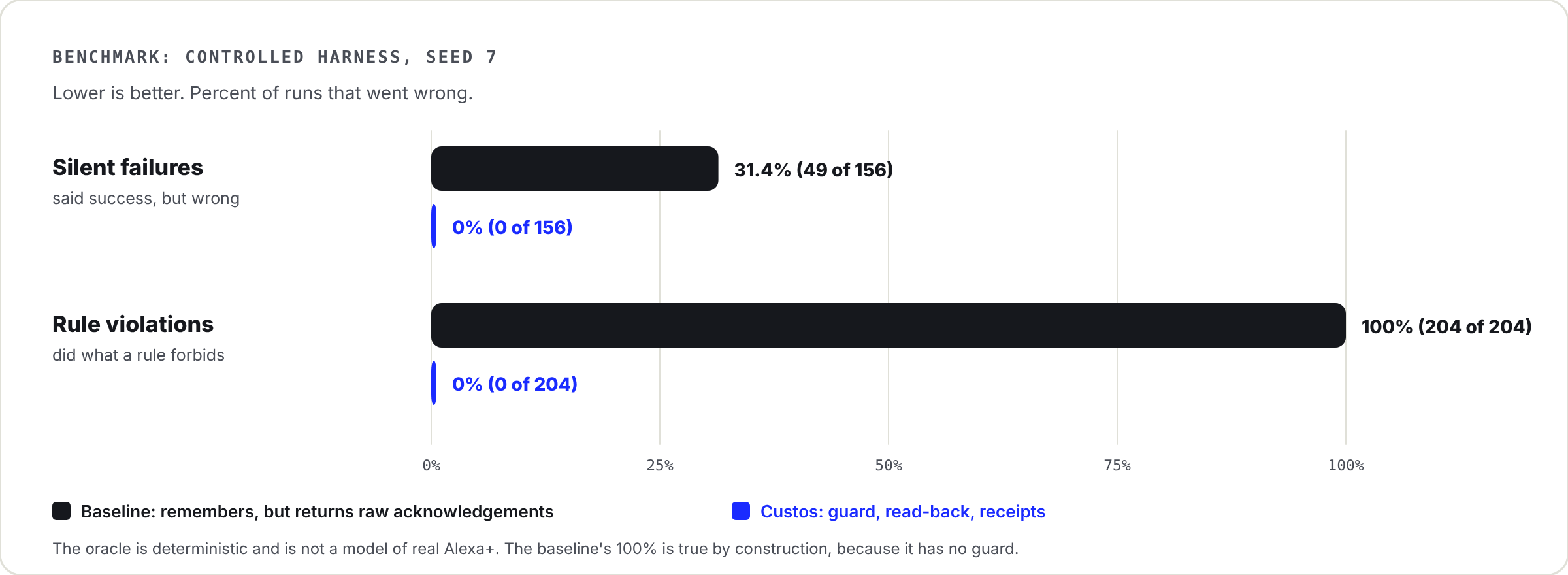
On a controlled harness (seed 7), Custos had 0 of 156 silent failures versus 49 of 156 (31.4%) for the baseline, and 0 of 204 rule violations versus 204 of 204 for the baseline. It disclosed all 13 unverifiable outcomes honestly.
We want to be clear about the limits. The benchmark uses a deterministic oracle, not real Alexa+. The baseline's 100% violation rate is true by construction because it has no guard. The prompt-injection sample is only three attempts.
Challenges
- Version friction. The Strands TypeScript SDK needs Zod v4, which broke our original v3 pin. A few APIs we planned around weren't in the installed SDK.
- Transport details. A plain JSON-RPC request fails with "Not Acceptable" unless the client accepts both JSON and event streams. The error doesn't name the missing header.
- Windows. FastMCP refused connections on
127.0.0.1whilelocalhostworked. - Proving things we can't observe. ntfy cannot confirm delivery of a scheduled message before it fires, so Custos reports "accepted by provider" and nothing stronger.
- Free-tier limits. OpenRouter's free quota ran out during testing, so we built a replay mode.
All of this is documented in our friction log and product feedback.
What we learned
- Enforcing policy in code at the tool boundary is far more reliable than putting it in a prompt.
- The most important design decision was the vocabulary of outcomes:
verified,verified_after_retry,unverified,blocked,needs_confirmation. Once "I couldn't prove it" is a first-class answer, honesty becomes the default. - A receipt turns a vague feeling of "I don't trust it" into something a family can actually check.
Honest status
- Devices are simulated through a device twin. No physical device or live Alexa+ session is involved.
- Amazon documents an MCP add-on path for Alexa+. We have not validated onboarding or compatibility end to end. The same
/mcpendpoint is what such an integration would call. - Ingredient matching uses heuristics and is not allergen-safety advice.
What's next
Validate the Alexa+ add-on path end to end. Add a real device adapter (Matter or Home Assistant). Grow the injection test set, publish model-driven benchmark runs, and add more diet packs such as halal and kosher.
Custos is MIT-licensed and open source. It is not affiliated with or endorsed by Amazon.
Built With
- amazon-web-services
- fastmcp
- hono
- mcp
- node.js
- ntfy
- open-meteo
- postgresql
- react
- render
- strands-agents
- supabase
- typescript
- vercel
- vite
- zod

Log in or sign up for Devpost to join the conversation.