Inspiration
Execution, not creativity, is the largest barrier to the release of new software products. It frequently takes weeks of planning, boilerplate setup, documentation, and frontend, backend, database, and infrastructure synchronization to transform an idea into a coherent, scalable, and production-ready codebase. I am motivated by the concept of "AI as a co-founder", a system that comprehends architecture, coherence, and developer intent throughout the project in addition to assisting with code generation. Kiro seemed like the ideal platform to realize this vision because of its semantic hooks, project-wide steering, and spec-driven intelligence.
What it does
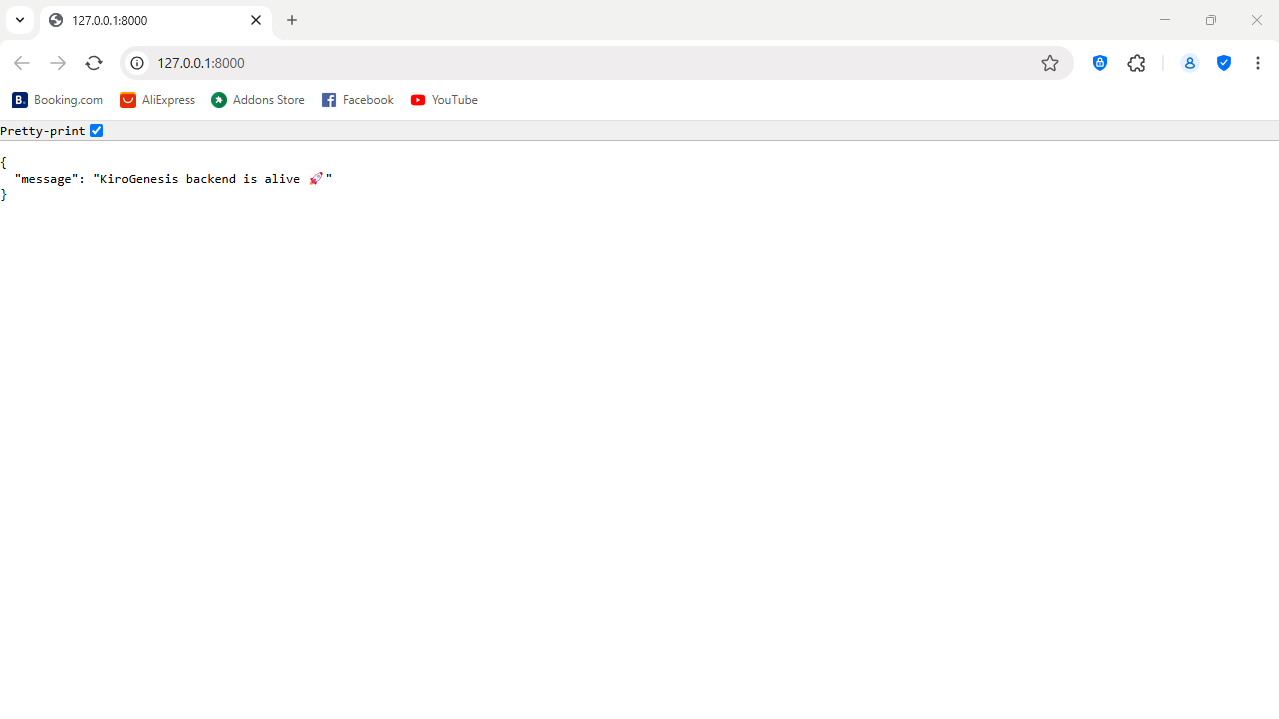
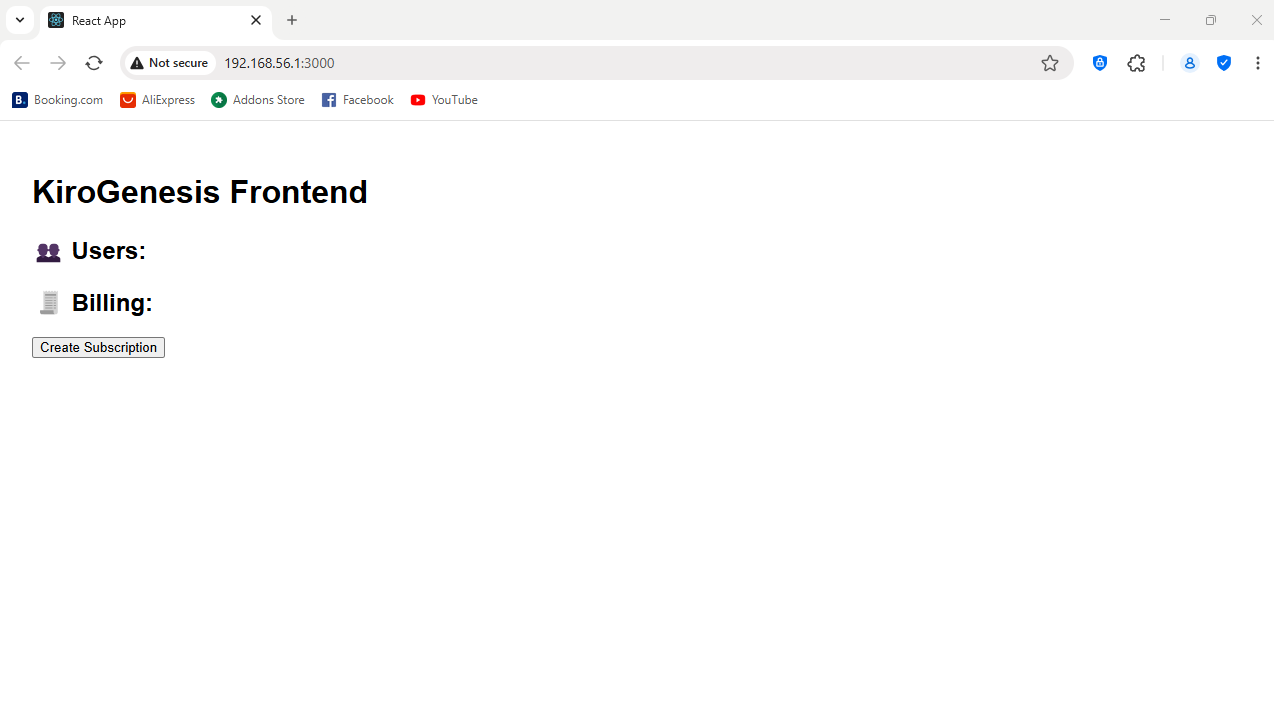
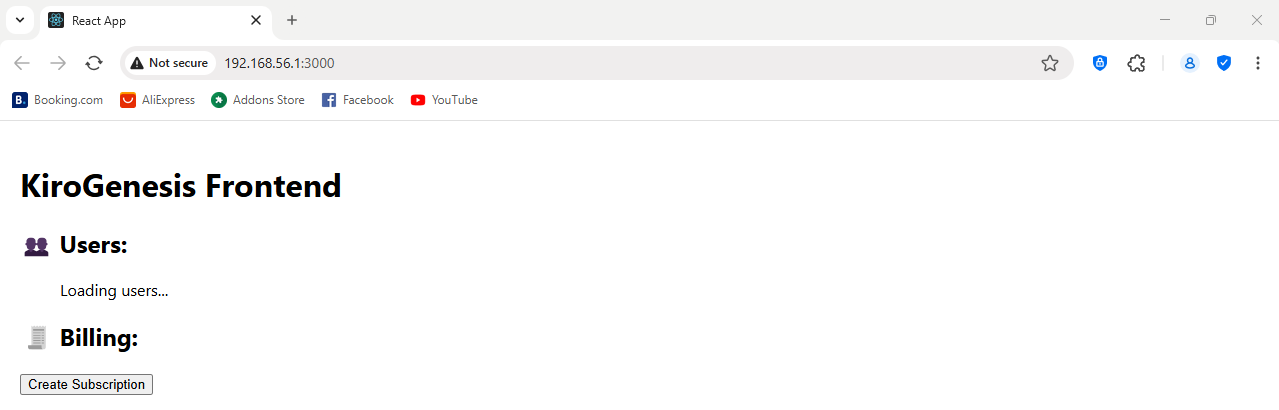
An autonomous AI agent called KiroGenesis uses Kiro's sophisticated code understanding to transform a plain-English product idea into a fully structured, full-stack monorepo.
For example, "Build a SaaS platform for remote drone diagnostics with Stripe billing and a real-time dashboard" is a one-sentence prompt.
The concept is then divided into structured .kiro/specs for the database, frontend, backend, testing, and CI/CD.
- Creates a monorepo using full-stack code (Docker, FastAPI/Express, Prisma/Postgres, Next.js/SvelteKit).
- Adds hooks for linting, documents, and test automation. -In order to maintain uniform naming, folder structure, and API conventions, steering rules are applied. Iterative development is made possible by natural language dialogues in Visual Studio Code.
How we built it
-We created modular .kiro/specs for a variety of common service types (API, dashboard, payment, and database) using Kiro Studio as the foundation.
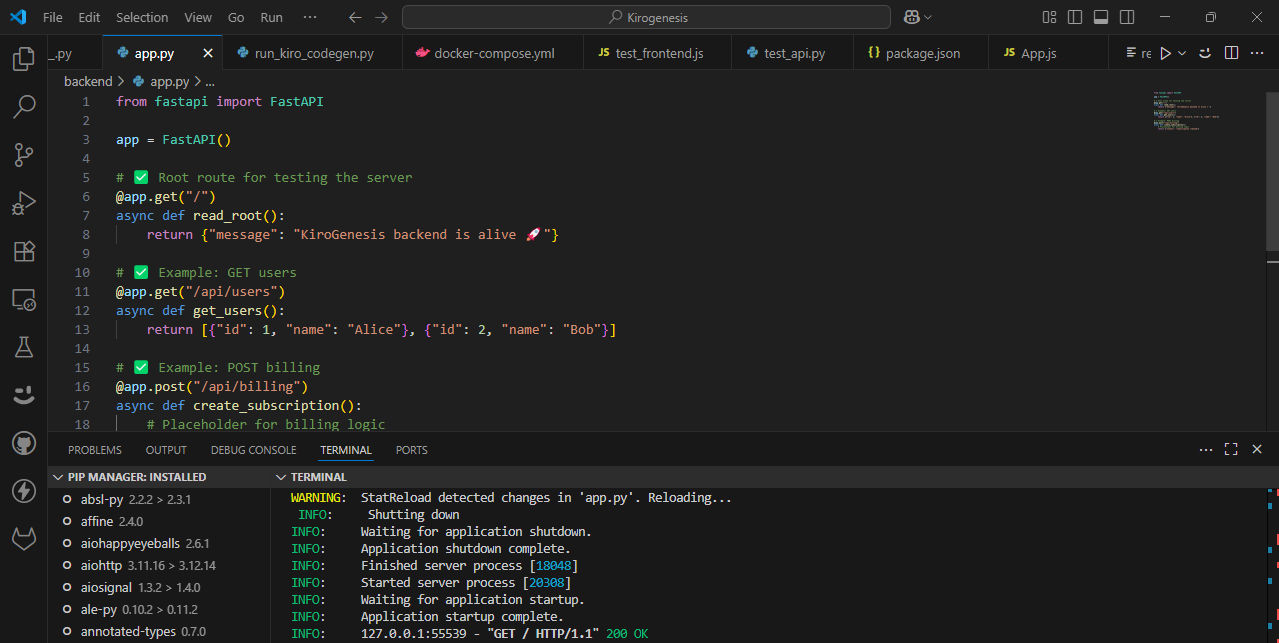
- Using Kiro's spec-to-code and agent hooks system, the entire project was constructed in VS Code. -We put in place processes that enabled semantic reasoning between modules, such as creating API endpoints that automatically establish connections with the database and frontend layers. -In order to enable highly reusable patterns, we constructed KiroGenesis as a thin layer of logic and prompts around Kiro's steering engine and API.
Tech Stack:
- VS Code (editor)
- Kiro (backend AI) -Frontend: Next.js/SvelteKit; backend: FastAPI/Express.js -Prisma (DB layer) -Docker + GitHub Actions (hooks/infra)
Challenges we ran into
- Coherence across modules: Making sure that the DB, frontend, and backend layers adhered to the same logic and schema. With Kiro's steering, we were able to resolve this.
- Prompt engineering: Organizing natural language specifications so that Kiro's AI can understand them while humans can read them.
-Making Kiro treat the current code as modifiable rather than fixed is known as "iterative correction." To direct regeneration, we used Git hooks and versioned
.kiro/specs. -Time-limited spec expansion: To enable quick yet adaptable generation in real time, we had to develop dynamic but constrained spec templates.
Accomplishments that we're proud of
-From a single natural language idea, a full-stack SaaS generator was created.
- Made full use of Kiro's /.kiro system, including steering rules, agent hooks, and specification generation.
- Developed reusable building blocks for startups powered by AI in the future. -It was not necessary to manually connect the services in order to maintain codebase coherence across services.
What we learned
- AI has evolved beyond merely assisting with code; it can now function as a system architect.
- Kiro’s capabilities go well beyond a file-by-file understanding. Kiro is capable of envisioning high-level architecture; moreover, Kiro can also enforce it throughout the entire codebase.
- Specs and hooks are not “extra features”: they are fundamental to the creation of sustainable AI-generated projects.
- Given the proper organization, AI is able to produce not only MVPs, but entire production-ready monorepos complete with deployment configuration.
What's next for Genesis: Autonomous Spec-to-Startup Generator
- VS Code Extension: Include spec editing and Kiro chat inline. Allow users to publish and remix.kiro/specs for their own product ideas through the Startup Templates Marketplace.
- Multi-agent mode: Permit front-end, back-end, and dev-ops Kiro agents to work together on big projects. -A research paper on "Spec-Driven Multi-Agent LLM Architectures for Rapid Software Prototyping" is being written by us and submitted to conferences on artificial intelligence and software engineering. -Open-source community: Request new steering grammars, hooks, and specifications from developers.


Log in or sign up for Devpost to join the conversation.