-
-
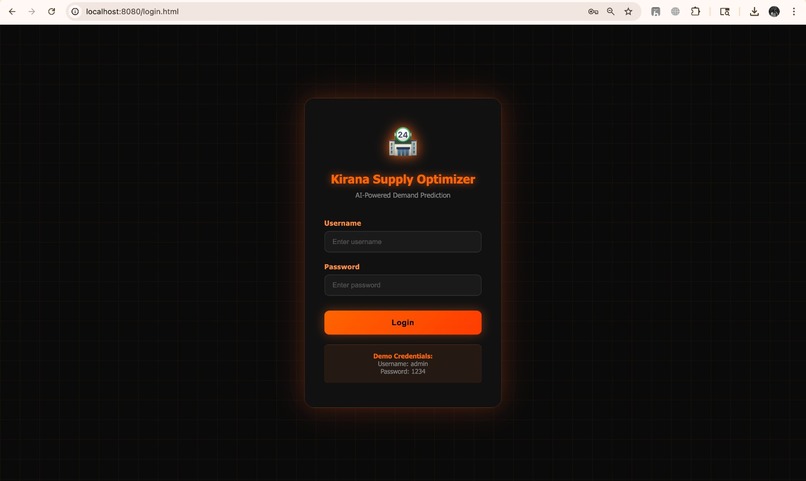
Kirana Supply Optimizer - AI powered demand prediction
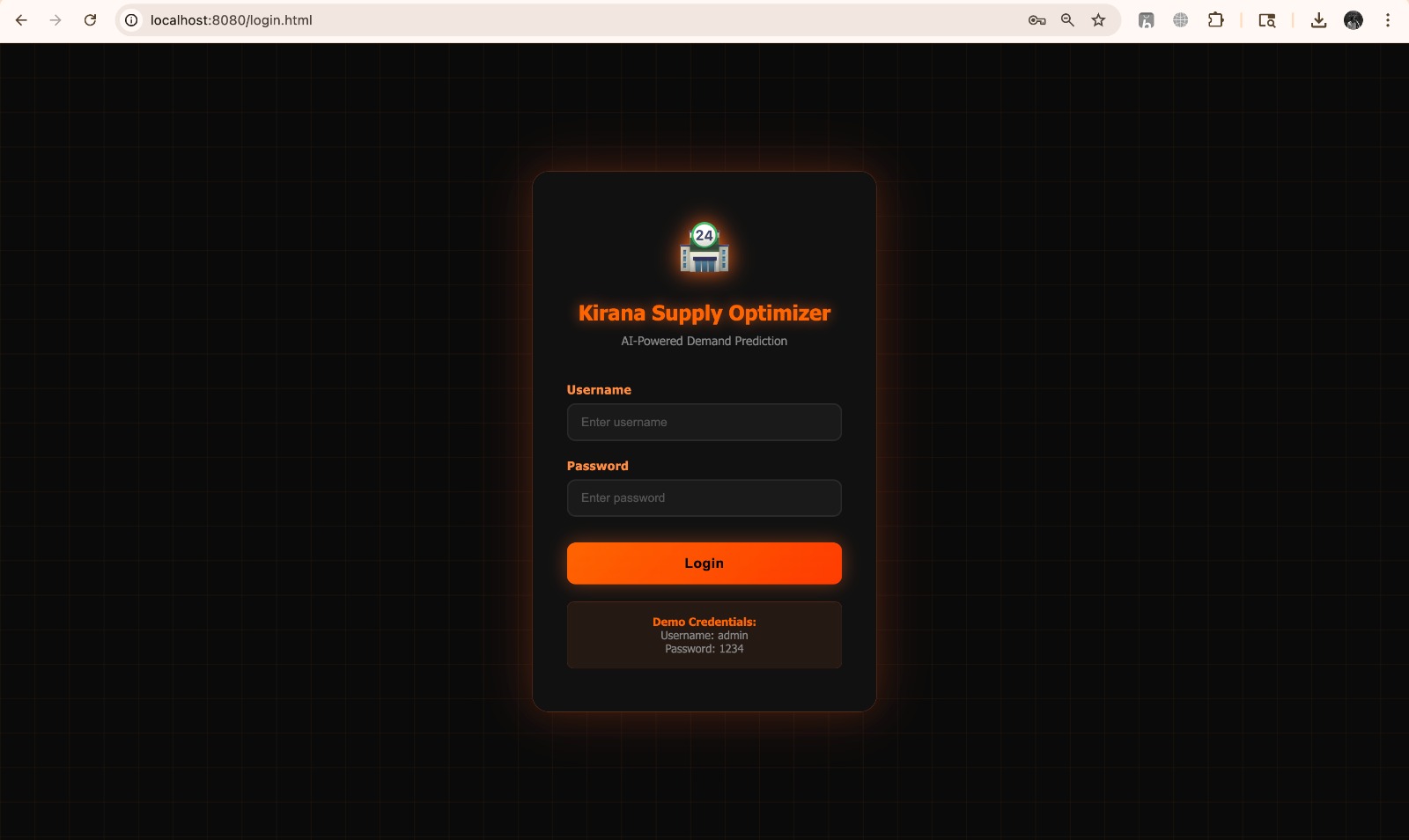
🧠 Kirana Supply Optimizer — AI-Powered Inventory Intelligence for Kirana Stores
💡 Inspiration
India’s kirana stores are the backbone of local commerce, yet most of them operate on intuition rather than data. Store owners often struggle with two critical problems:
- Overstocking → leading to wastage (especially perishables)
- Understocking → leading to missed sales opportunities
We were inspired by this gap between traditional retail practices and modern data-driven decision making. While large retailers use sophisticated supply chain systems, small stores lack access to such tools.
Kirana Supply Optimizer was built to bridge this gap using AI.
🚀 What It Does
Kirana Supply Optimizer is an AI-powered agent that helps kirana store owners:
- 📊 Predict product demand based on historical patterns
- 📦 Recommend optimal restocking quantities
- ⚠️ Prevent stockouts and reduce wastage
- 🧠 Provide simple, explainable insights for decisions
Example Output:
- Predicted Demand: 70 units
- Recommendation: Restock 30 units
- Insight: High evening demand pattern observed
🏗️ How We Built It
🔹 Data Layer (Databricks + Delta Lake)
We simulated real-world retail data including:
- product
- time slot (morning/afternoon/evening)
- day type (weekday/weekend)
- sales and inventory
All data was stored using Delta Lake, ensuring structured and scalable storage.
🔹 Data Processing (PySpark)
We used PySpark for:
- data cleaning (removing nulls, duplicates, outliers)
- feature engineering:
- day type
- time-based features
- rolling averages
- lag variables
🔹 Machine Learning Model
We trained a regression model to predict demand:
[ \text{Demand} = f(\text{product}, \text{time}, \text{day}, \text{inventory}, \text{historical trends}) ]
Using Spark ML, we implemented:
- feature vectorization
- demand prediction model
🔹 Decision Logic
We implemented a simple but effective rule:
[ \text{Restock Quantity} = \begin{cases} \text{Predicted Demand} - \text{Current Inventory}, & \text{if demand > inventory} \ 0, & \text{otherwise} \end{cases} ]
🔹 AI Explanation Layer
To make outputs understandable, we added an explanation layer:
- Converts predictions into human-readable insights
- Example: > "Demand is high due to evening peak consumption patterns."
🔹 Backend + Interface
- Backend: FastAPI
- Interface: Lightweight input form for demo
- Output: Structured JSON → clean UI display
🧠 What We Learned
- How to build end-to-end ML pipelines using Databricks
- Importance of feature engineering over model complexity
- How to balance speed vs correctness in a hackathon
- Designing systems where AI adds real decision value, not just predictions
⚠️ Challenges We Faced
1. Time Constraints (6 hours)
We had to:
- prioritize core functionality
- cut down advanced features like ensemble models and full MLflow pipelines
2. Data Availability
Real kirana data isn’t easily accessible, so we:
- simulated realistic datasets
- ensured variability for meaningful predictions
3. System Scope
Initially, we aimed for a full supply chain optimizer, but we refined the scope to:
Demand prediction + restocking intelligence
4. Databricks Integration
Ensuring proper usage of:
- Delta tables
- Spark transformations
while keeping the system lightweight was challenging.
🏆 What Makes Kirana Supply Optimizer Unique
- Focuses on small retailers, not large enterprises
- Combines:
- Data engineering (Delta Lake)
- ML prediction (Spark ML)
- AI reasoning (explainability layer)
- Provides actionable decisions, not just analytics
🔮 Future Improvements
- Real-time sales data integration
- Supplier recommendation system
- Mobile app for store owners
- Multi-store intelligence and benchmarking
🎯 Conclusion
Kirana Supply Optimizer transforms inventory management from guesswork to intelligence.
By combining AI with accessible tools, we aim to empower millions of small retailers to make smarter, data-driven decisions.
Smarter Stocking, Powered by AI

Log in or sign up for Devpost to join the conversation.