-
-
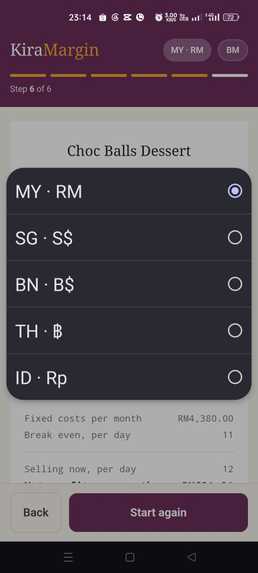
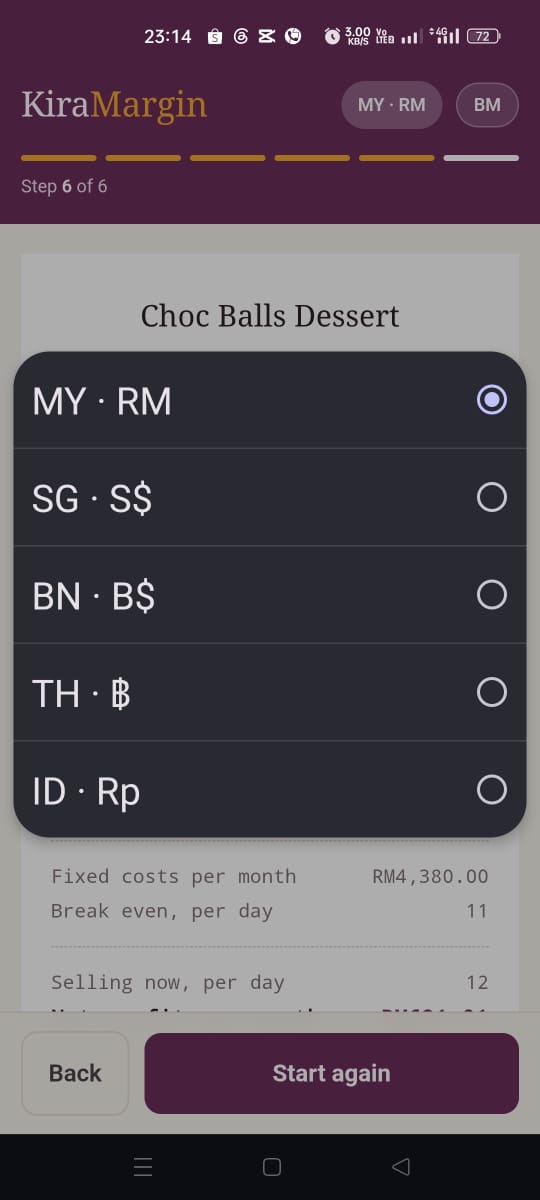
Currency Selector (We have users from Brunei & Singapore in the 1 week we launched)
-

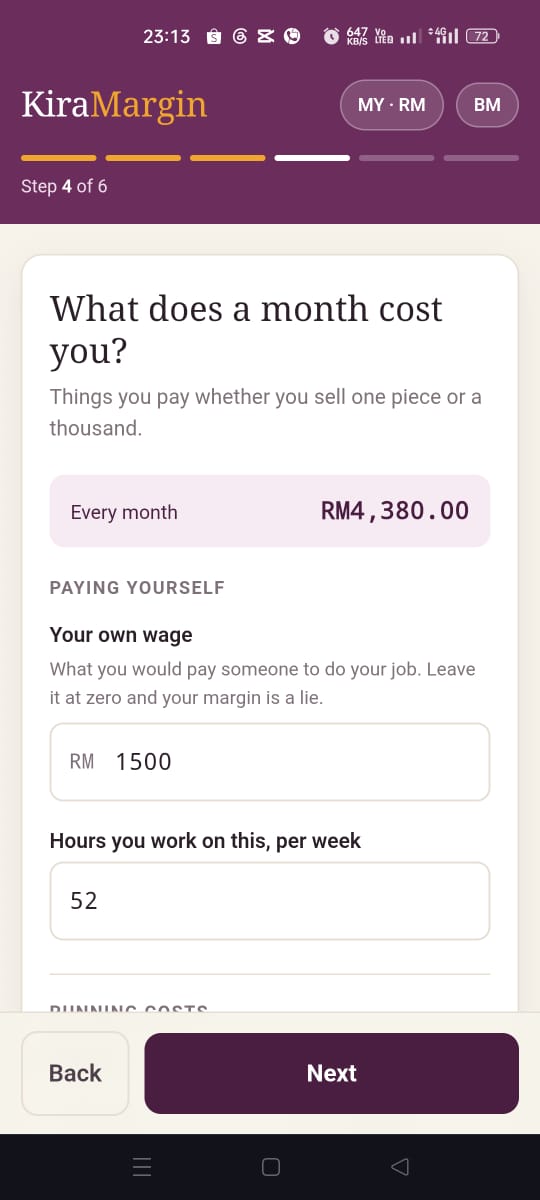
Add in your fixed costs here
-
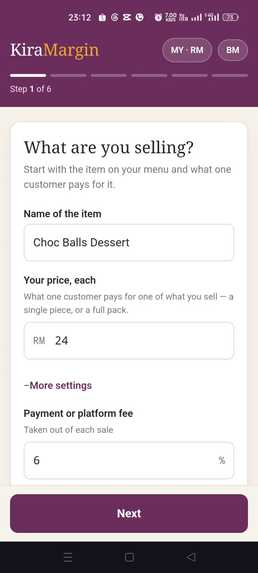
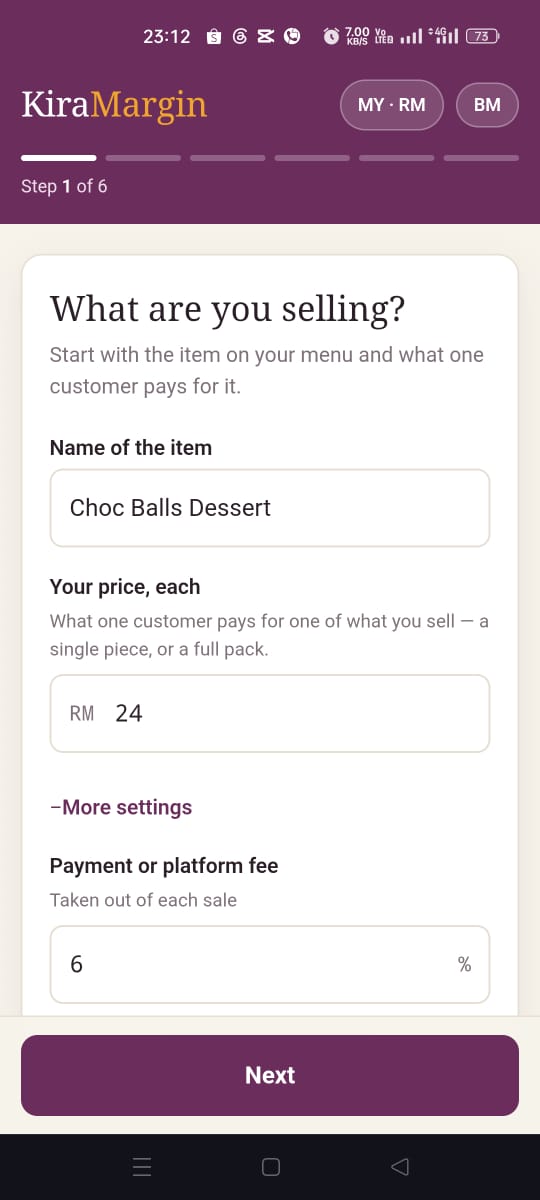
State your menu and how much it is sold. Add in platform fees if you sell on Tiktok/Shopee/Amazon
-
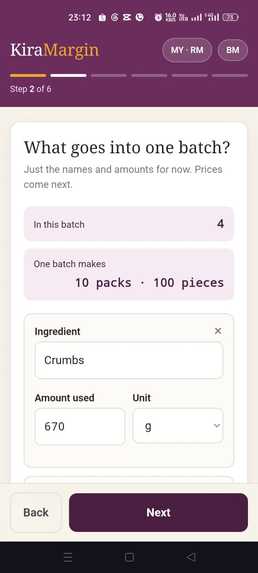
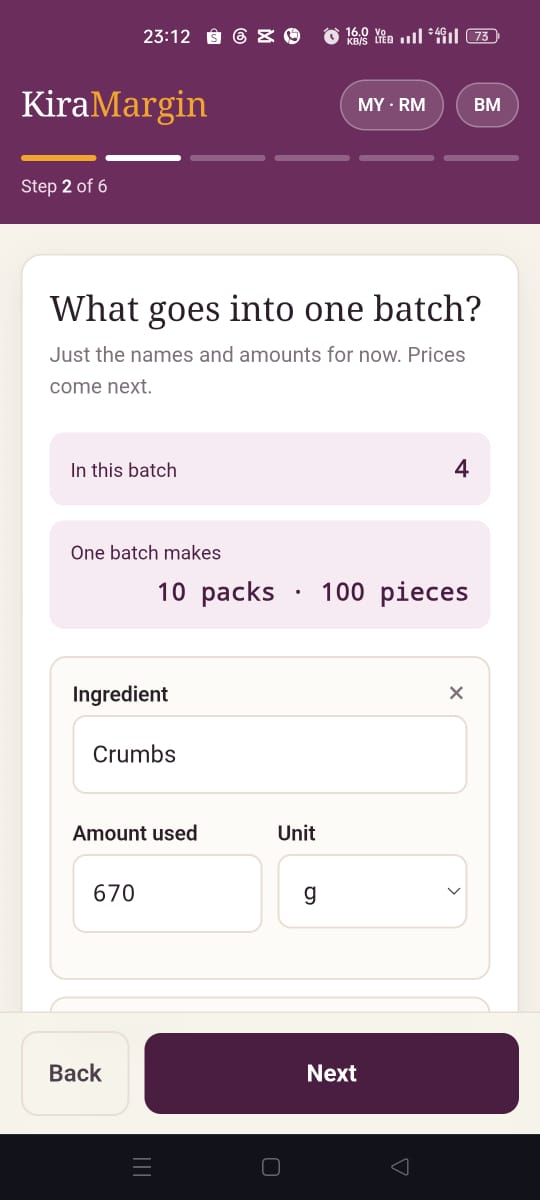
How many pieces can 1 batch yield
-
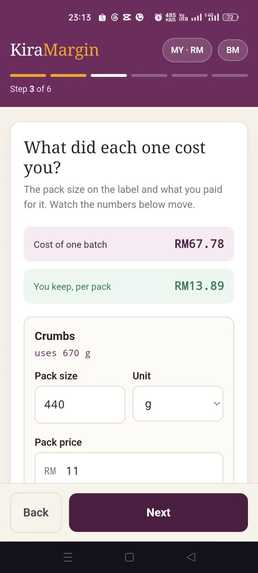
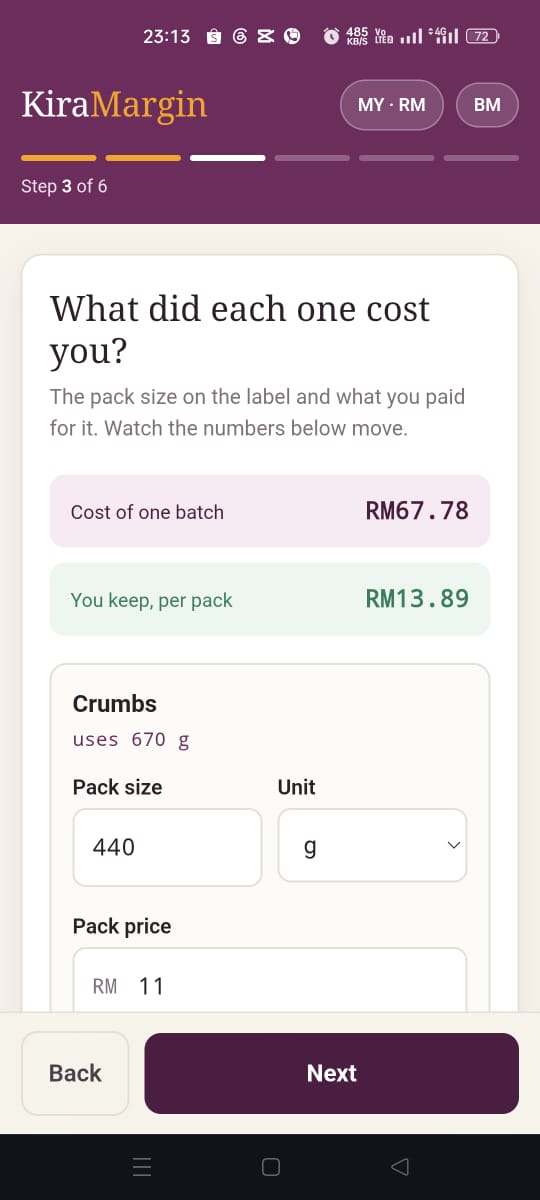
How much does each ingredient cost u
-
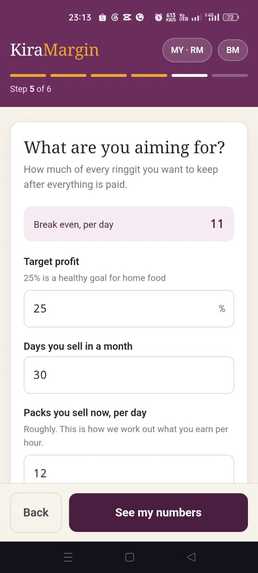
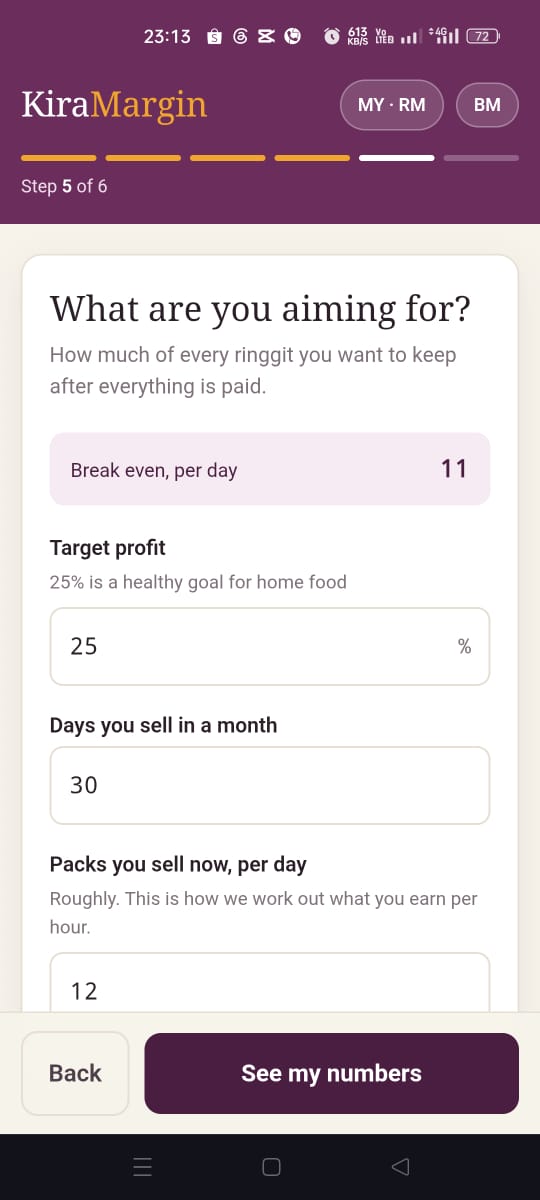
Set your net profit target
-
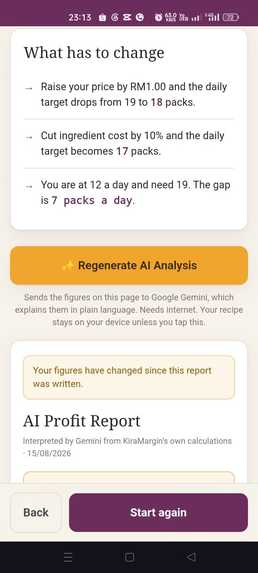
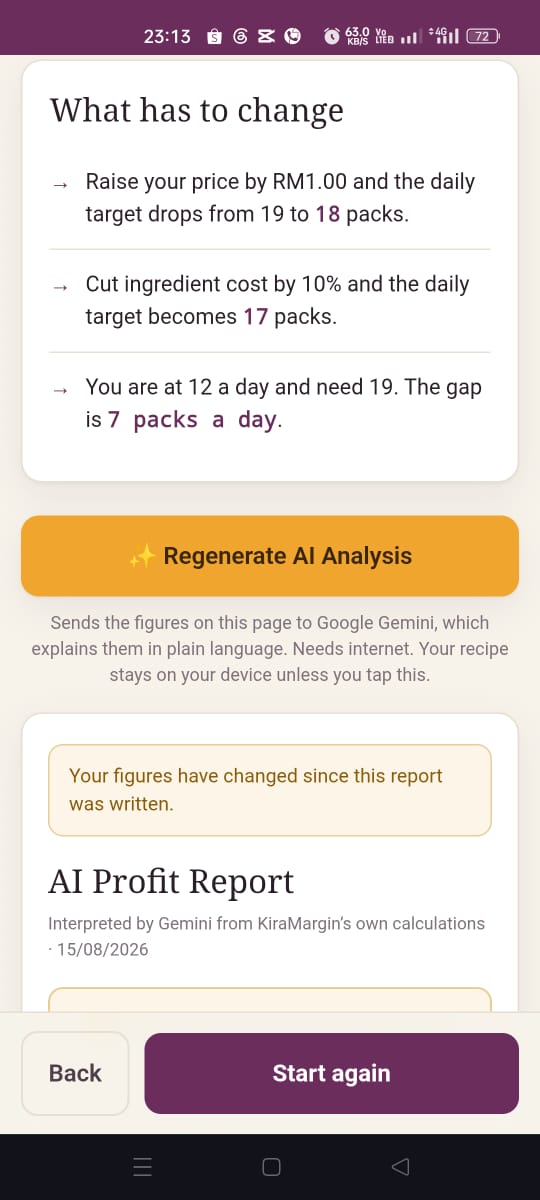
Just 1 click and you can get a detailed analysis on your product cost & margin
-
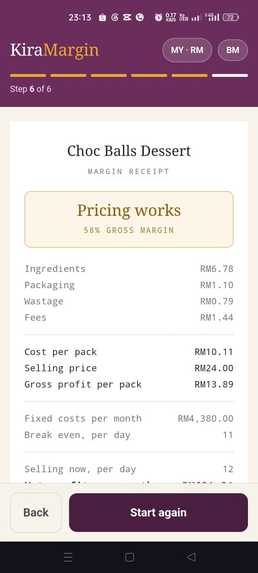
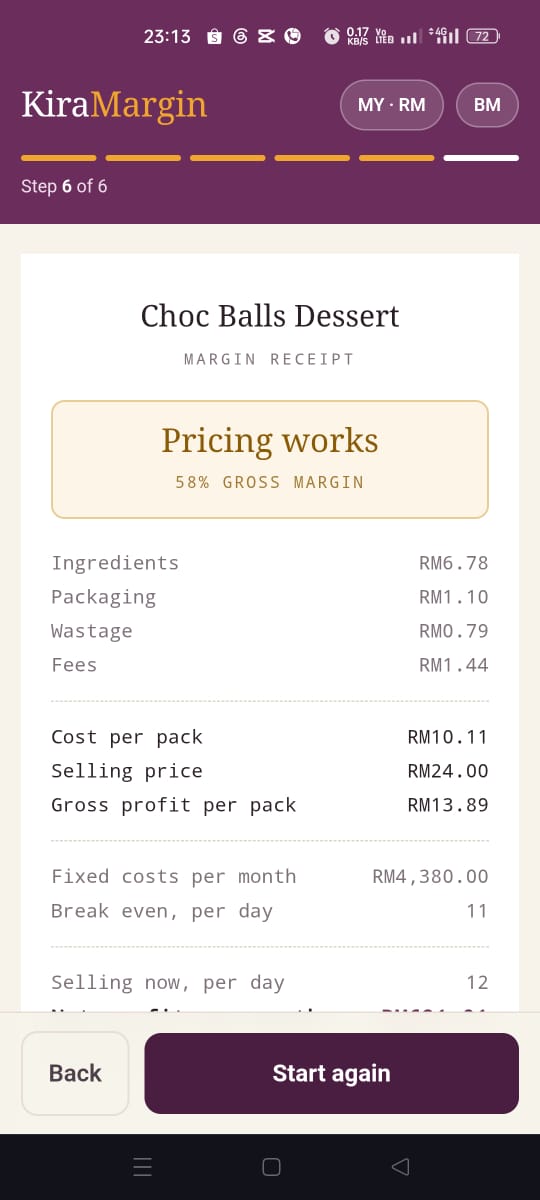
Summary of your COGS
-
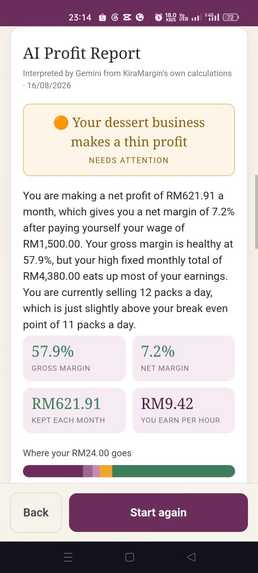
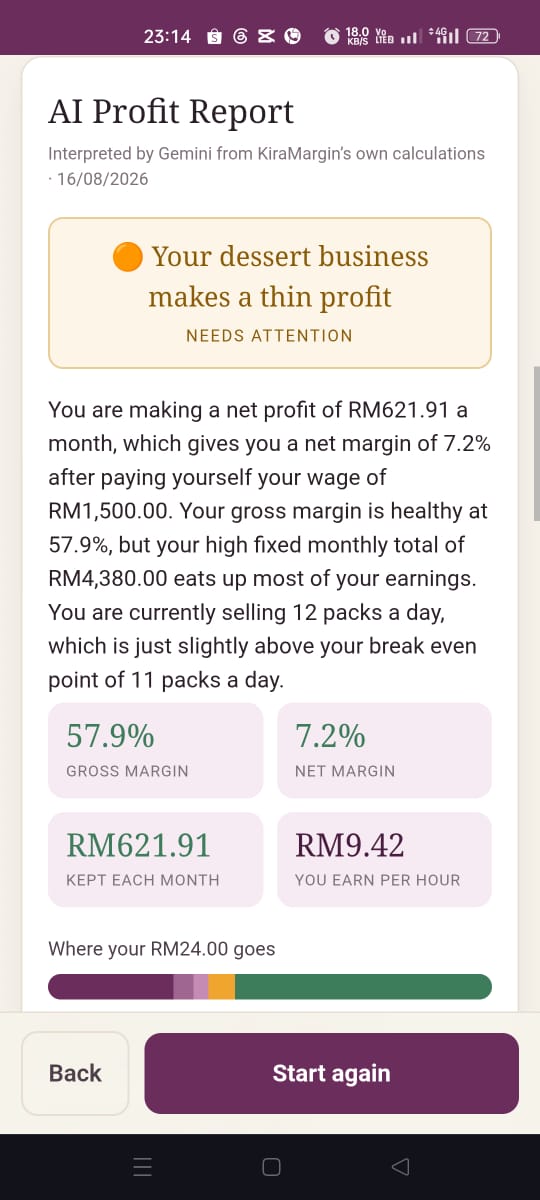
AI Report Details
-

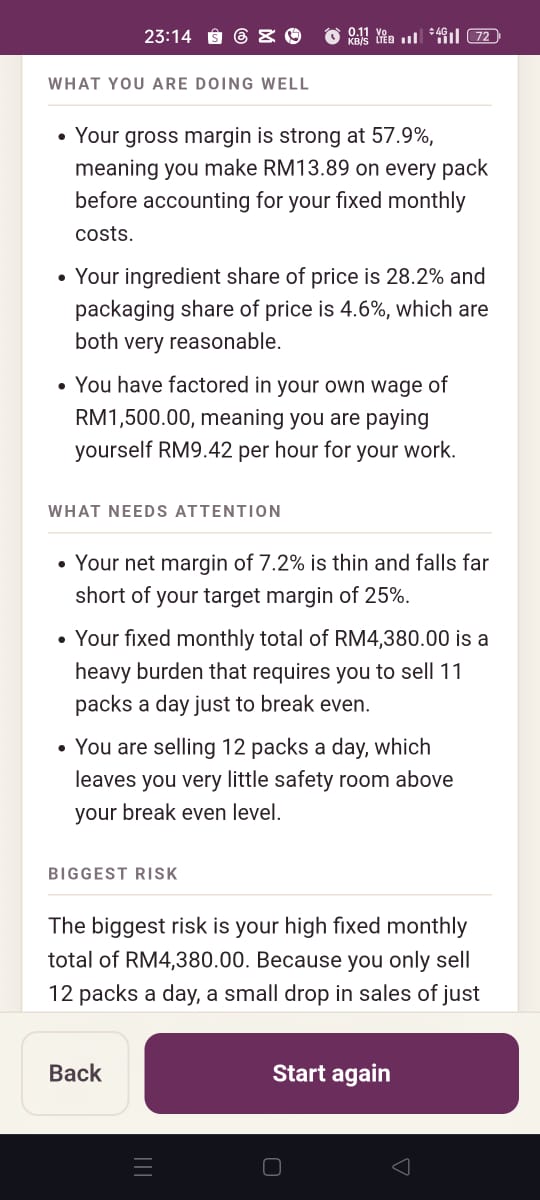
AI Report Details
-

AI Report Details
-
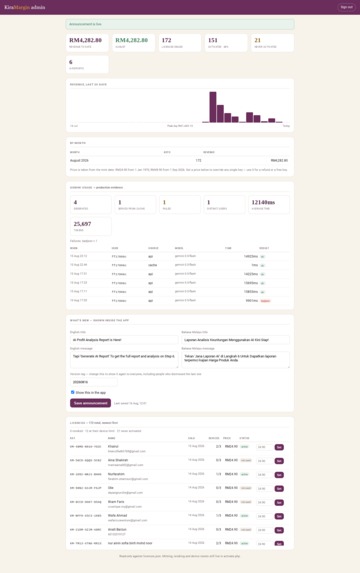
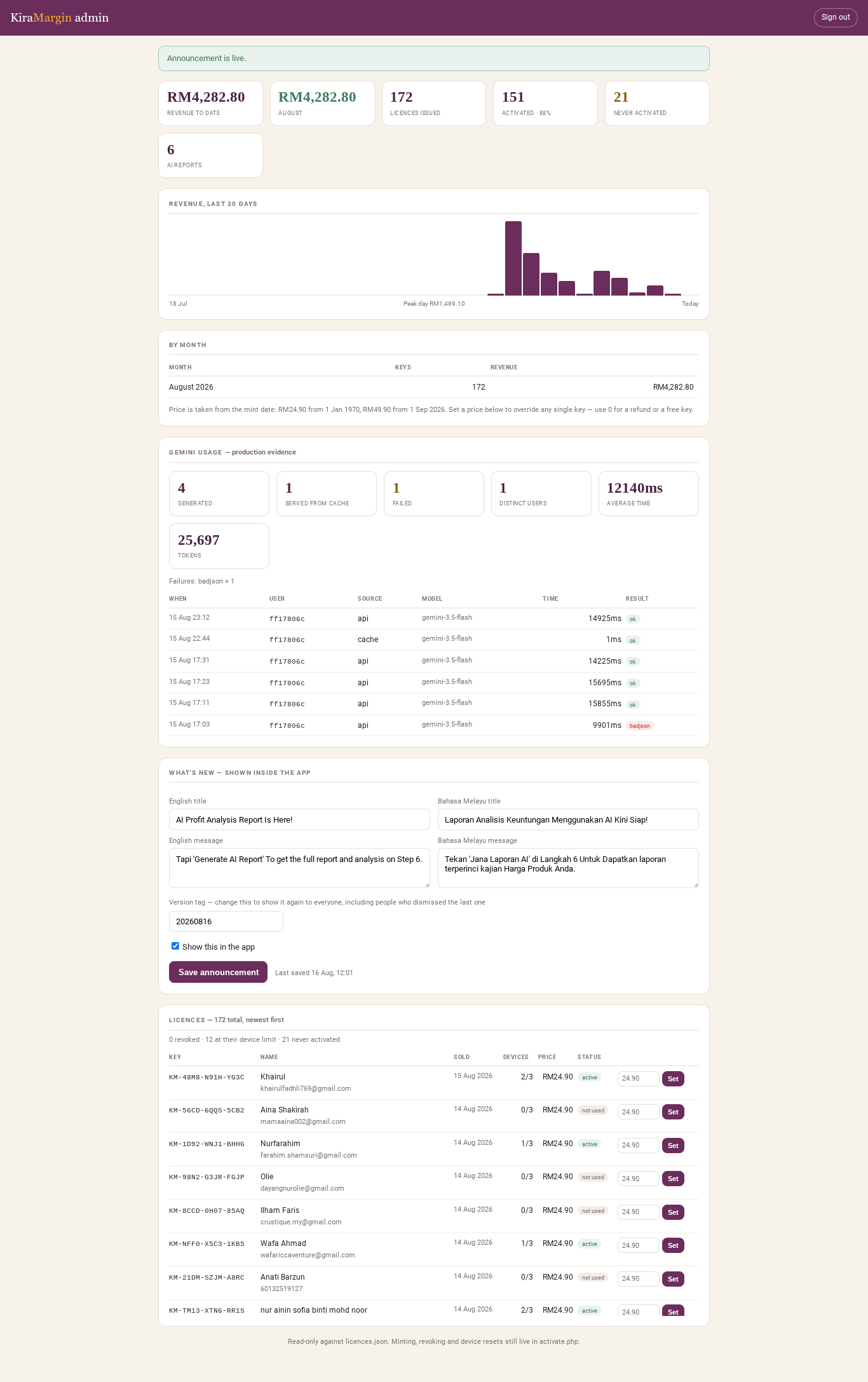
Admin Dashboard. Each user gets a unique user license that can be used on 3 devices.

Inspiration
KiraMargin came from a problem my wife and I personally experienced.
We have both run a small home-based food business, so we know what it feels like to be doing everything ourselves: buying ingredients, preparing orders, packing, replying to customers, managing costs and trying to figure out whether the business is actually making enough money.
Like many home-based sellers, we could see money coming in, but that did not always mean the business was truly profitable.
It is easy to calculate the obvious things such as flour, butter, chocolate or packaging. The harder part is remembering everything else: utilities, labour, fixed monthly costs, wastage and the small expenses that slowly reduce the real margin.
That experience made me realise that many small F&B businesses do not necessarily need a complicated accounting system.
They need a simple answer to a very practical question:
“After I count everything, am I actually making enough money?”
That became KiraMargin.
Development started on 5 August 2026.
The first version focused on making product costing simple enough for a home baker or small food seller to use without needing accounting knowledge. A seller enters their recipe, ingredient prices, operating costs and selling price, and KiraMargin calculates the real product cost, gross margin, net margin, expected profit and sales volume required to reach a target.
KiraMargin was launched publicly on 6 August 2026.
Within the first 11 days after launch, 177 users had paid for access.
That early response confirmed very quickly that this was not just a problem my wife and I had experienced. It was a problem shared by many other small F&B business owners.
That led to the next question:
“Once a small business owner knows their numbers, can AI help them understand what those numbers actually mean and what they should do next?”
That is where Gemini became valuable.
What it does
KiraMargin helps small food and beverage businesses understand whether the products they sell are actually profitable.
Users enter their recipe, ingredient prices, selling price and operating costs such as packaging, labour, utilities and fixed monthly expenses. KiraMargin then calculates the true product cost, gross margin, net margin, expected profit and the sales volume needed to reach a target.
The Gemini-powered AI Profit Report takes this one step further.
Instead of only showing numbers such as:
- Gross Margin: 62.6%
- Net Margin: 15.8%
- Net Profit: RM1,475.03
Gemini explains what those numbers actually mean in plain English or Bahasa Melayu.
It identifies:
- what the business is doing well
- which costs are putting pressure on profit
- the biggest financial risk
- practical ways to improve profitability
- a logical path towards a healthier margin
- the next three actions the owner should take
The goal is simple:
KiraMargin does not just tell a small business owner what their margin is. It helps them understand what to do about it.
The AI report can also be saved, printed or exported as a PDF, giving users a simple business report they can return to whenever they review their pricing or costs.
How we built it
Development of KiraMargin started on 5 August 2026, and the first live version was launched the next day on 6 August 2026.
The original product was built as a deterministic costing and margin engine first.
Only after the core product was already live, being used and generating revenue did we add the Gemini layer.
Because of that, we deliberately kept the financial calculation engine separate from the AI.
The workflow is:
User inputs → KiraMargin calculation engine → structured financial data → Gemini → AI Profit Report
KiraMargin remains responsible for all authoritative financial calculations.
For example:
[ \text{Gross Margin} = \frac{\text{Selling Price} - \text{COGS}} {\text{Selling Price}} \times 100 ]
Gemini does not independently calculate these values.
Instead, KiraMargin sends Gemini structured information such as:
- product selling price
- ingredient cost
- packaging cost
- labour cost
- utilities
- fixed expenses
- gross profit
- gross margin
- net profit
- net margin
- sales targets
Gemini then acts as the interpretation layer.
It analyses the numbers, identifies meaningful patterns and produces a structured response containing the business health assessment, risks, recommendations and next actions.
That response is rendered inside KiraMargin as a visual report rather than a chatbot conversation.
We also designed the AI feature so that it is isolated from the core application. If the Gemini service is unavailable, users can still complete their normal costing calculations without interruption.
AI reports are only generated when requested, and previously generated reports can be reused when the underlying costing data has not changed. This helps keep API usage efficient while still giving users access to useful AI analysis.
Challenges we ran into
The biggest challenge was not connecting to Gemini.
It was adding Gemini to a product that had already started gaining paying customers extremely quickly without damaging something that was already working.
KiraMargin went from development starting on 5 August 2026, to public launch on 6 August 2026, to 177 paid users within its first 11 days.
That meant we could not approach the integration like a typical hackathon prototype where the entire application could simply be rebuilt around AI.
Every change had to be made carefully.
The existing calculation formulas, user accounts, saved information and payment access had to remain untouched.
Another major challenge was deciding exactly where AI should be trusted.
Financial calculations require consistency. Asking a language model to independently calculate margins, target prices or profitability could create discrepancies between the AI report and the numbers shown elsewhere in KiraMargin.
We solved this by drawing a very clear boundary:
KiraMargin owns the maths. Gemini owns the interpretation.
A third challenge was making the AI genuinely useful to a non-technical small business owner.
It is easy for AI to produce a long financial explanation filled with generic advice.
That was not what we wanted.
The report had to be short, practical and specific enough for someone running a home bakery or small food business to understand immediately.
Instead of saying:
“Improve your cost structure.”
We wanted the system to say something closer to:
“Your fixed costs are putting pressure on your current margin. Increasing daily sales or reviewing your selling price would have the biggest impact.”
The challenge was not generating more information.
It was generating less information, but making every part of it useful.
Accomplishments that we're proud of
The accomplishment we are most proud of is how quickly KiraMargin was validated by real paying users.
Development started on 5 August 2026.
KiraMargin launched publicly on 6 August 2026.
Within just 11 days of launch, 177 users had paid for access.
That validation happened before the Gemini AI Profit Report became the centrepiece of the product.
This was important because KiraMargin was not created simply to demonstrate an AI concept.
It started from a real problem my wife and I experienced while running our own home-based food business, and the response from users showed that the same problem existed for many other small F&B entrepreneurs.
We are also proud that Gemini was integrated without turning KiraMargin into an AI gimmick.
The original product still works exactly as intended.
Gemini adds a new layer of value on top of it.
The application can now move a user from:
“My net margin is 15.8%.”
to:
“My net margin is 15.8%, here is why, here is the biggest risk, and here are the three things I should focus on next.”
That is a much more useful outcome for the type of small business owner we built KiraMargin for.
What we learned
One of the biggest things we learned is that small business owners do not necessarily need more data.
They need better interpretation of the data they already have.
A seller may know their revenue, ingredient costs and selling price, but those numbers do not automatically tell them whether the business is healthy.
We also learned that AI is most useful when it is given a clearly defined role.
Gemini does not need to replace the costing engine.
The traditional software is better at deterministic calculations.
Gemini is better at understanding the relationship between those calculations and communicating the result in a way that feels natural to a business owner.
Combining the two turned out to be much more useful than trying to make AI responsible for everything.
We also learned this from our own experience as home-based F&B sellers:
When you are running a small business, you are often the cook, marketer, customer-service person, packer, purchaser and administrator at the same time.
You do not have hours to analyse a financial report.
Sometimes what you need is simply:
“Tell me what matters and what I should do next.”
That insight shaped the entire AI Profit Report.
What's next for KiraMargin
The AI Profit Report is only the first step.
Right now, KiraMargin analyses an individual product and helps the owner understand its profitability.
The next stage is to help users understand their business as a whole.
Future capabilities we want to explore include:
Multi-product profitability analysis Identify which products generate the strongest and weakest margins.
Product portfolio recommendations Help sellers decide which products they should promote, reprice, improve or discontinue.
Ingredient price-change scenarios Show how an increase in the price of butter, chocolate, flour or other ingredients affects profitability across multiple products.
Target profit planning Allow a business owner to say, for example, “I want to earn RM10,000 per month,” and help them understand the sales volume and product mix required to reach that goal.
Monthly AI Business Health Reports Turn costing and sales information into a simple recurring business review.
Growth recommendations Help sellers understand whether their next opportunity should come from increasing price, increasing volume, reducing costs or changing their product mix.
Our long-term goal is for KiraMargin to evolve from a costing calculator into a simple financial decision-making companion for small F&B businesses.
We want a home baker, caterer, dessert seller or other small food entrepreneur to be able to open KiraMargin and quickly answer three questions:
Am I making money?
What is hurting my profit?
What should I do next?
Built With
- css3
- gemini
- html5
- javascript
- localstorage
- php
- pwa
- serviceworker
- webstorage

Log in or sign up for Devpost to join the conversation.