Inspiration
The rhythm of the wok is a language "Uncle Ah Hock" speaks fluently. For 30 years, he has served the best Char Kway Teow in my neighborhood. But last week, I saw that rhythm break.
It wasn't just the cooking that slowed him down—it was the invisible burden of being an accountant, a logistician, and a chef all at once. During the peak lunch rush, I watched him struggle to mentally calculate totals while packing orders, the stress evident on his face. I knew that after a grueling 12-hour shift, his work wasn't done—he still had to face the nightmare of creating financial statements from a pile of greasy receipts.
But the struggle wasn't just behind the counter.
I looked at the queue and saw my own grandmother. Like many elderly people, she feels left behind in this digital era. She often stands frozen in front of self-ordering kiosks at fast-food chains like McDonald's, intimidated by complex touchscreens and text she can barely read. She knows what she wants to eat, but the technology stands in her way.
It hit me: We are building a digital nation that is leaving our heritage and our elders behind.
Uncle Ah Hock shouldn't have to be a financial expert to survive. And my grandmother shouldn't need a degree in IT just to order a burger.
That was the spark for KiraKira POS Pro. I asked myself: Why force humans to learn the computer's language, when AI is smart enough to learn ours?
I built this project as a solo developer to bridge this gap. I wanted a system where a hawker could just say "Sold 3 plates nasi lemak" to handle their accounting, and where an elderly customer could just speak their order instead of fighting with a touchscreen. KiraKira POS Pro exists to restore dignity to the trade and independence to our elders, letting technology handle the chaos so we can focus on the human connection.
What it does
KiraKira is a comprehensive, AI-powered Operating System for F&B businesses. It features three distinct portals:
The "No-Touch" Staff POS: Staff can simply speak orders (e.g., "Dua Nasi Lemak, satu Teh Ais kurang manis") and Google Gemini 2.5 instantly transcribes the audio into a structured digital order using the streamlit-audiorecorder module.
The Smart Owner Dashboard: Owners can snap photos of supplier receipts. The AI analyzes the image, extracts the total cost, and automatically categorizes it as an Expense, updating the Net Profit analytics in real-time.
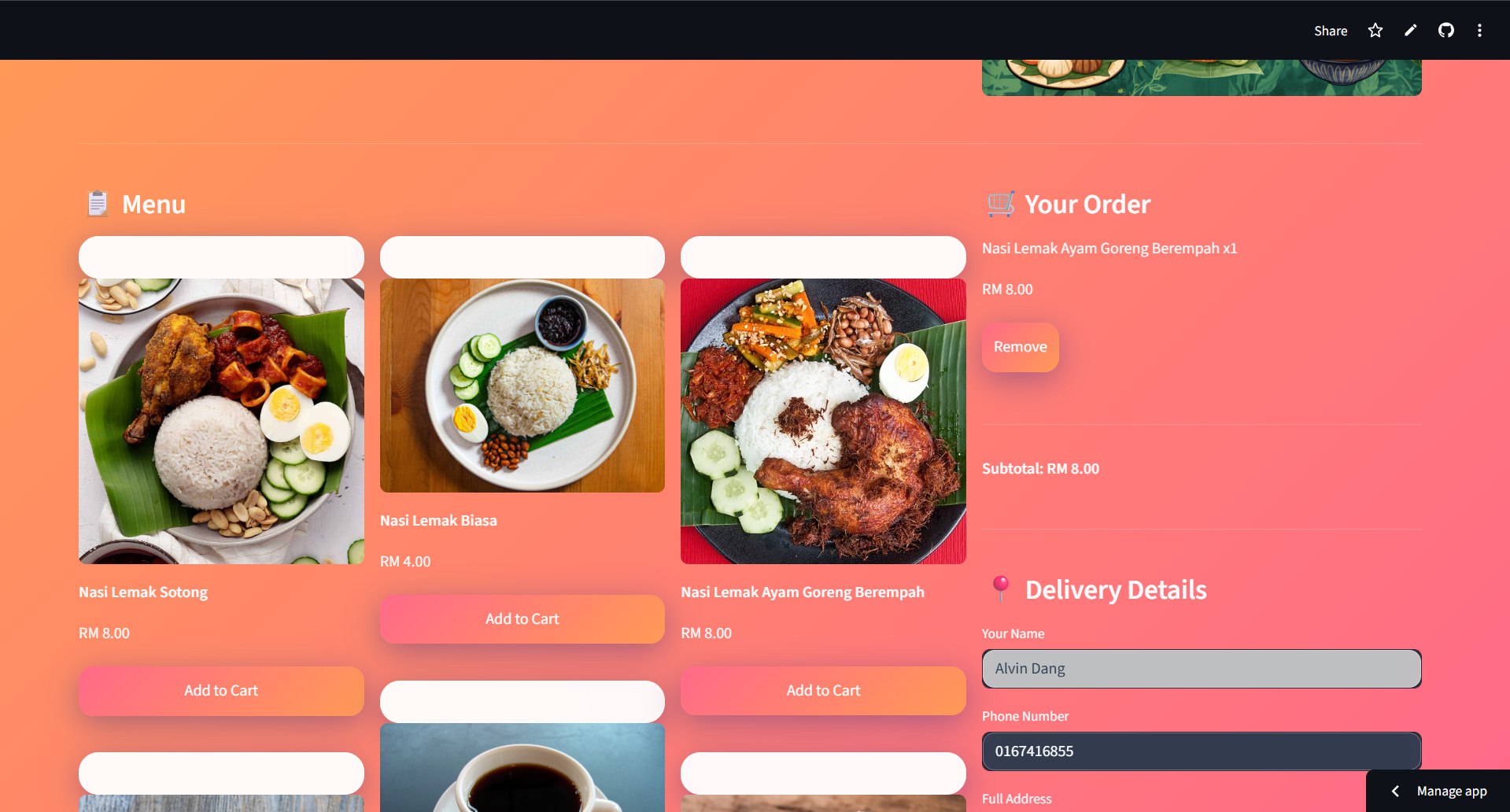
The Customer Delivery Portal: A dedicated link for customers to place orders. The system simulates logistics by calculating delivery fees based on distance (using Geopy) and requires customers to upload E-Wallet payment proof, which the AI and staff can verify.
How we built it
I built KiraKira POS Pro with the help of Cursor to accelerate my development speed as a solo developer.
-The Brain: I utilized Google Gemini 2.5 Flash for its multimodal capabilities. It handles the Voice-to-JSON transcription for orders and the Vision-to-Data extraction for receipt scanning.
-The Frontend: I used Streamlit (Python) for a responsive, mobile-friendly UI that works on both tablets and phones.
-The Database: I implemented SQLite to manage complex relationships between Users (Staff/Owners), Transactions, Products, and Shop Settings.
-Logistics: I used geopy to calculate delivery distances and dynamic fees.
Challenges we ran into
Handling "Manglish": Standard speech-to-text models struggle with Malaysian slang. I had to prompt-engineer Gemini effectively to understand context (e.g., knowing that "Kopi O Ikat Tepi" is a drink order, not random words).
State Management: Creating a seamless flow where a Customer places a delivery order and it instantly appears on the Staff's "Pending Orders" dashboard required complex session state and database management within Streamlit.
Vision Accuracy: Teaching the AI to distinguish between a "Sales Receipt" and a "Supplier Invoice" required refining my system prompts significantly.
Accomplishments that we're proud of
Multimodal Integration: I successfully combined Audio, Vision, and Text AI into a single workflow on my own.
Role-Based Security: I built a secure system where Owners have full access (Analytics, Menu Manager) while Staff are restricted to the Cashier, preventing data tampering.
The "Zero-UI" Experience: Creating a POS where you don't actually have to touch the screen—you can just talk to it—feels like magic.
What we learned
English is the new Programming Language: As a solo beginner, I realized that modern coding is less about memorizing syntax and more about logic and architecture. Learning to write precise, context-rich prompts for Gemini was just as critical as writing Python code. I learned to "program" the AI to think like an accountant.
Empathy is a Technical Skill: I learned that the most advanced technology (Multimodal AI) is useless if it creates friction. The biggest breakthrough wasn't the code itself, but realizing that for a non-tech-savvy hawker, the best User Interface is no interface at all—just their voice and a camera.
The Velocity of AI Development: Using Cursor, I learned that the gap between "having an idea" and "shipping a product" has collapsed. I was able to build a full-stack application (Database + Frontend + AI Logic) in 24 hours that would have previously taken me weeks, proving that one person with the right AI tools can act as an entire engineering team.
What's next for KiraKira POS Pro
- AI-Driven Micro-Financing (The "Shadow" Credit Score) Most hawkers operate in a cash economy and are "invisible" to banks, making it hard to get loans to upgrade their stalls.
The Plan: Since KiraKira POS Pro records real, verified transaction data, I plan to generate a "Digital Credit Score" for hawkers. It can partner with banks (like Ryt Bank) to offer micro-loans for equipment upgrades based on their actual AI-verified cash flow, not just formal paperwork.
- Predictive "Kopitiam" Analytics Currently, hawkers guess how much stock to buy. If it rains, they waste food.
The Plan: I will upgrade the AI to correlate sales data with Weather Forecasts and Public Holiday APIs. The system will proactively tell the hawker: "Uncle, tomorrow is a public holiday but heavy rain is predicted. Buy 20% more eggs, but 50% less ice." This reduces food waste and maximizes profit.
- The "Manglish" Phone Agent Many customers still prefer calling to order, interrupting the chef's cooking.
The Plan: I aim to integrate Voice AI Agents (via ElevenLabs) that can answer phone calls automatically. The AI will speak fluent local dialect ("Manglish"), take the order over the phone, and send it directly to the kitchen screen without the hawker ever needing to put down their wok.

Log in or sign up for Devpost to join the conversation.