-
-
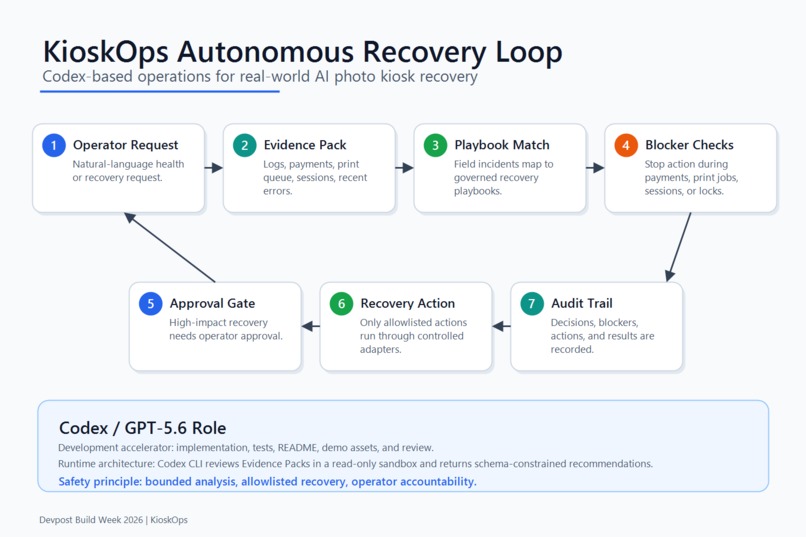
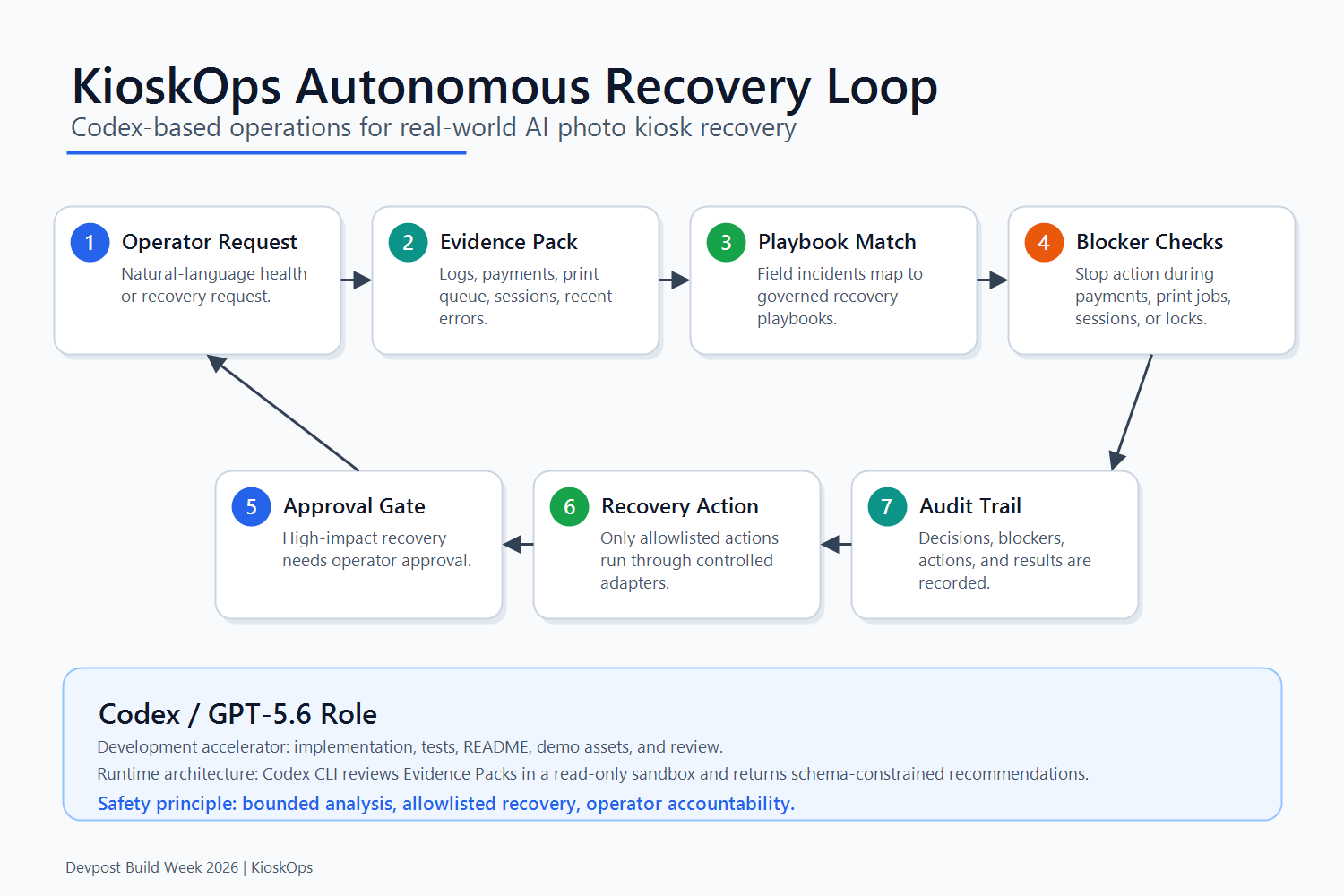
KioskOps recovery loop: natural-language request, Evidence Pack, playbook match, blocker checks, approval, recovery, and audit trail.
Inspiration
KioskOps came from real AI photo kiosk operations. I operate AI photo kiosks, including 63-01 and 63-02 at Seoul's 63 Building, and I have also operated kiosk services for multiple major Korean enterprise events.
The repeated field problem was clear: when a kiosk fails, the operator has to understand logs, payment state, print state, customer sessions, device status, and recovery risk under time pressure. KioskOps was built to turn that manual recovery work into a Codex-based autonomous operations workflow.
What it does
KioskOps lets an operator ask about kiosk health in natural language and turns that request into a governed recovery process.
It collects an Evidence Pack, identifies the kiosk and incident type, matches known recovery playbooks, checks blockers such as active payments, print jobs, customer sessions, and operator locks, and executes only approved recovery actions.
When no known playbook matches, Codex CLI can be used as a bounded final-defense analyzer. It reviews evidence in a read-only sandbox and returns schema-constrained recommendations instead of directly self-approving production actions.
How we built it
The system was built around the operational chain required for safe kiosk recovery:
- operator request
- intent routing
- evidence collection
- playbook matching
- blocker checks
- approval gates
- recovery execution
- audit trail
Codex was used throughout development to inspect field evidence, implement the workflow, write and refine tests, improve the README, create demo assets, and review the final submission narrative.
GPT-5.6 was used through Codex for implementation support, evidence-based reasoning, red-team critique, and final verification.
Challenges we ran into
The main challenge was balancing autonomy with safety. A kiosk operations agent must not blindly restart services, interrupt an active payment, lose a customer session, or hide a failure behind vague automation.
That is why KioskOps is designed around evidence-first recovery, allowlisted actions, blocker checks, and operator approval. The goal is not unrestricted AI control. The goal is faster and safer recovery with accountability.
Another challenge was turning real field experience into a product story. The project is technical, but the core problem is operational: helping people keep physical AI kiosks running reliably in public and enterprise environments.
Accomplishments that we're proud of
KioskOps connects a real business problem to a concrete AI-native product.
It demonstrates:
- a Codex-based autonomous kiosk operations system
- field-inspired recovery playbooks
- natural-language operations for kiosk managers
- Evidence Pack based incident handling
- safety gates before recovery execution
- Codex CLI as a bounded analysis layer
- a path from manual troubleshooting to governed AI-assisted recovery
What we learned
The biggest lesson is that autonomy is only useful when it is bounded by evidence, contracts, and accountability.
For physical kiosks, AI must understand the operational consequences of action. A recovery workflow needs to know when not to act as much as when to act. Codex and GPT-5.6 were most valuable when used inside that disciplined workflow: accelerating development, improving reasoning, and helping validate the product narrative without removing human responsibility.
What's next for KioskOps
Next, I plan to expand KioskOps from a Build Week submission into a production-ready operations layer for AI photo kiosk fleets.
The roadmap includes:
- broader playbook coverage from accumulated field error logs
- richer Evidence Pack comparison across kiosk sites
- tenant-level dashboards
- stronger approval and rollback controls
- live monitoring and alert integration
- Korean and English operator workflows
- controlled rollout to existing kiosk operations
Built With
- ai-photo-kiosk
- automation
- codex-cli
- devops
- evidence
- ffmpeg
- gpt-5.6
- javascript
- kiosk-operations
- monitoring
- openai-codex
- playwright
- python
- recovery-playbooks
- sqlite


Log in or sign up for Devpost to join the conversation.