🌱 Project Overview & Inspiration
Theme: Mend (QUX Design-a-thon 2026)
Interpersonal friction—between project teammates, roommates, or close friends—is an inevitable part of human connection. Yet today’s digital communication happens almost exclusively inside high-arousal instant messaging apps (iMessage, WhatsApp, Discord) engineered for speed rather than emotional safety. Trying to resolve hurt feelings inside a live chat thread often makes things worse: seeing "User is typing..." spikes cortisol, rapid-fire chat bubbles trigger defensive replies, and needing quiet time to process emotions feels like "ghosting."
Inspired by kintsugi—the traditional Japanese art of repairing broken pottery with gold lacquer—we designed Kintsugi Pact. Instead of treating interpersonal conflict as a failure to hide or delete, Kintsugi Pact provides a gentle, asynchronous, turn-based space where two people can hear each other, de-escalate tension, and turn resolved disagreements into a visible archive of shared resilience.
🔍 Research & Insights
To ground our design decisions in behavioral psychology and accessibility, we synthesized research on Diffuse Physiological Arousal (DPA) (Gottman Institute) alongside student experiences navigating group-project and roommate conflicts:
- The "Typing Indicator" Cortisol Spike: Live presence indicators push users into a fight-or-flight state, encouraging reactive speed-typing instead of active listening.
- Silence vs. Ghosting Anxiety: When a user is emotionally flooded, they need space to self-soothe. However, leaving a standard chat message on "Read" creates anxiety for the sender.
- Ephemeral Resolutions: Even when two people resolve a conflict in a chat app, their shared agreements quickly get buried under hundreds of new messages.
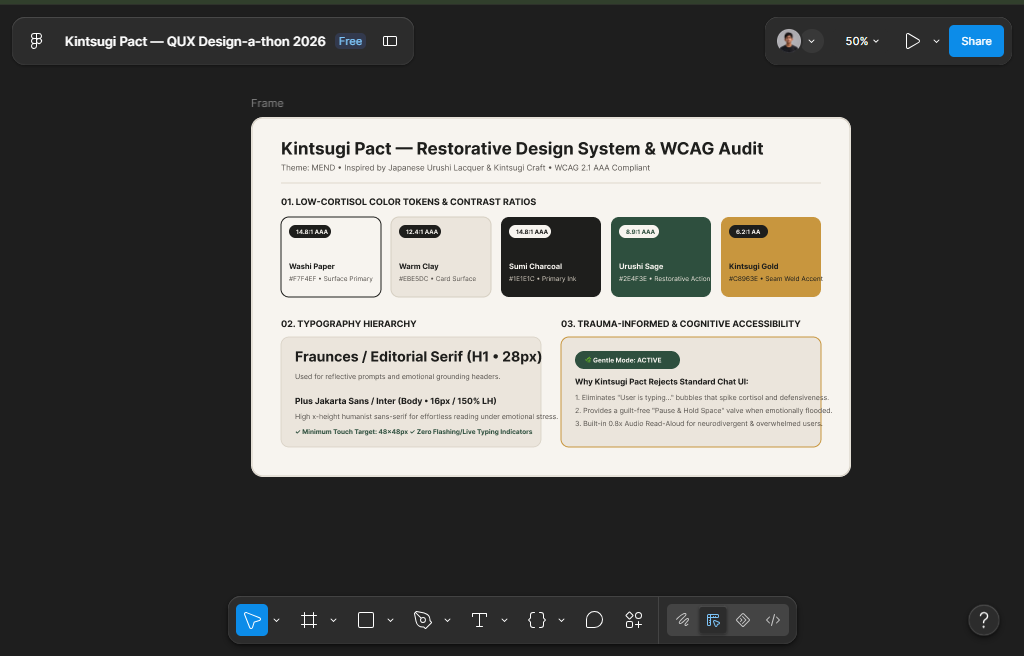
We also enforced strict mathematical accessibility standards across our color system using the WCAG 2.1 relative luminance contrast formula:
$$CR = \frac{L_1 + 0.05}{L_2 + 0.05} \ge 7.0 \text{ (WCAG AAA Standard)}$$
By pairing Unbleached Washi Paper (#F7F4EF) with Deep Sumi Charcoal (#1E1E1C), our primary reading surfaces achieve a contrast ratio of $14.8 : 1$, eliminating harsh #FFFFFF screen glare while exceeding WCAG 2.1 Level AAA legibility.
✏️ Initial Mockups & Key Iterations
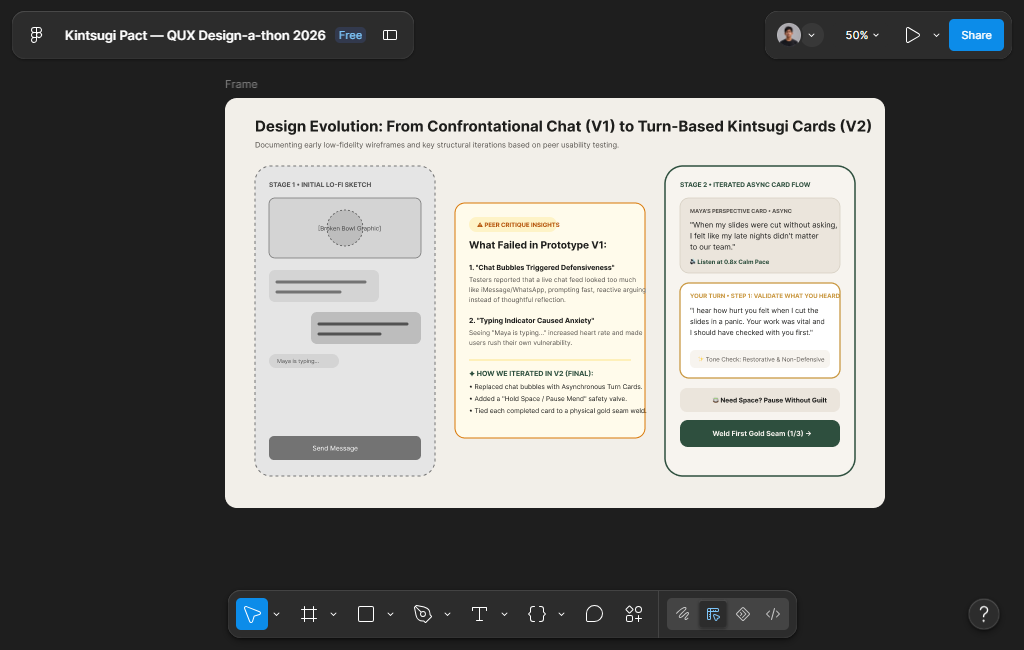
In our Stage 1 Low-Fidelity Wireframes (documented on Page 02 🔄 Lo-Fi & Iterations in our Figma file), we initially explored a mediated chat interface where two users messaged back and forth beneath a fractured ceramic vessel graphic.
During peer critique and usability reflection, we identified two major flaws in that initial mockup and executed three structural iterations for Version 2 (Final):
- Iteration 1: Eliminating Chat Bubbles for Turn-Based Reflection Cards. Testers noted that back-and-forth chat bubbles still felt too much like iMessage and triggered defensive habits. We removed the chat feed entirely, replacing it with a calm, 3-Seam Asynchronous Card Flow (1. Understanding, 2. Acknowledging, 3. Shared Pact).
- Iteration 2: Adding the "Pause Without Guilt" Safety Valve. Because healing isn't linear, we designed a dedicated bottom-sheet modal (
Screen 3) that lets either person pause the mend until the next morning while automatically sending a warm, reassuring note ("I care about our mend and am resting tonight") so neither person feels ghosted. - Iteration 3: Cognitive & Sensory Accessibility ("Gentle Mode"). For users experiencing emotional overwhelm or reading fatigue, we added a 4-second somatic breathing check-in on the invite threshold (
Screen 1) and a 0.8x Calm Voice Read-Aloud toggle (Screen 2).
✨ Final Product: The 5-Screen Restorative Flow
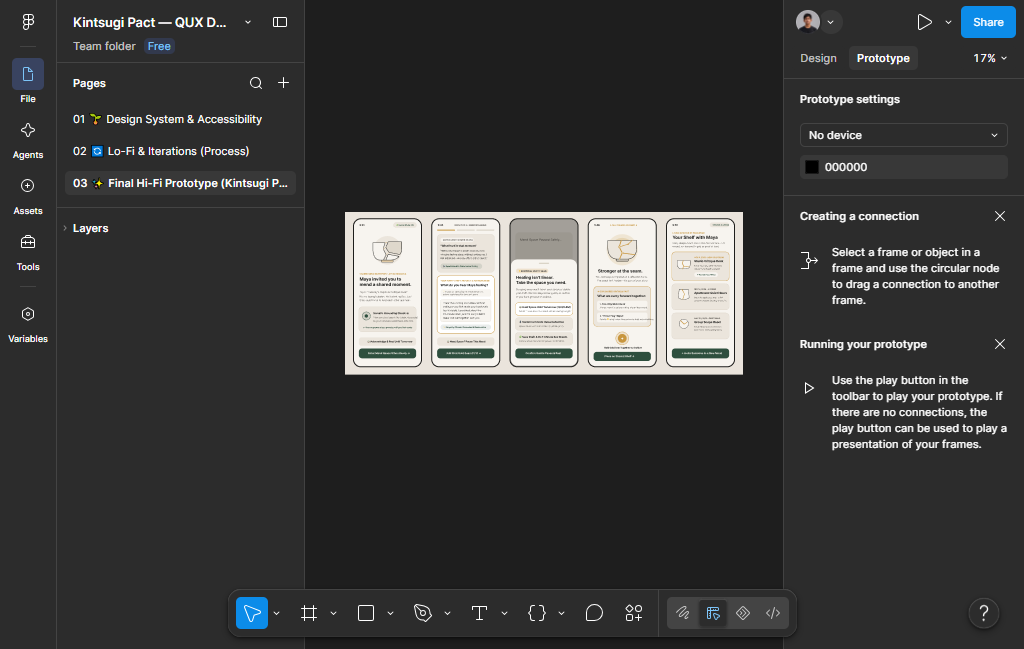
Our final interactive Figma prototype (03 ✨ Final Hi-Fi Prototype) guides two partners through five intentional stages:
- Screen 1 — The Gentle Threshold: Welcomes the user with a fractured ceramic bowl, sets expectations ("No live typing bubbles. No instant replies"), and guides a 4-second box breath before entering.
- Screen 2 — Turn-Based Reflection Cards: Displays the partner's perspective card ("What hurt in that moment") with an optional
0.8xaudio reader, paired with a guided empathy prompt ("What do you hear Maya feeling?") and a real-time non-defensive tone check. - Screen 3 — Emotional Safety Valve: A one-tap restorative sheet allowing users to hold space until tomorrow, switch to private voice reflection, or save their draft and take a breathing break.
- Screen 4 — The Kintsugi Ceremony: Once all three turns are aligned, the fractured ceramic shards bind together with glowing gold lacquer (
#C8963E), framing a concrete, two-point Shared Kintsugi Pact (1. Two-Way Slide Check, 2. Yellow-Flag Deadline Signal). - Screen 5 — The Ceramic Shelf (Living Archive): Completed mends sit on a warm shared shelf as unique gold-seamed vessels—honoring past cracks as proof that the relationship is stronger at the seams.
🛠️ How We Built It & Challenges We Faced
We built the entire project natively in Figma, organizing our file into three dedicated pages (01 🌱 Design System & Accessibility, 02 🔄 Lo-Fi & Iterations, and 03 ✨ Final Hi-Fi Prototype). All ceramic vessels, fractured shards, and Kintsugi gold weld seams were crafted using pure mathematical SVG vector paths and native Figma shapes.
Key Challenge: Our biggest design challenge was making a conflict-resolution tool feel hopeful and tactile rather than clinical or heavy. Balancing structured psychological guardrails with warm editorial typography (Georgia / Fraunces paired with Inter) and earthy Urushi lacquer tones (#2E4F3E and #C8963E) allowed us to transform an uncomfortable human experience into a safe, restorative ritual.
📚 Citations & Transparent AI Use Disclosure
- Visuals Compliance Statement: In strict accordance with QUX Design-a-thon rules, zero AI visual or image generation tools were used. All UI components, layouts, and Kintsugi ceramic vessels are 100% vector geometry inside Figma.
- Documented Non-Visual AI Use: Large Language Model assistance (Google Gemini) was used during the ideation and documentation phase to synthesize psychological research on asynchronous conflict de-escalation, refine the UX microcopy for the empathy prompts, and structure/proofread this written process documentation.
- References:
- Gottman, J. M., & Silver, N. (2015). The Seven Principles for Making Marriage Work (Research on Diffuse Physiological Arousal and structured self-soothing breaks).
- W3C Web Content Accessibility Guidelines (WCAG) 2.1 — Level AAA Contrast & Cognitive Accessibility Standards.
- Gopnik, B. (2009). "Golden Seams: The Japanese Art of Kintsugi." Smithsonian Freer Gallery of Art.
Built With
- figma

