Inspiration
Kintsugi Notes was inspired by the Japanese art of kintsugi, where broken pottery is repaired with gold instead of being hidden. We wanted to apply the same idea to learning: students’ mistakes should not be treated as failure, but as valuable signals that show exactly where growth can happen.
Many students feel discouraged when they get answers wrong, receive confusing feedback, or do not know how to revise effectively. Kintsugi Notes reframes those mistakes into “golden repair paths” that help students understand what went wrong, how to fix it, and what to practise next.
What it does
Kintsugi Notes is an AI-powered study companion that turns mistakes into personalized learning pathways.
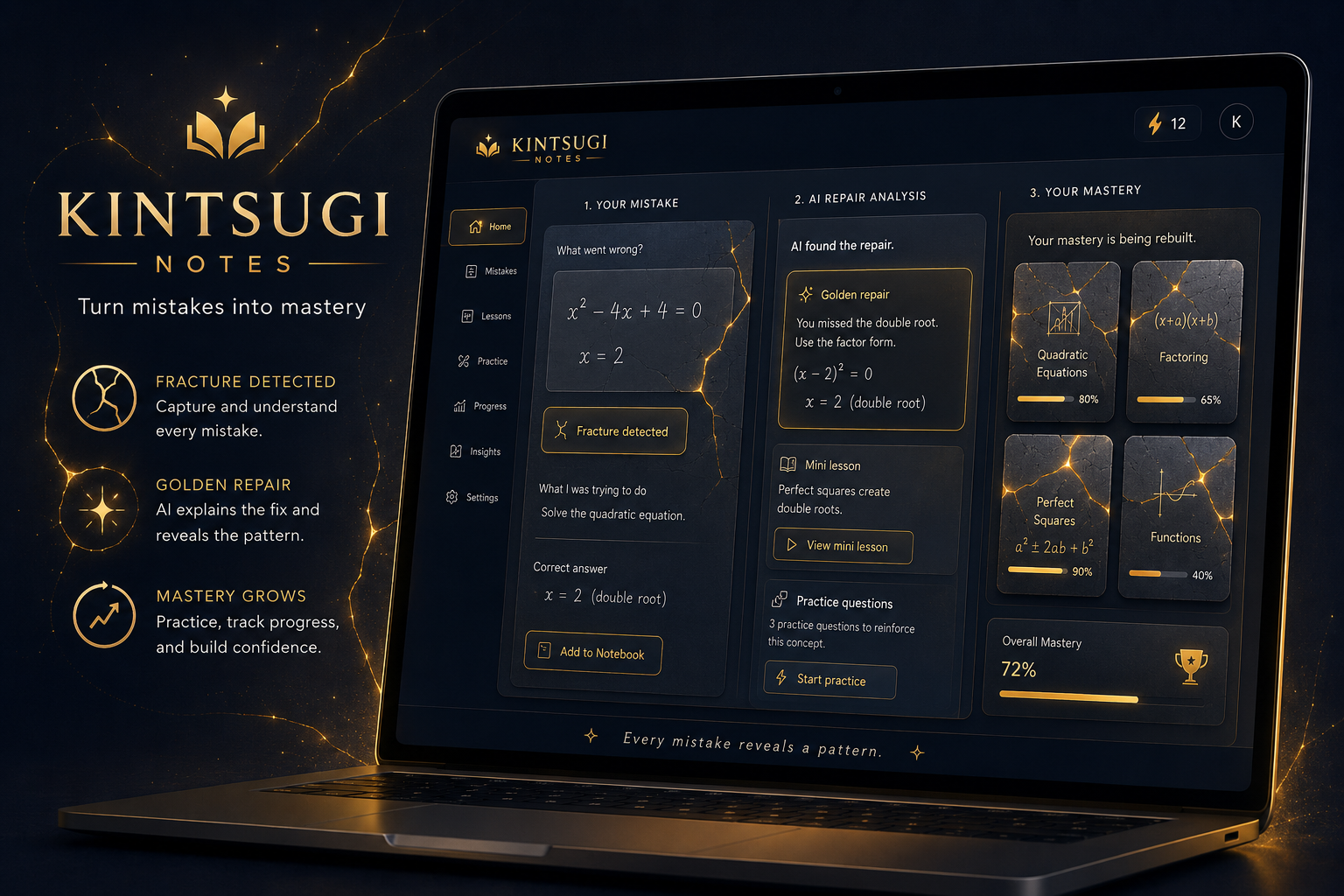
Students can enter a wrong answer, confusing concept, messy note, or exam feedback. The app then generates a structured repair analysis that includes:
- the core misunderstanding or “fracture”
- a simple explanation of why the mistake happened
- the corrected explanation or “golden repair”
- a short mini lesson
- practice questions
- a memory hook
- a next-step study recommendation
The dashboard also visualizes progress using cracked learning cards that become “repaired” as the student completes practice tasks. This makes revision feel more motivating, visual, and emotionally positive.
How we built it
We built Kintsugi Notes as a responsive web application with a clean, premium interface inspired by dark study dashboards and glowing gold kintsugi repair lines.
The app includes a mistake input workspace, repair analysis screen, mastery dashboard, practice mode, sample demo examples, and progress summary. We also designed the system with an AI service layer so it can support real AI-generated explanations while still having a strong fallback demo mode for reliable hackathon presentation.
Challenges we ran into
One challenge was making the product feel different from a normal AI chatbot. Instead of simply generating answers, we focused on creating a full learning journey: identify the mistake, explain the gap, repair the understanding, practise, and track mastery.
Another challenge was balancing emotional design with usefulness. We wanted the kintsugi metaphor to feel meaningful, not just decorative, so we connected the visual repair concept directly to the student’s learning progress.
Accomplishments that we are proud of
We are proud that Kintsugi Notes turns a negative learning moment into something constructive and motivating. The product gives students a clear path forward instead of just telling them they are wrong.
We are also proud of the visual experience. The cracked cards, gold progress indicators, and mastery dashboard help make learning progress feel visible and rewarding.
What we learned
We learned that the way feedback is presented matters a lot. A wrong answer can either discourage a student or guide them toward improvement. By designing around mistakes as learning assets, we can make revision feel less stressful and more empowering.
What is next for Kintsugi Notes
Next, we would like to add file upload support for lecture notes and marked assignments, deeper AI personalization, spaced repetition, teacher dashboards, and progress analytics. We also want to support multiple subjects and allow students to build a long-term “repair history” that shows how their understanding improves over time.
Built With
- ai-repair-service
- framer-motion
- lucide-react
- next.js
- shadcn/ui
- tailwind-css
- typescript
- vercel

Log in or sign up for Devpost to join the conversation.