Inspiration
For Episode 2, "Drifting Through Static," I wanted to break the silence. Episode 1 was atmospheric and quiet, so this one needed to scream. I was inspired by the psychological concept of "Flow State" where everything moves faster than you can think. I wanted to channel the energy of shows like Initial D but mix it with the moody aesthetic of Call of the Night. The goal was to create a "Rollercoaster" effect. I didn't just want a race. I wanted intense action followed immediately by slice-of-life comedy to make the characters feel real and human.
What it does
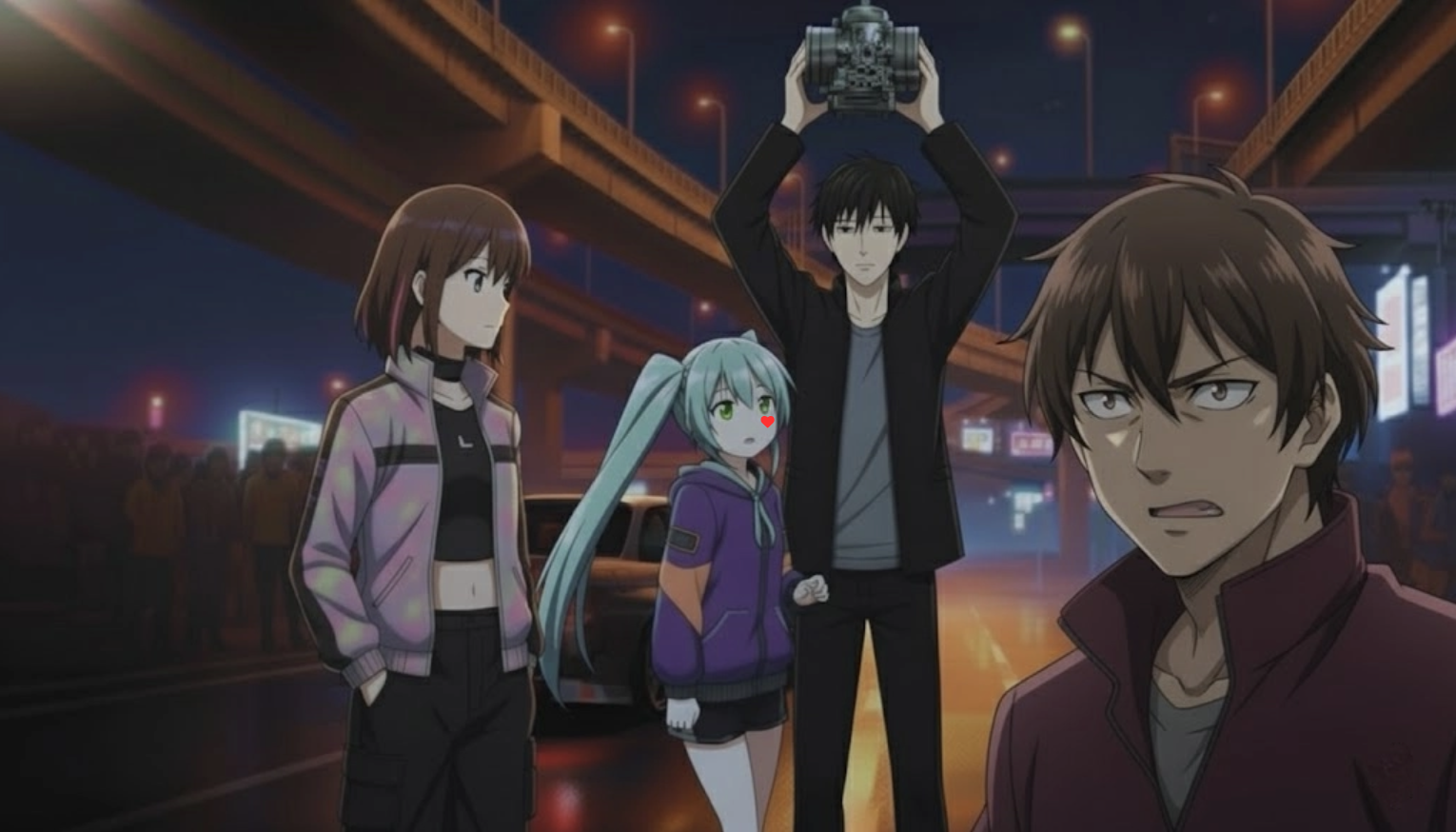
This project is a complete 22-minute cinematic anime episode. It serves as the major turning point for the protagonist, Kuon. It features a complex multi-stage street race that uses AI to generate drifting and dynamic camera tracking. It also expands the cast by introducing Emi, a chaotic cosplayer, and deepening the rivalry with Hayate. Visually, it tells a story by shifting art styles. We use a soft, Lo-Fi look for the quiet dawn scenes to show apathy, and a sharp, hyper-real look for the night scenes to show danger and passion.
How we built it
I built this using a custom end-to-end pipeline in ComfyUI.
Scripting: It started with a detailed shot list visualizing the race as a psychological battle.
Visuals: I used Nanobanana with a dual-prompt strategy. For night scenes, I prompted for volumetric lighting and wet asphalt. For dawn scenes, I switched to pastel, flat aesthetics.
Animation: I pushed Wan 2.2 to its limit with specific motion prompts to get the physics right, like cars drifting and smoke rising.
The Creative Fix: I wanted a character that paid homage to internet culture (Hatsune Miku) but faced copyright issues. Instead of scrapping her, I rewrote the character Emi as a die-hard fan who is cosplaying in the show. This turned a legal problem into a cool character trait.
Challenges we ran into
The biggest headache was the cars. AI struggles to keep a car's shape consistent at high speeds; they tend to melt or warp. I had to generate specific "Master Style Keys" and use them as strict inputs to keep the metal looking like metal. The other big challenge was the "Miku Problem." I risked copyright infringement with Emi's design. Solving that required a creative narrative rewrite rather than just a technical fix. Finally, balancing the tone was hard. It is difficult to go from a serious life-or-death race to a slapstick comedy moment without giving the audience whiplash.
Accomplishments that we're proud of
I am incredibly proud of the "Pacer's Gambit" sequence. Successfully animating a coherent shot where a car takes a shortcut between concrete pillars required perfect spatial consistency, and we nailed it. I is also proud of the visual metaphor. The shift from the 3D-feel of the night to the 2D-feel of the dawn works perfectly to show Kuon's mental state. Also, the new workflow is fast. By switching from a novel-style description to scene generation, I drastically cut down production time.
What we learned
I learned that constraints are actually a good thing. The legal restrictions on Emi forced me to make her a cosplayer, which actually made her a much more interesting and layered character than a generic anime girl. I also learned that "Narrative Consistency" matters more than "Visual Consistency." The audience accepts the change in art style (Lo-Fi vs High-Res) because it serves the story. It taught me that AI is just a tool, and the director's vision is what holds it together.
What's next for Kintsugi Heart Episode 2
The race is done, so now we deal with the aftermath. We are moving into Episode 3 which explores the "Morning After" using our Lo-Fi aesthetic. We will introduce the rival character Ren (and her competitive Teto cosplay) and finally start the production of Ibuki's mural project. I also plan to package the specific ComfyUI Car-Motion Workflow to share with the open-source community so others can make racing anime too.
Built With
- comfyui
- indextts
- svd
- wan
- wan2.2

Log in or sign up for Devpost to join the conversation.