-
-
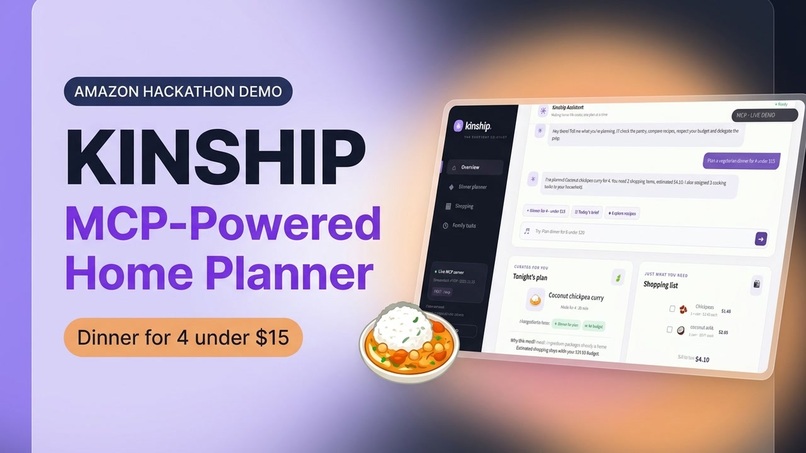
Kinship Thumbnail
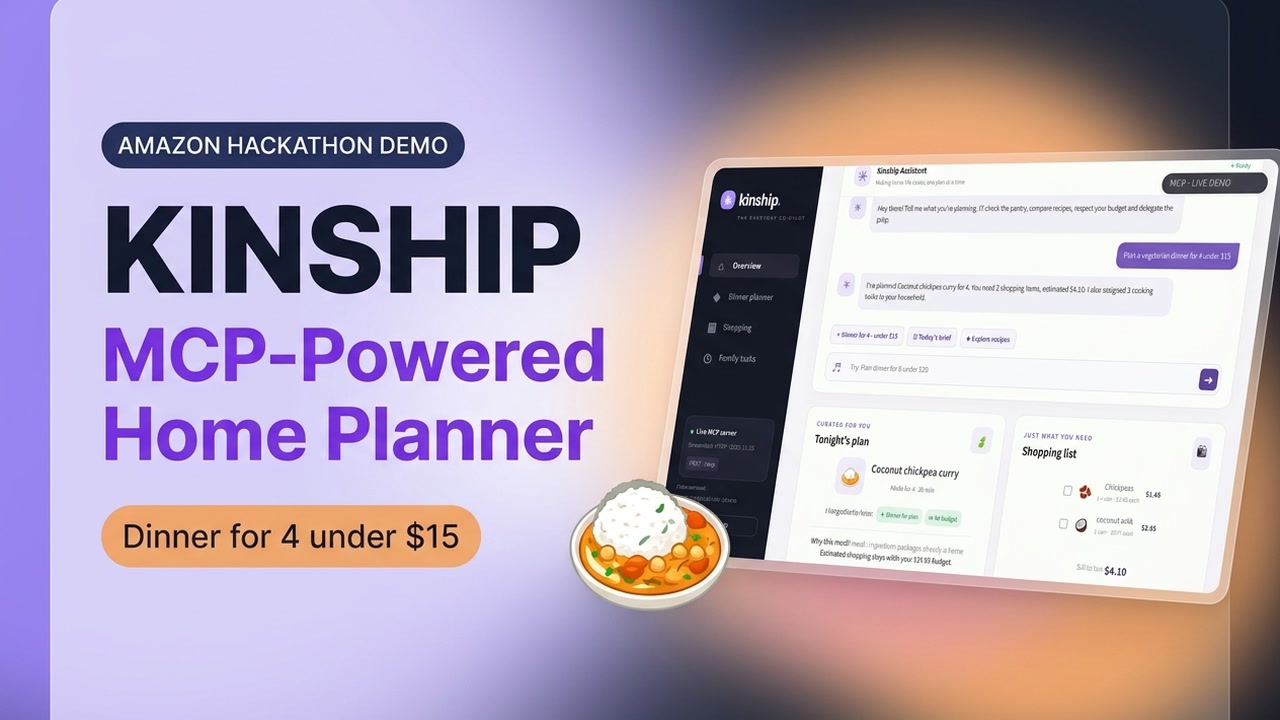
Inspiration
Every day, families spend time making small but important decisions: What should we cook? Do we have enough ingredients? How much will the groceries cost? Who will take care of the cooking?
These tasks often require switching between different applications and manually coordinating responsibilities.
Kinship was inspired by the idea of simplifying household management through a single, voice-friendly assistant.
What it does
Kinship — More Living, Less Juggling is an Alexa+-inspired household planning assistant powered by Model Context Protocol (MCP).
For example, a user can request:
"Plan a vegetarian dinner for four people under $15."
Kinship then:
- Checks available ingredients in the household pantry.
- Evaluates recipes based on dietary preferences and budget.
- Recommends a suitable meal.
- Calculates missing ingredients and estimated grocery costs.
- Generates a shopping list and assigns cooking tasks.
Users can mark groceries as purchased, complete tasks, and review their household progress through an interactive dashboard.
The application maintains persistent household information using SQLite.
How we built it
Kinship was developed using the following technologies:
- Python and FastAPI: Backend application and API development.
- Model Context Protocol (MCP): A self-hosted Streamable HTTP MCP server that exposes eight tools to compatible MCP clients.
- SQLite: Persistent storage for pantry information, shopping lists, and household tasks.
- HTML, CSS, and JavaScript: Responsive, interactive frontend.
- JSON-RPC 2.0: Communication protocol used by the MCP server.
- Pytest: Automated testing of application and MCP functionality.
- Docker: Containerized deployment support.
The application uses rule-based command processing and a recipe-selection algorithm. Its interface is an Alexa+-inspired browser simulator rather than a direct integration with Amazon Alexa+ devices.
AI-assisted development tools were used in preparing the prototype, source code, and documentation.
Challenges we faced
One of the main technical challenges was designing a system that combines several household operations into one coordinated workflow.
Another challenge was implementing MCP tool discovery and invocation while keeping the application simple enough to run independently.
To address this, Kinship separates its backend planning logic, MCP communication layer, database, and frontend interface.
Accomplishments
- Implemented a functional self-hosted MCP server.
- Developed eight discoverable MCP tools.
- Built an interactive household planning dashboard.
- Added budget-aware meal recommendations.
- Created persistent grocery lists and task assignments.
- Implemented automated API and MCP tests.
- Published the project on GitHub with documentation and a demonstration video.
What we learned
Building Kinship demonstrates how MCP can make ordinary application functions accessible through a standardized tool interface.
The project also highlights the importance of maintaining state across interactions, designing predictable tool behavior, and making automation results understandable to users.
What's next for Kinship?
Future improvements could include:
- Integration with approved Alexa+ development tools.
- Natural-language understanding using an LLM.
- Real-time grocery pricing and shopping integrations.
- Household accounts and personalized meal preferences.
- Calendar integration and scheduled task reminders.
- A cloud-hosted application with secure authentication.
Our long-term vision is to turn Kinship into a practical smart-home assistant that helps families spend less time managing daily tasks and more time together.
Project links
GitHub: https://github.com/Tusharbhushansingh/Kinship
Demo video: https://youtu.be/VnGu595roKs


Log in or sign up for Devpost to join the conversation.