-
-
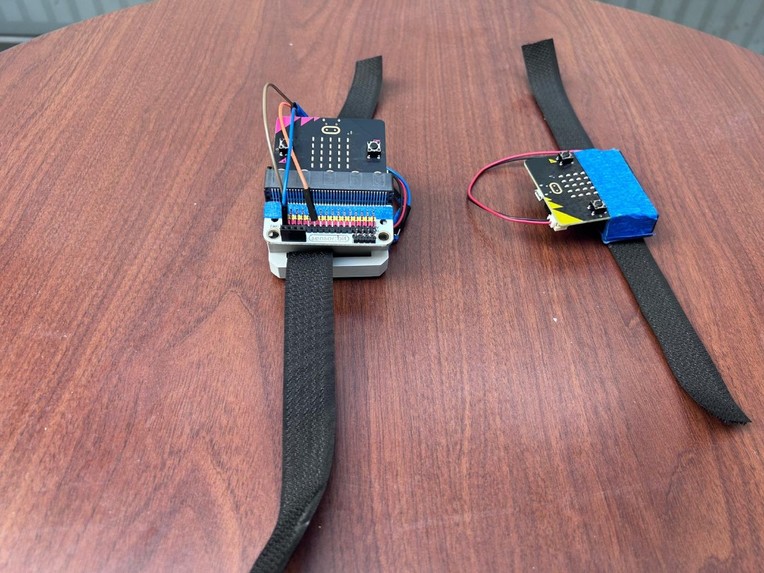
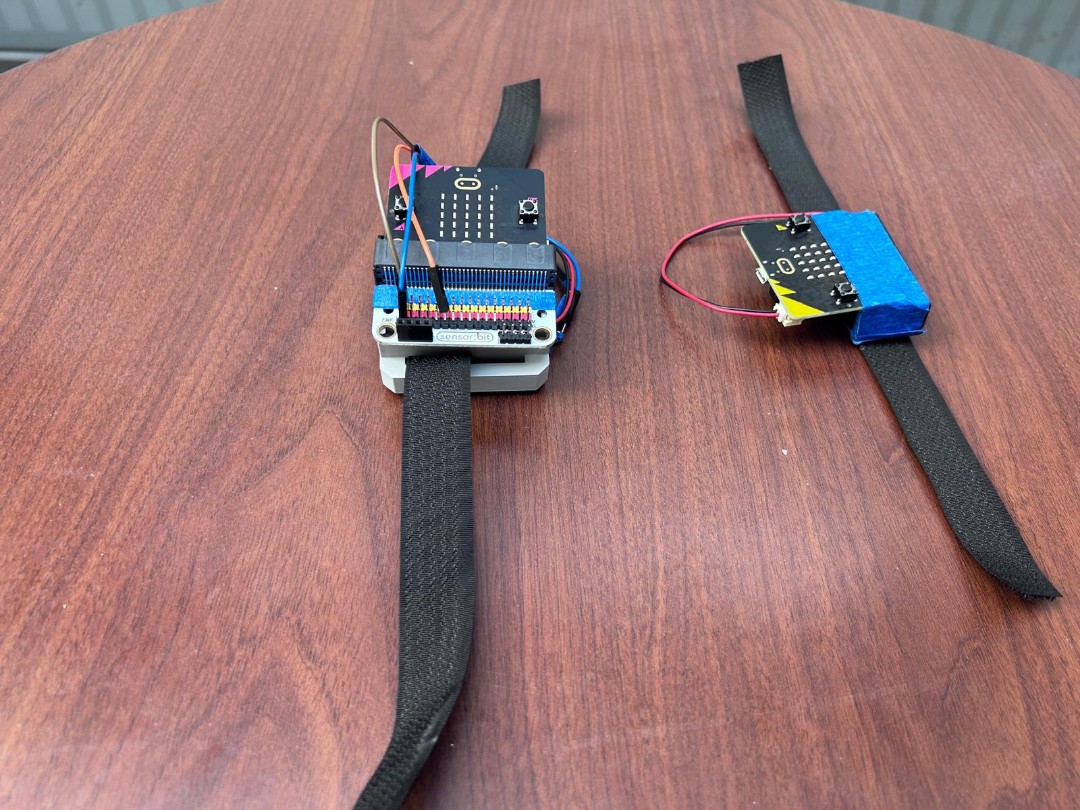
Shoe module on the right and Braclet on the left
Inspiration
The inspiration for Kinetiq came from one of our teammates, who has a five-year-old brother she helps look after while balancing academics, work, and everyday responsibilities. This made us think about the challenges people face when caring for younger siblings, parents, or grandparents when they cannot always be physically beside them.
We wanted to explore whether wearable technology could provide an extra layer of awareness by notifying someone when a person they care for experiences a potential fall. This idea became Kinetiq.
What it does
Kinetiq is a wearable fall-alert prototype.
A BBC micro:bit worn by the user monitors movement using its built-in accelerometer. When the system detects a high-acceleration movement associated with a potential fall, it wirelessly sends an alert using the micro:bit's built-in radio.
A second micro:bit receives the alert and activates a vibration motor, notifying a caregiver that the wearer may need assistance.
Movement → Accelerometer → Fall Trigger → Wireless Radio → Receiver → Vibration Alert
How we built it
We built Kinetiq using two BBC micro:bits programmed in TypeScript with Microsoft MakeCode.
The first micro:bit acts as the wearable sensing and transmitting device. It monitors acceleration and sends an alert through the micro:bit's built-in radio when our fall condition is triggered.
The second micro:bit acts as the receiver and controls a vibration motor.
To safely control the motor, we designed a transistor-based motor driver circuit using a transistor, resistor, and flyback diode. This allowed the micro:bit to switch the vibration motor without powering it directly from a GPIO pin.
We also designed and 3D printed an enclosure for our wearable prototype.
Challenges we ran into
One of our biggest challenges was integrating the external sensors we originally planned to use. Some required a 5 V supply, while the micro:bit operates with approximately 3.3 V GPIO logic. This introduced power and voltage-level compatibility issues.
Under the time constraints of the hackathon, we decided to rethink our architecture and use the micro:bit's built-in accelerometer instead.
We also encountered challenges with our 3D-printed components. Some of our original measurements and component fits were off, requiring us to adapt the physical design and find ways to work around these limitations.
These challenges forced us to continuously test, simplify, and optimize our system while working under a strict deadline.
Accomplishments that we're proud of
We successfully established wireless communication between two BBC micro:bits using their built-in radio, allowing an event detected by one wearable device to trigger a response on another.
We also designed and optimized a transistor, resistor, and flyback-diode motor driver circuit to control the vibration motor from the receiving micro:bit.
For members of our team, this was also our first experience designing for 3D printing, giving us hands-on experience turning a CAD design into a physical prototype.
We're especially proud that when our original approach encountered problems, we adapted our architecture and continued building instead of abandoning the project.
What we learned
Kinetiq taught us about risk-taking, problem-solving, and engineering under strict time constraints.
Not everything went according to our original plan. When our 3D-print measurements were off, we had to adapt the physical prototype. When our external sensors required different voltage levels, we had to understand the electrical limitations and rethink our system architecture.
We learned to identify the most important parts of our project, simplify when necessary, and optimize around the hardware and time we actually had available.
Most importantly, we learned that engineering isn't always about getting the first design right. It's about understanding what went wrong, adapting, and finding a solution that keeps the project moving forward.
What's next for Kinetiq
We want to continue developing Kinetiq beyond the hackathon.
Our next step is to revisit the external sensors from our original design and develop the appropriate power and voltage-interface circuitry to integrate them safely.
We also want to improve our 3D-printed enclosure by correcting our measurements, optimizing the internal component layout, and making the wearable smaller and more comfortable.
On the software side, we want to improve our fall-detection algorithm beyond a simple acceleration threshold. Future versions could analyze more aspects of motion to better distinguish potential falls from normal activities and reduce false alerts.
Ultimately, we want to develop Kinetiq into a more reliable wearable system that helps caregivers stay connected to the people they care for.
Built With
- 3d-printing
- accelerometer
- feedback
- haptic
- micro:bit
- micro:bit-radio
- microsoft-makecode
- vibration-motor


Log in or sign up for Devpost to join the conversation.