Inspiration
We kept watching AI demos end in a text box. We wanted to see what happens when a model's answer has to be something you can watch happen: an arm reaching for a roll of tape, or shaking its head because it can't find it.
The other half came from thinking about people who can't use a joystick or a keyboard. If one arm could understand a sentence and follow the signals from your own muscles, it could be useful to a lot more people than just us at a workbench.
What it does
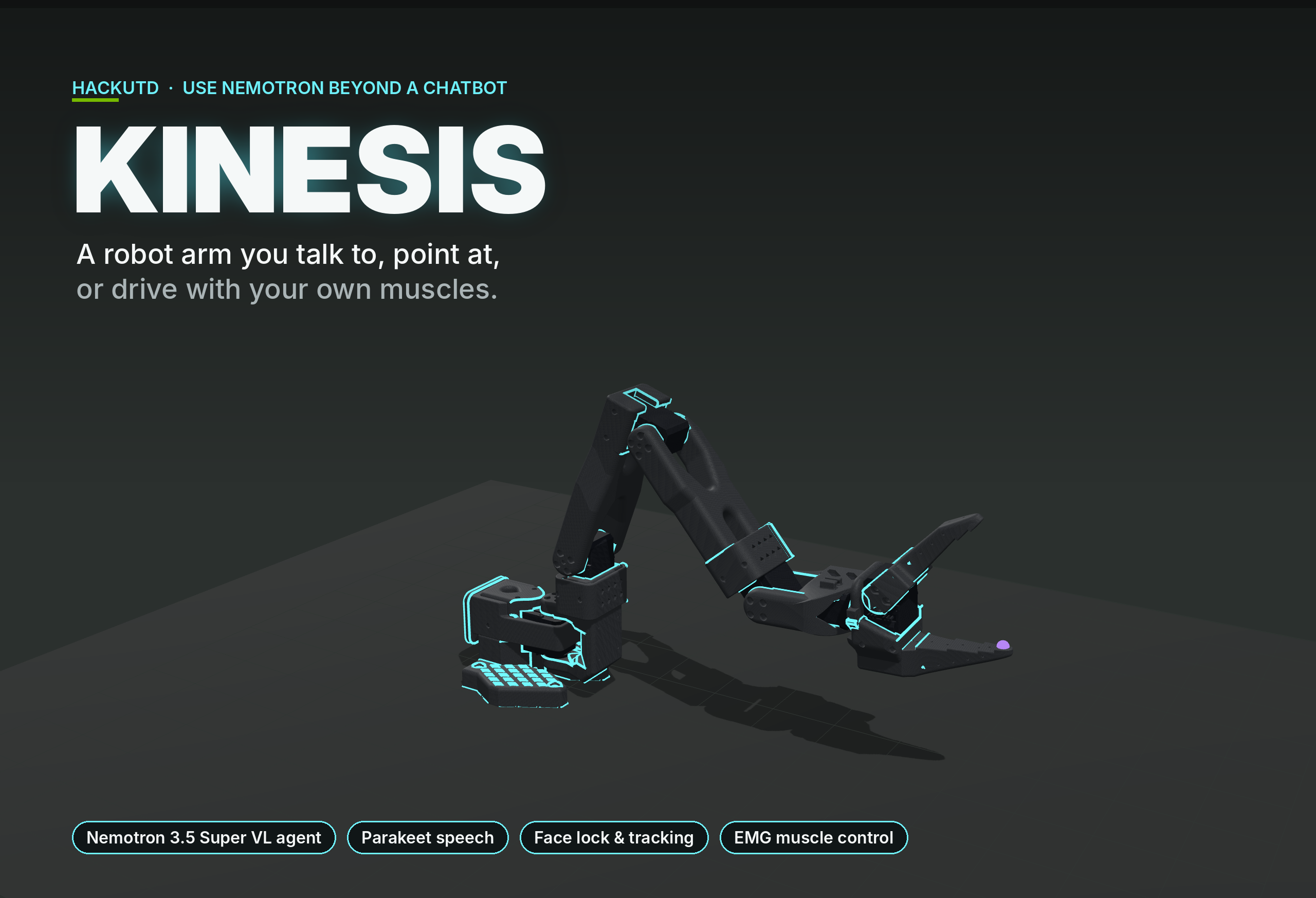
Kinesis is an SO-101 robot arm with a camera on its wrist. It never talks back. You ask, and it does something.
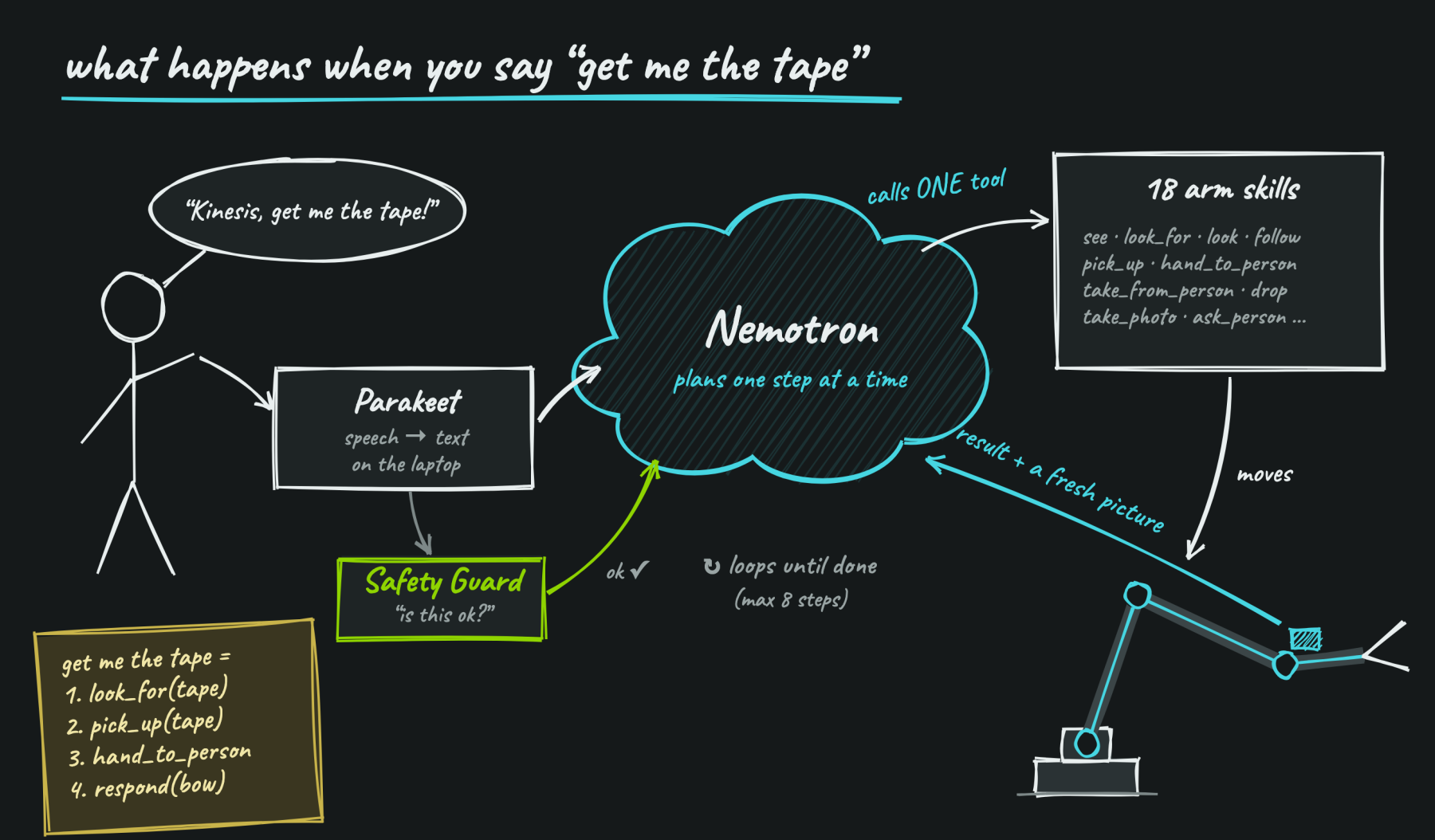
Ask "do you see my water bottle?" and it checks the camera, draws a box around it, and nods. Say "pick it up" and it grabs it. "Give it back" and it holds it out until you take it. Wave and it waves back. Point and it looks where you're pointing. It remembers faces, so the second time you walk up it greets you by name.
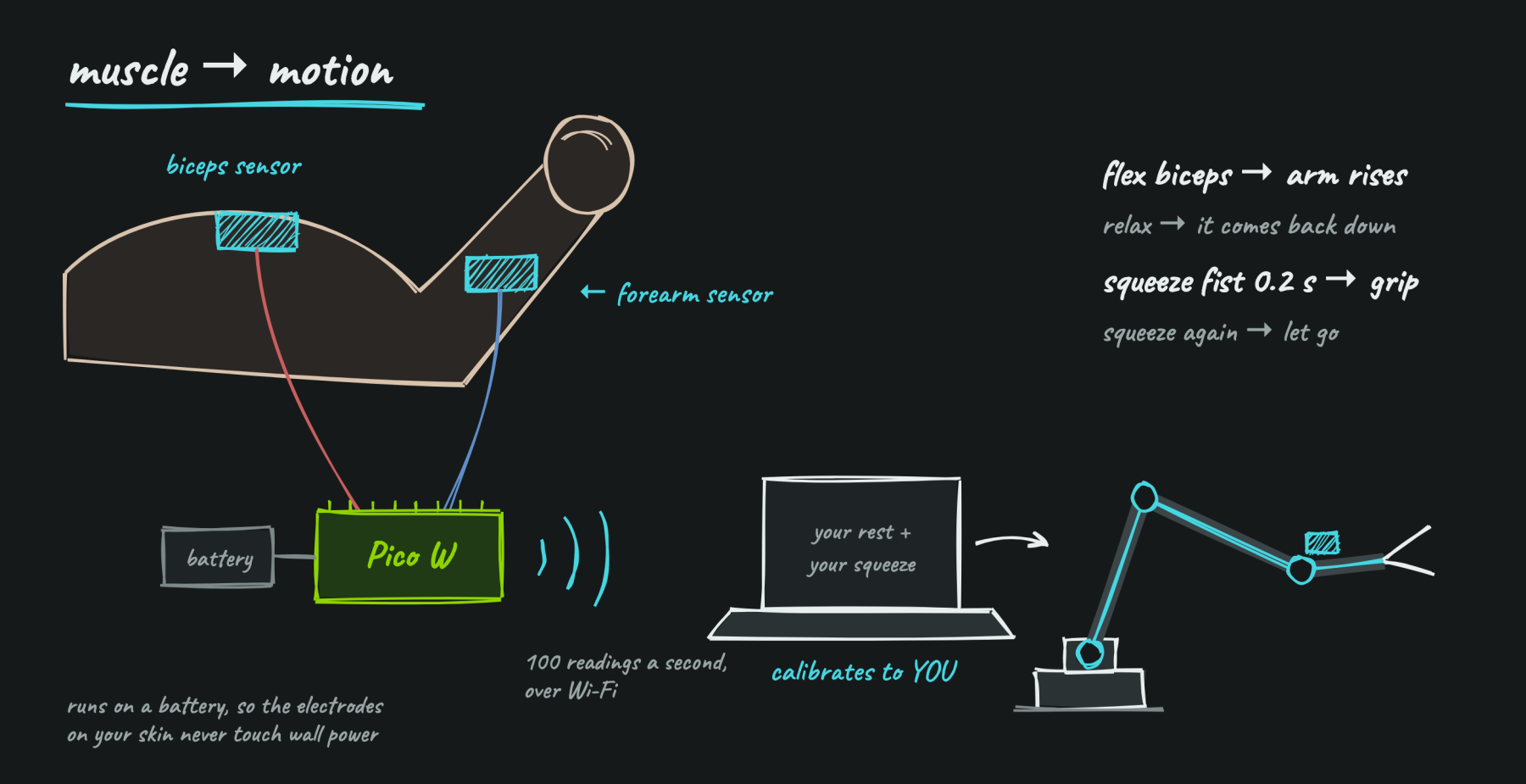
Say "Kinesis, manual mode" and voice control steps aside. Two muscle sensors on your arm take over: flex your biceps and the arm rises, squeeze your fist and the gripper closes.
How we built it
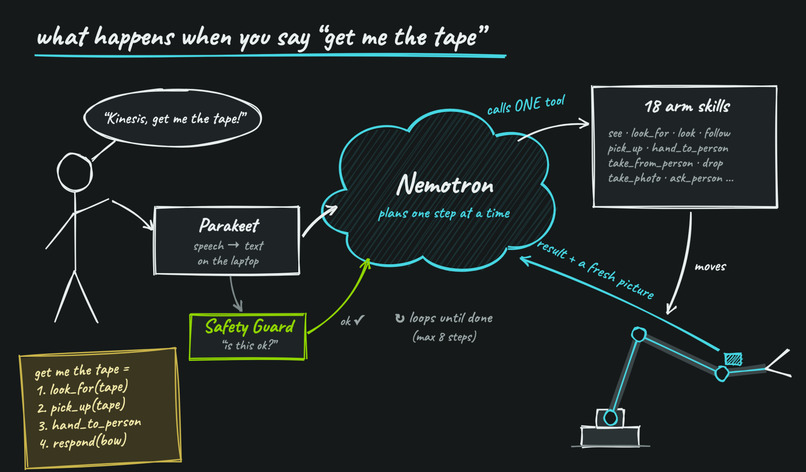
Speech is transcribed on the laptop with NVIDIA Parakeet. Every request is checked by Nemotron Safety Guard, then handed to Nemotron, which works as an agent. It gets the camera picture and the actual audio of what you said, picks one of 18 tools (see, look_for, pick_up, hand_to_person, take_photo, ask_person and so on), runs it on the arm, and then gets the result plus a fresh picture before choosing the next step. Sending the audio means that when Parakeet hears "calendar", Nemotron can still tell you said "caliper".
To find things in a picture we use Qwen 3.5 VL, which returns bounding boxes that we draw live on screen. When the arm looks around for something, it sends five camera views in one request instead of making five round trips.
Not everything goes through the model. Following your face, waving back, steering the camera ("turn left a bit") and "stop" all run locally, so they react instantly even on a slow network.
Which Nemotron answers depends on the Wi-Fi
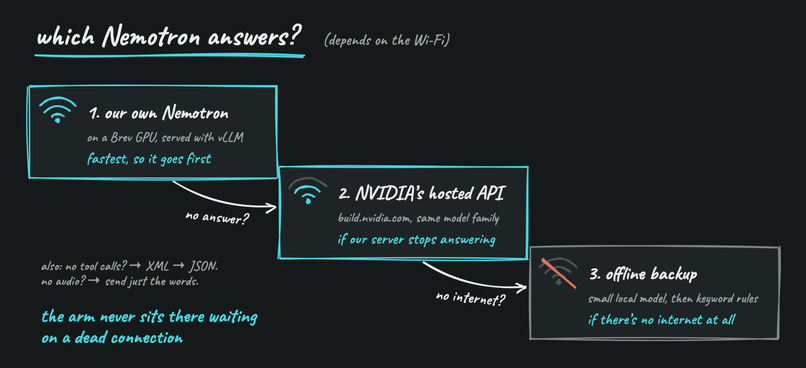
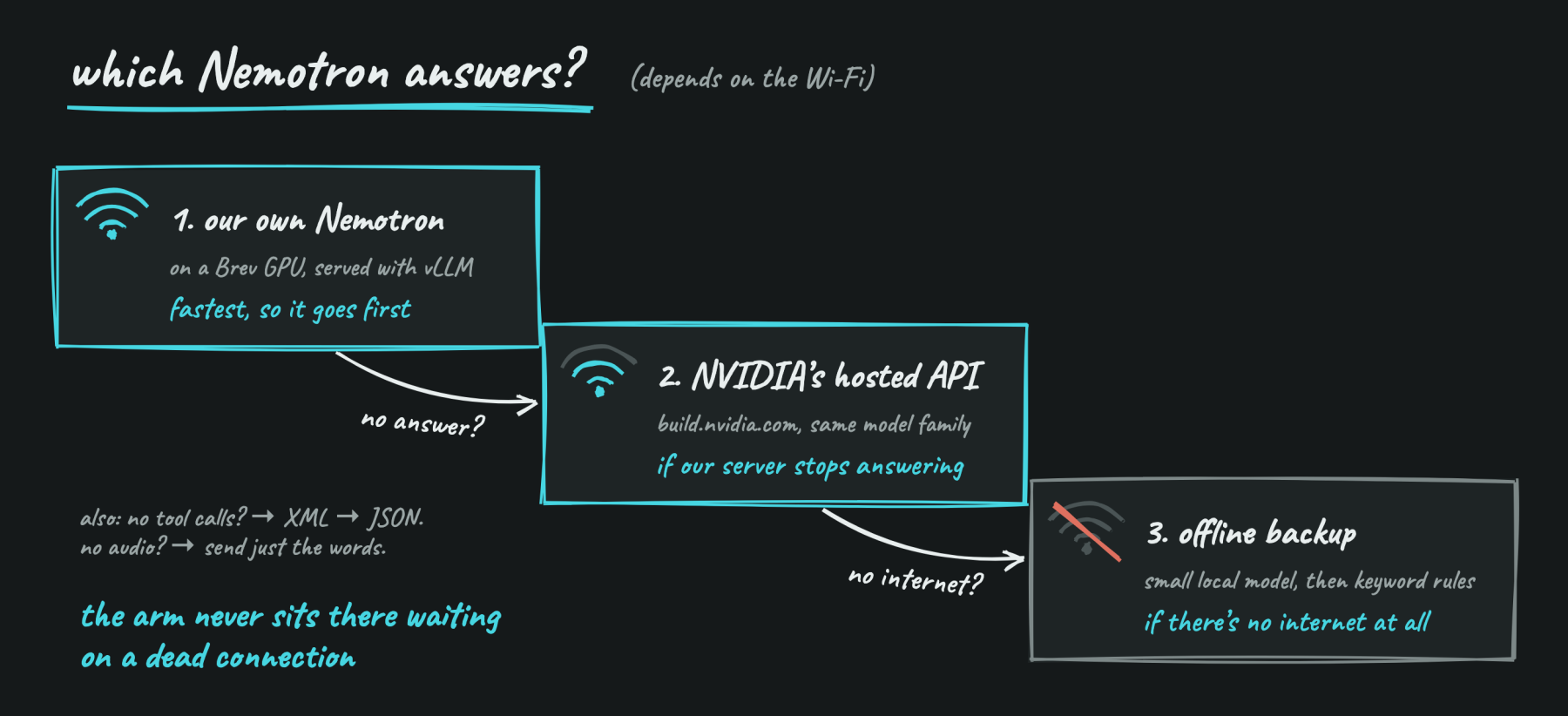
Venue Wi-Fi was the part we trusted least, so the brain uses whatever it can reach. First choice is our own Nemotron, running on an NVIDIA Brev GPU with vLLM. If that stops answering, it switches to NVIDIA's hosted API on build.nvidia.com. With no internet at all, a small local model takes over, and if that's missing too, plain keyword rules. So the demo runs on whichever Nemotron the connection allows that day, and the arm keeps working either way.
Muscle control
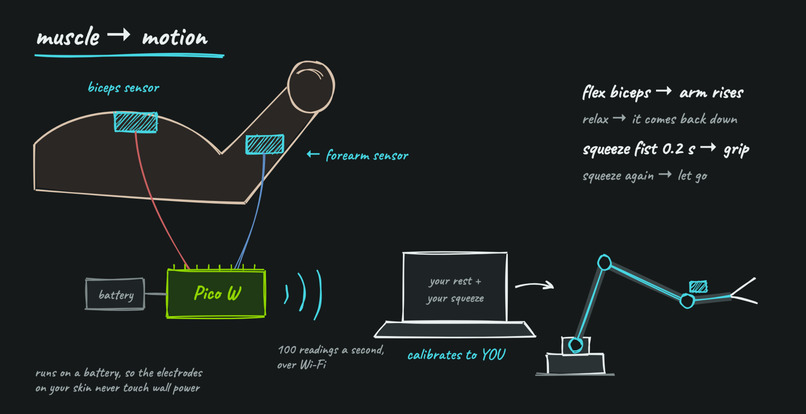
Two MyoWare 2.0 sensors on the forearm and biceps feed a Raspberry Pi Pico W. It averages ten readings per line and sends 100 lines a second over Wi-Fi. When you start, it calibrates to you: relax, flex, squeeze. Each reading \( v \) becomes an effort between your resting level \( r \) and your hardest squeeze \( m \):
$$ e = \operatorname{clip}!\left(\frac{v - r}{m - r},\; 0,\; 1.2\right) $$
That way someone with weak muscle signals still gets the arm's full range of motion. The Pico runs on a battery, so the electrodes on your skin never share a circuit with wall power.
Moving without hurting anyone
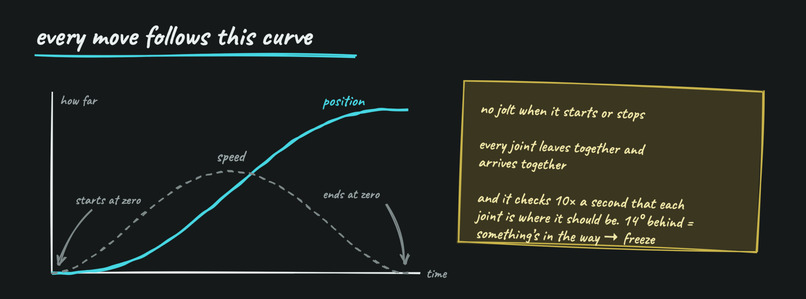
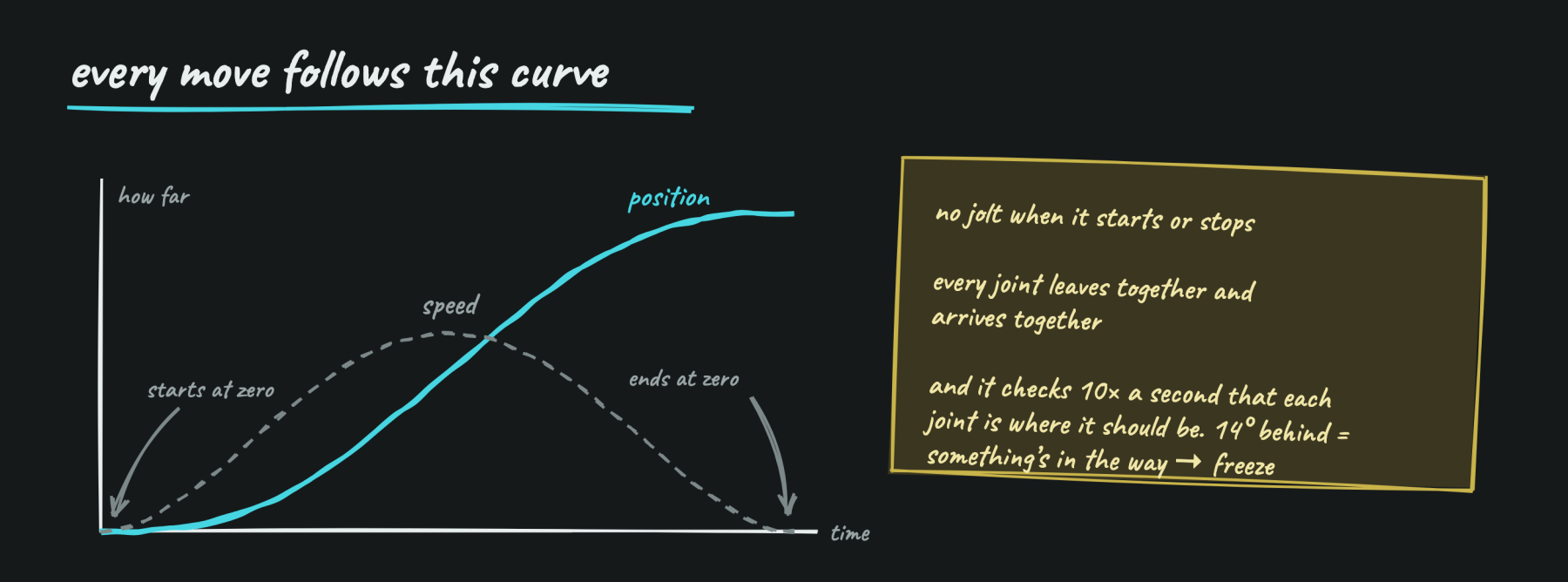
Every move follows a minimum-jerk curve, so all the joints leave together, arrive together, and never jolt:
$$ \theta(t) = \theta_0 + (\theta_1 - \theta_0)\left(10u^3 - 15u^4 + 6u^5\right), \qquad u = \frac{t}{T} $$
Ten times a second it checks each joint against where it should be. If one falls 14° behind twice in a row, something is in the way, so the arm freezes and holds. The joints run at limited strength inside limits we measured by hand, and saying "stop", pressing Esc, or hitting Ctrl+C freezes everything immediately.
Challenges we ran into
The Pico couldn't get online. The venue network had a login page, which a Pico W can't get past. We ended up having the laptop switch on its own hotspot automatically and broadcast a "here I am" message every second, so the Pico finds it even when the laptop's address changes.
The camera kept seeing its own hand. The gripper jaws sit at the bottom of every frame and threw off how the arm learned which way to turn. The fix was to only learn from the top 60% of the picture.
Every endpoint behaved differently. One wouldn't accept tool calls, one wouldn't accept audio, one rejected a setting we sent. Every fallback in the code is there because we hit that exact error.
Servos don't always do what they're told. Ours would sometimes ignore "torque off" while straining. We wrote a simulator that reproduces those quirks byte for byte and tested against it before trusting the real arm.
Waiting looks broken. A robot that sits frozen for five seconds while it thinks looks dead. So while Nemotron thinks, the arm keeps eye contact and tilts its head, and every step shows its timing on screen.
Accomplishments that we're proud of
A language model that plans multi-step jobs and checks its own work through a camera, then answers you with its body. Three different ways to control one arm (voice, gestures and muscles) in one program. And a test suite with a simulated arm, fake cameras, fake muscles and a fake NVIDIA API, so most of the system runs with no hardware plugged in at all.
What we learned
Giving the agent a fresh picture after every action made a huge difference: it started noticing its own mistakes. In a live demo, graceful fallbacks mattered more than a slightly smarter model. Anything that has to be instant or safe belongs on the laptop, and the model can handle the meaning. And muscle signals are noisy and very personal, which is why calibrating to each person mattered more than any fixed threshold.
What's next for Kinesis
Picking things up from the table and muscle control both run end to end in simulation, and we're still tuning them on the physical arm. After that: more sensors for wrist rotation and finer grip, letting only registered faces use manual mode, and packaging the whole thing as an affordable assistive kit (an arm, two sensors and a laptop).


