Inspiration
One in three Australians reports feeling lonely, and long term loneliness is linked to health risks on the scale of smoking. Australia and the UK now have social prescribing: a GP refers a lonely patient to a link worker, whose job is to reconnect them with their community.
The hardest part is the very first step. "Join a club" rarely works for someone who hasn't left the house in months. What works is something that already feels like them: a place where people who share their tastes already go, close enough to reach, calm enough to walk into alone. Finding that by hand takes a link worker hours. Qloo knows what people with similar tastes enjoy, so we used it to give link workers a better first step in seconds.
What it does
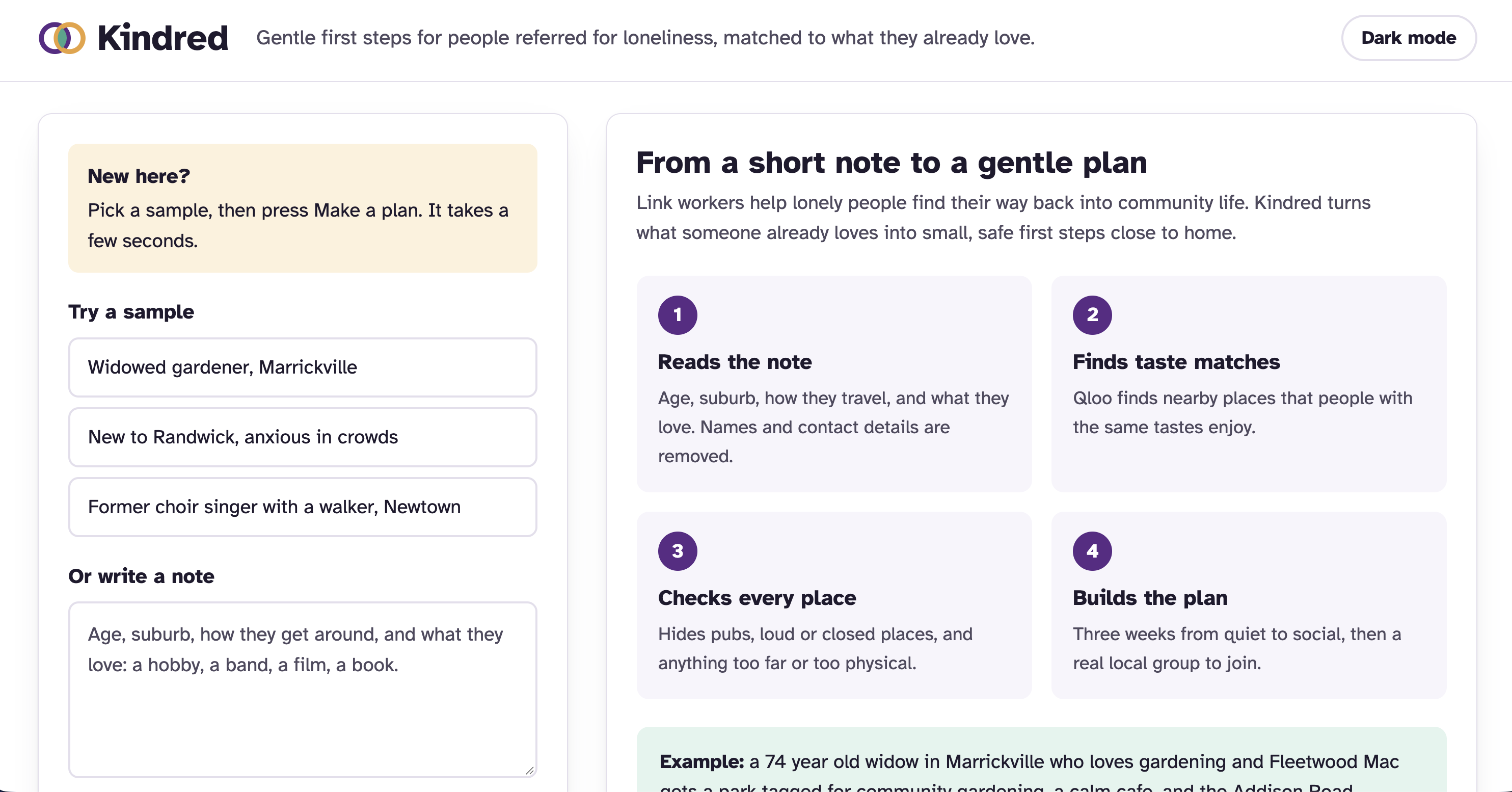
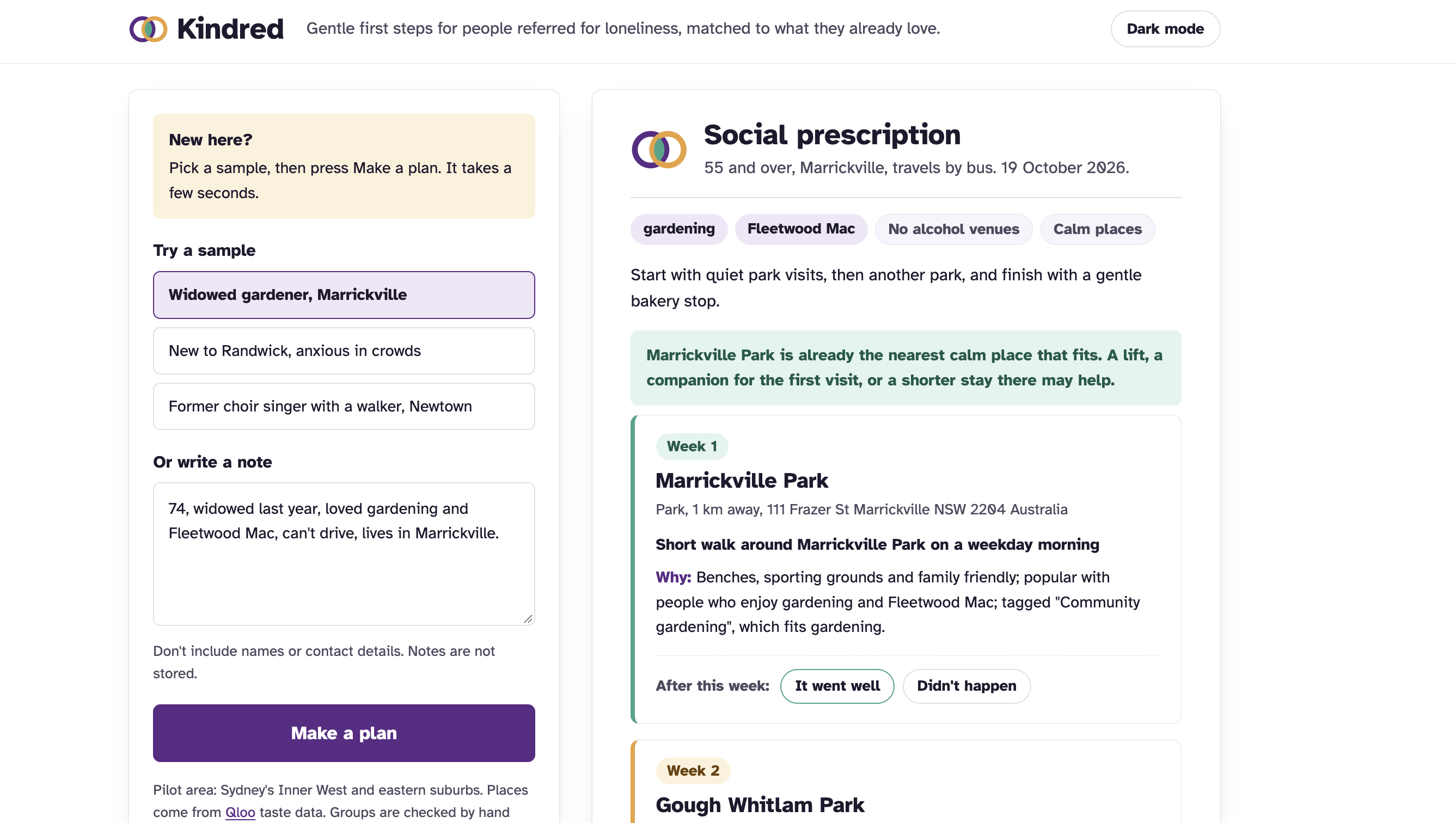
A link worker writes a short note, the way they normally would:
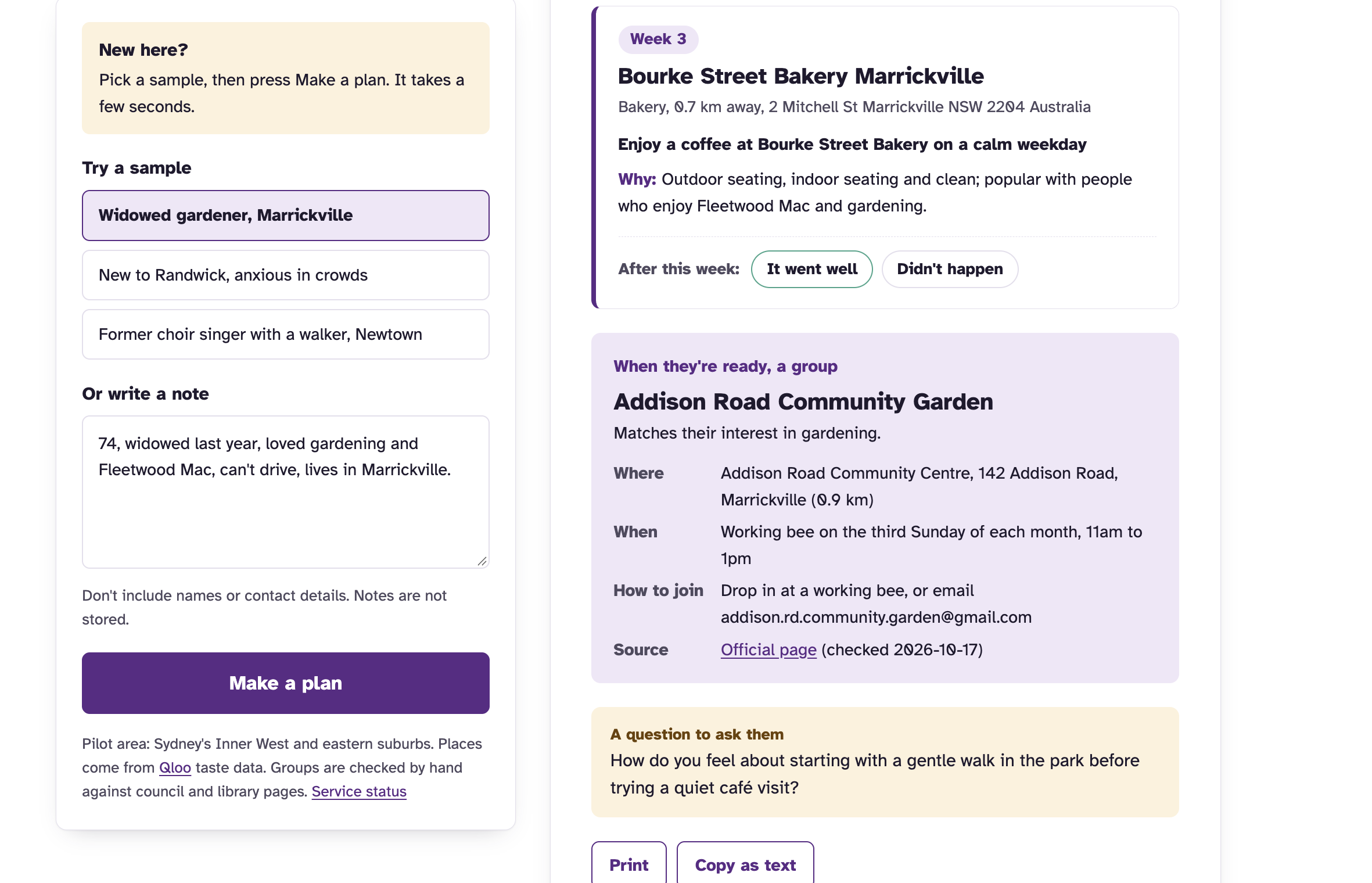
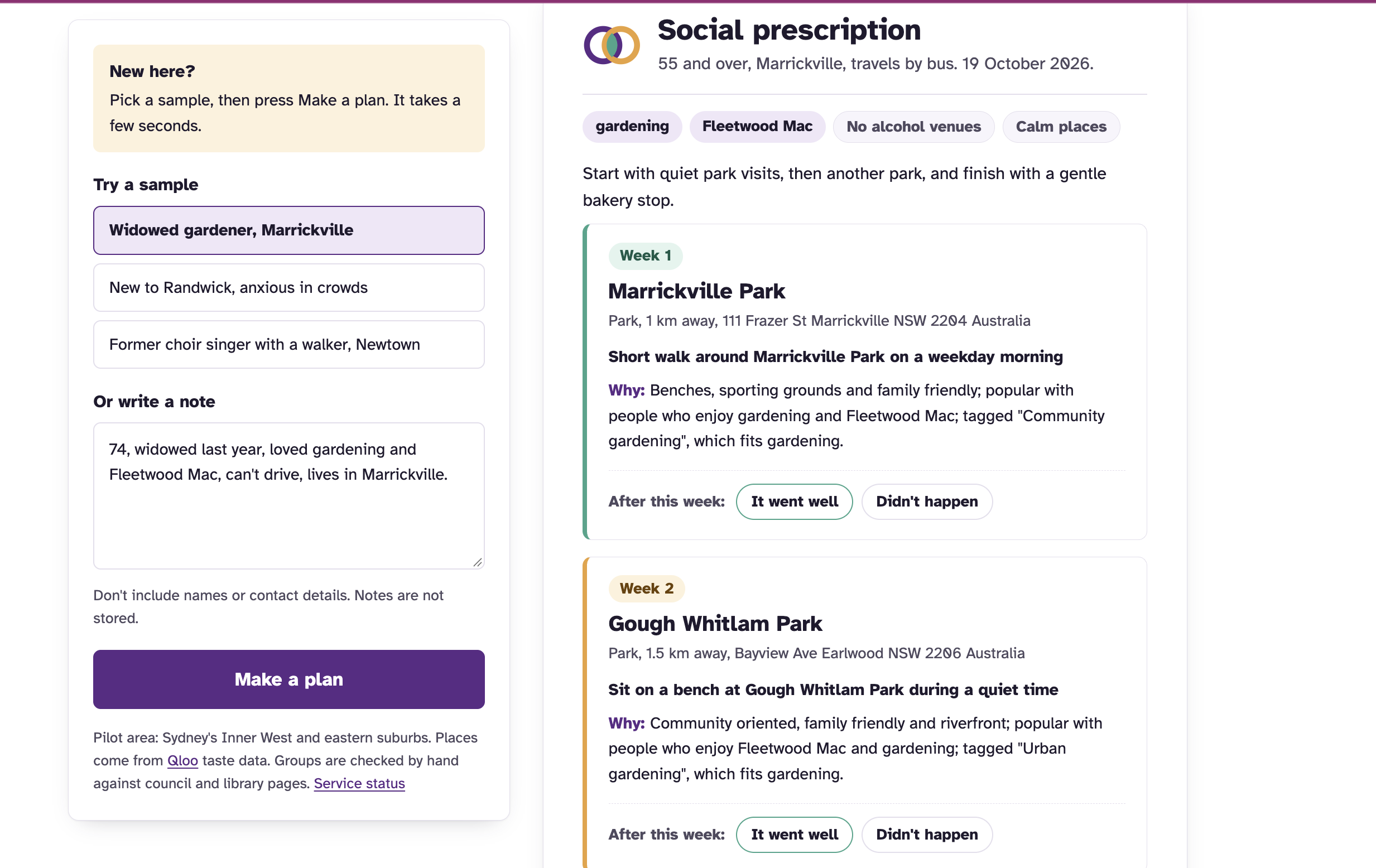
74, widowed last year, loved gardening and Fleetwood Mac, can't drive, lives in Marrickville.
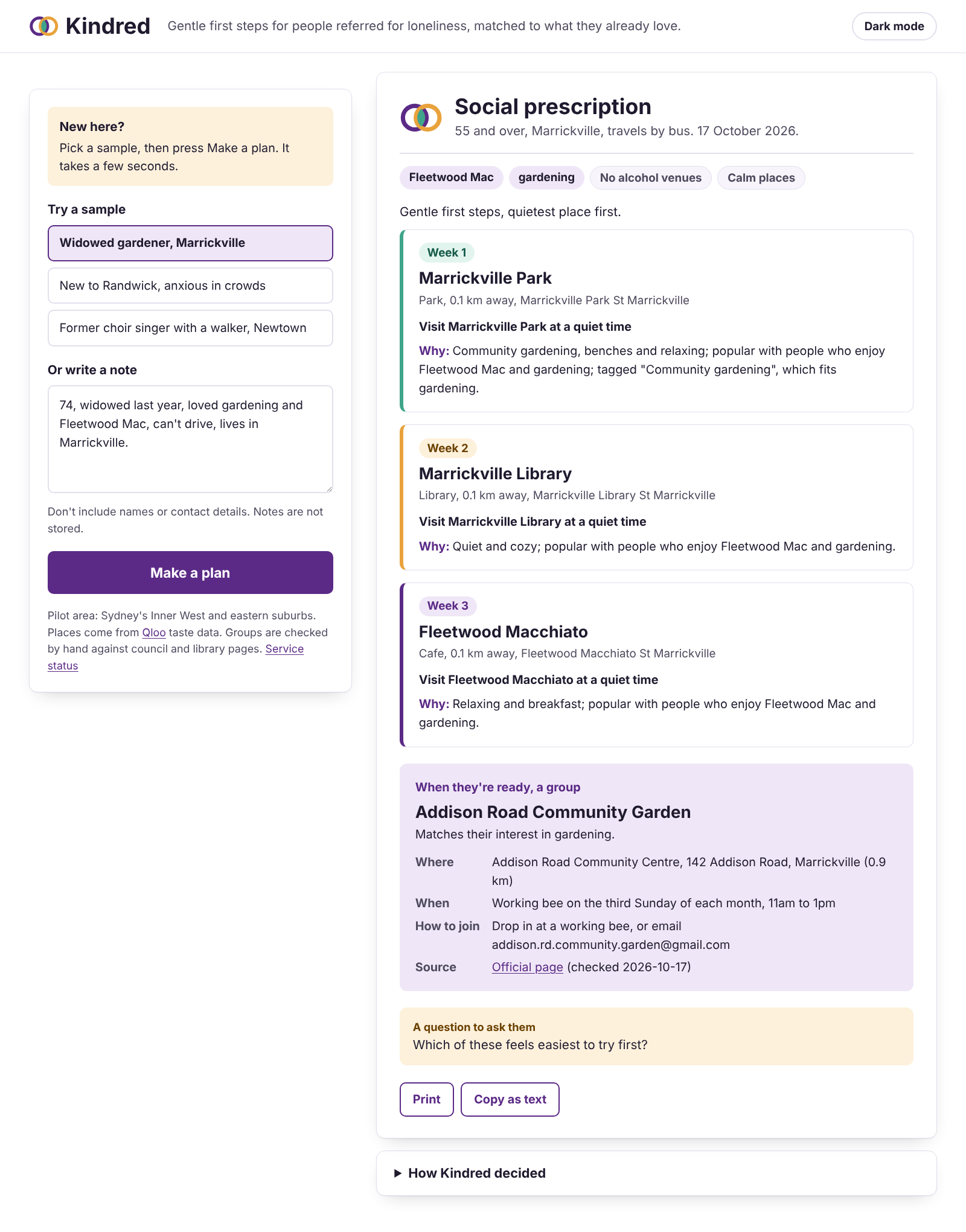
Kindred returns a printable social prescription:
- Three weeks, from quiet to social. Week 1 is the calmest (a park), week 3 the most social (a café or community centre). Every step names a real place, its distance, and why it fits, using Qloo's own evidence: "popular with people who enjoy gardening and Fleetwood Mac; tagged Community gardening".
- A real local group for when they're ready, from a hand checked list with source links. Here: the Addison Road Community Garden working bee, 0.9 km away.
- Safety by default. Pubs, closed, loud or crowded venues, physically demanding places for frail people, and anything beyond how far the person can travel are hidden. For someone who doesn't drink, places that serve alcohol are hidden too.
- Follow up. Each week can be marked It went well or Didn't happen with a reason (too far, too busy, not ready, not their thing). Kindred adapts only that week, and says plainly when there's no better option.
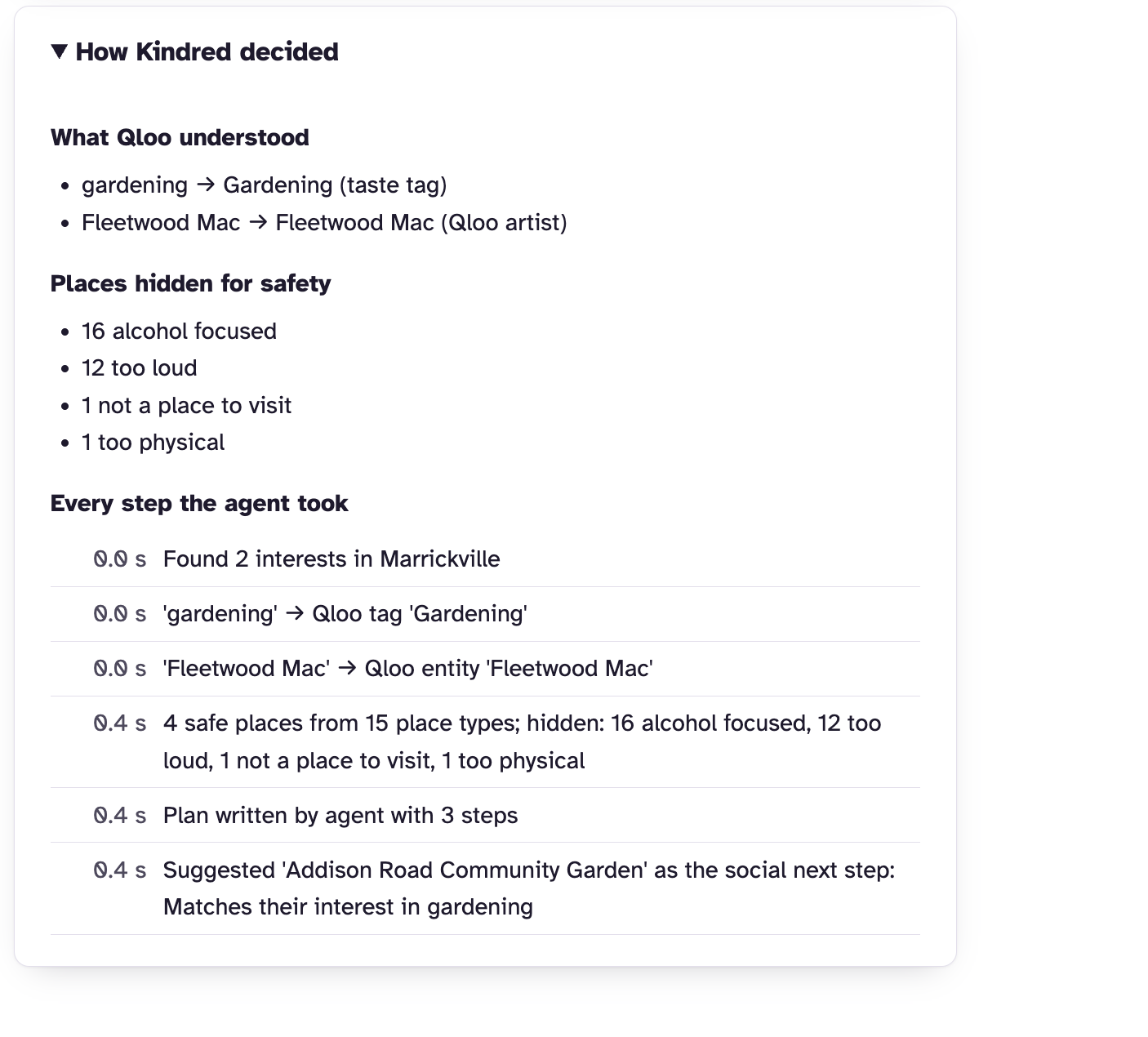
- A full decision trace. "How Kindred decided" shows what Qloo understood, how many places were hidden and why, and every step the agent took.
No sign in. Notes are never stored. Contact details are removed before anything reaches a model.
How we built it
Qloo is the core of Kindred. The LLM never picks a place on its own.
- Read the note. A risk check runs first, in plain code: notes that mention self harm stop immediately and tell the worker to follow their escalation process. Then an LLM (gpt-oss-120b on Groq) extracts age band, suburb, travel, interests and needs. If the LLM fails, a rules based reader takes over.
- Resolve interests in Qloo.
/searchand/v2/tagsturn "Fleetwood Mac" into an artist entity and "gardening" into a keyword tag. If Qloo doesn't know a franchise or author, the agent tries a well known work ("Studio Ghibli" becomes Spirited Away). - Find taste matched places.
/v2/insightswithfilter.type=urn:entity:place, one call per place category, withfilter.location.query, the person's interests as signals, andsignal.demographics.age. - Check every place in code. Distance, category tags,
is_closedand Qloo's descriptive tags feed transparent safety rules. - Recover when results are thin. The agent widens travel slightly, then searches neighbouring suburbs.
- Plan. The LLM orders checked places from quiet to social, but can only return IDs from the checked list. The "why" text is written in code from Qloo evidence, so it can't be invented. If the LLM fails, a rules planner does the same job.
- Match a group from 14 hand checked council and library groups, by interest, age and distance.
Stack: Python, FastAPI, Qloo Insights API, Groq, plain HTML and JavaScript, Render, and 214 offline tests on GitHub Actions.
Challenges we ran into
- Name matching. Early versions turned "Studio Ghibli" into a yoga studio and "documentaries" into a TV channel. We built strict name rules (accents, joined spellings, word stems, a leading "the") and a test for each failure.
- Evidence that sounded right but wasn't. "Wheel of Fortune" matched a "Wheelchair accessible" tag. Word stems and stop words fixed it.
- Places that are real but wrong. Specialist services, a tattoo shop listed as a gallery, supermarkets, fast food chains, a bouldering gym for an 80 year old. Each became a rule and a test.
- API quirks. Search is worldwide and the radius filter isn't reliable, so distance is enforced in code. Category filters are loose, so each place's own category tags are checked.
- A fair evaluation. Our first checker matched same name places in London and a lookalike restaurant 4 km away. We fixed it to use the nearest branch within 15 km and the exact place suggested.
- Free model rate limits. Fast timeouts, a backup model, a cache and rules fallbacks mean a plan always comes back.
Accomplishments that we're proud of
We compared Kindred with a plain LLM on 20 realistic notes, with the same model, note and safety instructions. Every suggested place was then looked up in Qloo the same way for both.
| Check | Kindred | Plain LLM |
|---|---|---|
| Confirmed as a real place within 15 km | 72% | 13% |
| Within reach for how the person travels | 98% | 75% |
| Alcohol focused or closed venues | 0 | 0 |
The plain LLM's plans sound more specific ("Glebe Community Choir"), but 87% of its places couldn't be confirmed as real places nearby. Every Kindred place is a real Qloo place with coordinates, explained with Qloo evidence. When too few safe places are in reach, Kindred gives a shorter plan rather than inventing one.
We're also proud that it's transparent, works on a phone, prints as a one page prescription, and keeps working when the LLM doesn't.
What we learned
Taste data is strongest combined with hard constraints. Qloo tells us what someone is likely to enjoy; code makes sure it's safe, reachable and real; the LLM is best for reading messy notes and ordering, not inventing. An honest "no better option" is more useful than a confident wrong answer.
What's next for Kindred
- Test with practising social prescribing link workers.
- More cities, starting with other Sydney councils.
- Connect to local service directories for groups instead of a hand checked list.
- Let the worker edit a step before printing, and track outcomes over time.
Built With
- css
- fastapi
- github-actions
- groq
- html
- javascript
- llm
- python
- qloo
- render

Log in or sign up for Devpost to join the conversation.