Inspiration
Learning is supposed to be social. People collaborate, argue, explain things badly and try again, and eventually arrive at understanding together. But for students with ADHD, autism, dyslexia, or DLD, that process is full of barriers that have nothing to do with their intelligence. 20.5% of undergraduates reported a disability in 2019-20. Autistic students consistently report loneliness and isolation in higher education. ADHD is directly linked to lower college performance through executive function deficits. Students with DLD fall behind specifically in the literacy-heavy tasks that dominate university assessment. These are not edge cases. What pushed us to build something was a simpler observation: the AI tools that were supposed to help these students were actively making things worse. AI detectors flag neurodivergent writing as machine-generated because structured, templated prose looks statistically "predictable" to them. Autistic students write with high structural regularity. ADHD students over-edit into uniformity. Dyslexic students use tools like Grammarly to produce clean prose. All of them get flagged. Liang et al. (2023, Stanford HAI, 500+ citations) found 97% of real TOEFL essays were flagged by at least one detector. The accommodations system and the integrity system are in direct conflict, and nobody has fixed it.
What it does
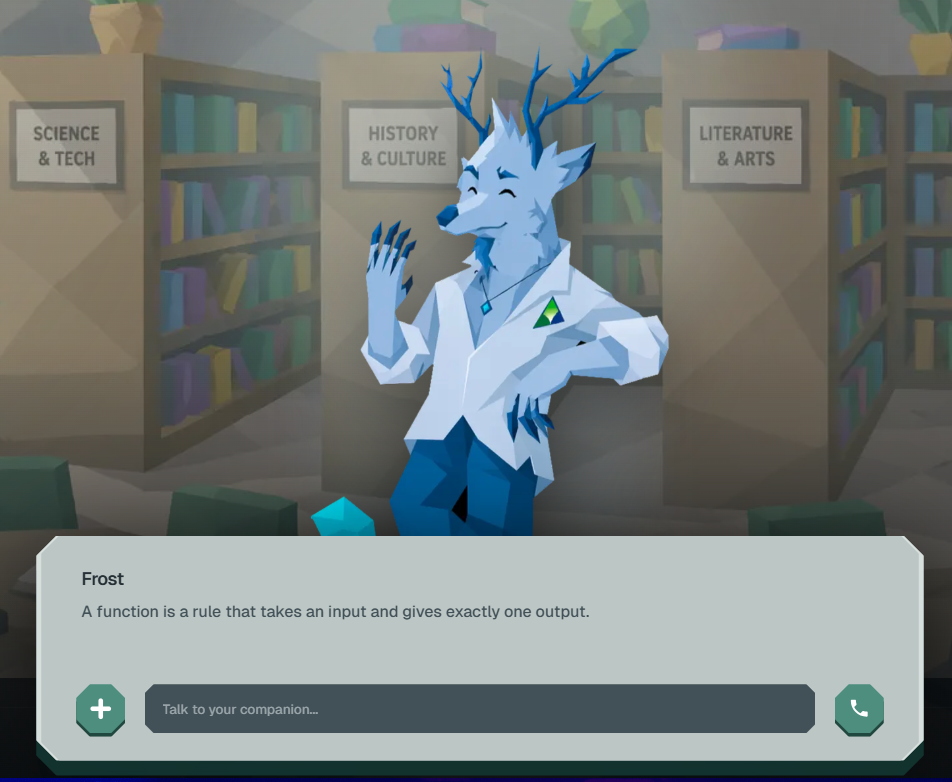
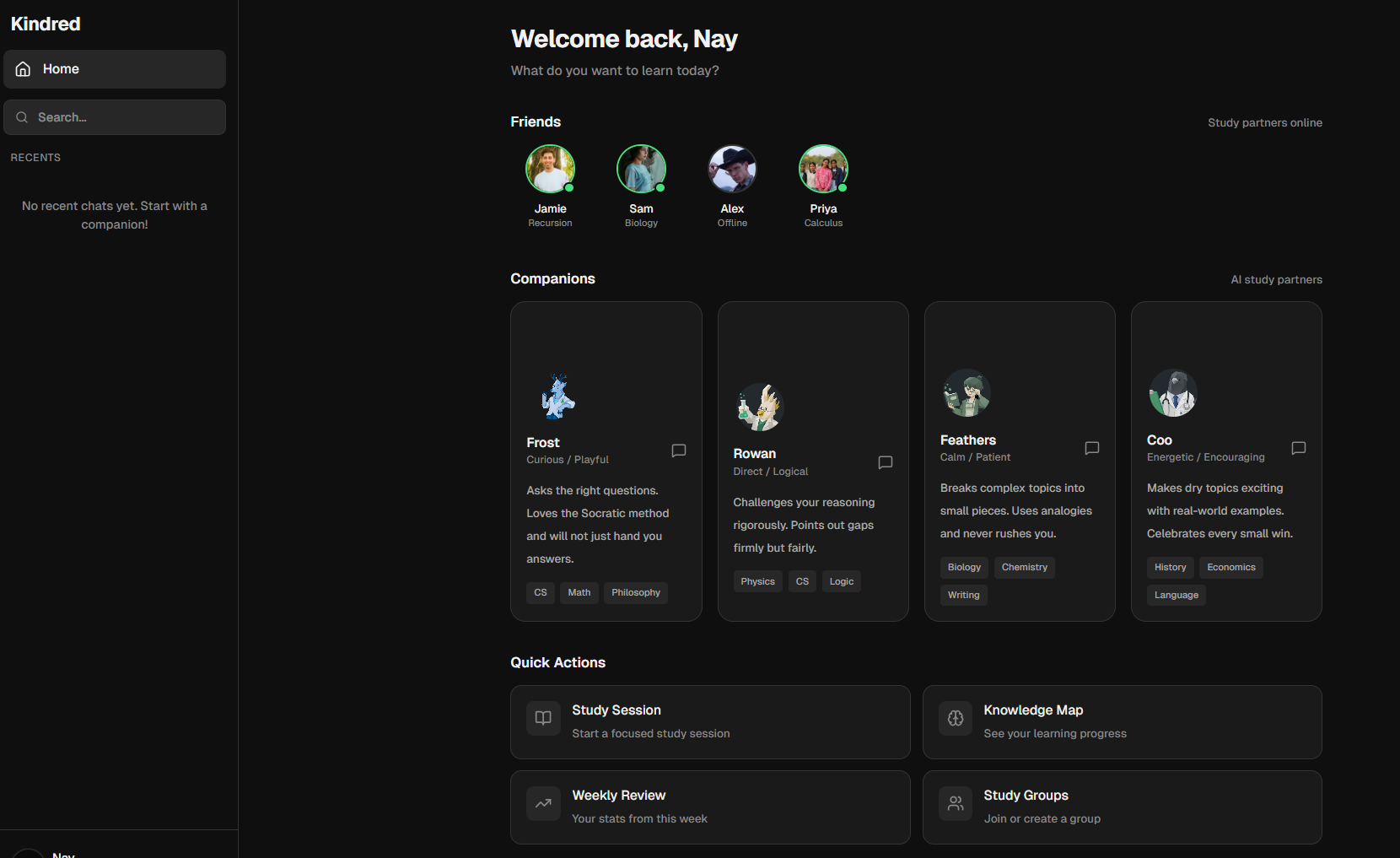
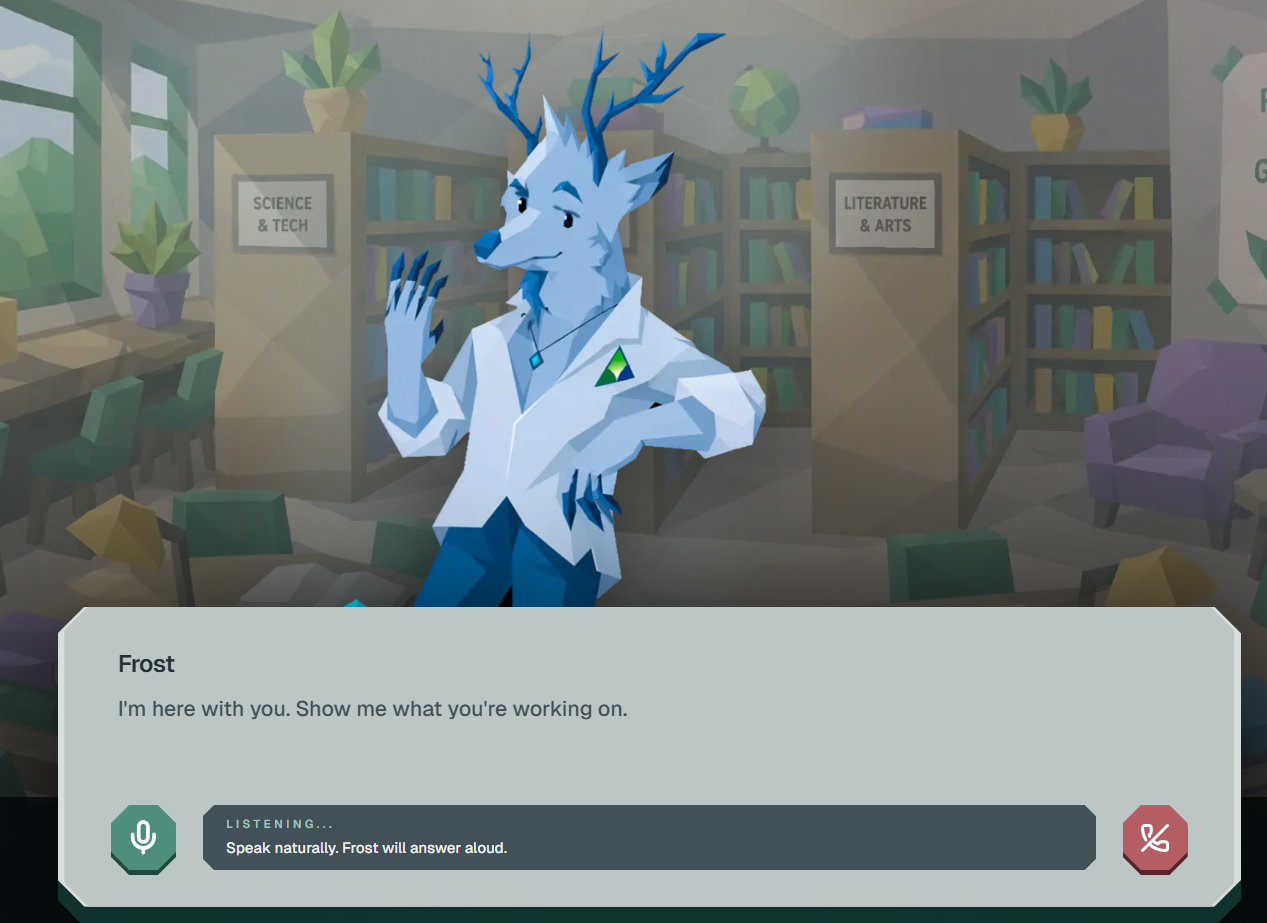
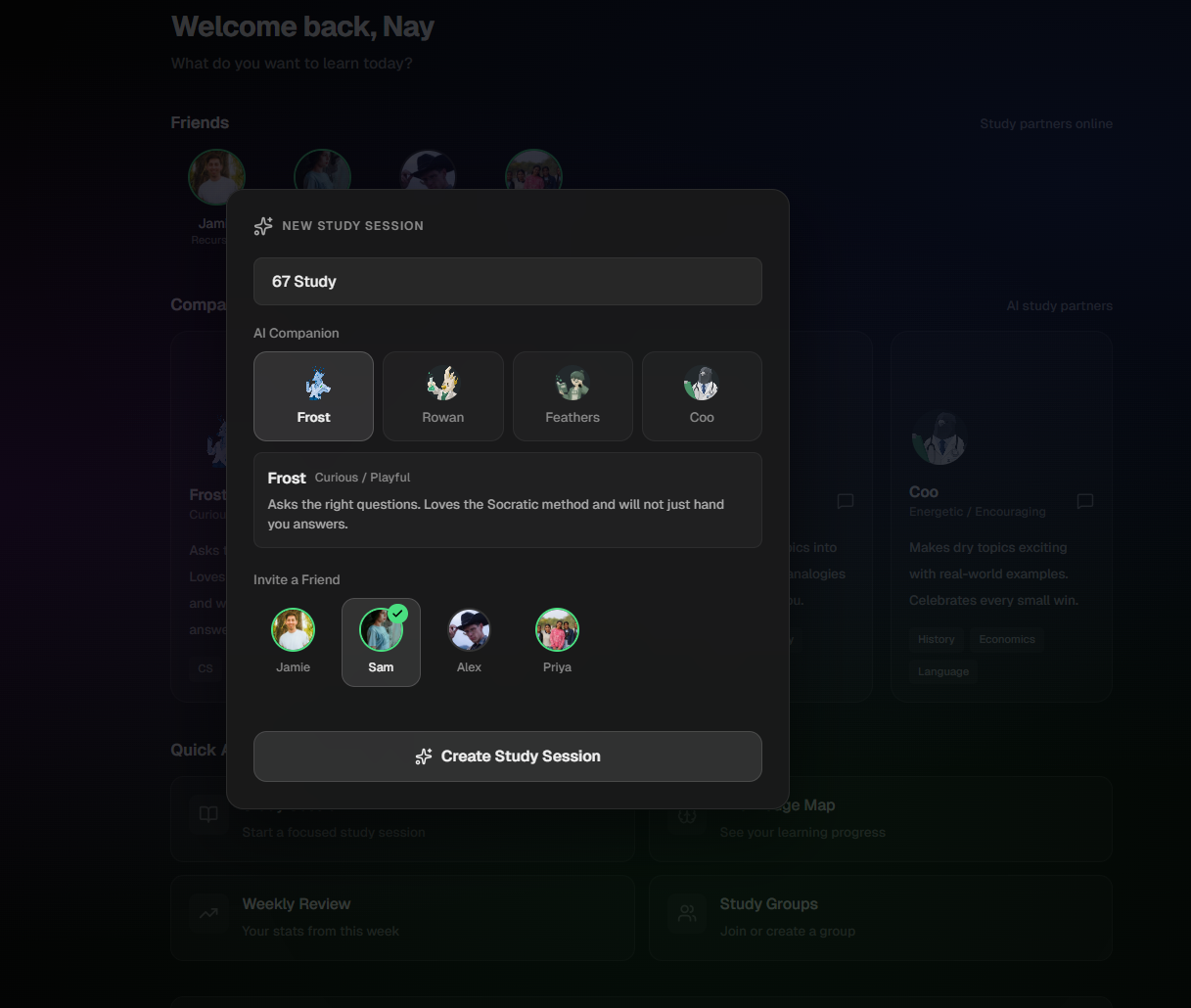
Kindred is a social platform where students study with AI companions that never give direct answers. You pick a companion with a personality that works for you, give it a topic, and it studies alongside you rather than teaching at you. It asks what you think, gets confused in the right places, and pushes back on your reasoning until you can actually defend it. On top of the companion, every session quietly builds a writing fingerprint from how you naturally communicate. Over time that becomes a personal authorship baseline. If a detector ever flags your work, you have documented evidence that the flagged piece is consistent with everything you have written before, compared against yourself rather than against a neurotypical standard. The platform also has a social feed where students share breakthrough moments from their sessions: the analogy that finally made something click, the misconception the companion found. And for neurodivergent students specifically, there are purpose-built modes planned, like: ADHD mode for focus and task chunking, structured mode for predictable interactions, speech input for dyslexic students.
How we built it
Kindred has three parts. The companion. We used the OpenRouter API(GPT-5.4) with a system prompt built around the Feynman technique: the companion never gives a direct answer, responds to the student's specific reasoning rather than a generic version of the question, and maintains the persona of someone working through the problem alongside them. It has its own confusions and misunderstandings by design. When a student submits an explanation, the companion finds the weakest point in their reasoning and pushes on it. This makes the platform cheat-resistant without any detection: a pasted ChatGPT answer gets attacked on ChatGPT's reasoning, which the student then has to understand and defend. Authorship provenance. Each session builds a stylistic fingerprint from the student's writing: sentence length, vocabulary range, syntactic regularity. Over time this creates a personal baseline. When a detector flags a submission, the student has a documented history comparing that piece against their own prior work rather than against a neurotypical population average. That is the architectural shift that matters. Neurodivergent-specific modes. ADHD mode strips the interface and delivers one question at a time with a Pomodoro focus timer. Structured mode gives autistic students a predictable, fixed interaction format. Speech input is available for dyslexic students. These are not cosmetic. They address the specific executive function and sensory processing barriers documented in the research. We also built a social feed where students share breakthrough moments: the analogy that finally worked, the misconception the companion found. Structured reflection built into sharing, grounded in retrieval practice research. Stack: Next.js, FastAPI, Claude API, lightweight vector store for session fingerprints.
Challenges we ran into
The hardest design problem was motivation. Why would a student use Kindred at midnight instead of just asking ChatGPT? Sweller's Cognitive Load Theory predicts people take the path of least resistance when outcomes feel equivalent. Our answer is that Kindred does not compete on convenience. It competes on something different: the satisfaction of actually winning. Successfully defending your reasoning against something that specifically targeted your argument feels nothing like getting a correct answer handed to you. Whether that is enough to change behavior is an empirical question we cannot answer yet. The neurodivergent UX was harder than expected. Talking to ND students mid-hackathon revealed we had gotten several things wrong. The focus mode had too many options. The companion's natural language variation, which we considered a feature, created friction for autistic users who needed predictability. We rebuilt both. The authorship fingerprint works as a proof of concept, but it needs a full semester of sessions to build a reliable baseline, and validation against actual neurodivergent writing corpora. We named this gap clearly in our presentation.
Accomplishments that we're proud of
Getting the companion to actually feel like a peer and not a tutor was harder than we expected. The line between "redirecting reasoning" and "being annoying" is thin, and we crossed it several times before finding the right interaction patterns. The version we shipped feels genuinely collaborative rather than evasive, which was the goal from the start. The authorship provenance system being cheat-resistant by design rather than by detection is something we are proud of architecturally. We did not set out to build a detector. We set out to make detection irrelevant, and the fingerprint system does that in a way that no current product does. We also rebuilt the neurodivergent UX mid-hackathon after talking to ND students and realizing our initial assumptions were wrong. The willingness to throw out a few hours of work and start fresh on those components produced a significantly better result, and we are glad we did it.
What we learned
The research that shaped Kindred most was on peer learning. A review of peer-support interventions in higher education found that peer learning and mentoring produced the strongest positive effects on student anxiety and stress. A systematic review specifically on autistic students in peer-mentorship programs found improvements in social skills, academic performance, and sense of belonging. The consistent finding: peer learning works, but only when it has structure, clear roles, and active retrieval built in. That pointed directly at the design failure of every existing AI study tool. They give answers. A peer does not give answers. A peer asks what you think, gets confused alongside you, and makes you explain yourself until it makes sense. Bloom (1984) quantified what good tutoring actually does: the average student tutored one-on-one outperforms 98% of students in conventional instruction. Two full standard deviations. AI is the first technology that can realistically close this gap, but only if it is designed to tutor rather than to answer. Csikszentmihalyi's Flow Theory gave us the engagement model. Flow happens when challenge sits just above your current skill level. Too easy and you disengage. Too hard and you give up. The goal is to hold that edge continuously, which requires knowing where the student actually is at any moment. On the neurodivergent side specifically: gamification improves outcomes for ADHD and dyslexic students by increasing attention and task persistence through clear goals and immediate feedback. Non-judgmental environments address emotional and social barriers for autistic students and students with DLD by reducing fear of failure. Combined, they target both the cognitive and emotional constraints these students face. That framing became the core design principle of Kindred.
What's next for Kindred
The most important next step is replacing the current lightweight fingerprinting with a proper knowledge tracing model. SAINT+ (Shin et al. 2021), trained on 131 million real student interactions, would let the companion calibrate challenge level dynamically rather than relying on fixed difficulty settings. That is the piece that would make the flow-state engagement model actually work at scale. The authorship system needs longitudinal validation. We want to pilot with a cohort of neurodivergent students over a full semester, build real baseline data, and test whether the consistency scores hold up as evidence in actual academic integrity disputes. That requires institutional partnerships, which is the longer-term goal. The social feed is underdeveloped. Right now it is read-only. The next version would let students create shared study rooms with both AI companions and real people, which is what our PDF proposal originally described and what the peer learning research most strongly supports. Finally, we want to open the companion personality system so students can genuinely build companions that fit them rather than choosing from a preset list. The research on non-judgmental learning environments shows that the relationship between the student and their study partner matters. That relationship should be something students can shape themselves.
Built With
- next.js

Log in or sign up for Devpost to join the conversation.