Inspiration
Most unclaimed-money tools exist for one person checking their own name,
once, if they remember to. But money doesn't just sit unclaimed for the
person searching — it sits unclaimed for aging parents who don't know to
look, for siblings who moved states years ago, for the whole extended
family nobody's actively watching out for. We wanted to build something
that treats "checking for unclaimed money" the way you'd treat checking in
on family — ongoing, not a one-time favor to yourself.
What it does
Kindred searches California's public unclaimed-property records for a
name and shows what's owed, in seconds. What makes it different is the
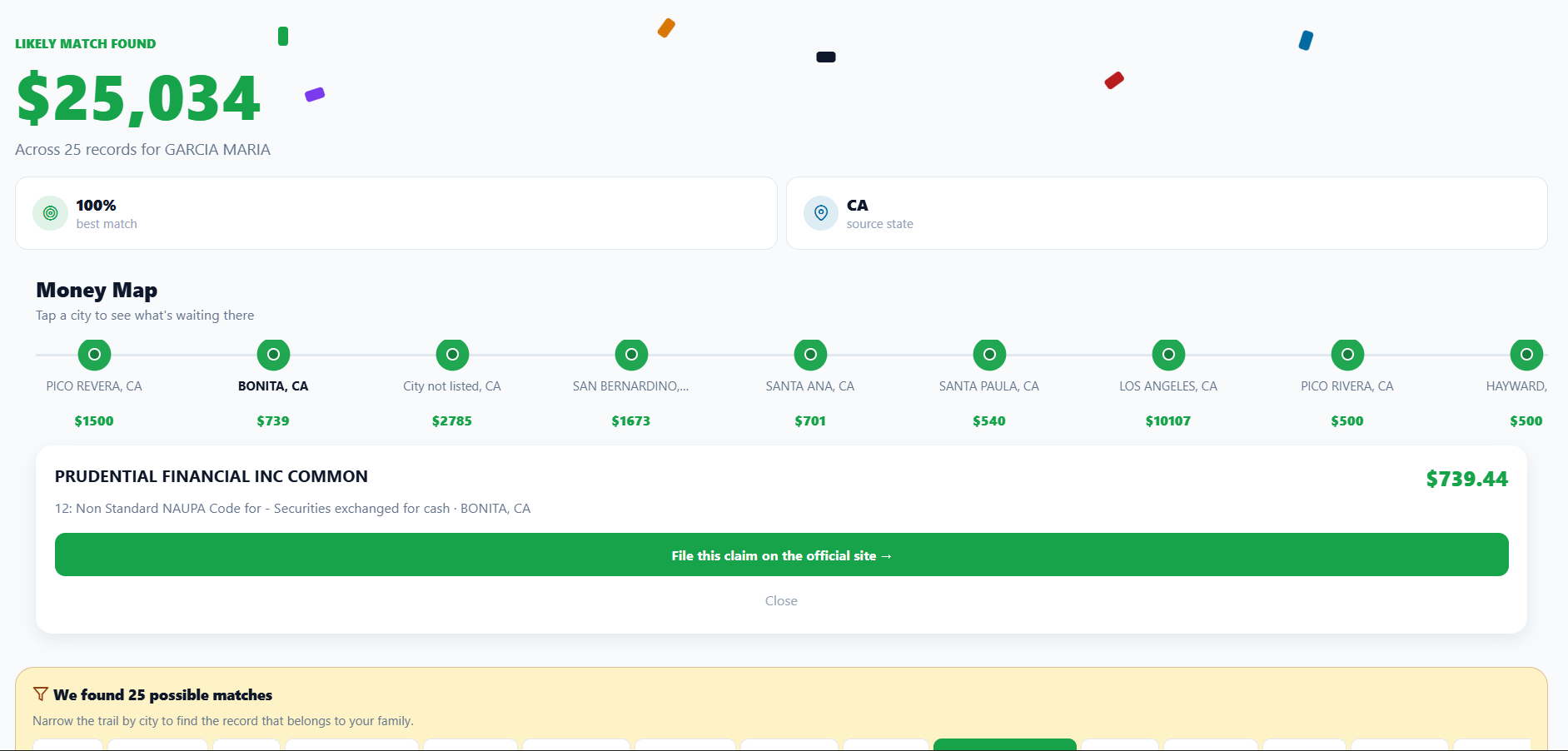
Money Map — instead of a flat list of results, matches are shown as
glowing markers across a timeline of the cities tied to your search,
tappable to reveal the full match detail (who owes you, how much, and a
direct link to file the claim on the real, official state site — Kindred
never files claims on a user's behalf, and searching is always free).
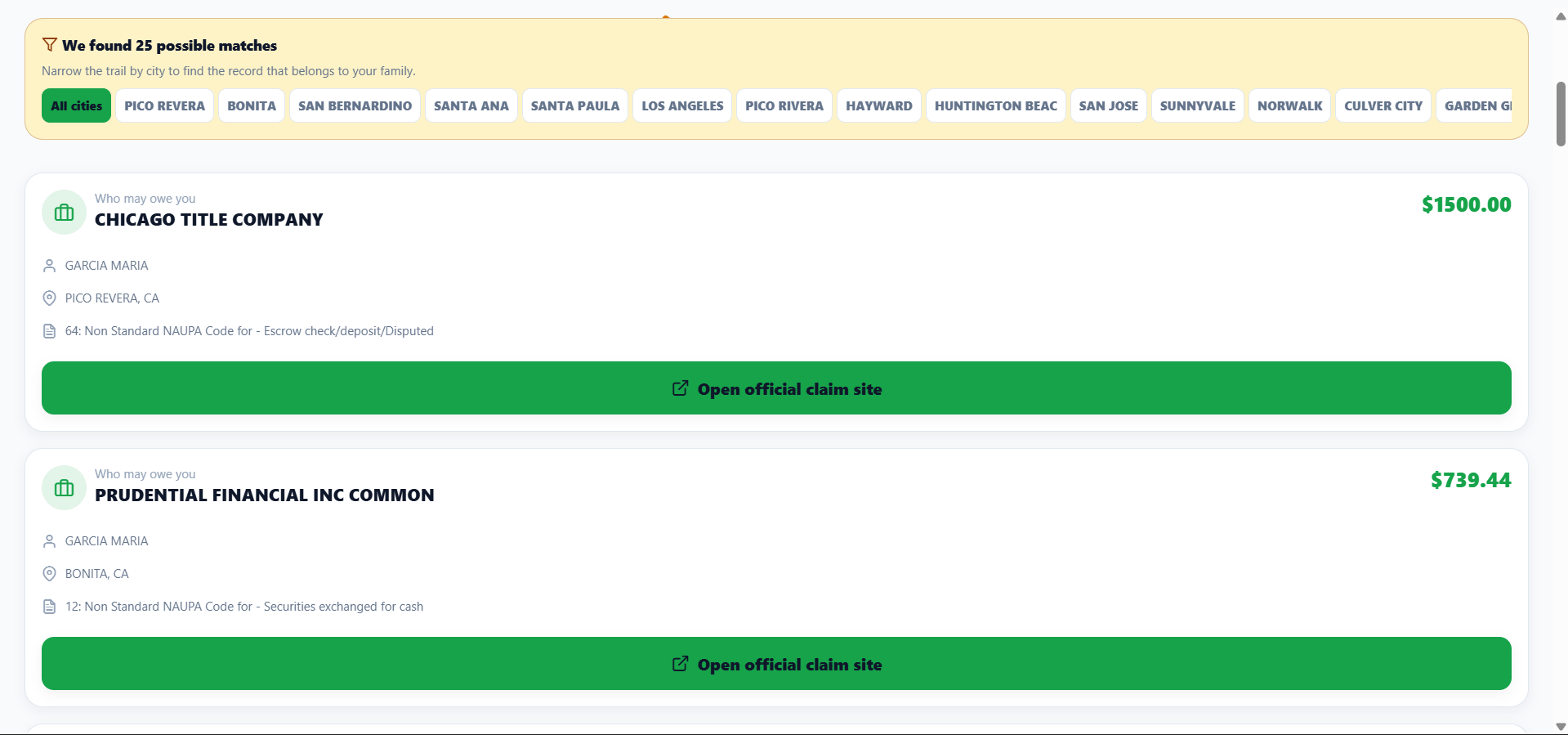
Search handles messy real-world names with nickname-aware fuzzy matching
(so "Bob" correctly matches "Robert"), and when a common name returns many
possible matches, Kindred surfaces a disambiguation view so users can
narrow by city instead of guessing. Kindred Pro extends this from a single
search to ongoing monitoring: saved profiles for family members, and
automatic re-scans so nobody has to remember to check again.
How we built it
Frontend: React Native + Expo, with react-native-reanimated for
the Money Map's motion (pulsing match markers, animated detail cards)
and expo-haptics for tactile feedback on key moments.
Backend: Python + FastAPI, indexing California's real public
unclaimed-property bulk data (published directly by the California State
Controller's Office) into SQLite, with rapidfuzz powering the fuzzy
and nickname-aware name matching.
Monetization: RevenueCat, handling the subscription entitlement for
Pro (family profiles + re-scan alerts) and the native paywall UI.
We leaned heavily on AI-assisted development to move fast — describing
features and interactions in detail and iterating against real,
running code rather than writing everything by hand — and treated
automated + manual verification as a first-class part of the process,
not an afterthought.
Challenges we ran into
Getting real government data in was harder than it looked — the state's
public files don't come with a clean, documented schema, so ingestion
needed real column-mapping and validation against the actual downloaded
file rather than assumptions.
Building the Money Map itself took multiple real iterations — an
open-ended "make it visual and delightful" instruction is genuinely hard
to get right on the first pass, AI-assisted or not, and we learned to be
increasingly specific and to verify against the running app rather than
trusting a description of what was built.
We also had a real (and useful) scare with API key hygiene: RevenueCat
separates secret keys from public SDK keys, and it's easy to accidentally
copy the wrong one — we caught it, rotated the exposed key immediately,
and it reinforced how seriously we now treat credential handling.
Accomplishments that we're proud of
A signature, genuinely interactive feature (the Money Map) rather than
a plain results list — built, tested, and confirmed working end to end.
Real government data, not a mocked dataset — verified against known
fake sample records to confirm we were actually querying live public
data, not our own test fixtures.
A disambiguation experience for common names that we hadn't originally
scoped, but added once we saw how often "Maria Garcia"-style names
returned dozens of legitimate matches.
A monetization model that's honest about what it charges for — Kindred
charges for ongoing monitoring convenience, not for locating or filing
a claim, which is explicitly always free through official government
channels.
What we learned
We learned a lot about the unclaimed-property space itself — how
fragmented state-by-state data access is, and how meaningfully California
stands out by publishing its full dataset openly. We learned that
AI-assisted building is genuinely powerful but requires real verification
discipline: an AI tool confidently saying a feature is "done" isn't the
same as it actually being done, and building small automated checks (like
a script that confirms real vs. sample data programmatically) turned out
to be one of the most valuable things we built. We also came away with a
much sharper sense of how consumer fintech-adjacent products need to earn
trust explicitly — through visible disclosures, not just a working
feature.
What's next for Kindred
Expanding beyond California to additional states as their public data
becomes accessible, prioritizing states with the largest populations
first.
A give-back mechanic tied to Pro subscriptions, granting free monitoring
access to families facing financial hardship.
Push notifications (via OneSignal) for real-time re-scan alerts instead
of manual re-checks.
Exploring on-device tools (like scanning old mail for potential
unclaimed-property leads) as an additional, privacy-preserving way to
surface matches without requiring manual search.
Built With
- android
- consumer-app
- expo-haptics
- expo.io
- family-tech
- fastapi
- fintech
- government-data
- in-app-purchase
- ios
- javascript
- mobile-app
- open-data
- public-data
- python
- rapidfuzz
- react-native
- react-native-reanimated
- react-navigation
- revenuecat
- sqlite
- subscription
- unclaimed-property

Log in or sign up for Devpost to join the conversation.