Inspiration
Friendships rarely end with a fight. They drift. You change schools, a sports season ends, someone moves to a new city. Nobody decides to stop talking. Everyone just assumes someone else will text first, and a few months later the group chat is dead.
The U.S. Surgeon General's 2023 advisory on loneliness found that people aged 15–24 spent 70% less time with friends in 2020 than in 2003. Group chats don't fix this. They're loud for the people who are active and silent about the person who stopped talking. The friend who's struggling is usually the least likely to speak up, and the friends who care often don't reach out because it feels awkward ("what do I even say after three weeks?").
I wanted a tool that notices who went quiet, and that makes reaching out feel small and safe instead of awkward.
What it does
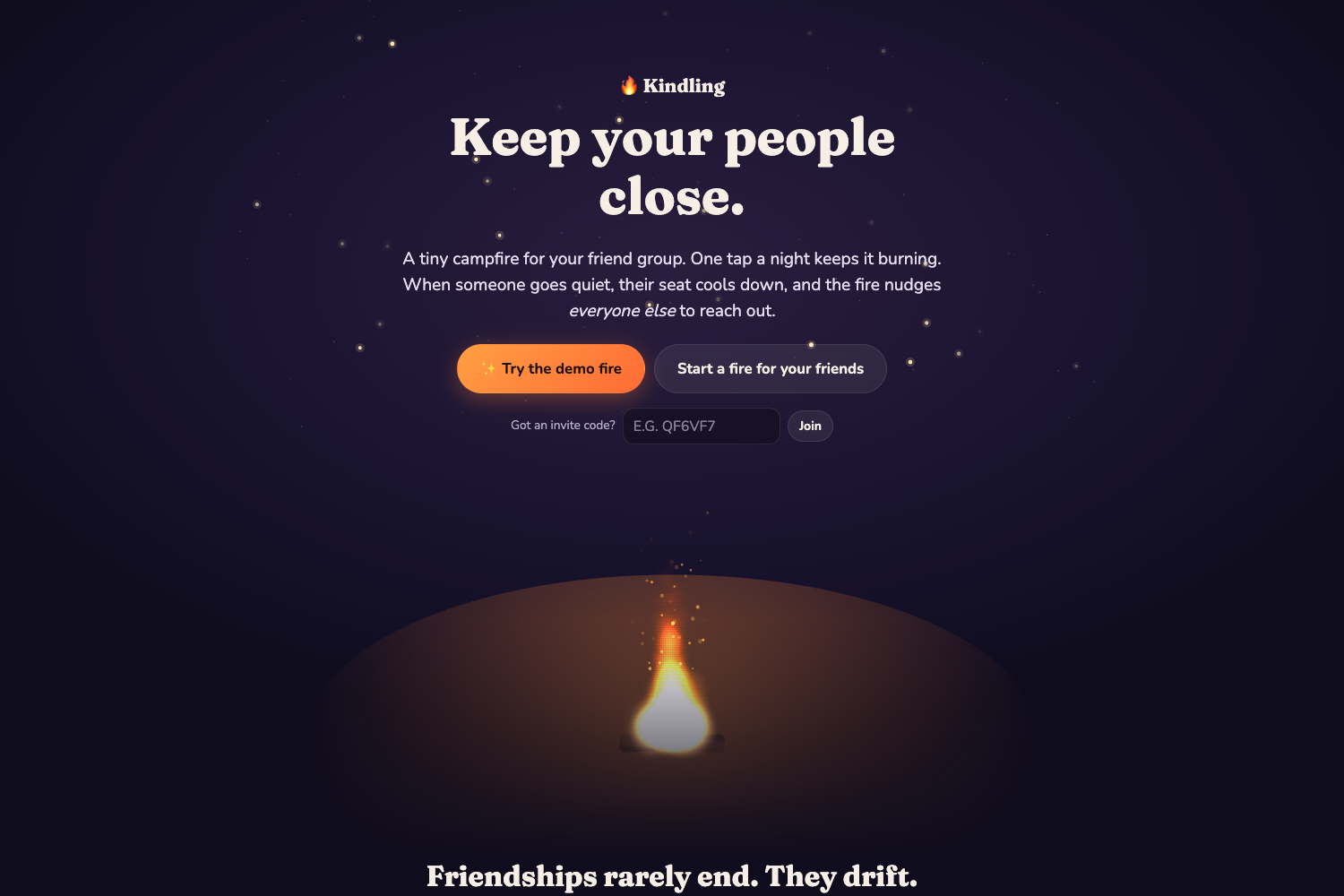
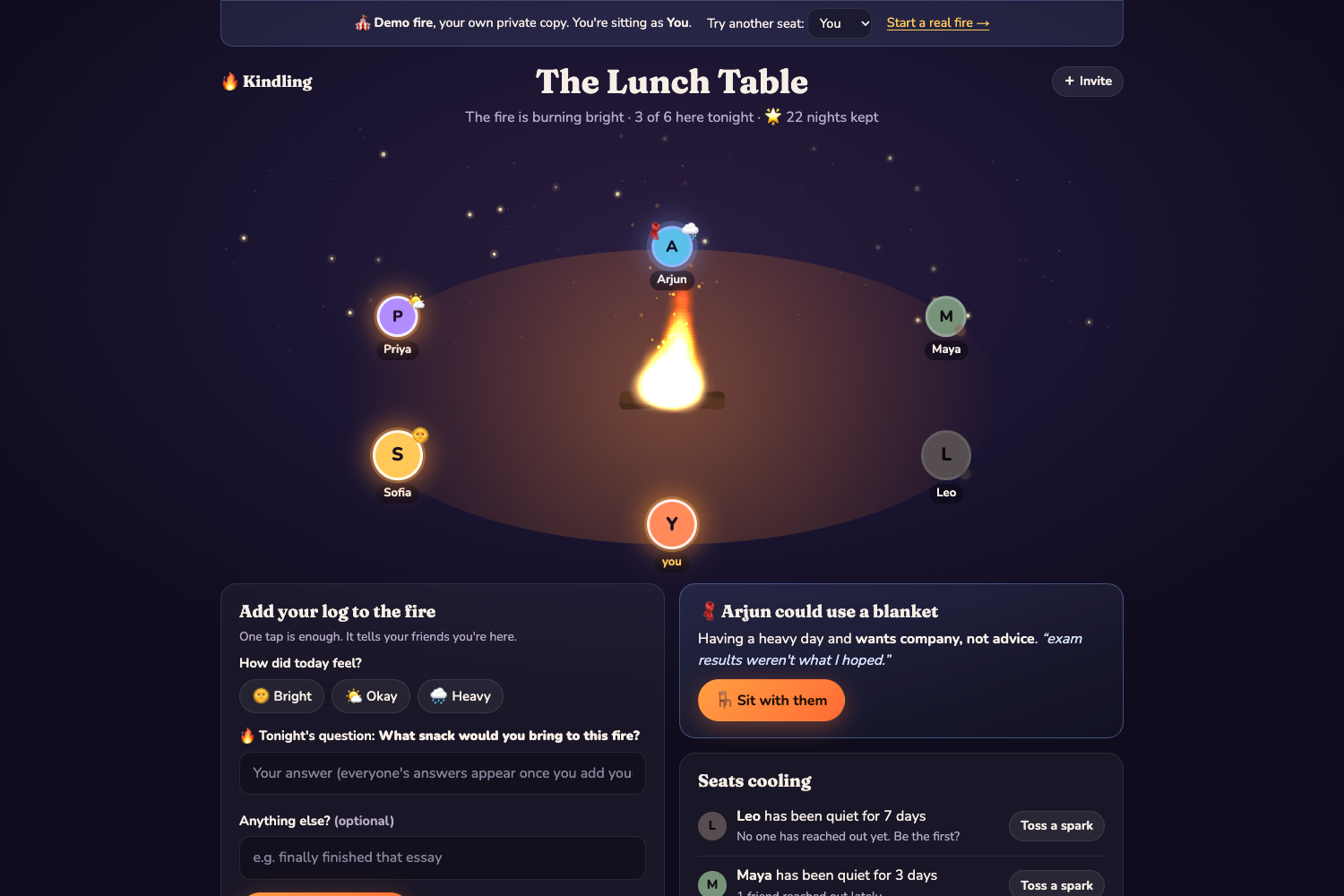
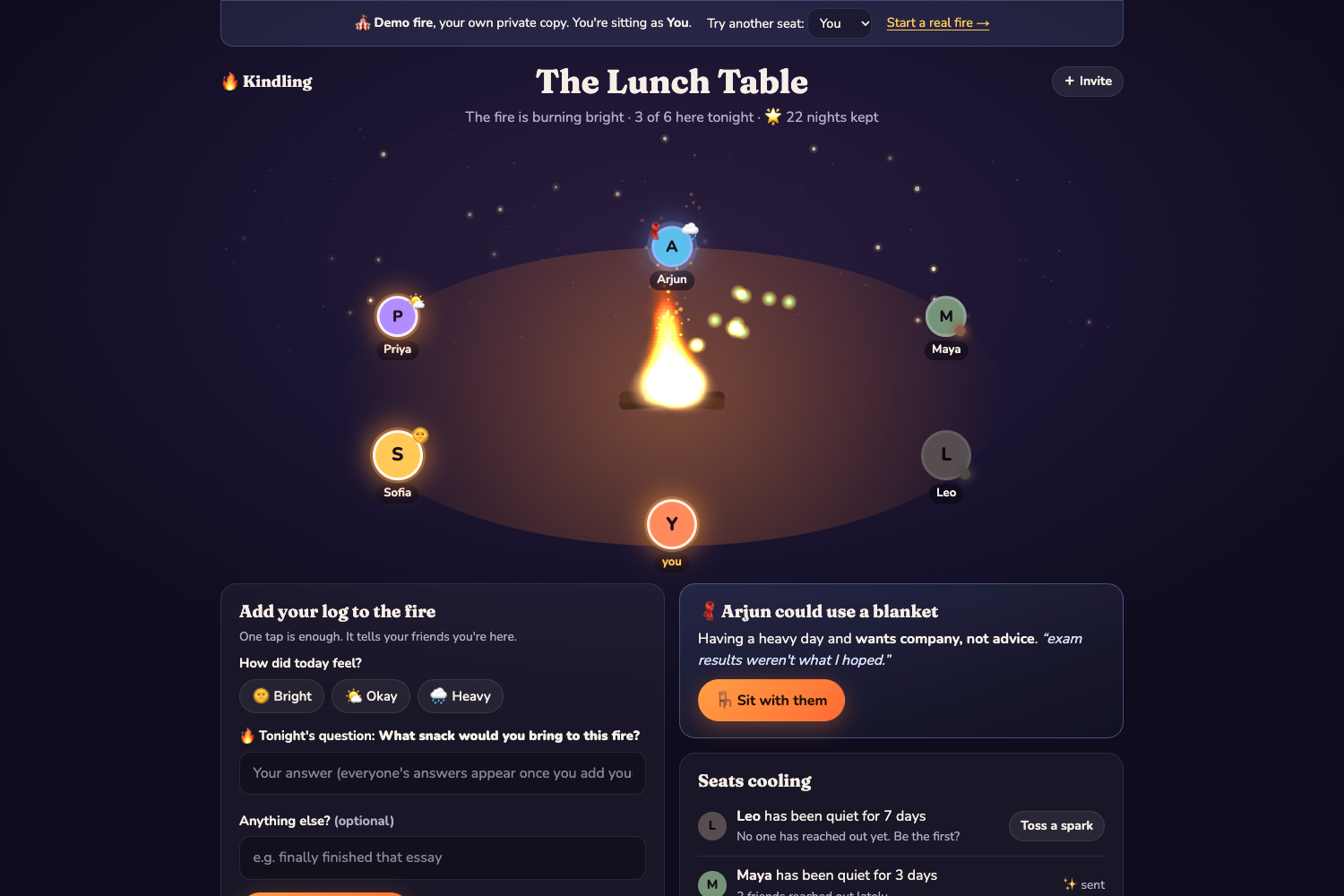
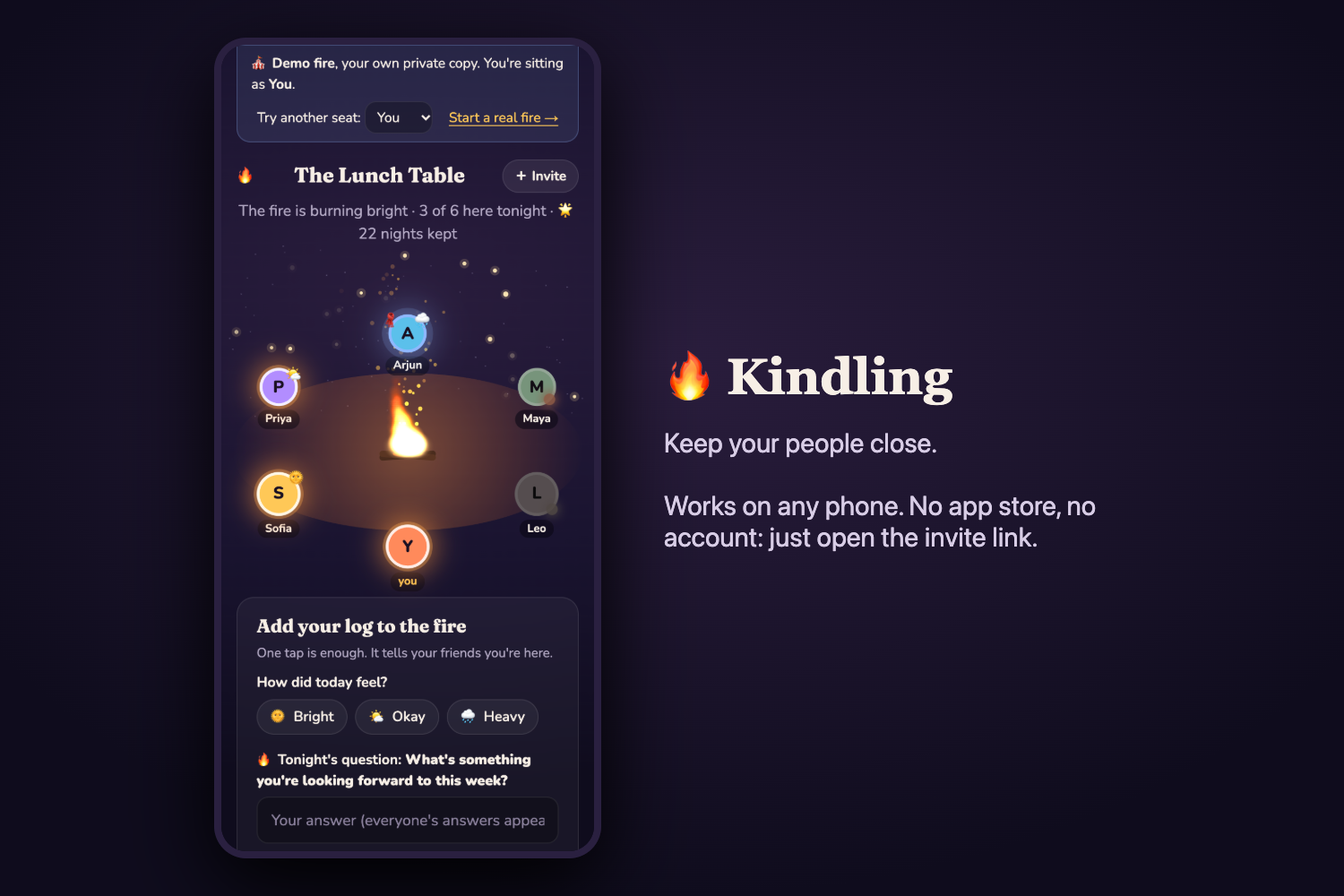
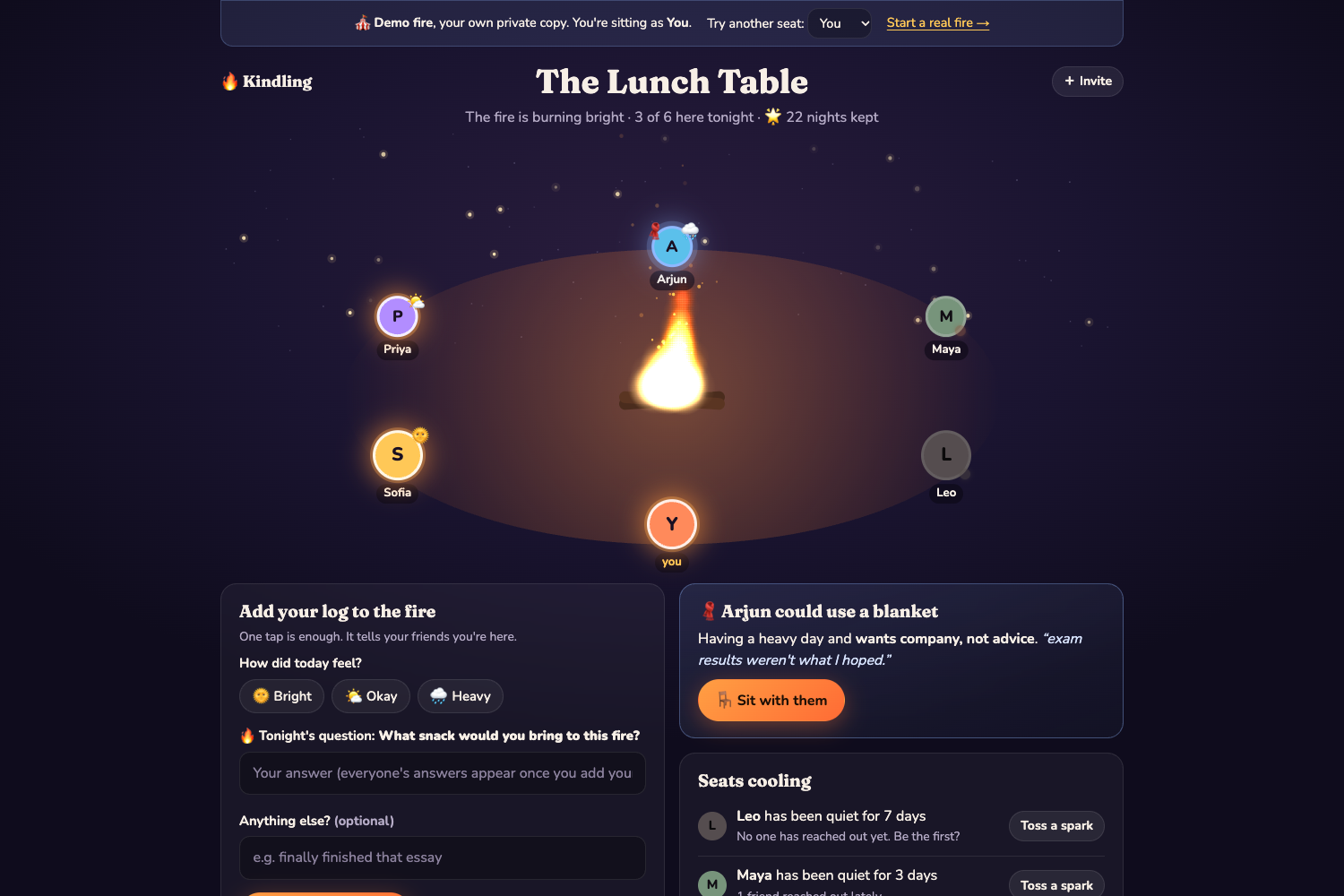
Kindling gives a small friend group (up to 12 people) one shared campfire. Each friend has a seat around it.
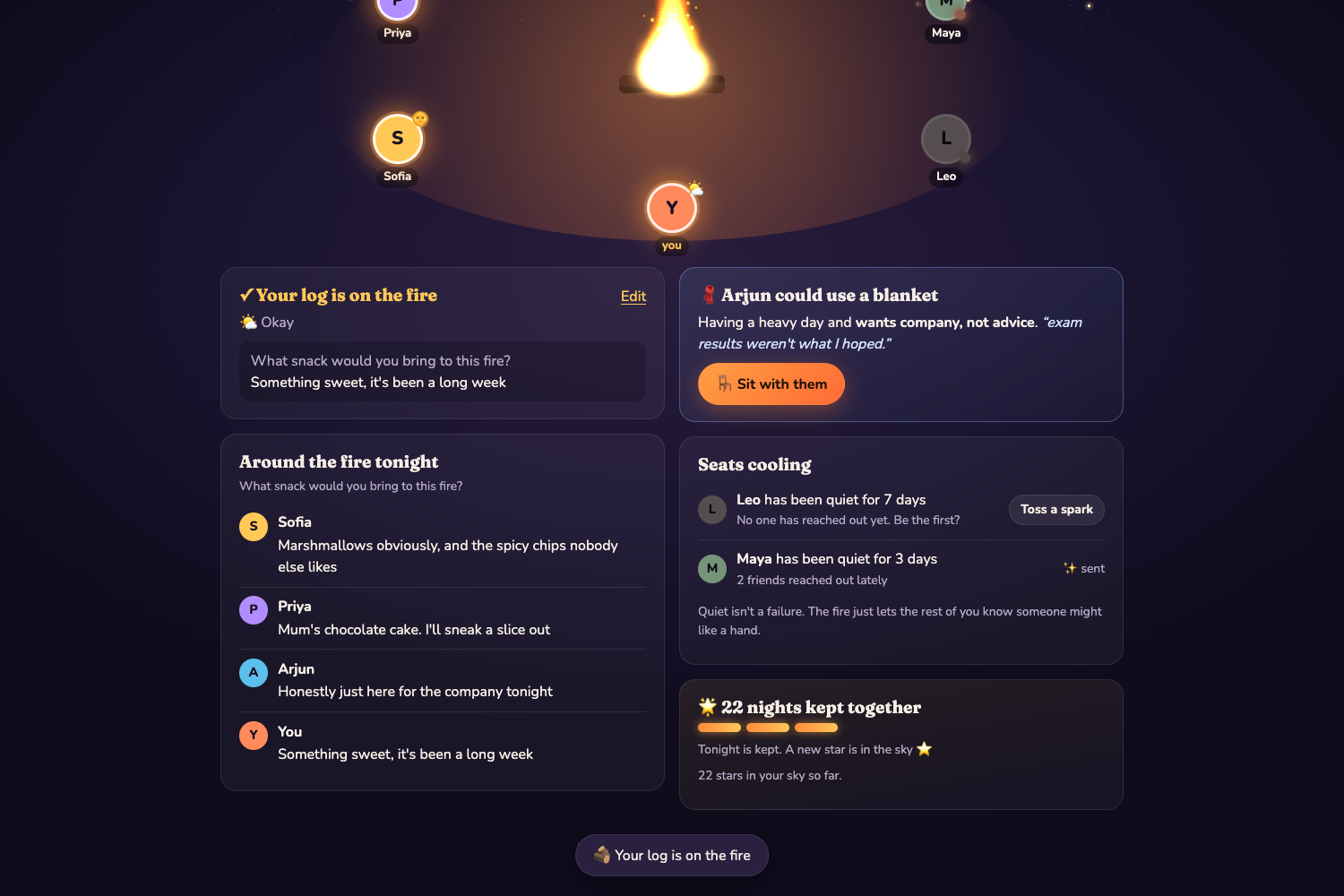
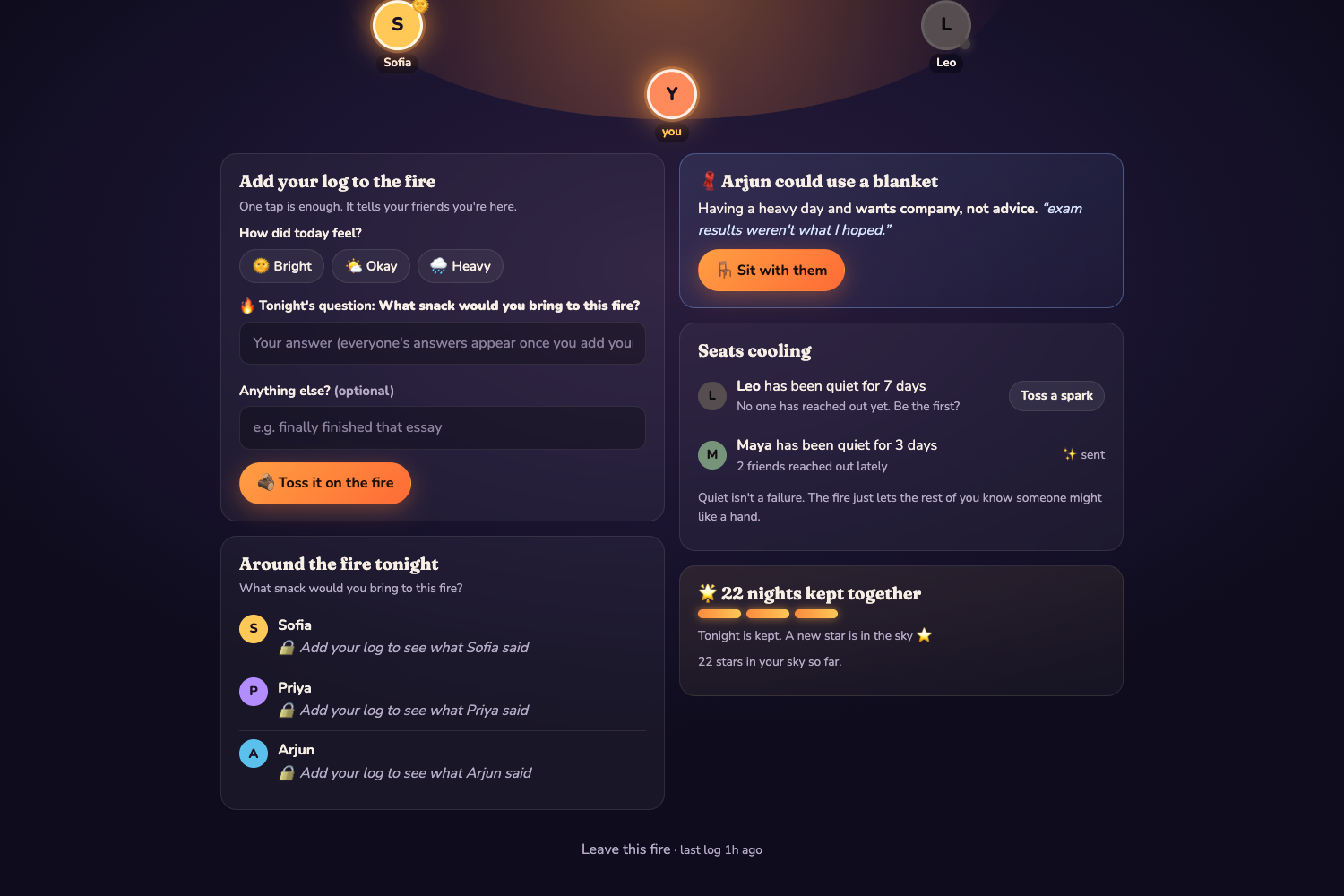
- 🪵 One tap a night. Log how your day felt (bright, okay or heavy) and answer a fun nightly question like "What snack would you bring to this fire?" Everyone's answers stay hidden until you add yours, so everyone shares before anyone scrolls.
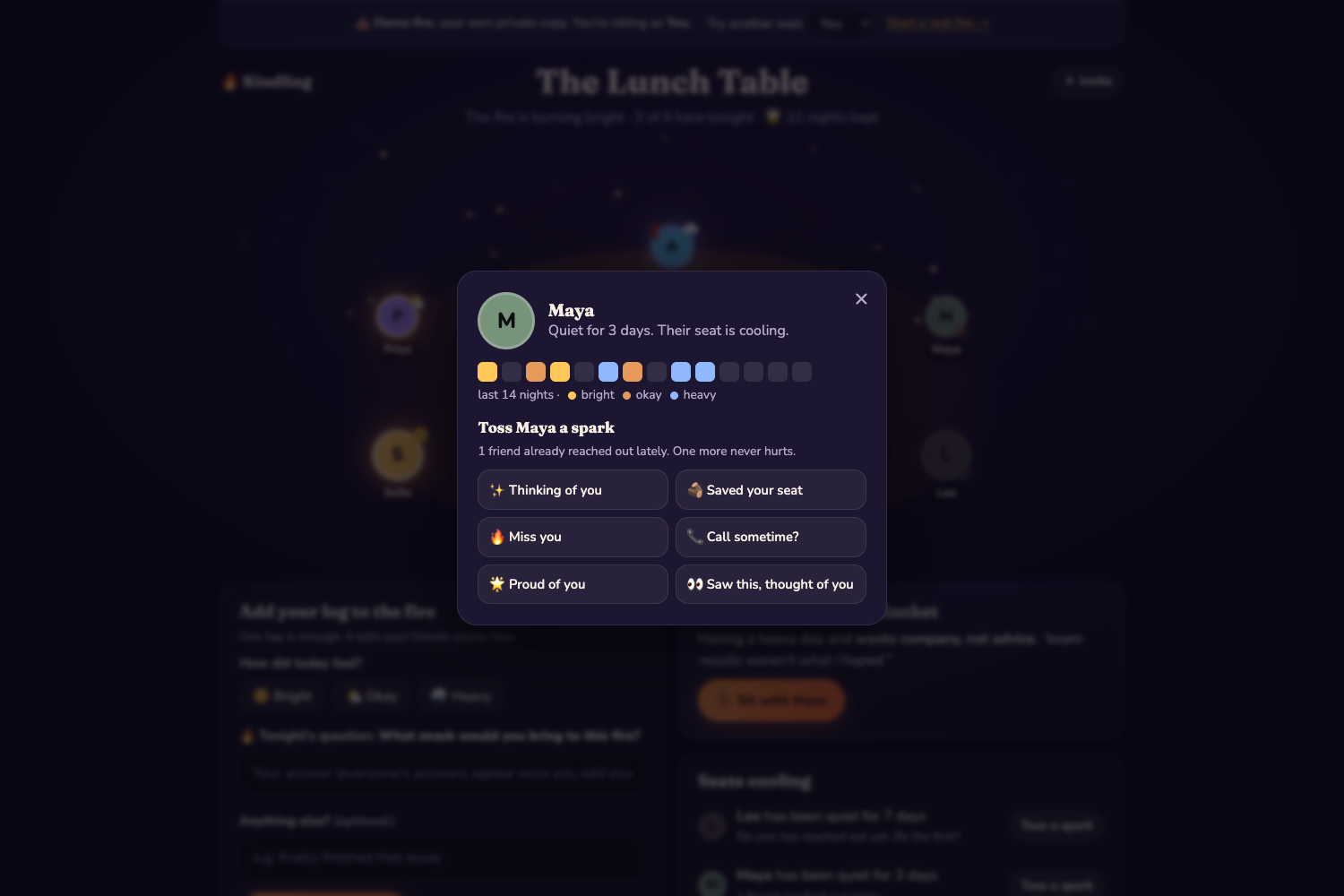
- 🌫️ Quiet seats cool down. If a friend hasn't checked in for a few days, their seat fades from glowing to cooling to embers. Kindling doesn't guilt the quiet friend. It nudges everyone else: "Maya has been quiet for 4 days. No one has reached out yet. Be the first?"
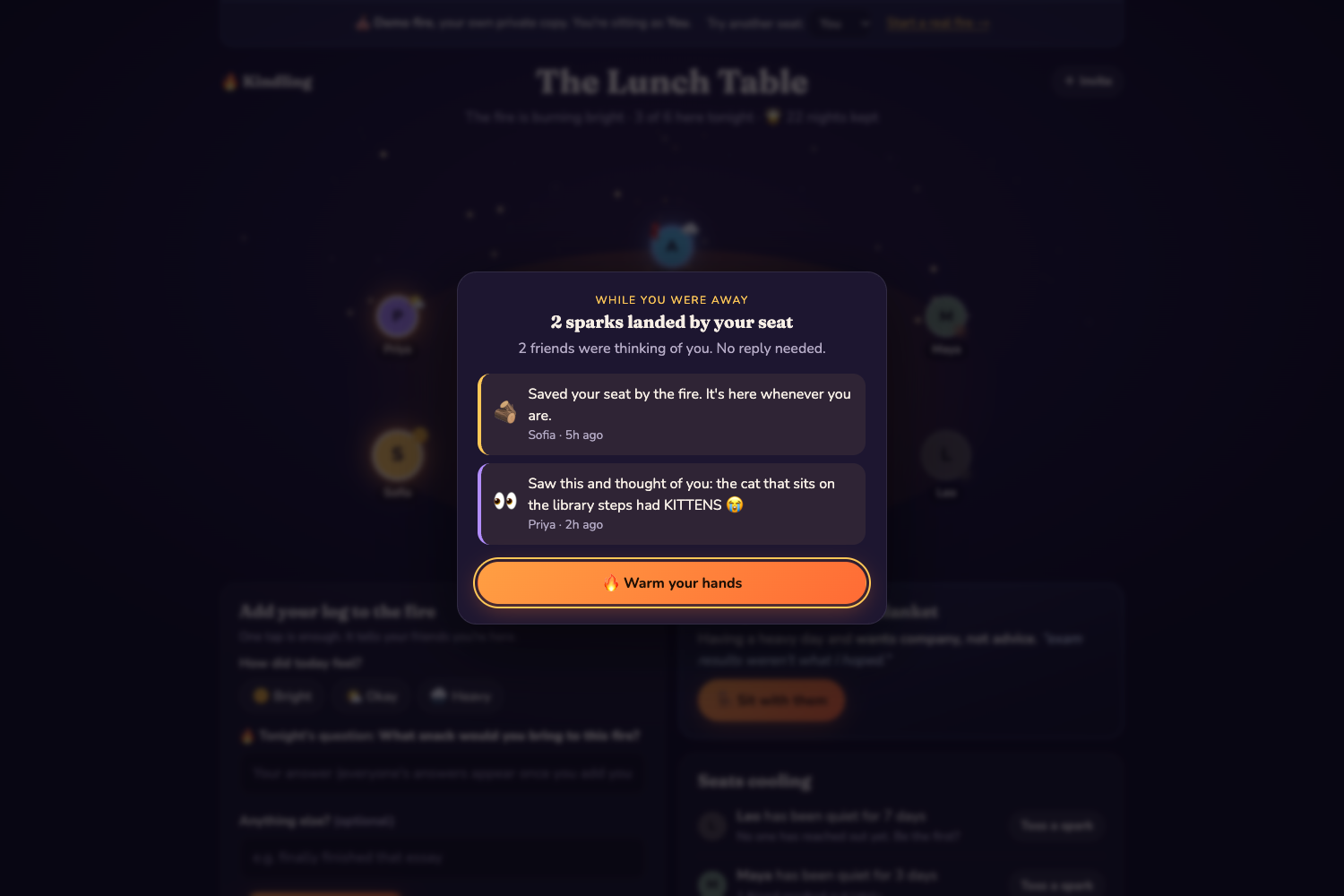
- ✨ Sparks, no reply needed. One-tap messages like "Saved your seat by the fire" or "Thinking of you. No reply needed." You watch the spark fly across the fire to their seat, and when they come back they see "While you were away, 2 sparks landed by your seat." You can also send it as a text.
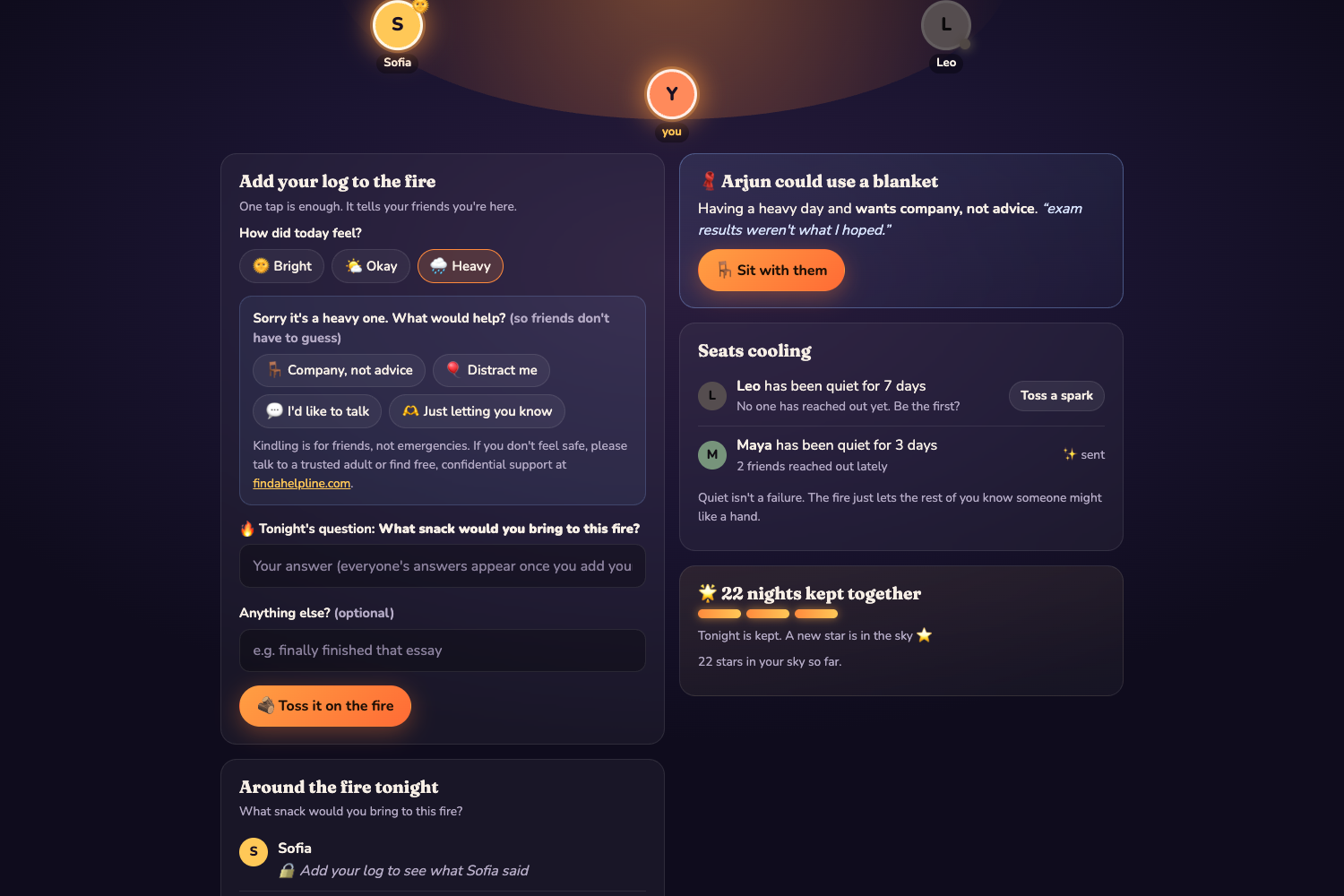
- 🧣 Heavy days, named needs. When you log a heavy day, Kindling asks what would help: company, not advice, distract me, I'd like to talk, or just letting you know. Friends see a blanket on your seat and a matching button (🪑 Sit with them, 🎈 Send a distraction, 💬 Offer to talk), so nobody has to guess the right thing to say.
- 🌟 A shared streak. A night counts as kept when half the group checks in. The streak belongs to everyone, so no one person gets blamed for breaking it. Every kept night adds a star to the sky above your fire.
Try the demo fire on the home page. It gives you a private copy of "The Lunch Table", a friend group with three weeks of history. You can switch seats to see the fire from the quiet friend's side.
How I built it
- Next.js 16, React 19 and TypeScript for the website and API routes, deployed on Vercel.
- Turso (hosted SQLite) stores circles, seats, nightly logs and sparks.
- The fire is a canvas particle system. Hundreds of soft, low-opacity puffs are blended additively, so where they overlap the core glows hot while the edges stay orange-red. Puffs get pulled towards the centre as they rise, which forms flame "tongues". Embers drift up, and sparks fly along a curved path to a friend's seat.
- The fire's size is the group's warmth. Each friend's check-in fades over about a day and a half, and recent sparks add a bit of heat, so reaching out keeps the fire going as much as showing up does:
$$\text{warmth} = \frac{1}{n}\sum_{i=1}^{n} e^{-t_i/36\text{h}} + \min(0.2,\ 0.04 \times \text{sparks in last 24h})$$
where \(t_i\) is the time since friend \(i\)'s last check-in. It's clamped between 0.08 (embers never fully go out) and 1 (roaring).
- The rules of the fire (seat cooling, warmth, the shared streak, who to nudge) are pure functions with unit tests, so they work the same everywhere.
- Privacy by design. There are no accounts, emails, likes or public profiles. Your seat is a private token on your device, and circles are invite-only. Sparks between other people stay private: you only see that someone reached out, never what they said. Tonight's answers are hidden on the server until you add yours, and "Leave this fire" deletes everything you wrote. Heavy days show a gentle link to findahelpline.com, because Kindling is for friends, not emergencies.
Challenges I ran into
- Making "you've been quiet" feel kind, not guilty. My first idea was a personal streak, but that punishes the person who's already struggling. Moving the nudge to the rest of the group and making the streak shared changed the whole feel of the app.
- Making the fire look like fire. At first it was a white blob, because too many bright particles stacked up. Lowering each particle's opacity, fading its colour from yellow to orange to red over its life, and pulling particles to the middle fixed it.
- A seat hidden behind the flames. With six friends, one seat sits directly across the fire, and the flames covered it. I moved the fire down and widened the circle of seats.
- Time zones. "Tonight" means different hours for different friends, so each log stores the writer's local day, and the demo builds its history in the visitor's own time zone.
- A demo that makes sense for any question. The nightly question changes every day, so the demo picks a circle whose question tonight matches one the demo friends have written answers for.
What I learned
- Design choices are social choices. Whether a streak belongs to one person or the group decides whether an app supports people or pressures them.
- How particle systems work, and why additive blending turns white when too many particles overlap.
- Enforcing privacy on the server (hidden answers, private sparks) instead of just hiding things in the interface.
- Deploying a full-stack app with a hosted database, for free.
What's next
- Optional notifications when a spark lands or a friend has a heavy day.
- Fires for school clubs and teams, so members stay connected after the season ends.
- Gentle weekly recaps ("Your fire stayed lit 5 nights this week. Leo's seat warmed up again 🔥").
- More languages, plus accessibility testing with screen-reader users.
Built With
- canvas
- claude
- css3
- html5
- javascript
- libsql
- next.js
- node.js
- react
- sqlite
- turso
- typescript
- vercel
