-
-

Kindling Logo
-
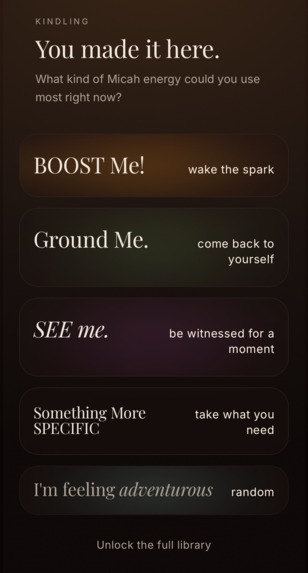
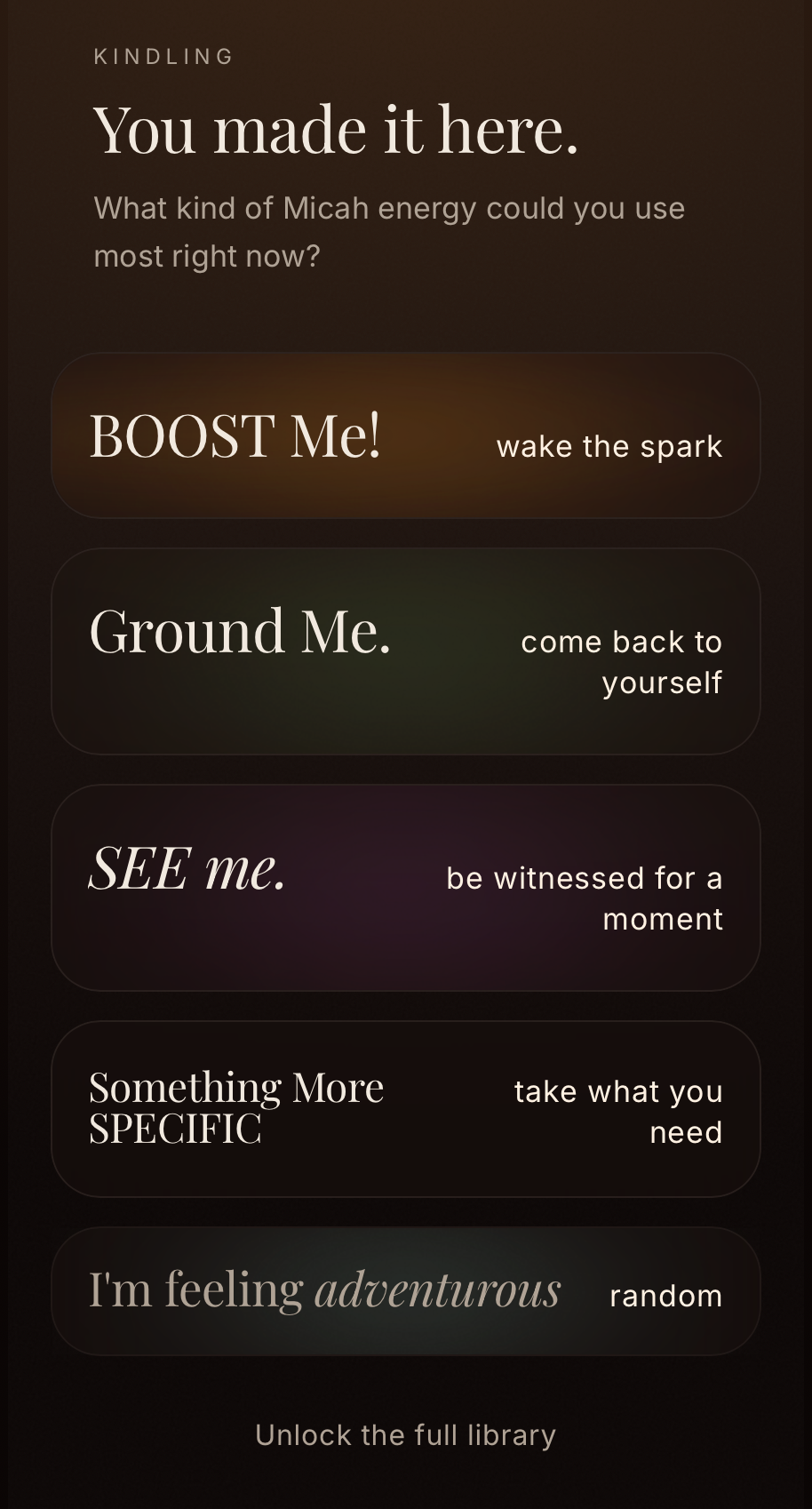
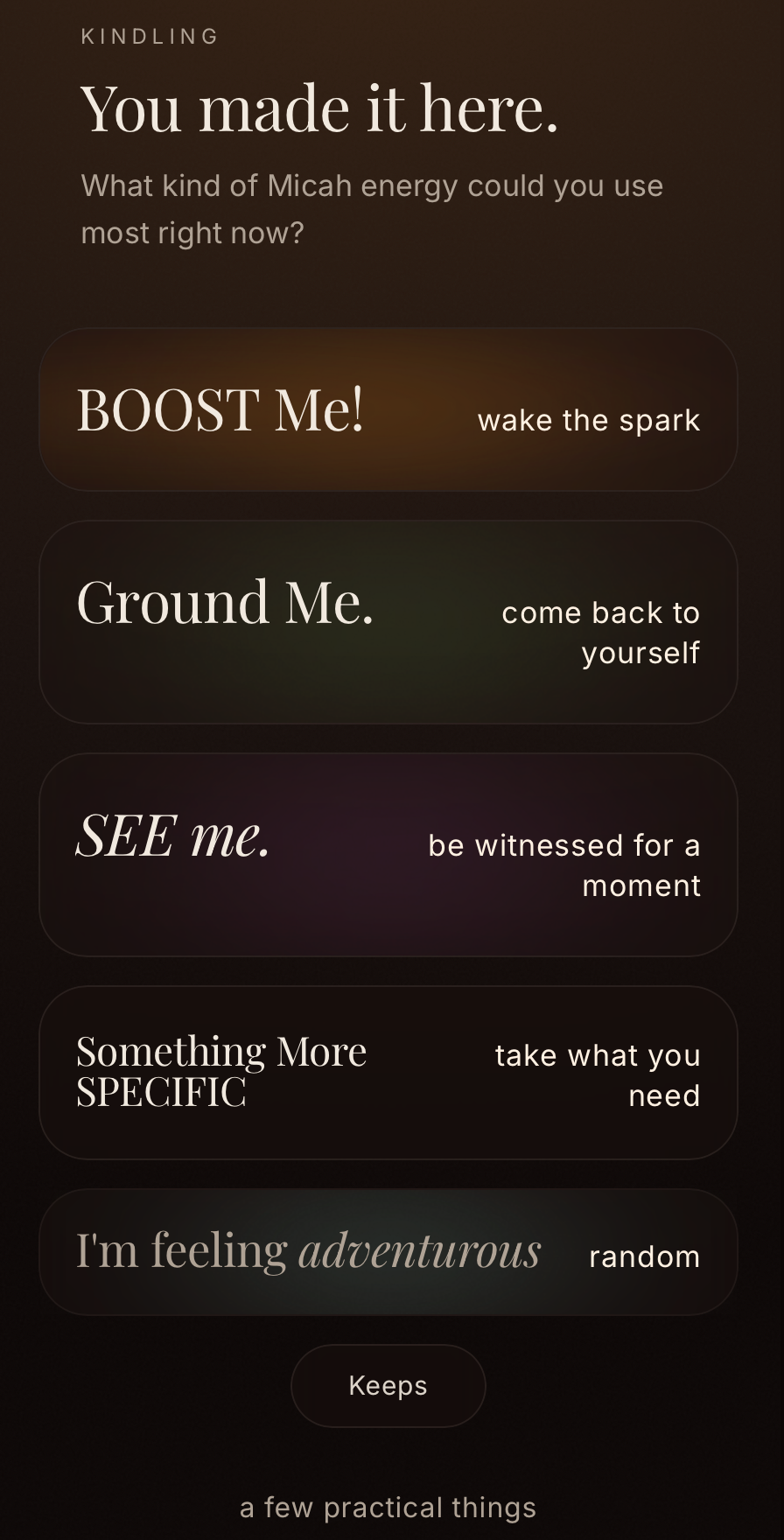
Kindling home screen before Unlock: choose the mode that best meets your moment—or let Kindling surprise you
-
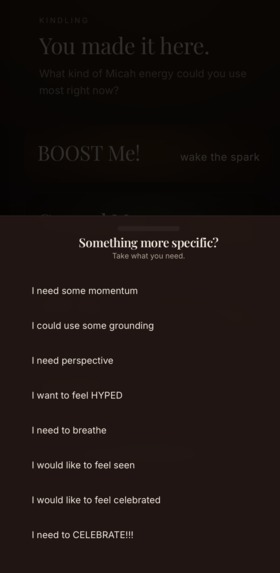
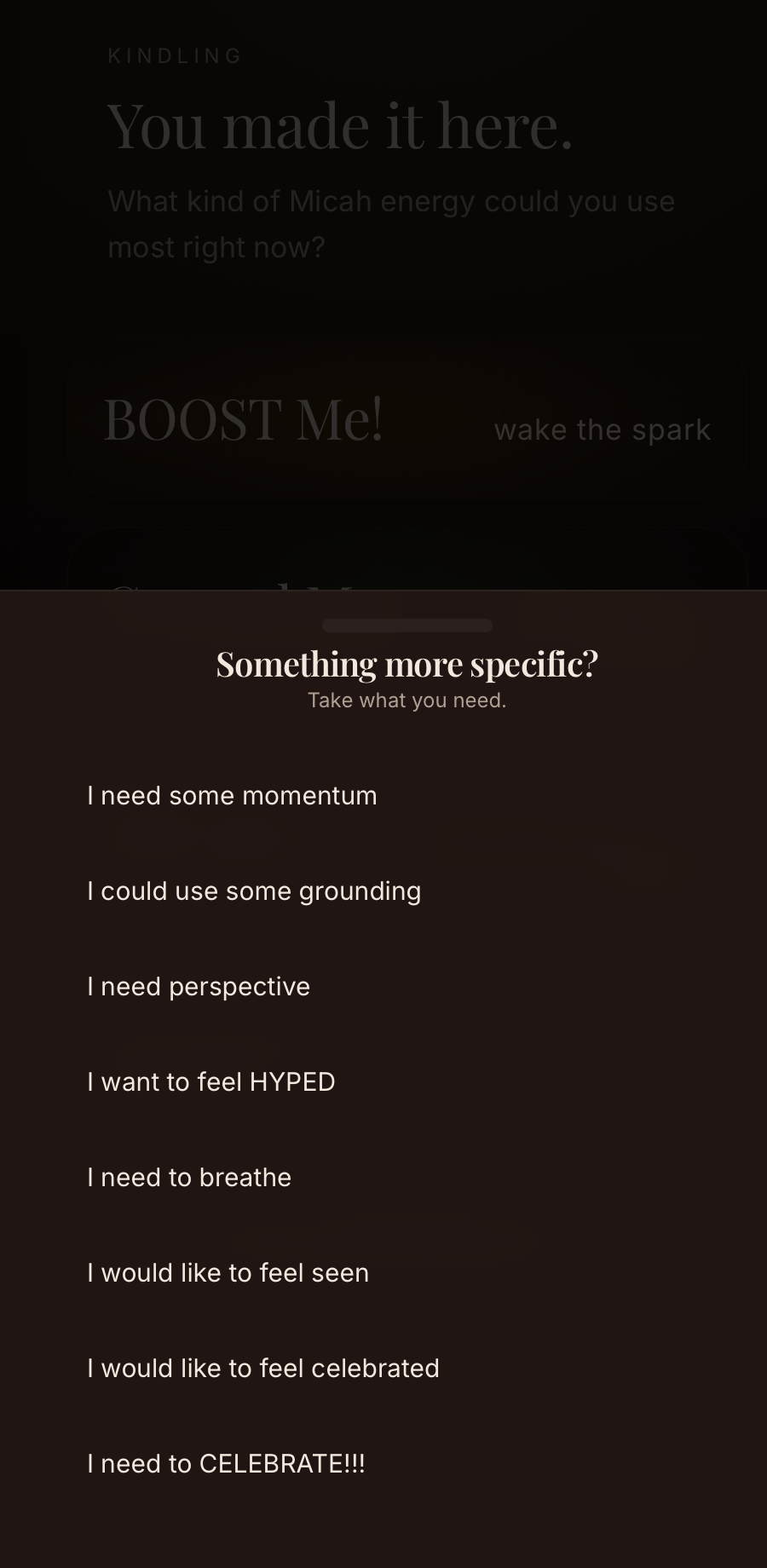
"Something more specific" Shelf
-
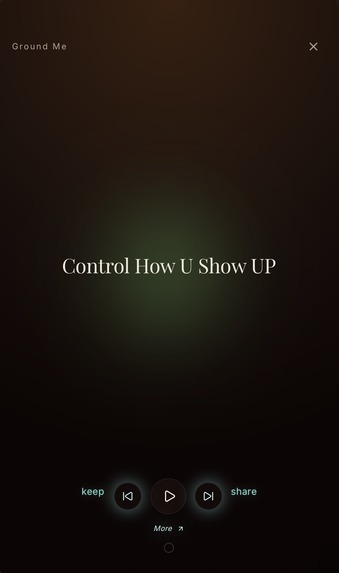
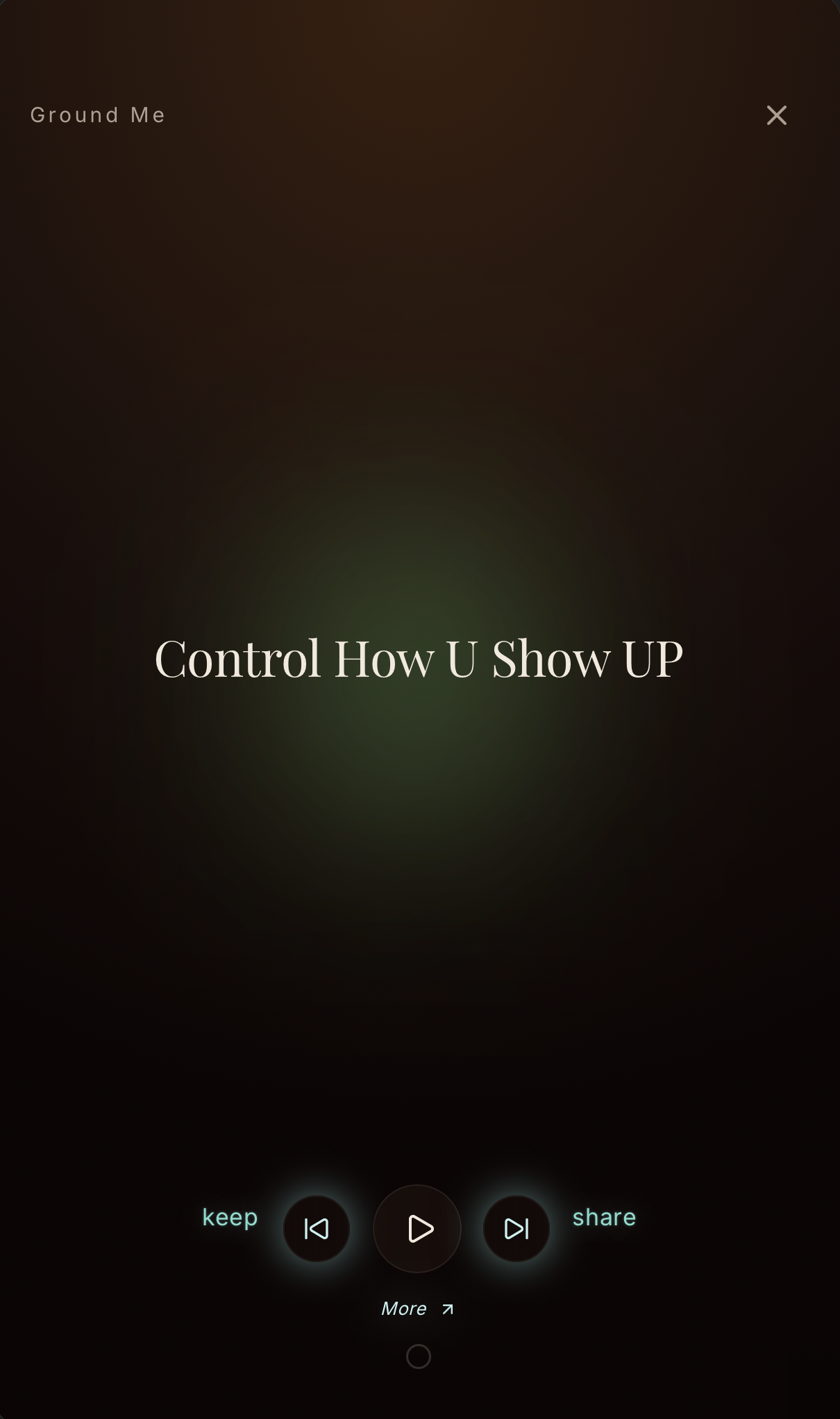
Kindling Player: "Ground Me" clip
-

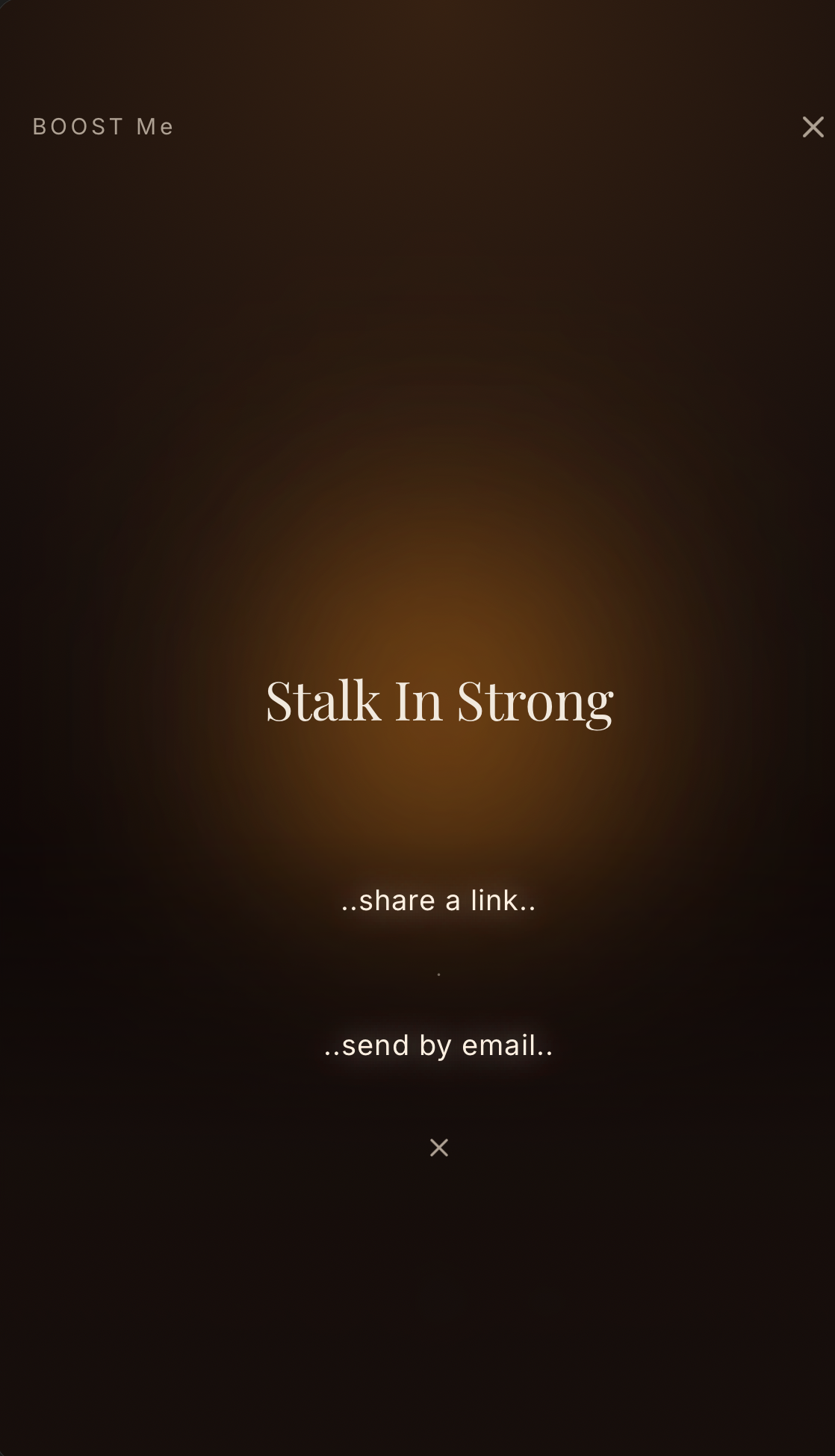
Inside the Player: Send a Kindling Clip via email or sms link
-
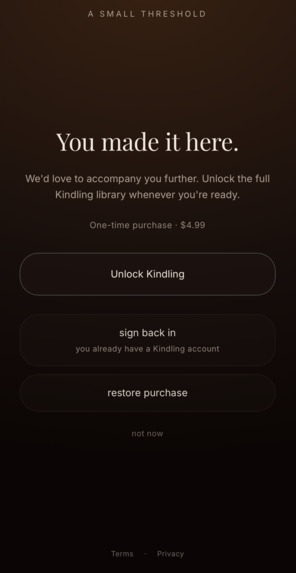
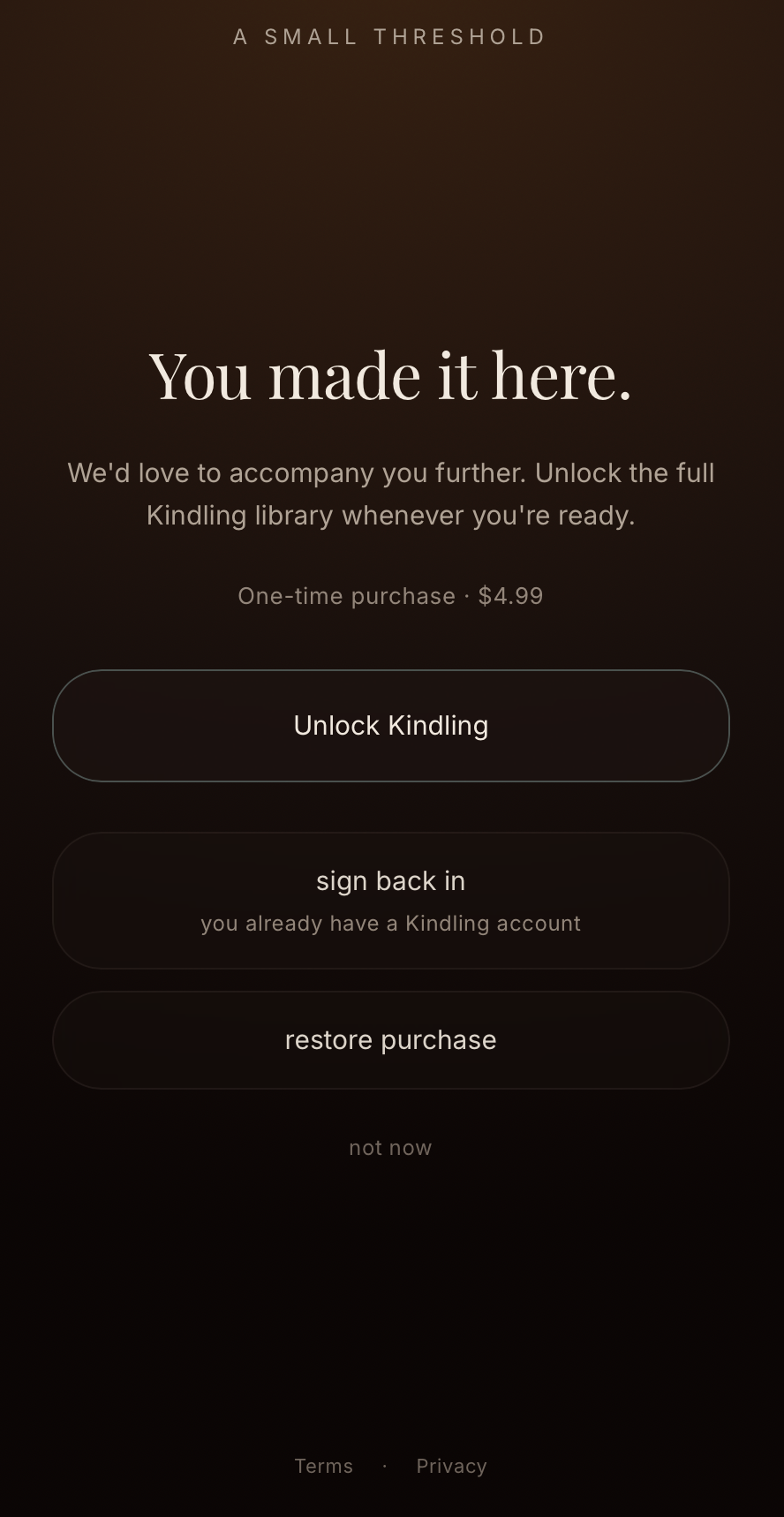
Unlock Kindling Paywall after sampling several clips to see if it's something you'd like to have on hand
-
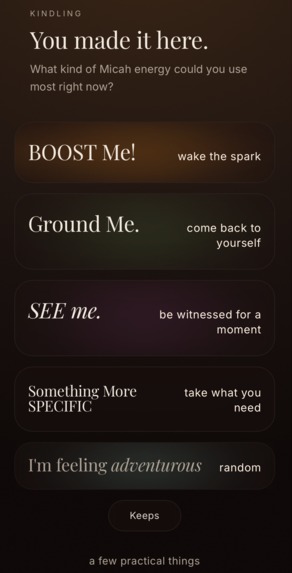
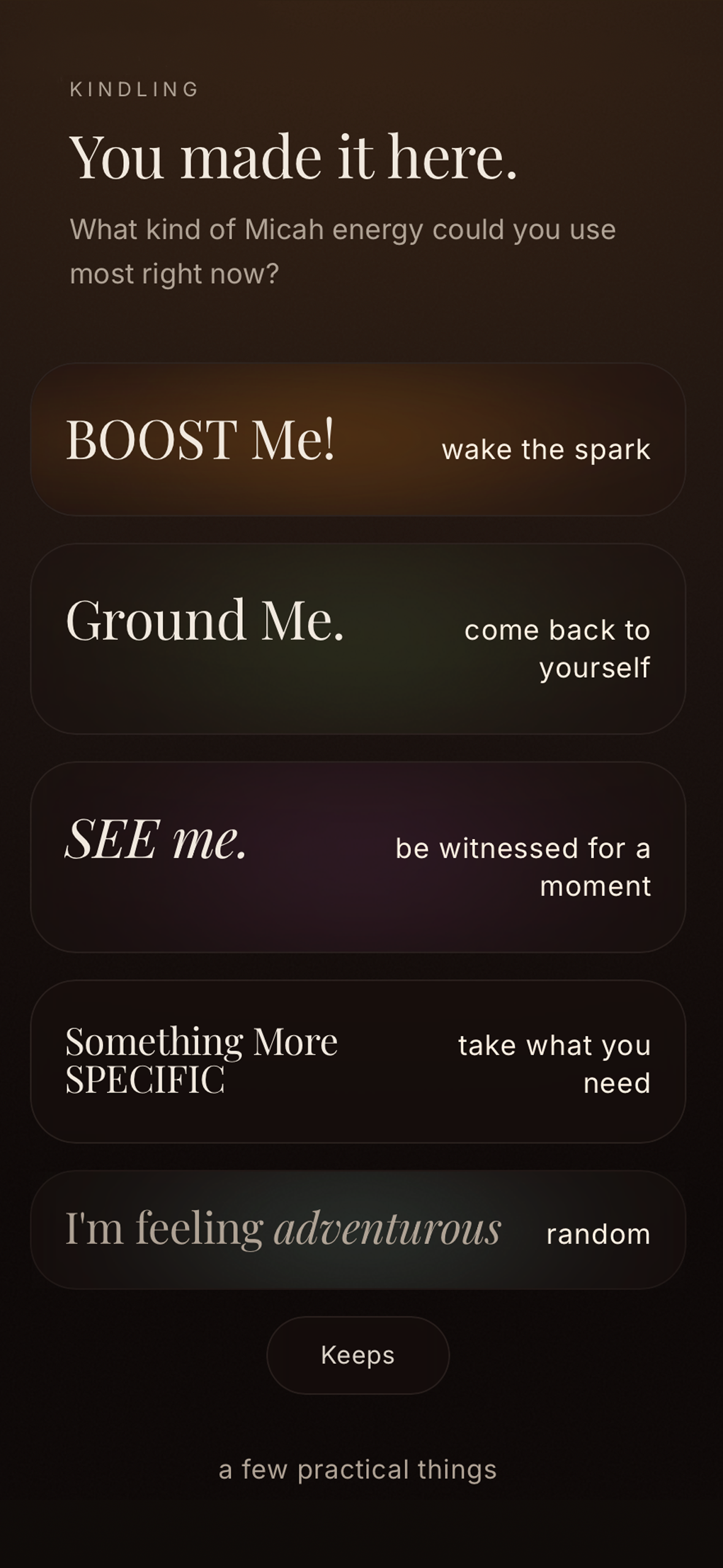
Kindling Home Screen after Unlock (Keeps available)
-
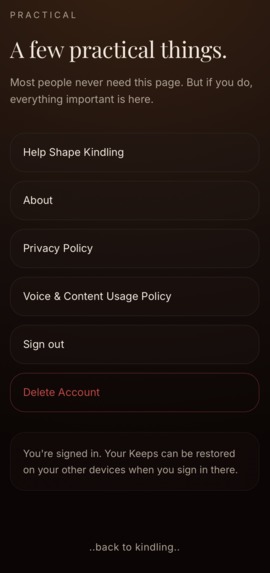
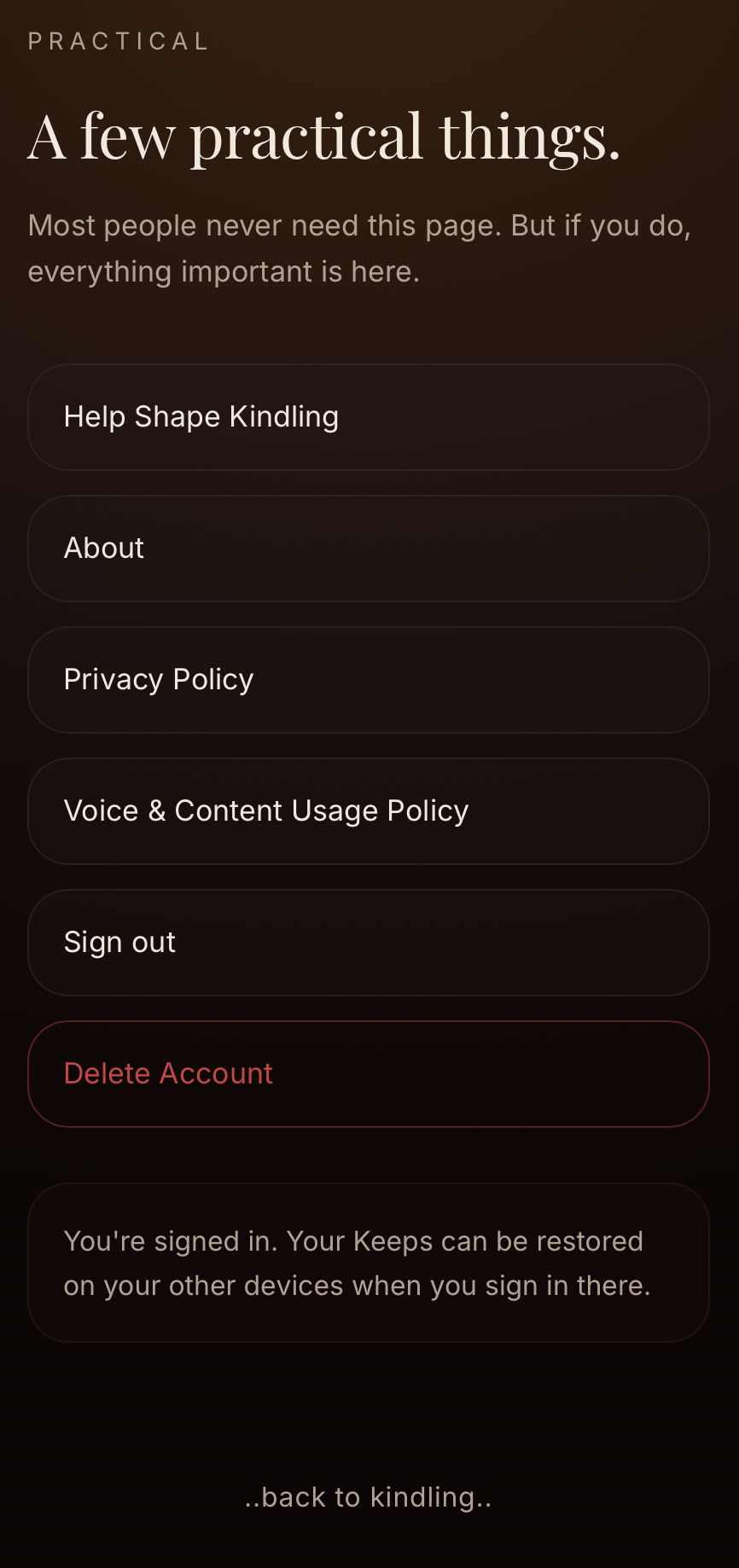
A few practical things: the place where behind the scenes stuff lives
-
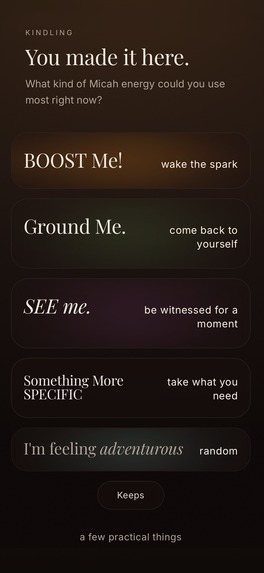
Kindling Home_1179x2556

Inspiration
The original inspiration for Kindling came from two things people had been telling me for literal years:
“YOU are the product. If you could figure out how to package your energy, it would be gold.”
And:
“Your energy is infectious. I wish I could shrink you, carry you around in my pocket, and pull you out whenever I need a Micah boost.” Eventually technology reached a point where I realized: I might actually be able to make something like that happen.
Enter Kindling.
What Kindling Does
Kindling is emotional accompaniment on demand, delivered through my actual recorded voice. You open the app with some general sense of what you need—maybe a boost, grounding, perspective, acknowledgment, reassurance, or celebration—and receive a short prerecorded piece intended to meet you there.
It is deliberately not designed around an infinite feed or maximizing time-in-app. The philosophy is closer to:
I don’t need you to need Kindling. I just want it to be there when you do.
One important distinction: AI helped me build Kindling but AI is not what you encounter inside Kindling. The voice is mine. I personally recorded and mastered every single clip. AI played an immense role in helping me develop and build the system to hold all of it.
From Prototype to Product
Before Kindling, I had literally zero coding experience. The beginning was exhilarating.
After several weeks developing the idea with ChatGPT and creating detailed source-of-truth and handoff docs, I brought that material into Lovable. Once it had the full context, it essentially generated the visual interface I had been imagining in one shot.
I was floored. It was AMAZING and mind-blowing—and utterly deceptive in terms of how fast I’d be able to ship an actual working app. Then I discovered the collosal gap between making a working prototype and shipping an actual product.
Getting a web prototype to play a few dozen locally stored clips was one thing. Building a real content system where audio, metadata, tagging, backend infrastructure, authentication, purchases, entitlements, sharing, and the frontend all reliably communicated with one another was something entirely different. And I’d never even heard of most of those things.
And then there was the mobile native piece.
I knew I didn’t want Kindling to simply become a perfunctorily wrapped website masquerading as an app. While researching how to make that transition properly, I spent several weeks building an entire dummy application just to test whether it could wrap my Lovable project. Eventually I discovered that platform wasn’t actually designed to do that. It was essentially a Lovable competitor.
Wonderful.
I had spent time building an entire application for a purpose it would never fulfill. Aside from immense frustration, that experience taught me an important lesson:
Before solving a technical problem, make sure I actually understand what problem I’m solving for.
How I Built It
Kindling ultimately became a small ecosystem of interconnected tools rather than something built inside one platform.
- Lovable became the frontend and UI layer.
- Notion became the source system for clip metadata and tagging.
- Supabase became the backend for authentication, storage, and the mirrored clip/content library.
- RevenueCat handles purchases and entitlements.
- GitHub became the source of truth for version control and release history.
- Capacitor, Xcode, Android Studio, the App Store, and Google Play Console became the native packaging, testing, and release layer.
ChatGPT functioned less like a simple coding assistant and more like a technical collaborator and orchestrator: helping me reason through architecture, write instructions for other systems, troubleshoot failures, verify proposed fixes, and translate between platforms that each spoke technical languages I did not.
At one point, I effectively turned my own computer into a development environment by following ChatGPT’s guidance one instruction at a time—installing and configuring tools I had never used before, constantly checking what I was changing and why. Because of the potential risks to my computer and all I’d wrought so far, the experience was terrifying. But it worked. The finished product became dramatically more robust, interconnected, and technically sophisticated than the prototype I first imagined.
Challenges and What I Learned
AI was extraordinarily enabling throughout this process, but it was also capable of being very confidently wrong. At one point, I needed a special reviewer account so Apple could test Kindling. The AI system I was working with told me it had created the account, so we continued as though that were true.
Later, when testing failed, we spent considerable time troubleshooting. Eventually we discovered there was no broken account. There was no misconfigured account. There was no account.
It had never actually been created.
That permanently changed my workflow. From that point forward, I treated reported completion and verified completion as two different states.
I started cross-checking systems against one another. I would have one AI review another system’s proposed solution. Sometimes all of my primary systems kept circling an answer that didn’t work, so I’d pull in another system: I’d Google it. Sometimes I noticed something none of them had pointed toward and followed that instead.
The biggest skill I developed was learning when to trust them, when to verify them, and when to redirect them. AI radically lowered the barrier to beginning. Shipping still required judgment, persistence, testing, and responsibility. I didn’t learn to code. I learned when and how to direct systems that could.
What Exists Now
Kindling is now a real iOS application, live in Apple’s App Store and being used by actual listeners. (Android build is literally days away.)
RevenueCat powers its paid entitlement and unlock layer within a larger system that includes authentication, backend content infrastructure, metadata, sharing, telemetry, and the native mobile architecture required to turn that early prototype into something people could actually install on their phones.
Kindling also lets a listener send an individual recording directly to another person. That recipient does not need to purchase or even download the app to hear what was sent to them.
Some of the most meaningful early feedback has come from using that feature myself. I’ve sent specific Kindlings to people because I thought a particular piece might strongly resonate with them in a particular moment. More than one wrote back telling me they cried—in the deeply witnessed, I needed to hear that right then kind of way.
Then I got to tell them:
“That came from my app.” Those moments translated the months of technical work into incredibly powerful moments of validated JOY.
What Comes Next
First is growing the Kindling user base and getting it into more people’s hands. I am deeply excited at the potential of what this app can contribute to people’s lives. There are so many instances of people who never feel validated, held, seen, acknowledged—and sometimes just hearing the simplest affirmation:
“It matters that you woke up this morning. I am grateful you exist.” Can absolutely blow a person’s world wide open. Even if the words are from a stranger. Kindling IS that experience and so many more.
The next experiment I want to run will be with a company, school, community organization, or other shared environment willing to give a group of employees, students, or staff access to Kindling. I want to learn what happens when an organization offers people access to small, intentional moments of human emotional accompaniment as part of their everyday environment.
That leads to a delightful thought question for Kindling:
What changes when human presence and emotional accompaniment become something an organization can intentionally make more available?

Log in or sign up for Devpost to join the conversation.