-
-
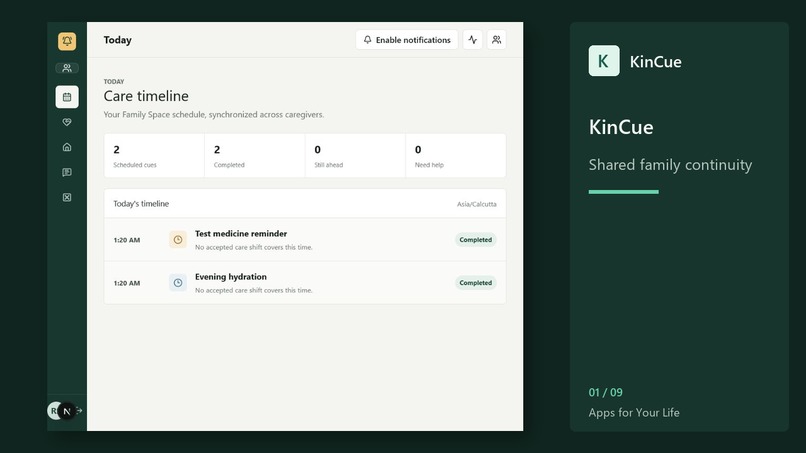
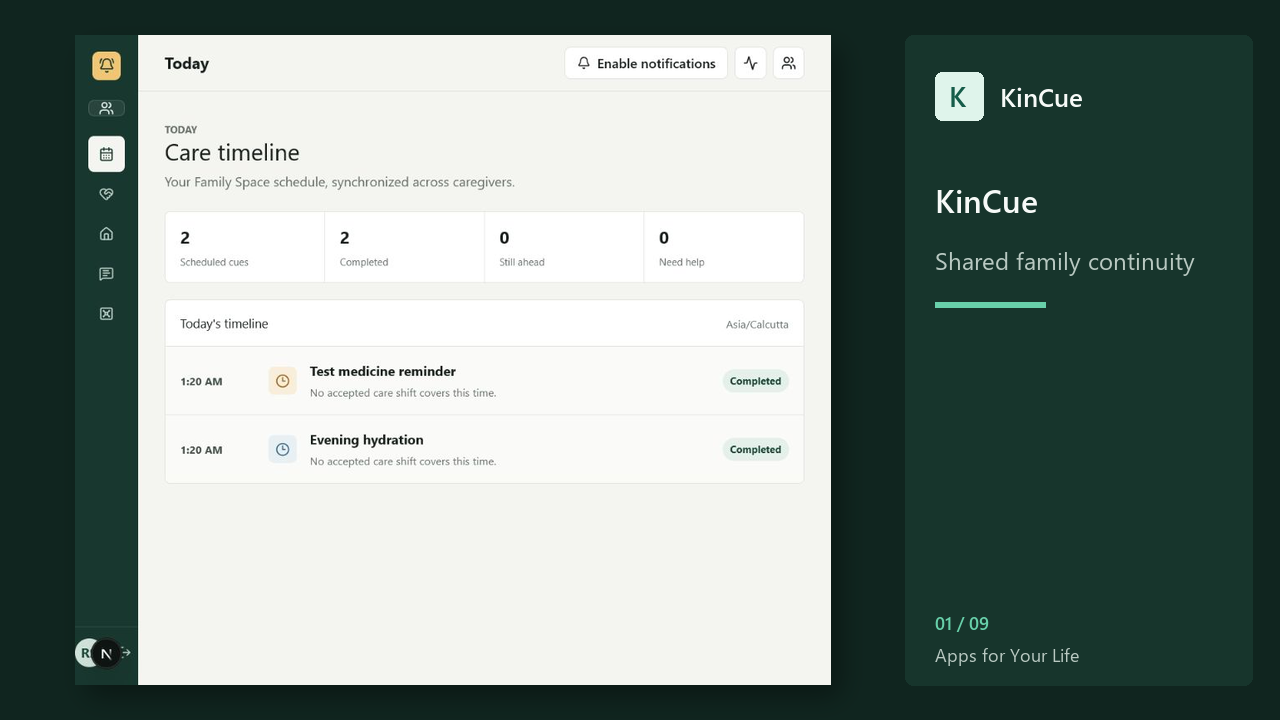
Today dashboard
-
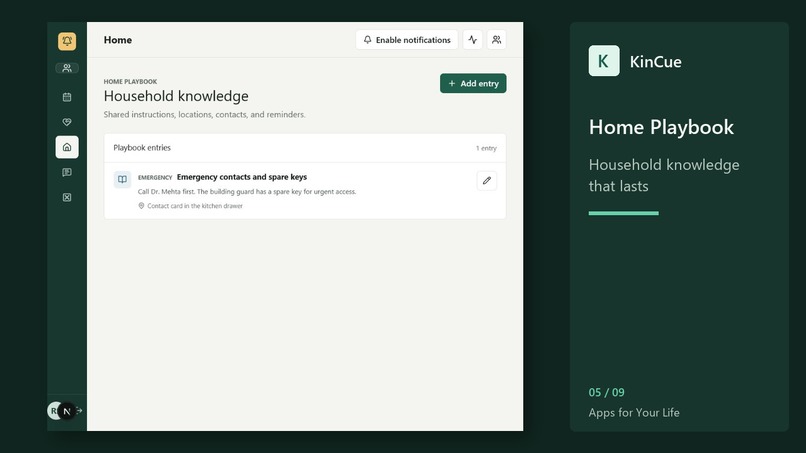
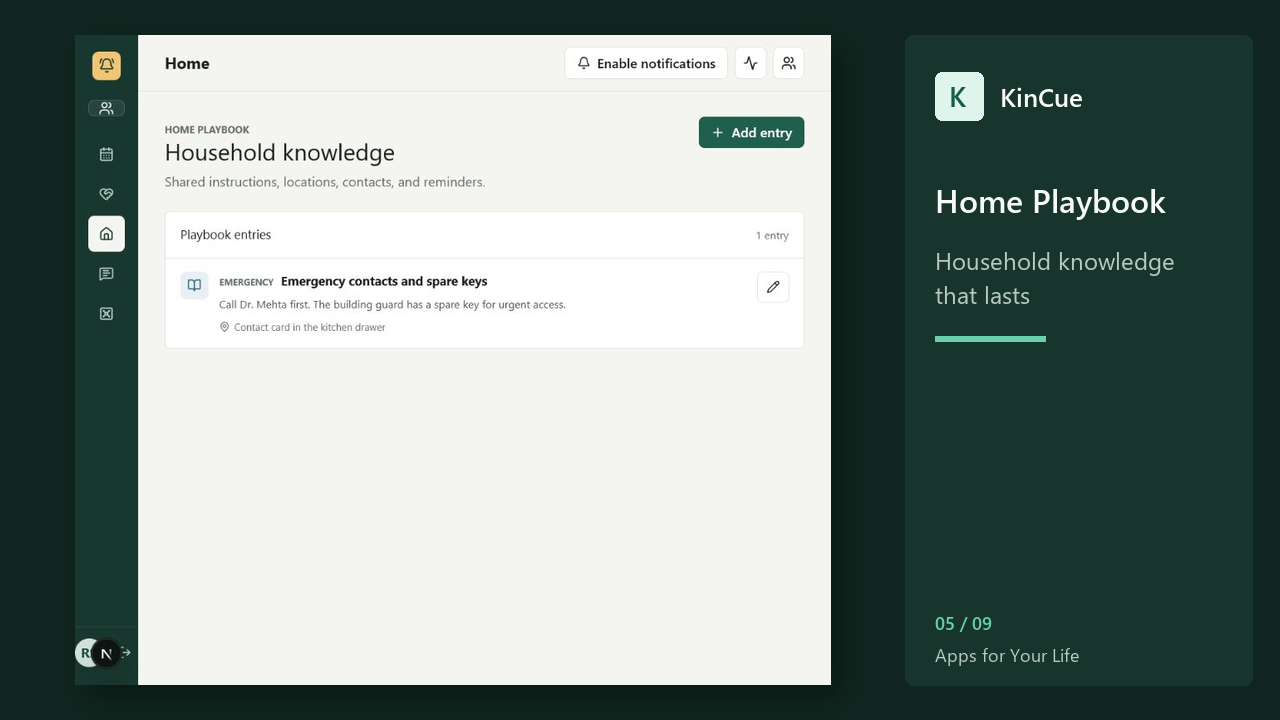
Home :- Household Knowledge
-
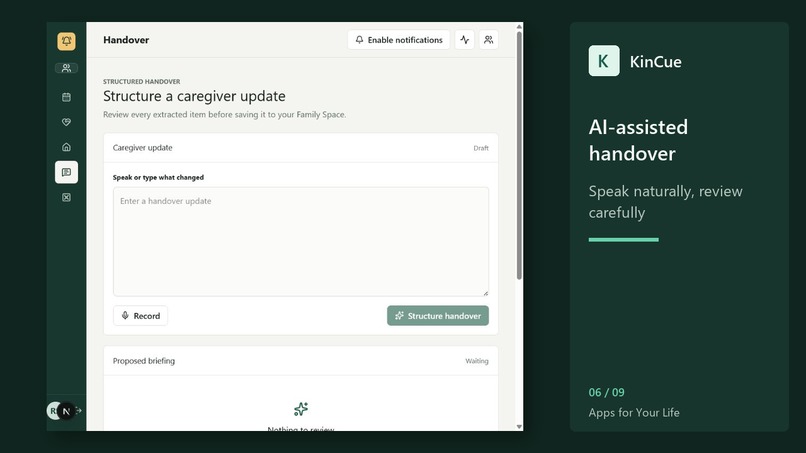
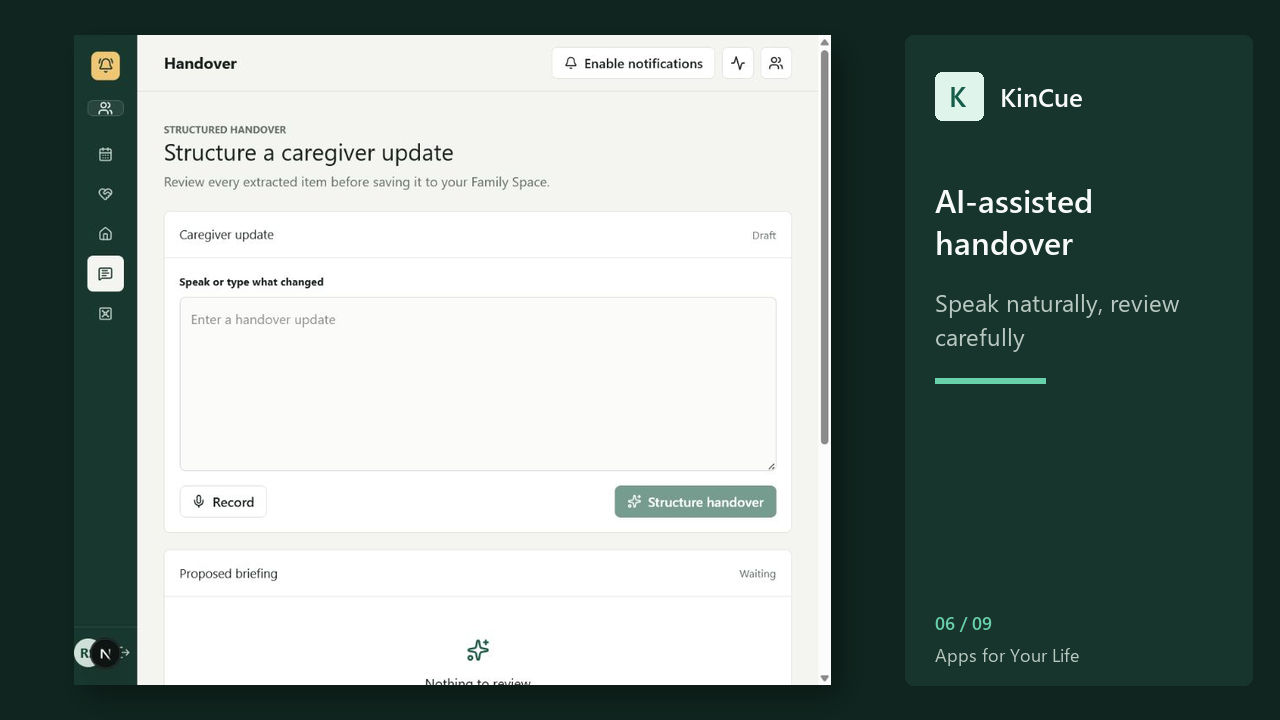
Handover
-
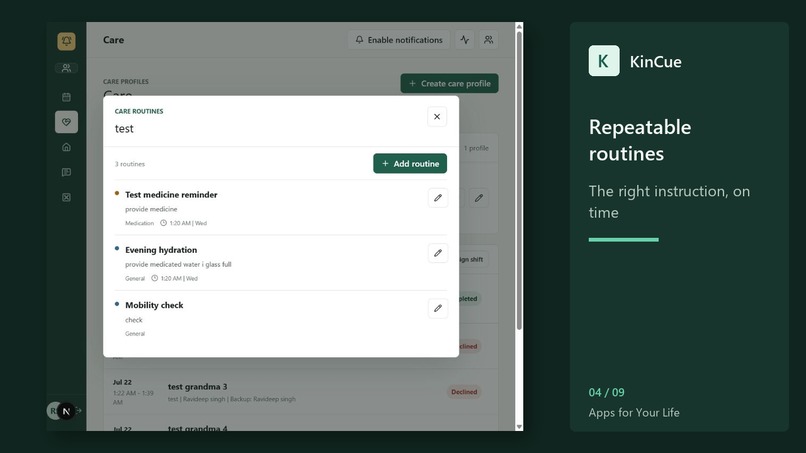
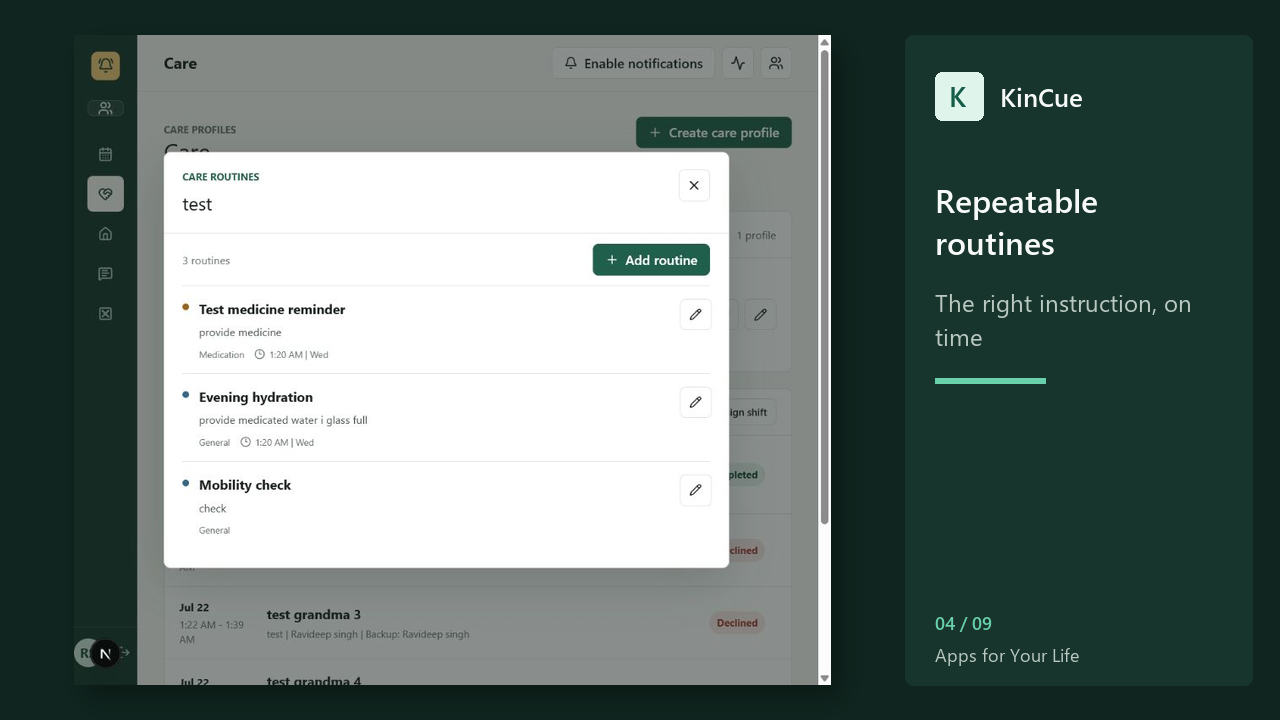
add routines
-
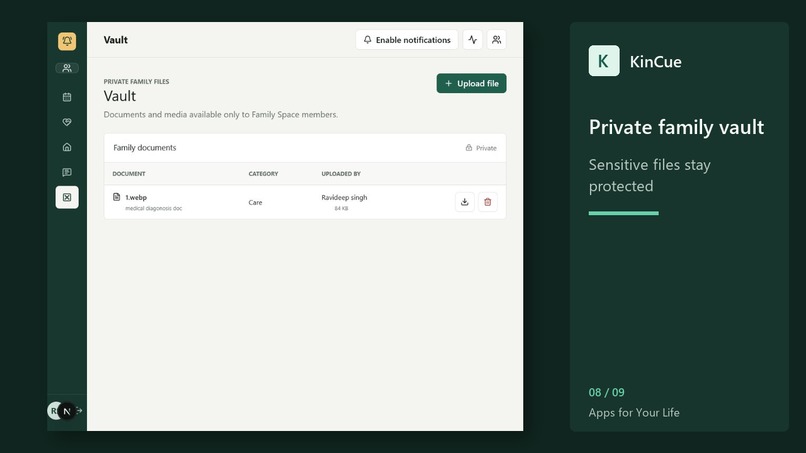
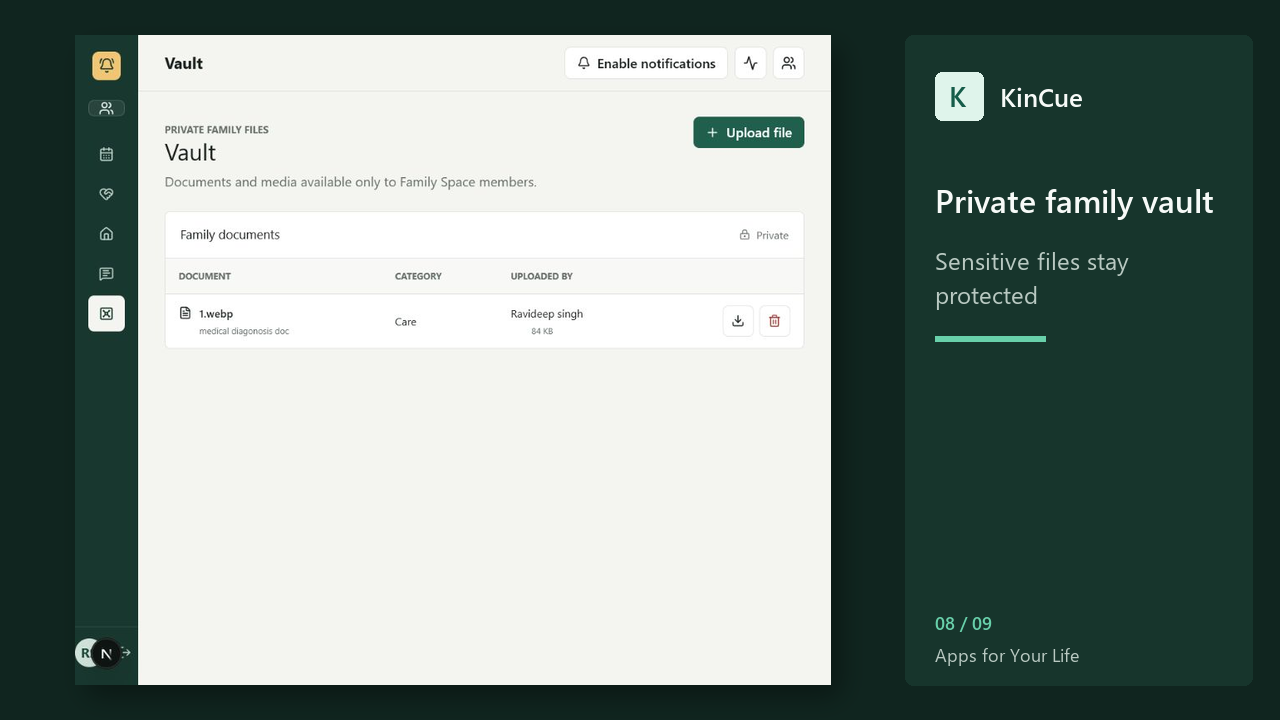
Vault
-
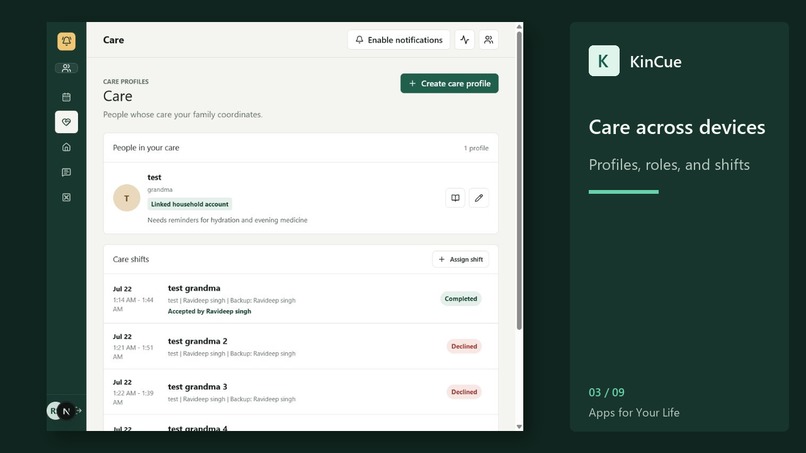
Care Routines
Inspiration
In many families, one person remembers every care routine, medicine, appointment, emergency contact, document, bill, and household detail. When that person becomes busy, travels, or gets sick, another family member receives a rushed handover and must reconstruct everything from messages, notes, and memory.
KinCue was inspired by this fragile transfer of responsibility. The goal is to make family knowledge shared, gradual, and actionable instead of leaving it inside one person's head.
What it does
KinCue gives a household one private Family Space where every member signs in with their own Google account and receives an appropriate role.
Families can:
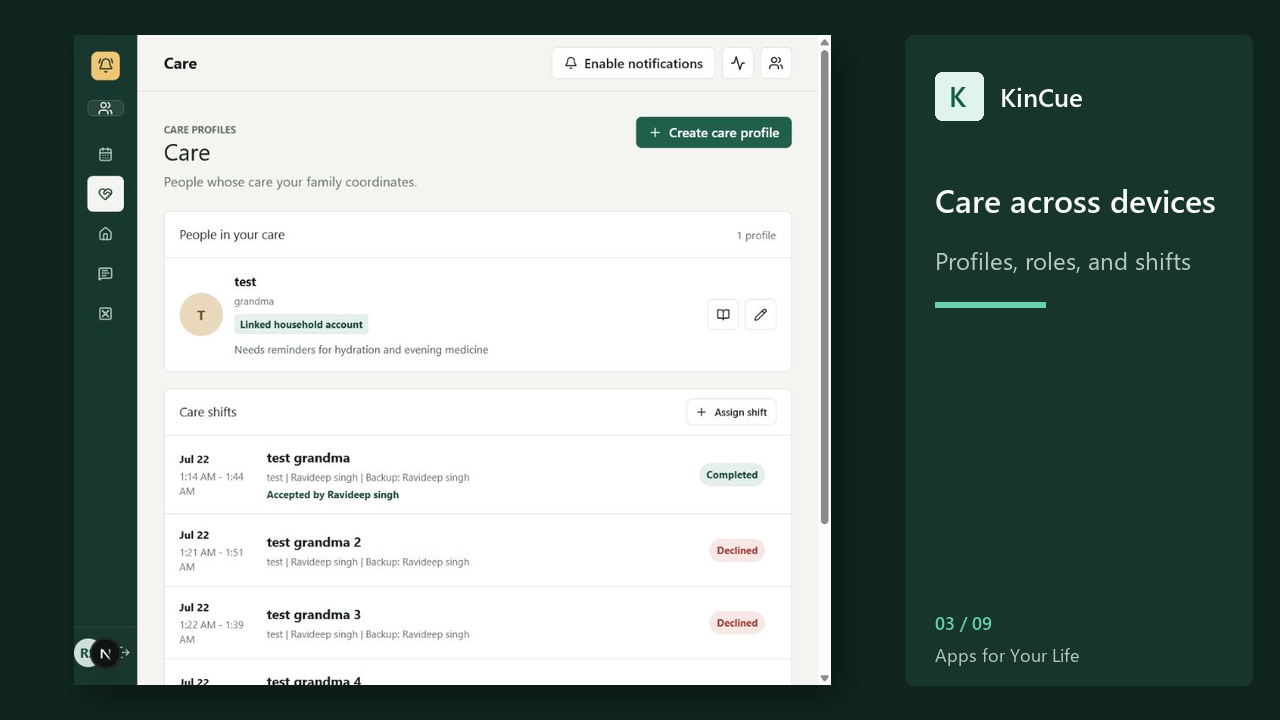
- Create care profiles, including profiles linked to existing household members
- Define repeatable care routines with instructions, schedules, and importance
- Assign care shifts to primary and backup caregivers
- Accept, decline, and complete assignments across different devices
- Receive synchronized scheduled cues, alarms, and browser notifications
- Record completion and other actions in Family Activity
- Store emergency contacts, item locations, utility instructions, and other household knowledge in the Home Playbook
- Convert natural caregiver updates into structured, reviewable AI handovers
- Store important files in a private family Vault
KinCue keeps responsibility explicit. One accepted caregiver establishes coverage for a shared shift, while an uncovered cue remains visibly blocked instead of silently assuming someone will handle it.
AI-assisted handovers
A caregiver can type or record an unstructured update. KinCue extracts medication details, completed tasks, appointments, item locations, follow-up actions, confidence levels, and unresolved questions.
The AI is deliberately conservative. It preserves source excerpts, does not invent missing details, and never saves proposed information until a person reviews and confirms it.
The runtime pipeline supports the OpenAI Responses API with GPT-5.6, Gemini 2.5 Flash, and a local fallback behind the same typed contract. The recorded demonstration transparently uses Gemini because the OpenAI API account did not have available quota.
How we built it
KinCue is a responsive web application built with Next.js, React, and TypeScript.
Firebase Authentication provides Google sign-in. Cloud Firestore synchronizes Family Spaces, memberships, care profiles, routines, shifts, scheduled cues, Playbook entries, handovers, and activity records across devices. Role-aware Firestore security rules keep each family's data separated.
Private documents are stored in Supabase Storage. Server routes verify Firebase identity and Family Space permissions before generating short-lived signed links, so storage credentials never reach the browser.
The handover pipeline uses a Markdown extraction skill and Zod-validated structured output. The production application is deployed through Codex Sites using a Cloudflare-compatible vinext Worker build.
How we used Codex and GPT-5.6
Codex with GPT-5.6 was used throughout the development process. It helped:
- Turn the initial family continuity problem into a technical architecture
- Implement Firebase authentication and realtime data workflows
- Design caregiver assignment and response semantics
- Review and strengthen Firestore security rules
- Debug OAuth, deployment, and cross-device synchronization issues
- Improve the responsive desktop and mobile interface
- Create focused automated and live integration tests
- Prepare the working demonstration and deployment
Important decisions were made iteratively with Codex rather than delegated blindly. These included first-acceptance shift coverage, visibly blocked uncovered cues, evidence-preserving AI extraction, and mandatory human confirmation.
Challenges
The hardest challenge was representing one care shift across multiple caregivers. A primary caregiver declining should not automatically decline for the backup caregiver. KinCue therefore models a single shared shift whose coverage remains pending until someone accepts or every available caregiver declines.
Another challenge was deploying Firebase Admin, private storage routes, and the Markdown AI skill to an edge-style runtime. We introduced REST-based Firebase transport and bundled the skill into the production Worker without exposing server credentials.
Accomplishments
- Real Google authentication and private Family Spaces
- Cross-device caregiver assignments and responses
- Persistent scheduled cues with alarm and completion states
- Household members who can also become care recipients
- Human-reviewed AI handovers with source evidence
- Private documents accessed through expiring signed links
- Role-based Firestore security rules
- A production deployment with 32 passing automated tests
What we learned
Family coordination is not only a reminder problem. It is a context, responsibility, and accountability problem.
Realtime synchronization is useful only when ownership and uncertainty are explicit. We also learned that AI is more trustworthy in sensitive family workflows when it structures a person's words for review instead of silently turning uncertain statements into instructions.
What's next
Future work includes background push notifications when KinCue is closed, richer recurring schedules, calendar integrations, multilingual voice handovers, encrypted document previews, and caregiver acknowledgement analytics.
Before supporting real medical usage, KinCue would require formal privacy, security, and clinical-safety review.
Built With
- admin
- agents
- ai
- api
- authentication
- cloud
- cloudflare
- codex
- firebase
- firestore
- gemini
- gpt-5.6
- lucide
- next.js
- openai
- react
- sites
- supabase
- typescript
- vinext
- workers
- zod


Log in or sign up for Devpost to join the conversation.