-
-
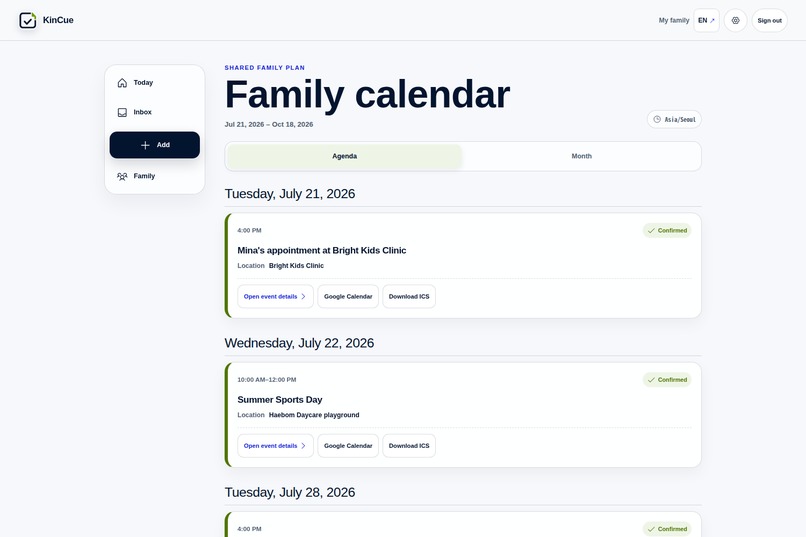
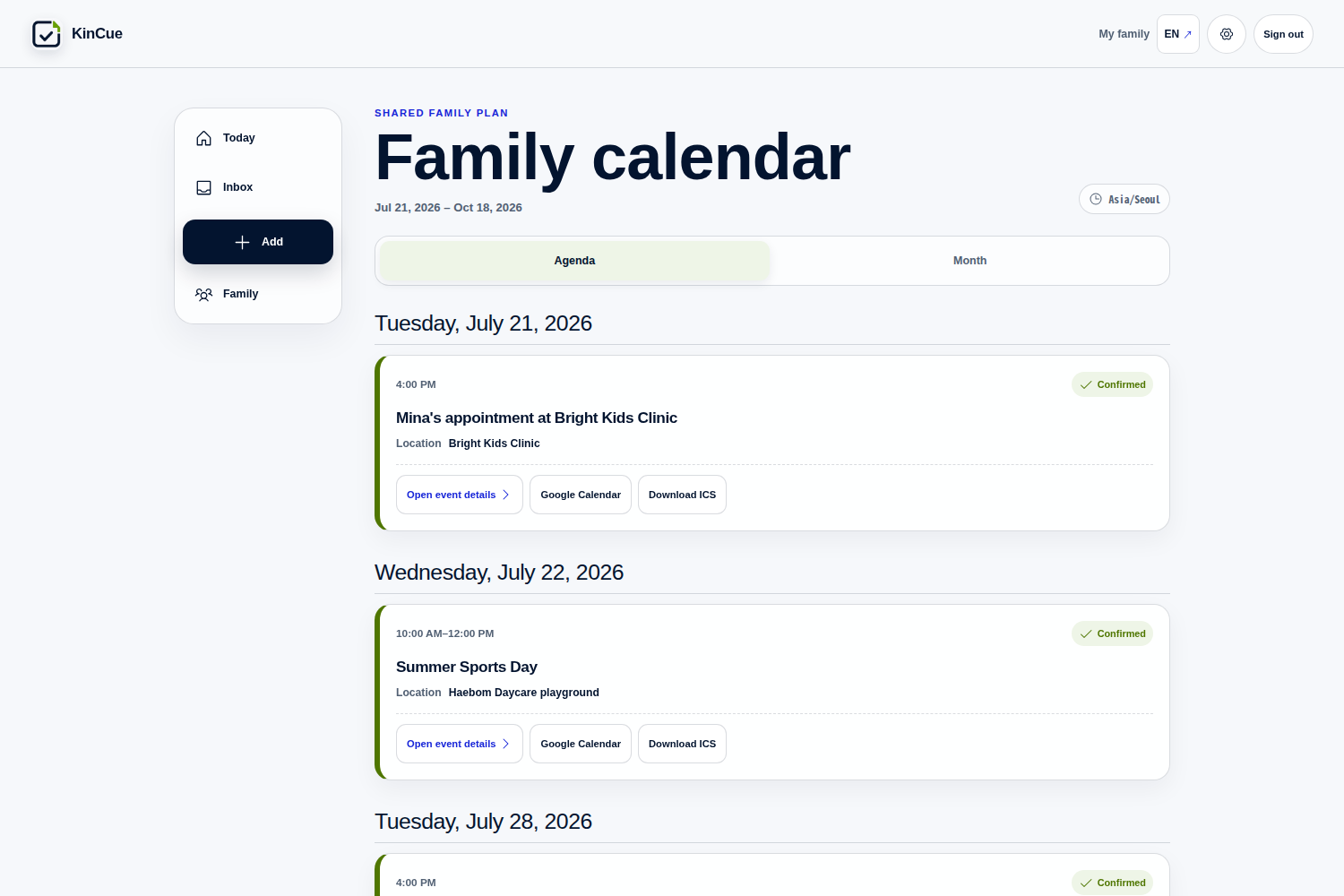
KinCue Calendar keeps confirmed family events in one place, with Google Calendar handoff and standard iCalendar export.
-
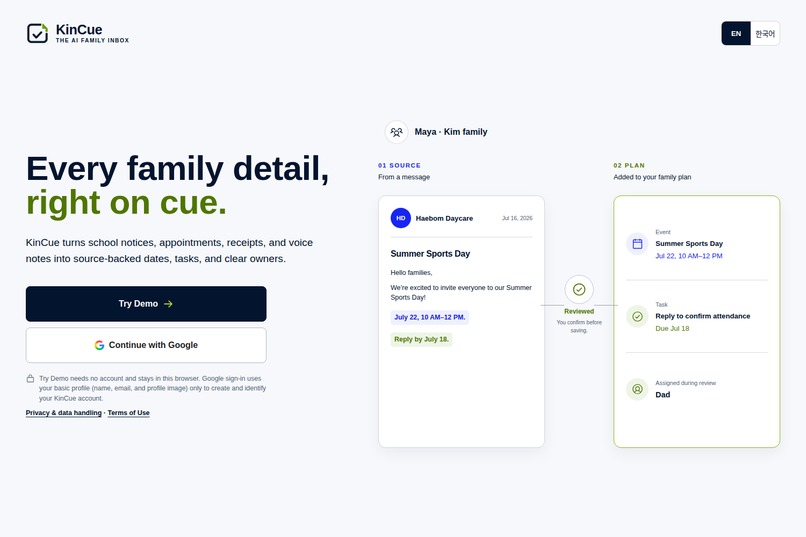
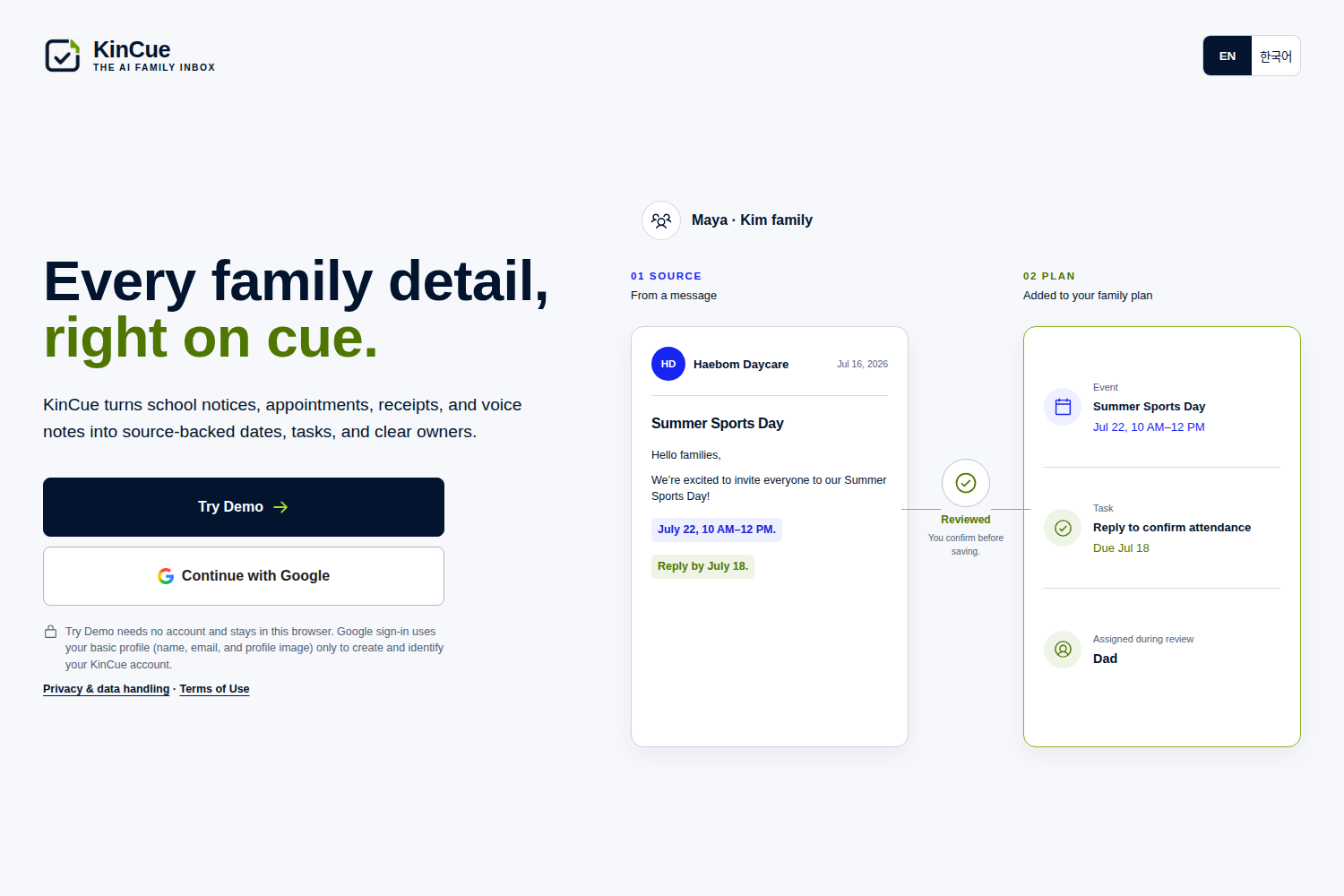
KinCue turns scattered family information into one source-backed plan the whole family can trust.
-
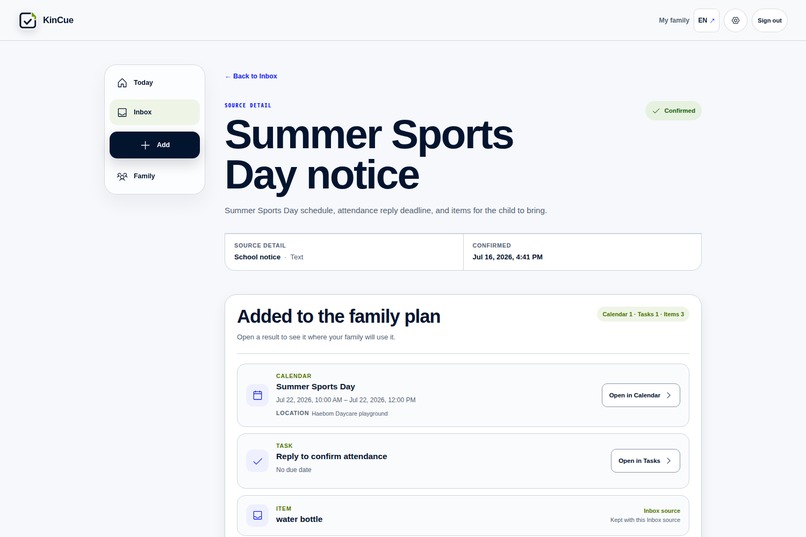
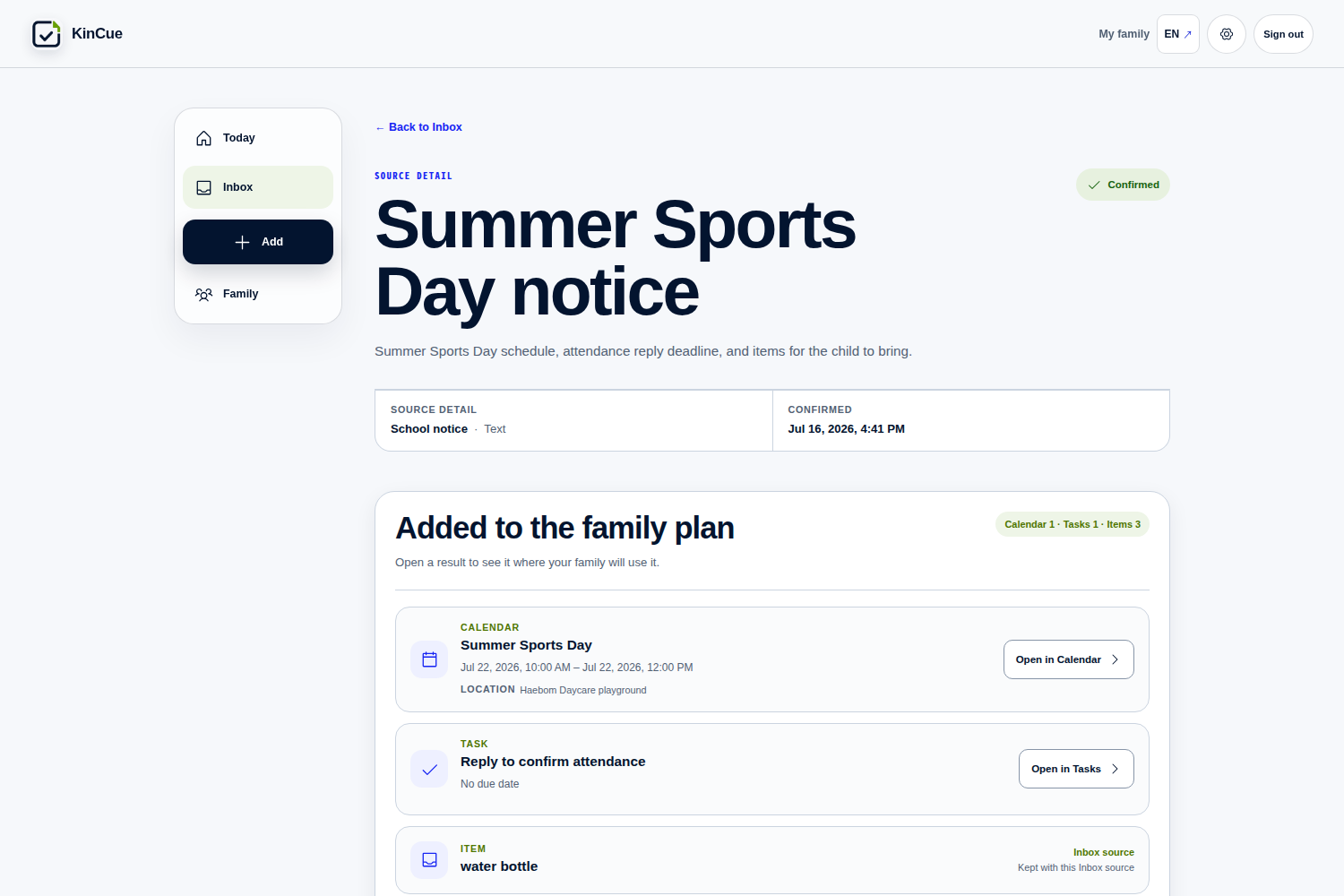
A confirmed school notice becomes a saved family plan with its event, reply task, items, references, and original source evidence.
-
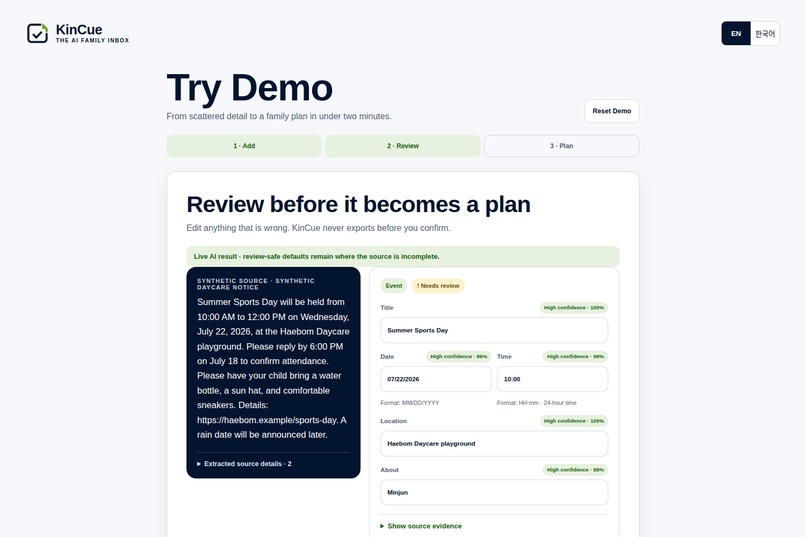
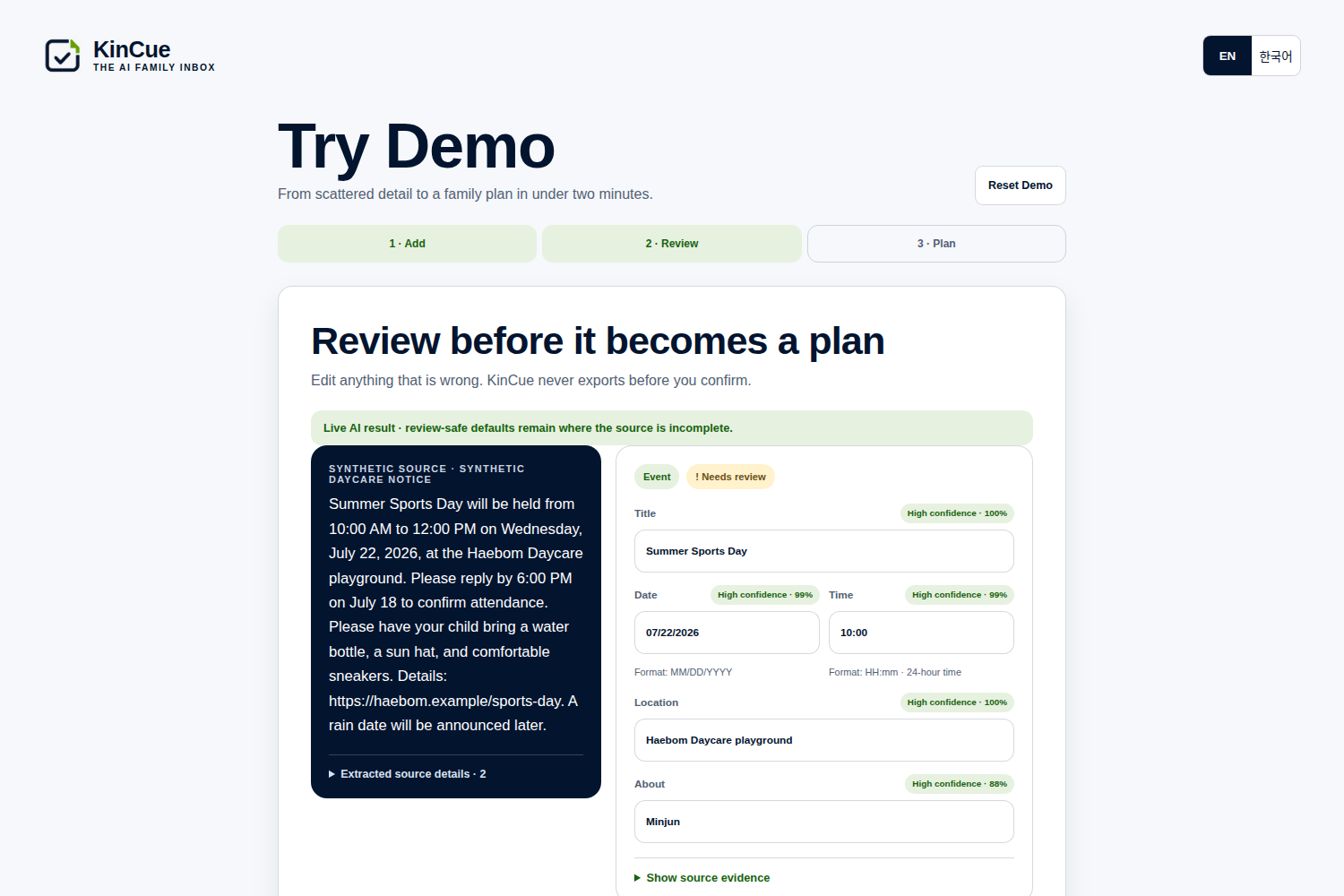
GPT-5.6 structures a live school notice while keeping source evidence, confidence, and uncertainty visible for human review.
-
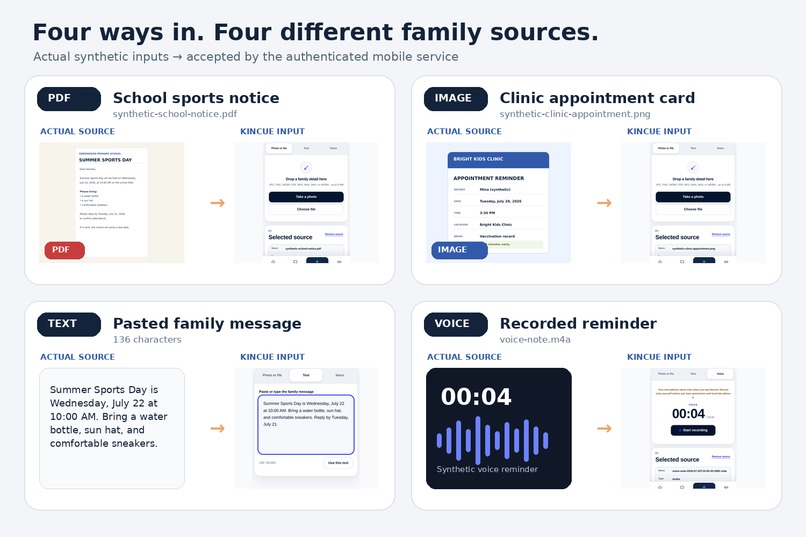
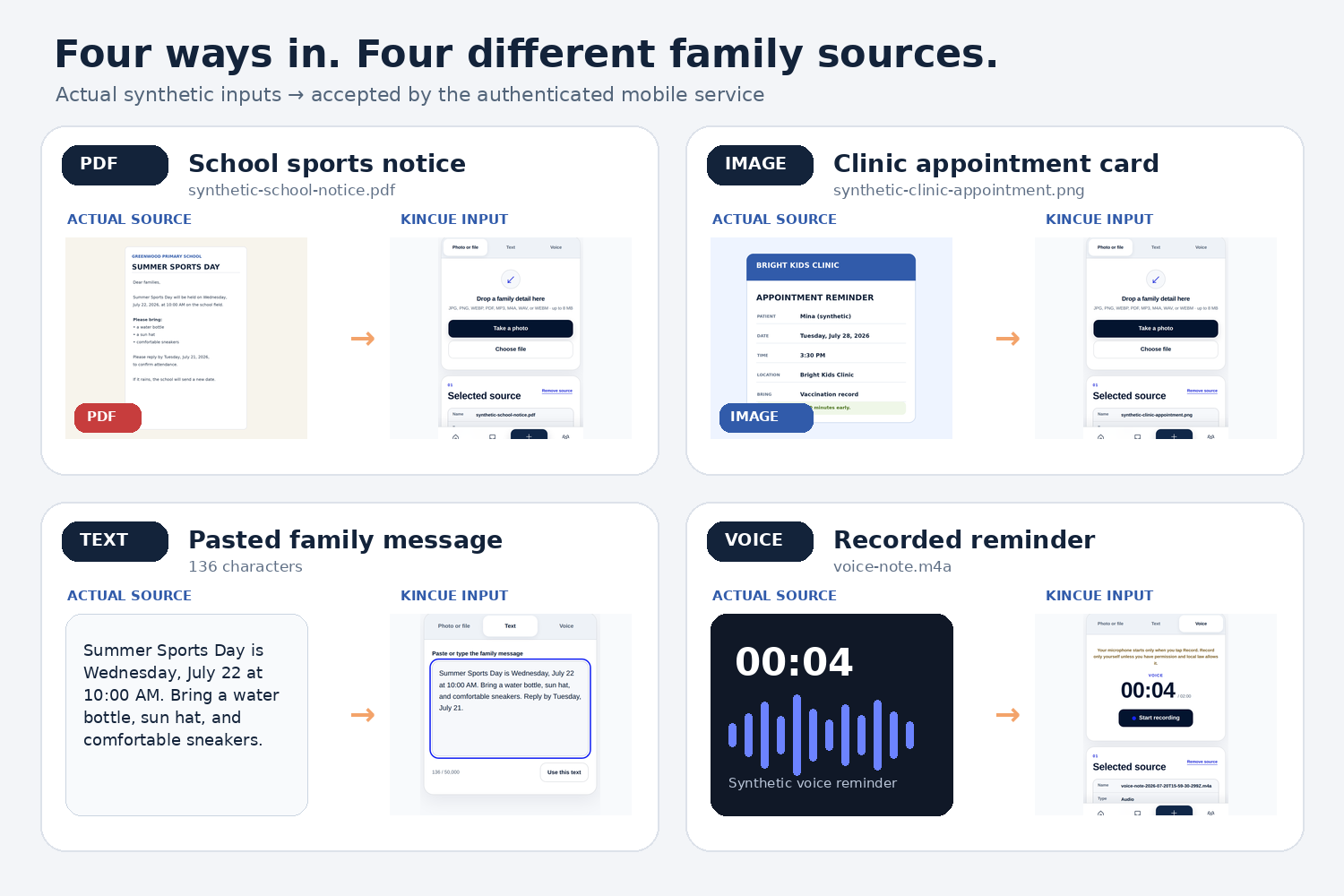
Bring in the source you already have—PDF, image, pasted text, or voice—from KinCue's authenticated mobile experience.
-
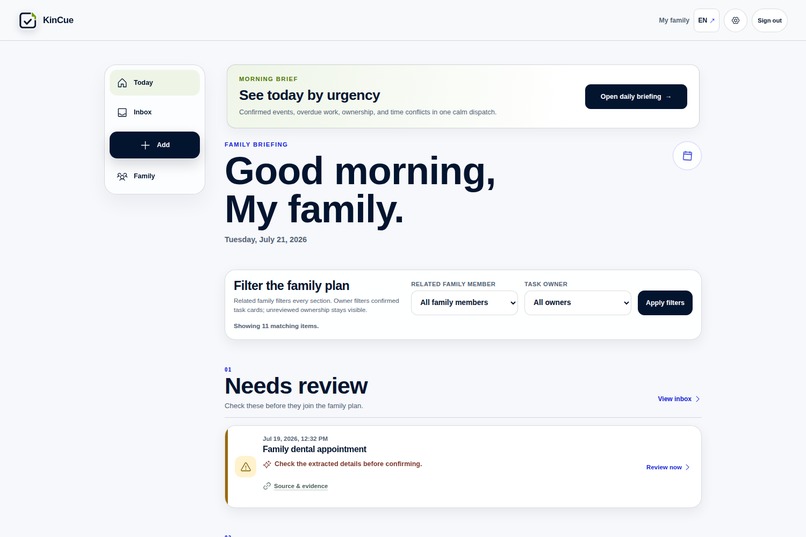
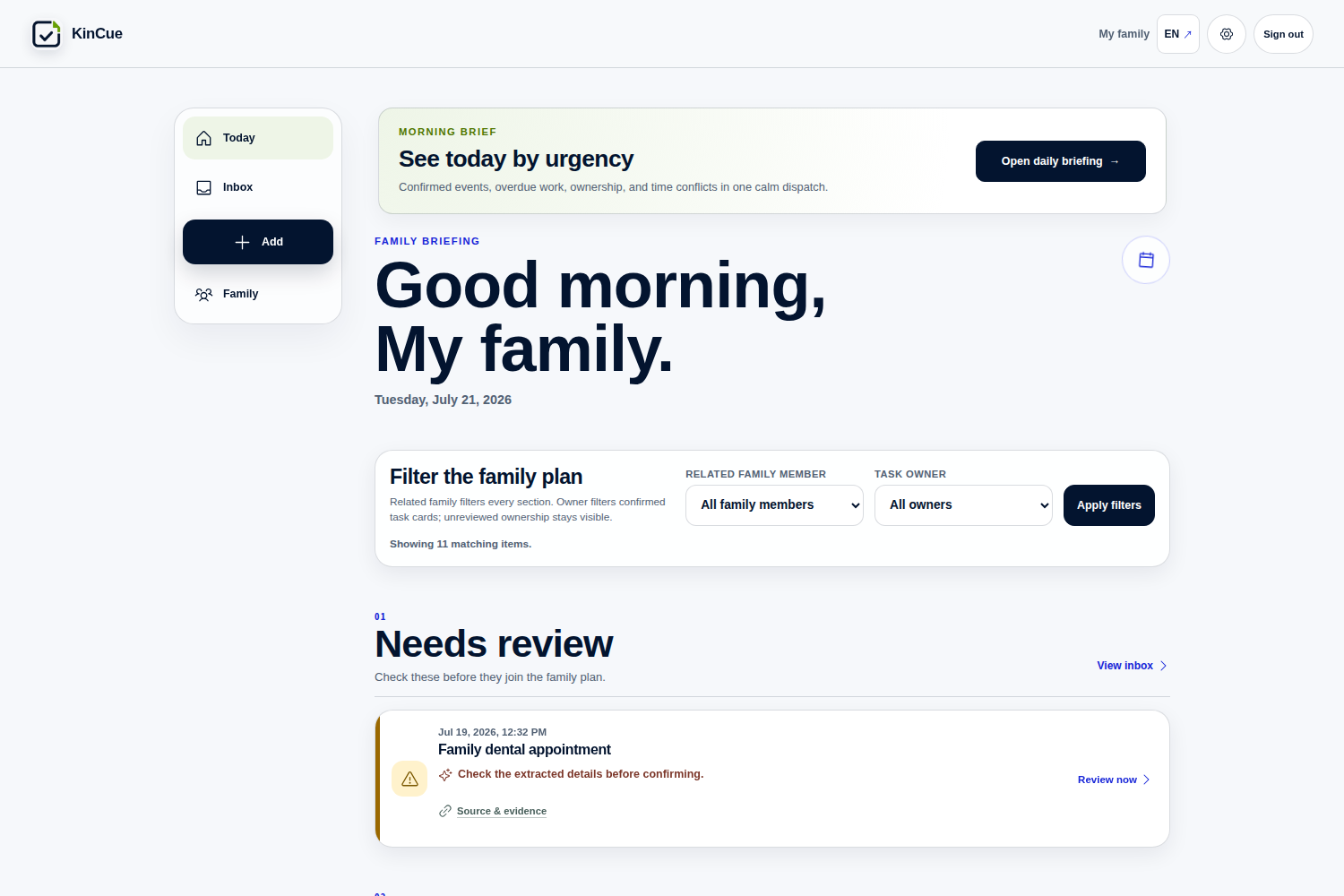
The authenticated Today view prioritizes family tasks, upcoming events, ownership, and anything that still needs review.
Inspiration
Family life rarely arrives in one organized place. A school notice comes as a PDF, an appointment as a screenshot, a return deadline appears on a receipt, and an important reminder gets buried in a chat or voice note.
Existing tools can store these fragments, but someone still has to read them again, find the dates, decide what needs to happen, copy everything into a calendar, and remember who is responsible. That invisible work often falls on one person.
KinCue was inspired by a simple question: What if AI could turn scattered family information into a plan—without asking families to blindly trust the AI?
What it does
KinCue is an AI family inbox that turns school notices, appointment screenshots, receipts, PDFs, pasted text, and voice notes into clear, actionable family plans.
GPT-5.6 extracts:
- events and date-only deadlines
- tasks and required items
- people, places, and relevant family members
- suggested owners
- source evidence and uncertainty
Instead of immediately saving the AI’s output, KinCue presents a review step. Users can compare each important value with its source, correct mistakes, assign an owner, and confirm the result.
Confirmed information then appears in KinCue’s Today, Agenda, Month, and family-task views. Users can also open a prefilled Google Calendar draft or export an .ics file for Apple Calendar and Outlook.
Judges can try the full core loop without creating an account. Google sign-in enables real uploads and persistent family data.
How we built it
KinCue is a mobile-first Progressive Web App built with Next.js, React, and TypeScript. It runs on Cloudflare Workers through OpenNext, while Supabase provides Google authentication and persistent family data.
GPT-5.6 is the reasoning layer behind the product. Images, PDFs, text, and editable voice transcripts are converted into validated structured outputs rather than free-form summaries. The schema separates events, tasks, items, family members, ambiguities, and field-level source evidence.
The interface follows a deliberate human-in-the-loop flow:
Add → Analyze → Review → Confirm → Act
Nothing is added to the family plan or an external calendar until the user reviews and confirms it.
Voice capture uses the browser MediaRecorder API and a speech-to-text step before entering the same structured analysis flow. Date-time values are stored as canonical UTC instants and displayed using each user’s IANA timezone, while date-only deadlines remain date-only instead of receiving an invented default time.
Codex with GPT-5.6 was used throughout Build Week as the development partner for architecture, implementation, testing, debugging, deployment, and iterative browser QA. Cloudflare provides the public deployment and privacy-safe web analytics.
Challenges we ran into
The hardest problem was not extracting more information—it was preventing AI-generated certainty where the source was incomplete.
For example, a document that said “Return the books by July 21” initially produced an arbitrary morning time. That would look harmless in a demo but could create a genuinely incorrect reminder. We had to preserve the difference between a date-only deadline and a timestamp throughout the model schema, interface, database, and calendar-export paths.
Semantic overlap was another challenge. In “return two borrowed books,” the books are the direct object of a task, not necessarily a separate packing item. But in “bring two books to the meeting,” keeping the books as required items is useful. This required normalization beyond simple text matching.
Source evidence also becomes difficult when identical wording appears more than once in a PDF or image. We designed the review state to expose ambiguity instead of pretending the system can always identify one exact occurrence.
Finally, we had to make live AI analysis, authentication, mobile PWA behavior, timezone handling, persistence, and calendar export work as one reliable end-to-end experience—not as disconnected prototypes.
Accomplishments that we're proud of
We are proud that KinCue completes a full source-to-action loop:
- Add a real-world family document or voice note.
- Analyze it with GPT-5.6.
- Review structured results against source evidence.
- Correct uncertain fields and assign responsibility.
- Confirm the plan.
- See it in Today or Calendar and export it when needed.
The no-account demo makes the core value immediately accessible, while the authenticated path supports real inputs and persistent data.
We also built KinCue around trust rather than hiding AI limitations. Important values remain editable, unsupported details are not supposed to be silently confirmed, and users stay in control before any external action.
KinCue supports both English and Korean, works as an installable mobile PWA, and uses synthetic family data for its public demonstration.
What we learned
We learned that structured output alone does not make an AI product trustworthy. A valid JSON response can still contain a plausible but unsupported value.
Reliable consumer AI needs several layers working together:
- a strict schema
- semantic normalization
- source evidence
- calibrated uncertainty
- human review
- end-to-end regression tests
We also learned that simple interfaces require difficult product decisions. Showing every extracted detail would have been easier, but families do not need another complicated dashboard. They need to know what happens next, when it happens, and who will handle it.
Most importantly, AI should reduce the family’s mental load without taking control away from the family.
What's next for KinCue
Next, we plan to add production-grade reminders, two-way Google and Apple Calendar synchronization, email and sharing-extension inputs, stronger duplicate and revised-notice detection, and more granular privacy and retention controls.
A native mobile experience could make it possible to send a screenshot, document, or voice note to KinCue directly from any app. Over time, KinCue could also learn each family’s preferred responsibilities and routines—while continuing to require explicit confirmation for important actions.
The long-term goal remains simple:
Every family detail, right on cue.
Built With
- cloudflare
- codex
- gpt-5.6
- multimodal-ai
- next.js
- openai-api
- postgresql
- pwa
- react
- speech-to-text
- supabase
- typescript

Log in or sign up for Devpost to join the conversation.