
Inspiration
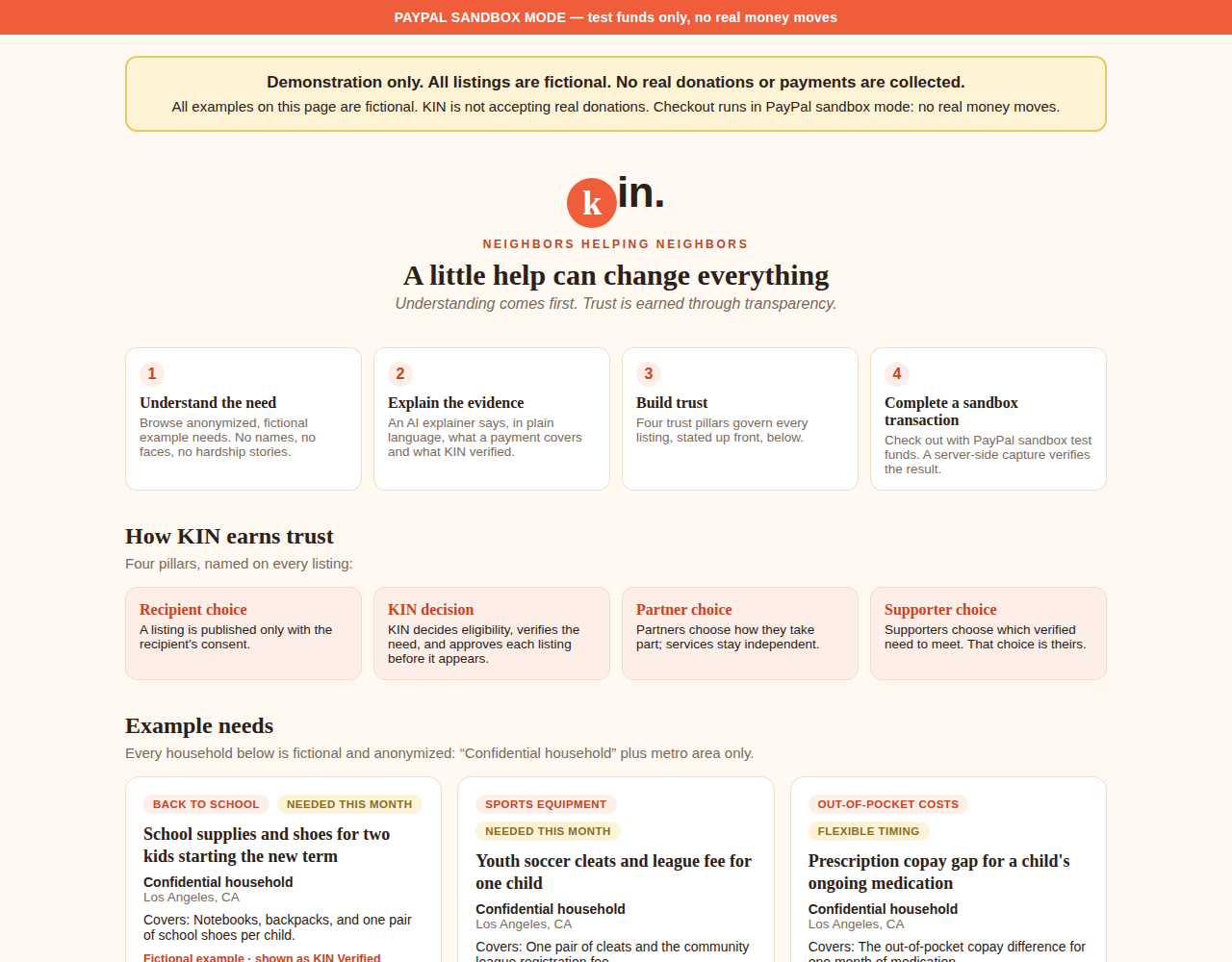
KIN exists so a single mother never has to tell her hardest story in public to get help with ordinary costs. We wanted to test whether generosity could start with understanding instead: a verified need, dignity intact, and a payment flow a supporter can trust. This prototype is the supporter side of that model, built with fictional listings only.
What it does
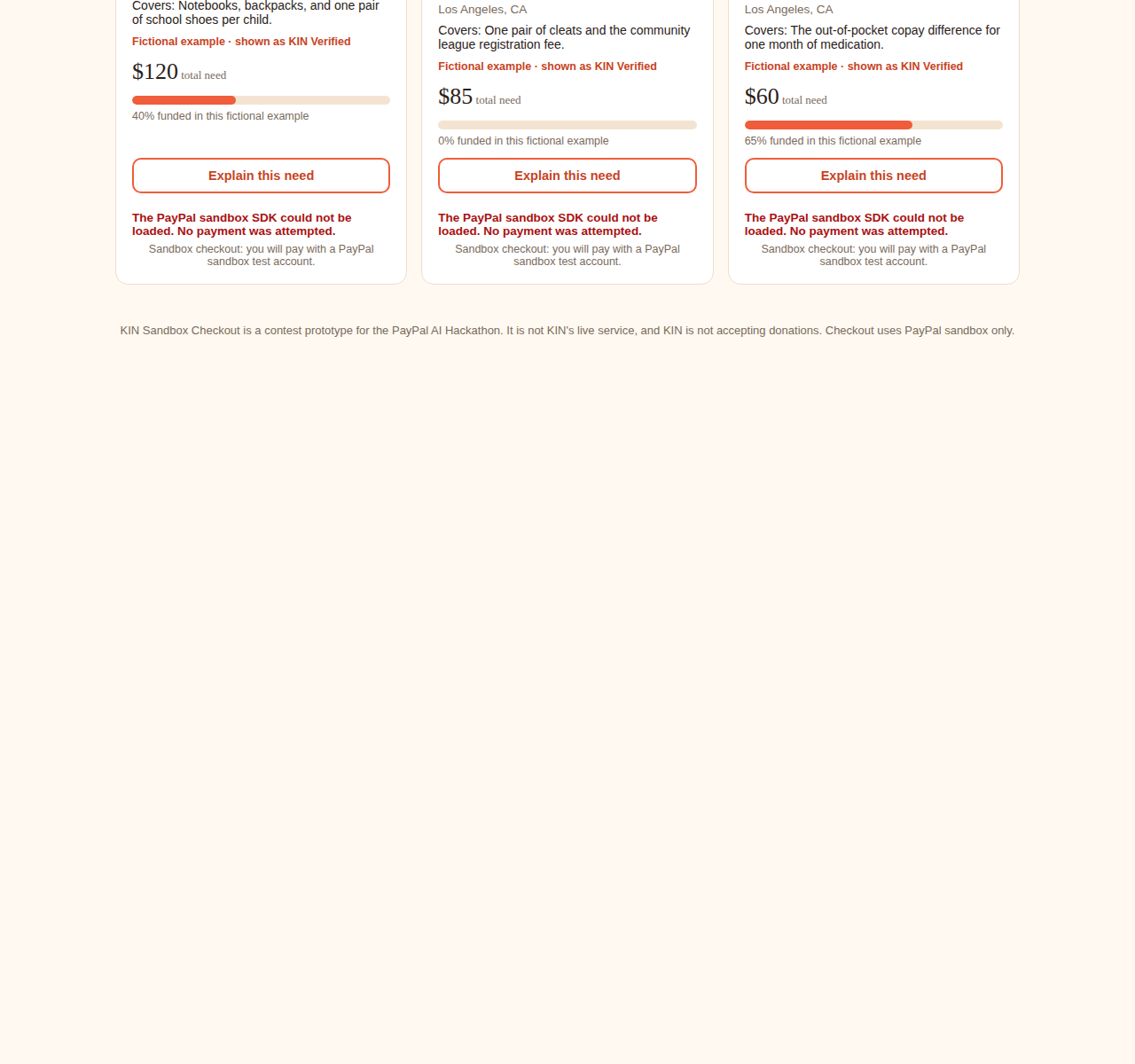
Supporters browse three fictional, anonymized needs, shown as "Confidential household" plus a metro area, with no names, no faces, and no hardship stories: back-to-school supplies and shoes ($120), youth soccer cleats and a league fee ($85), and a prescription copay gap ($60). Four trust pillars govern every listing: recipient choice, KIN decision, partner choice, supporter choice. A live AI explainer answers questions about each listing using only that listing's own fields, and PayPal sandbox checkout completes the support. Success appears on the page only after a verified server-side capture. The page opens with its honesty notice: all listings are fictional, no real donations are collected, and checkout runs in sandbox mode only.
How we built it
A zero-dependency Node.js server with a plain HTML, CSS, and JavaScript front end. PayPal Checkout runs server-side: the server creates the sandbox order with an idempotency key, the buyer approves inside PayPal's own sandbox checkout, and the server captures the order, showing success only on a verified COMPLETED response with a transaction ID. Approval alone is never treated as completion, and no fake success state exists in the code. The AI explainer (OpenAI, gpt-4o-mini) is governed by a strict prompt: answer only from the listing's fields, cite the facts used, flag assumptions separately, and refuse plainly when the listing does not say. If the live call fails, the interface shows a clearly labeled pre-generated fallback instead of invented text. Before submission we hardened the build: it now refuses to start in any mode other than sandbox, and static file serving is restricted to an explicit allowlist.
Challenges we ran into
First, sequential PayPal calls from one long-running Node process intermittently failed on a reused connection. The fix was a single automatic retry on order creation, made safe by the idempotency key, so a retry can never create a duplicate charge path. Second, keeping the AI honest took architecture, not hope: listing data lives completely separate from generated explanations, and every answer returns structured facts and assumptions metadata. We describe the explainer as prompt-grounded, not hallucination-proof, because that is what it is.
Accomplishments that we're proud of
The full flow is verified, not just built. On November 6, 2026, a sandbox buyer approved the $85 soccer listing and the server captured it: Transaction ID 4JY15284257332943, Order ID 3MP81250H5370563W, USD 85.00 in PayPal sandbox test funds, no real money moved. The explainer passed its hardest test the same day. Asked "Does this child have any siblings?", it answered: "This is not something the listing states." Usefulness, then restraint. A full rehearsal on November 11 repeated both proof points with a second verified capture.
What we learned
Trust in a giving product is mostly subtraction: no hardship stories, no public photos of children, no fake success states, no invented answers. And a checkout is only complete when the server can prove it, not when a buyer clicks a button.
What's next for KIN Sandbox Checkout
It stays what it is: a sandbox demonstration, not a live donation platform. A future KIN pilot would add real partner verification and fulfillment safeguards while keeping families' private stories private. Because a little help can change everything.
Built With
- gpt-4o-mini
- html
- javascript
- node.js
- openai-api
- paypal-checkout
- paypal-sandbox
