-
-
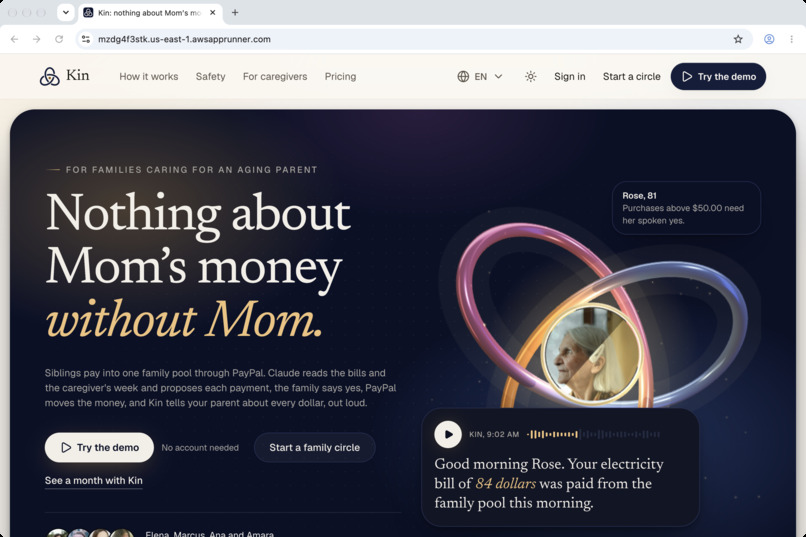
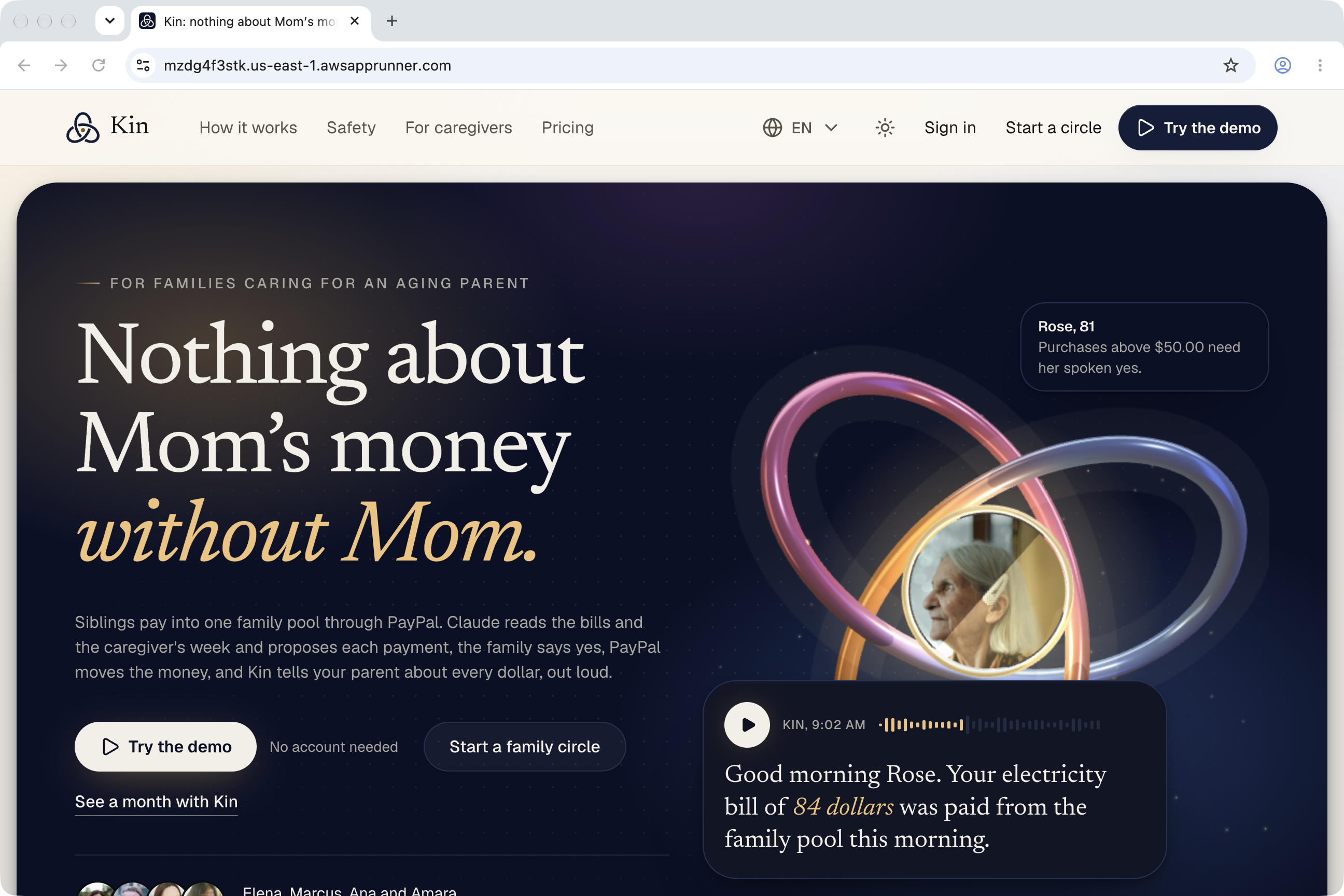
Nothing about Mom's money without Mom. One family pool on PayPal; Claude proposes, people approve, PayPal pays, and Rose hears every dollar.
-
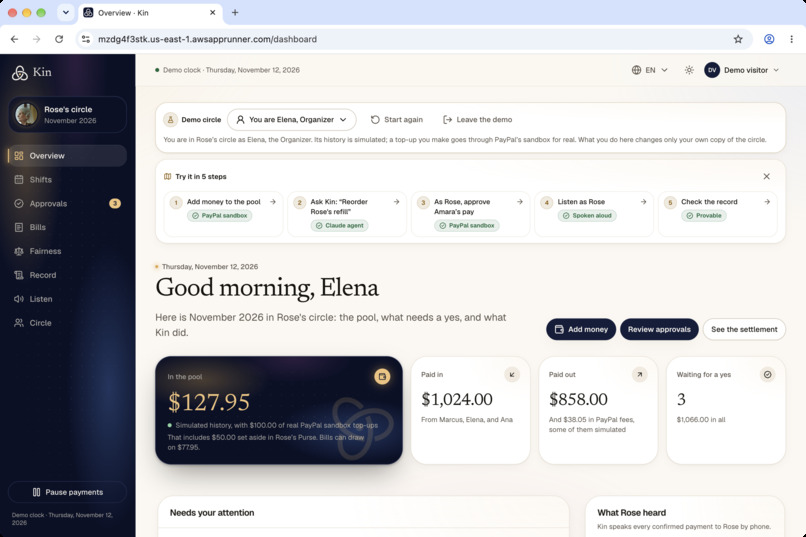
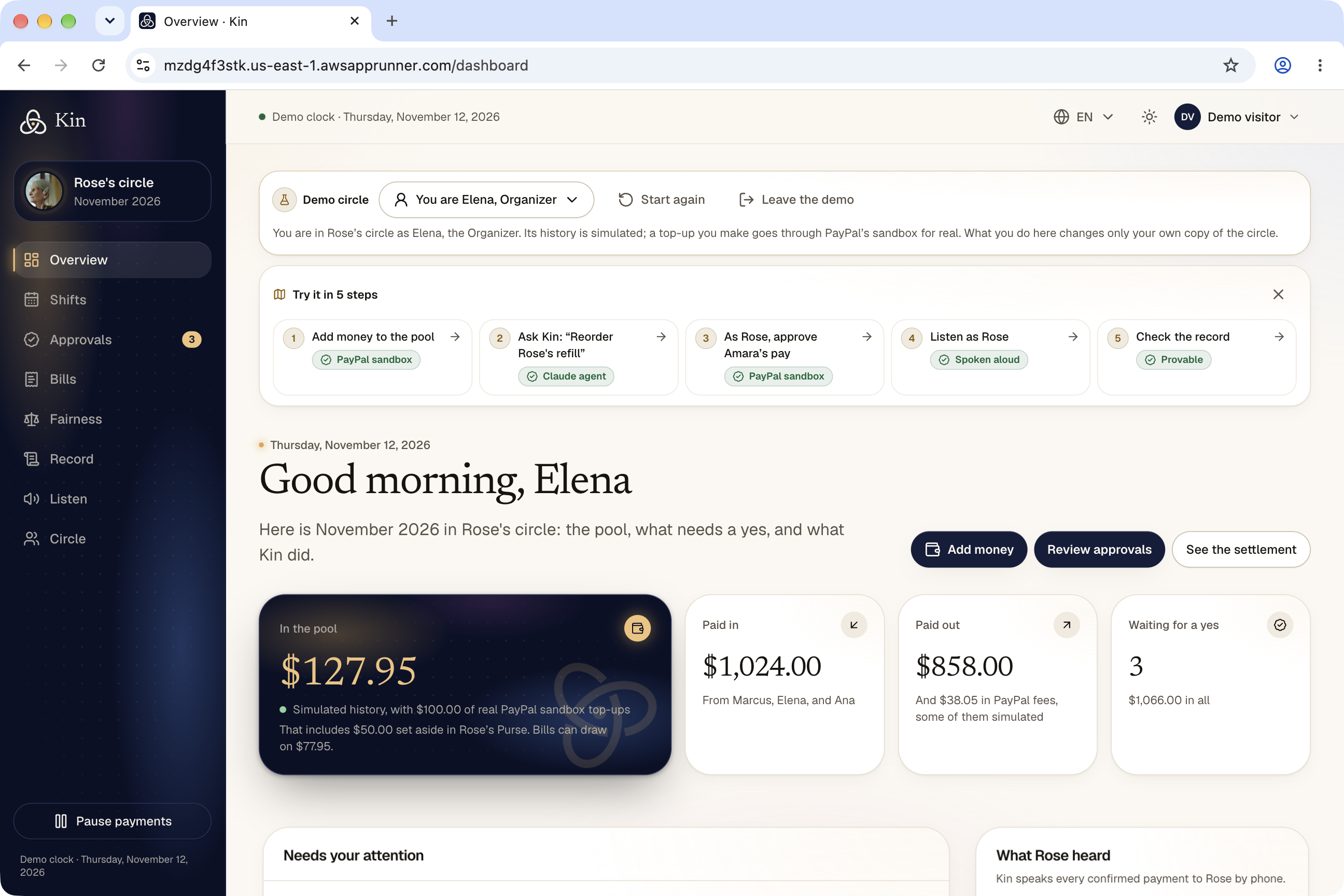
The family's month at a glance, with the five-step judge's path. Each step says what is real: PayPal sandbox, Claude, or simulated.
-
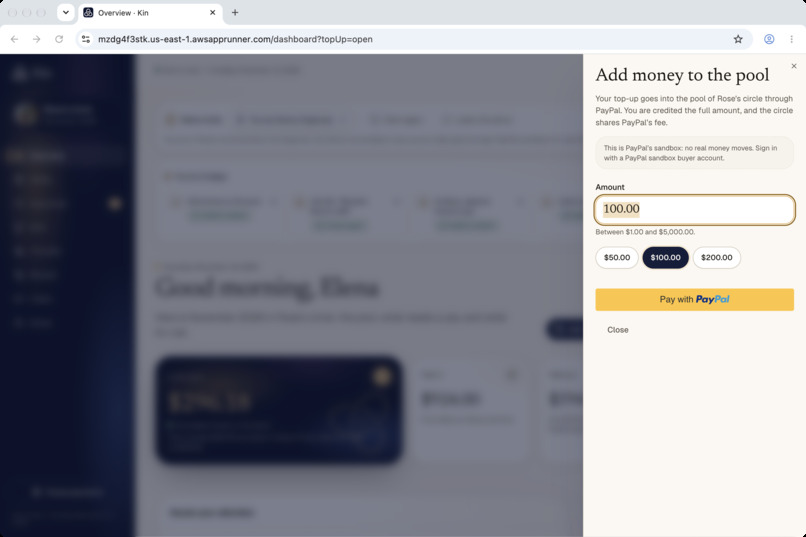
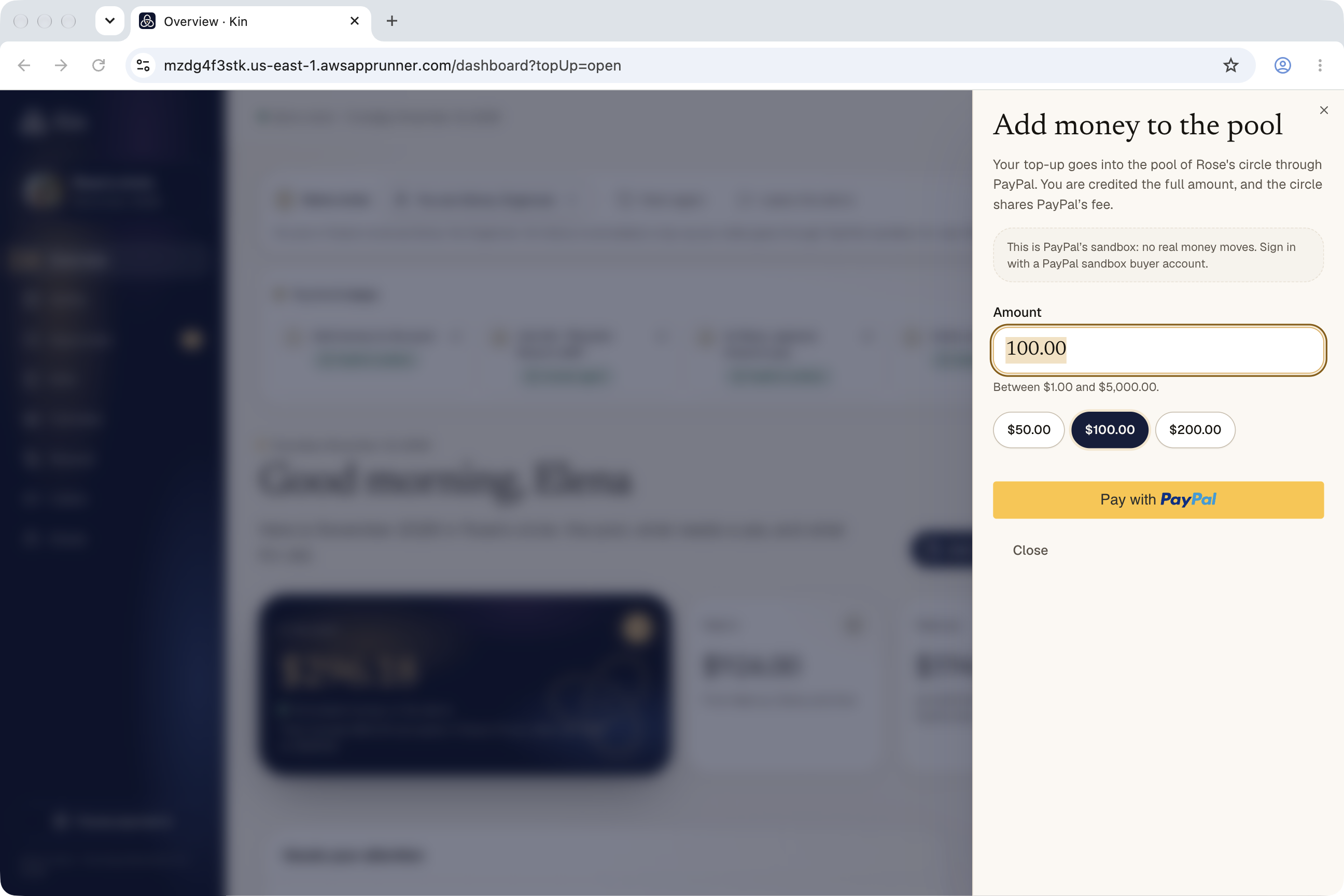
A sibling tops up the family pool through PayPal. The dialog says plainly that this is PayPal's sandbox, with test money.
-
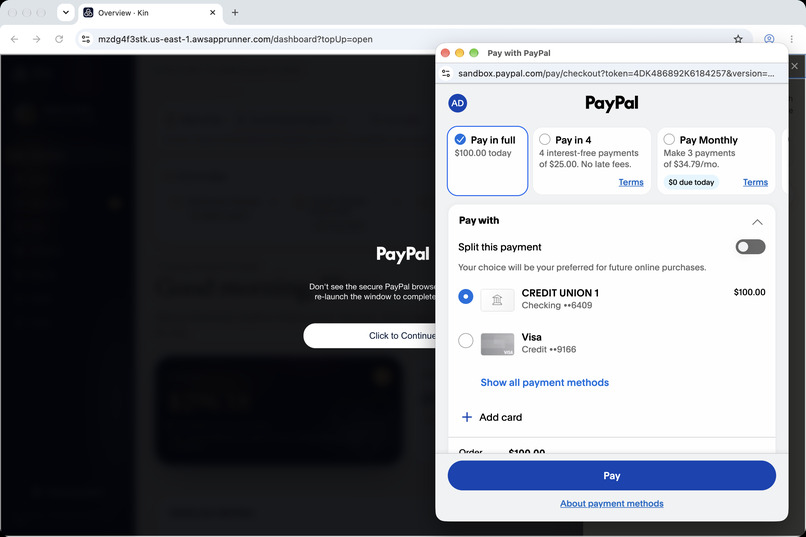
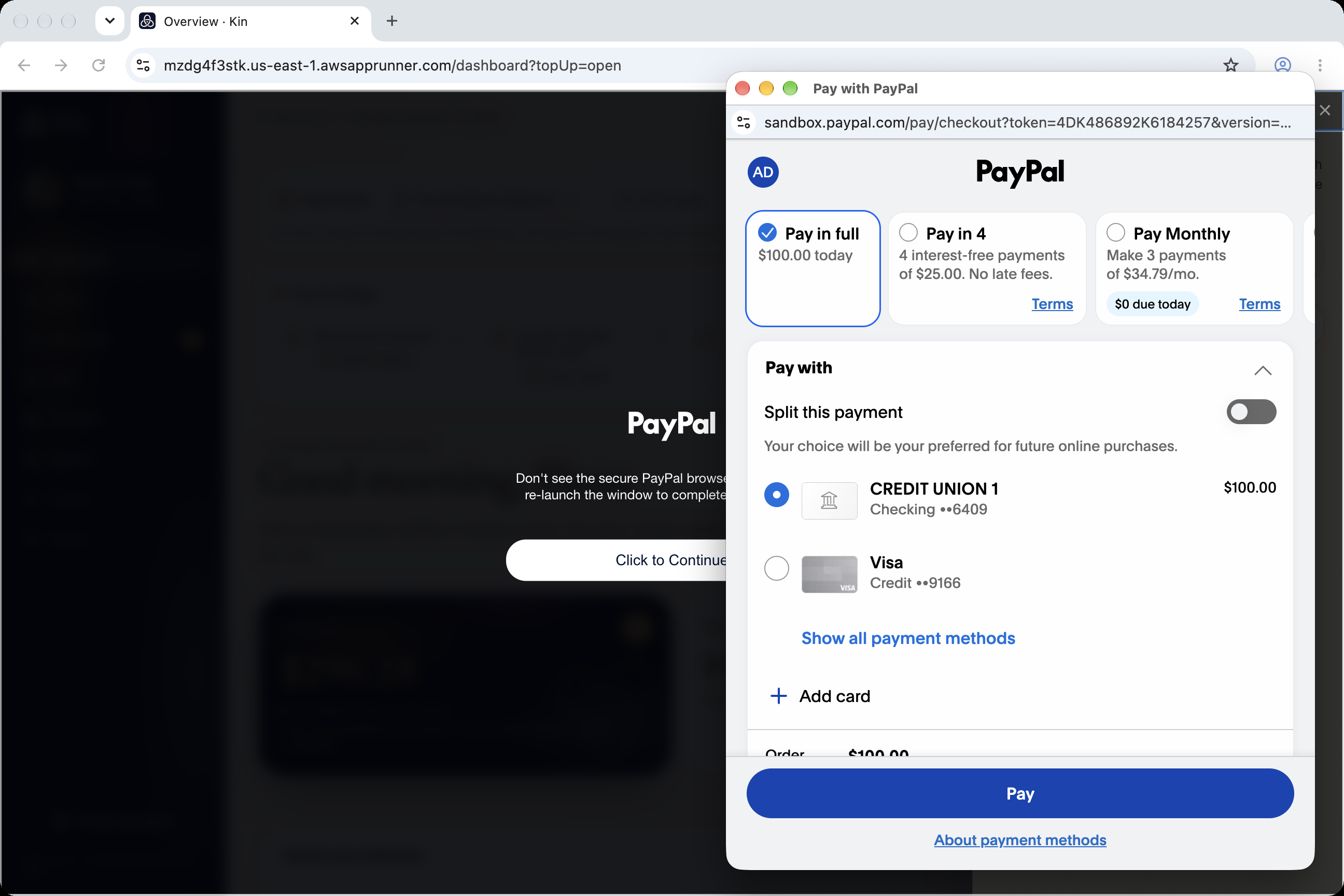
PayPal's own checkout (sandbox.paypal.com), opened by the PayPal JavaScript SDK v6, with Pay in 4 and Pay Monthly offered.
-
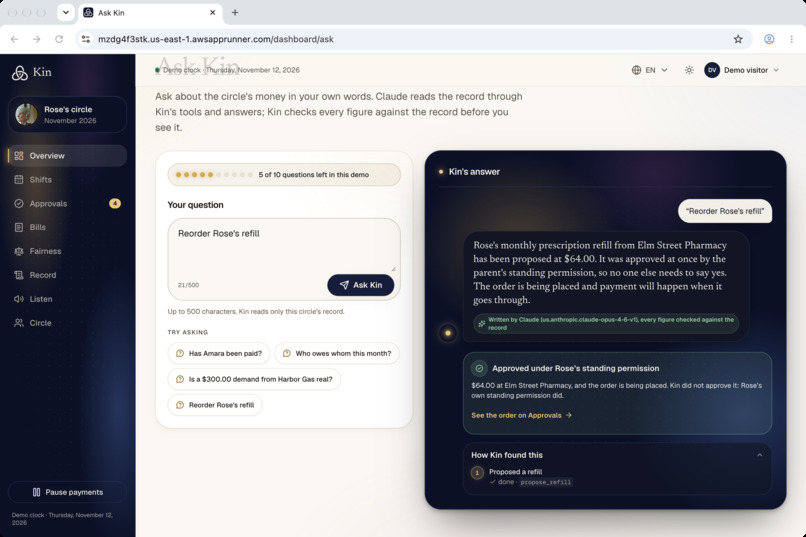
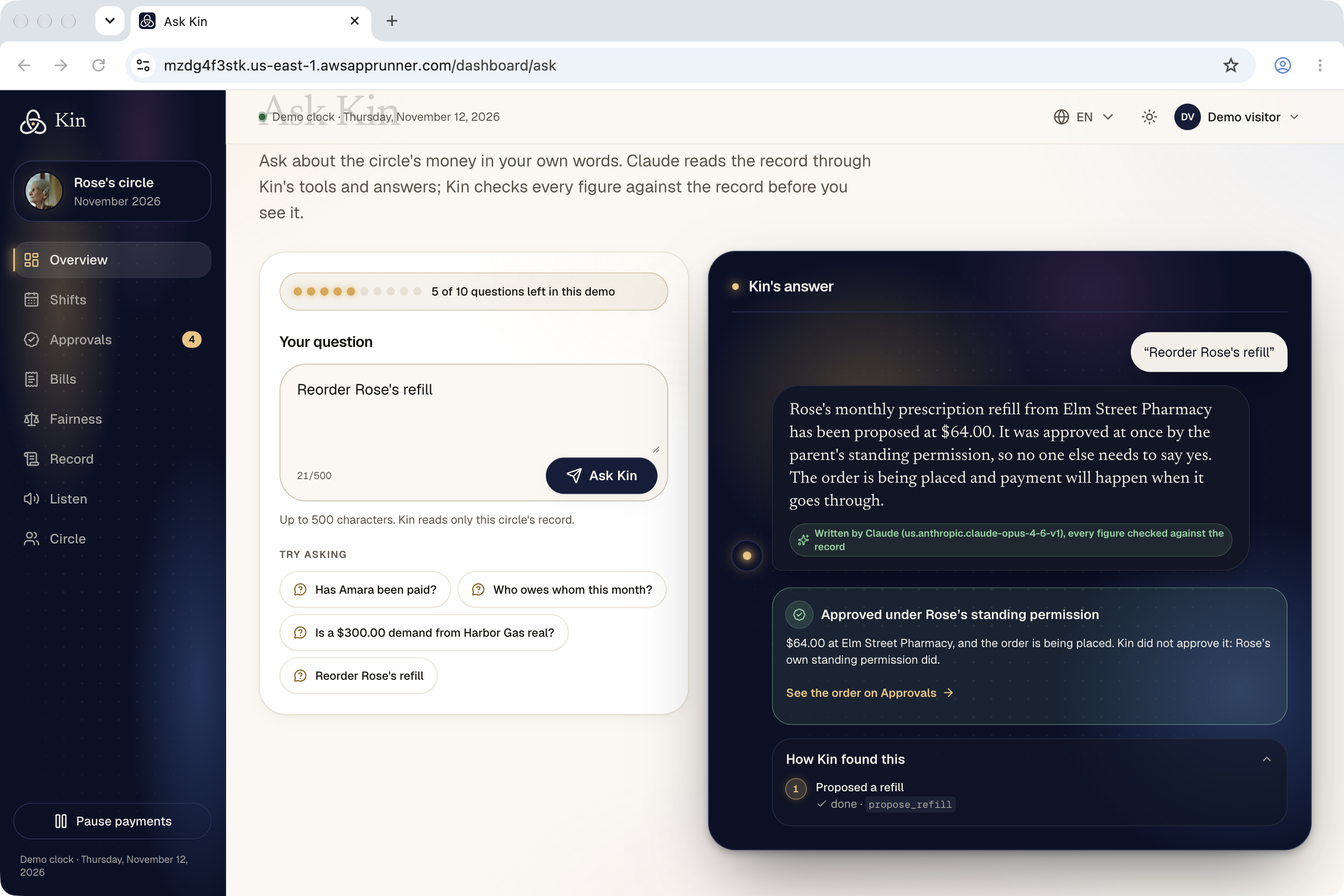
An agent that buys within the parent's rules. Claude raises Rose's refill; her own standing permission approves it, not Kin.
-
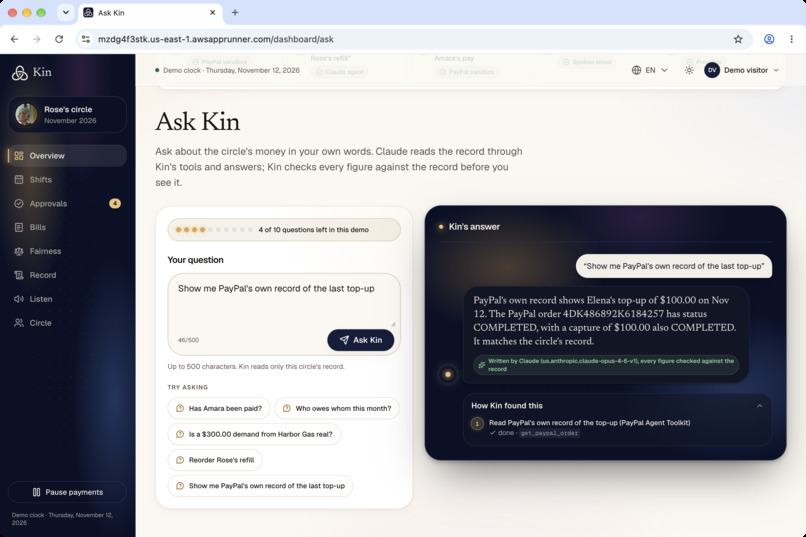
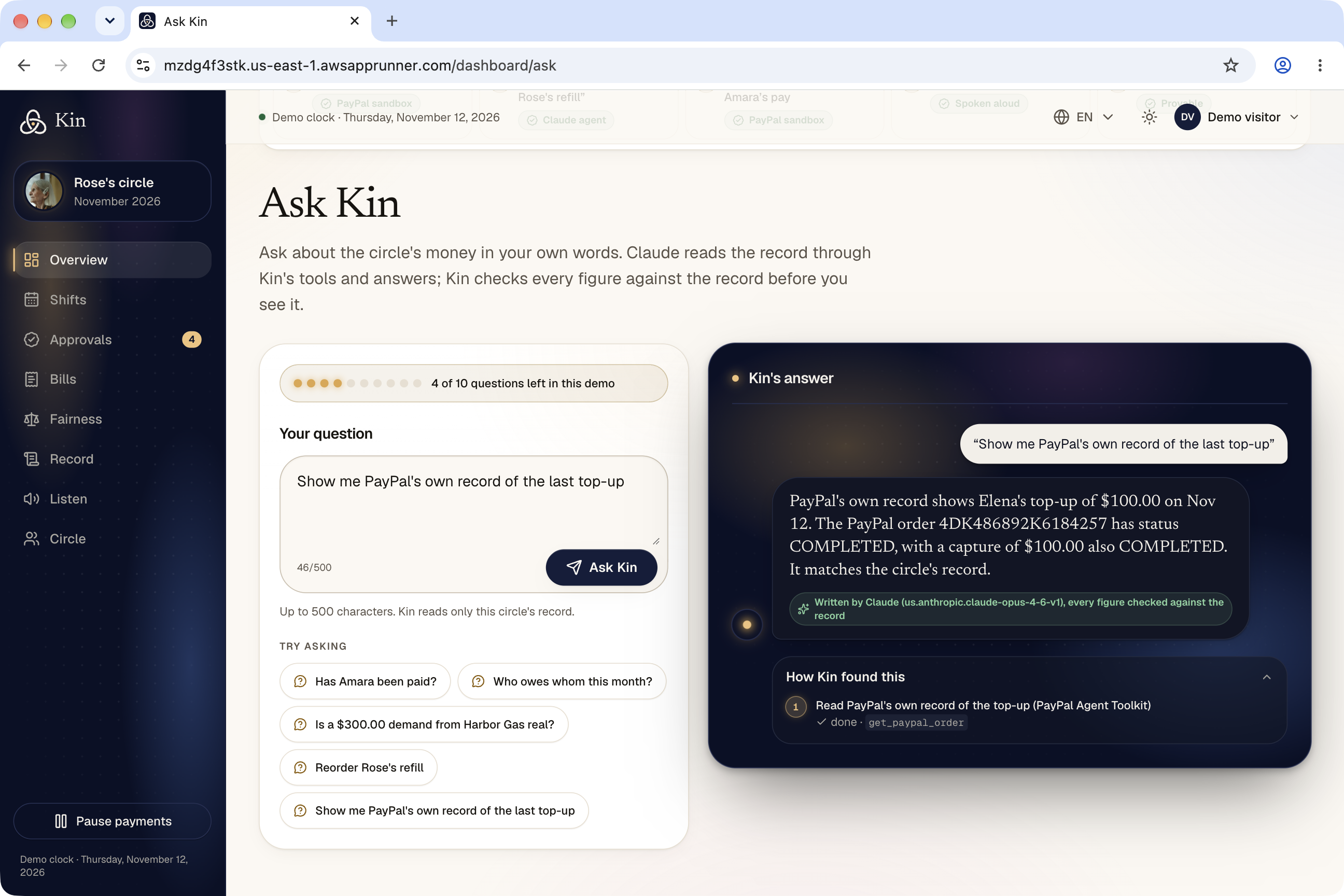
Ask Kin reads PayPal's own record through the PayPal Agent Toolkit: order and capture COMPLETED, matching the circle's record.
-
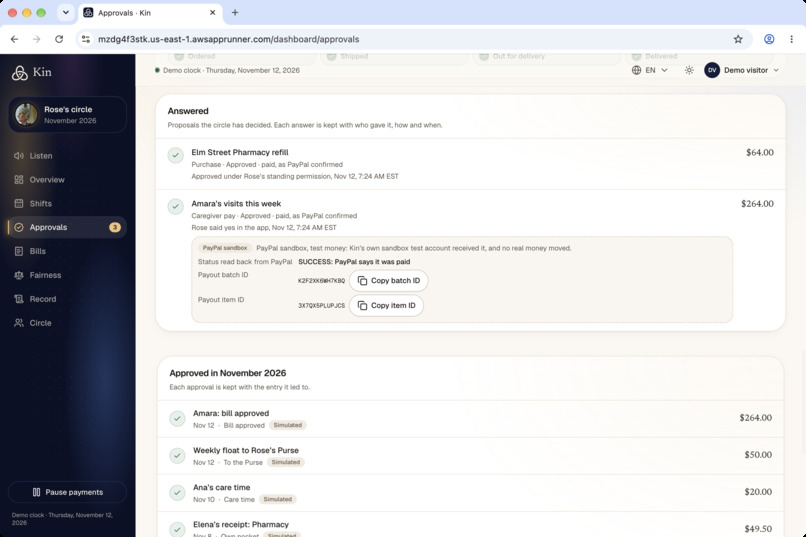
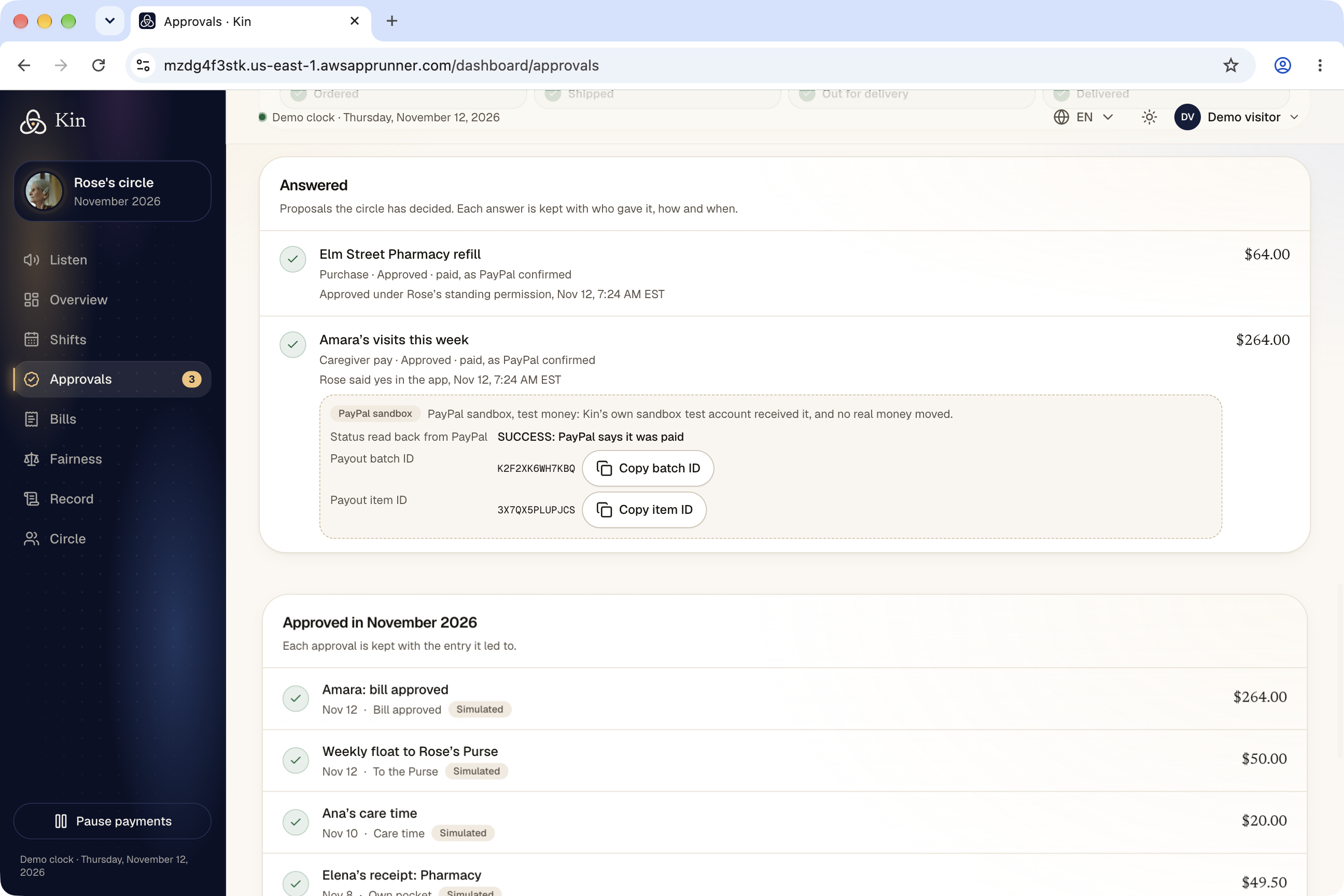
PayPal pays Amara. Recorded as paid only when the payout item read back from PayPal says SUCCESS; the refill shows "paid, as PayPal confirm
-
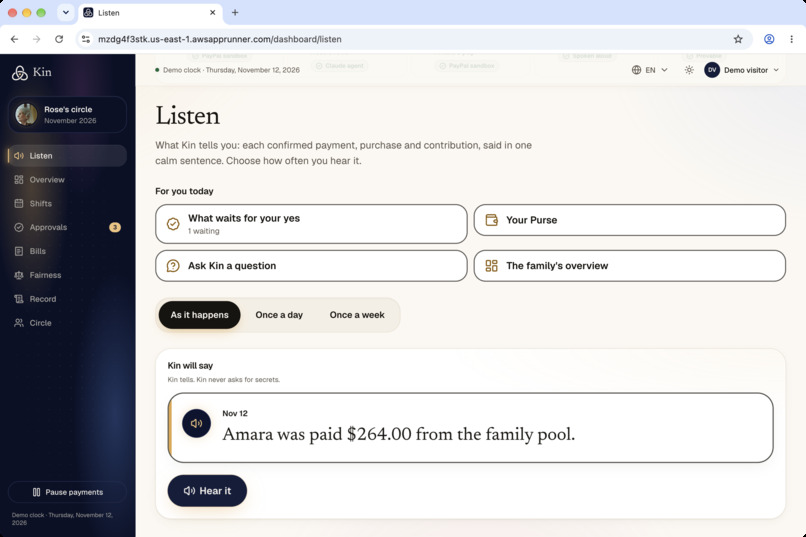
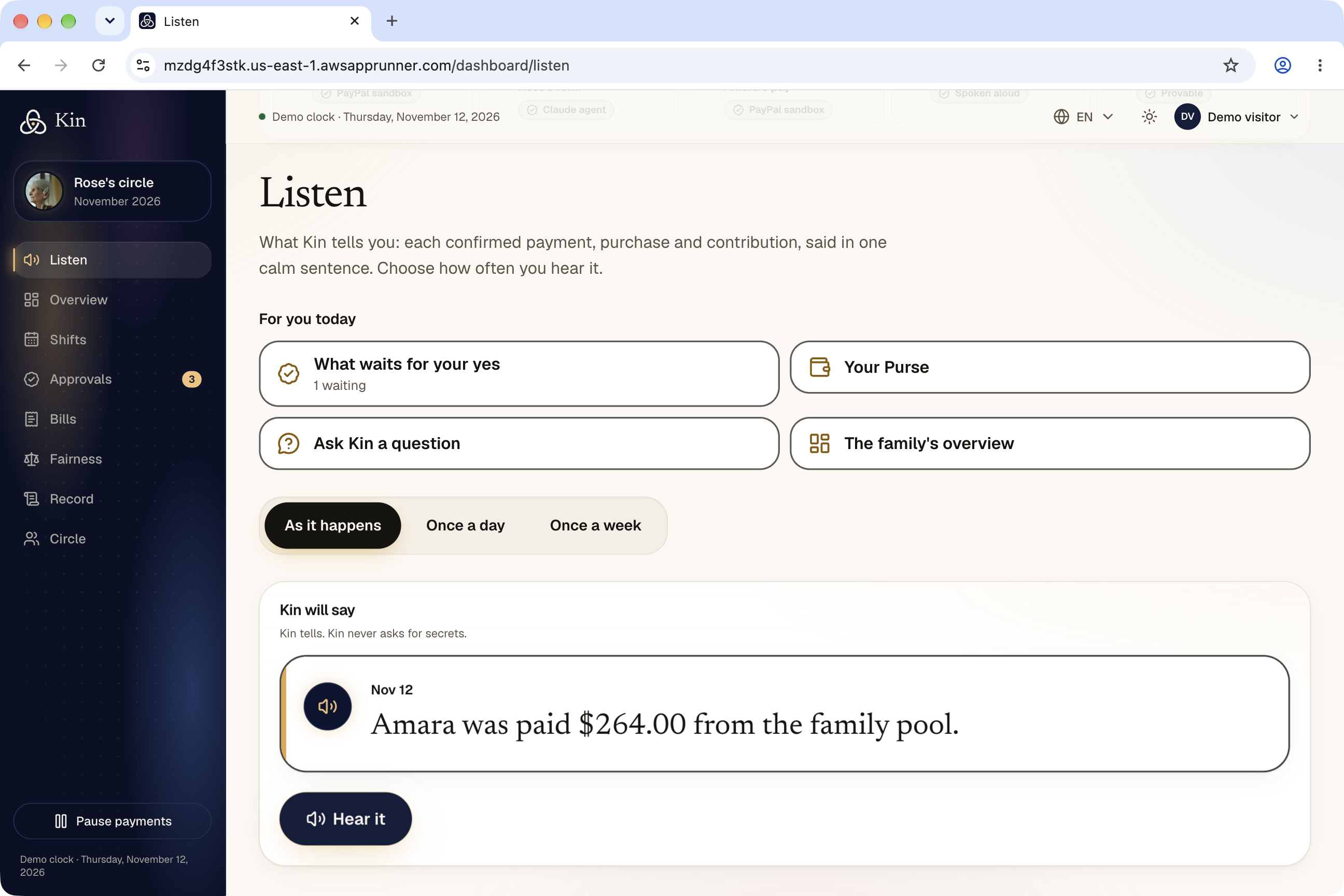
Rose's first screen. Every confirmed payment, said in one calm sentence, in very large type, read aloud.
-
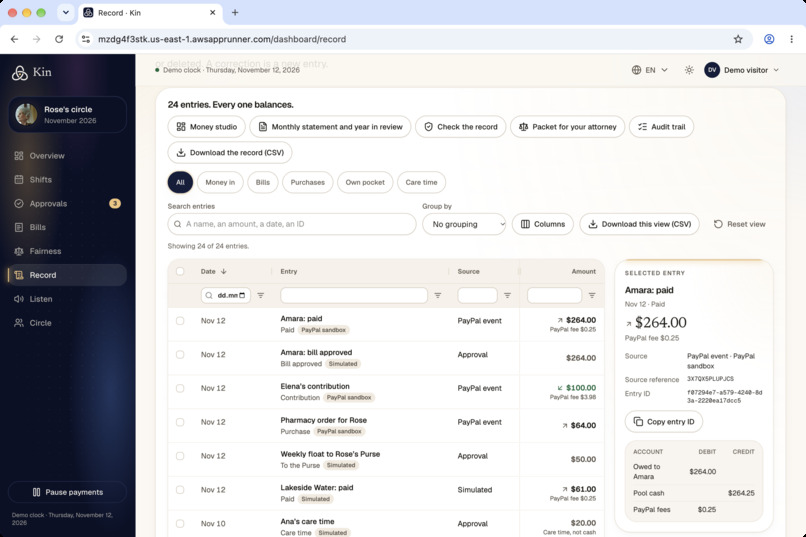
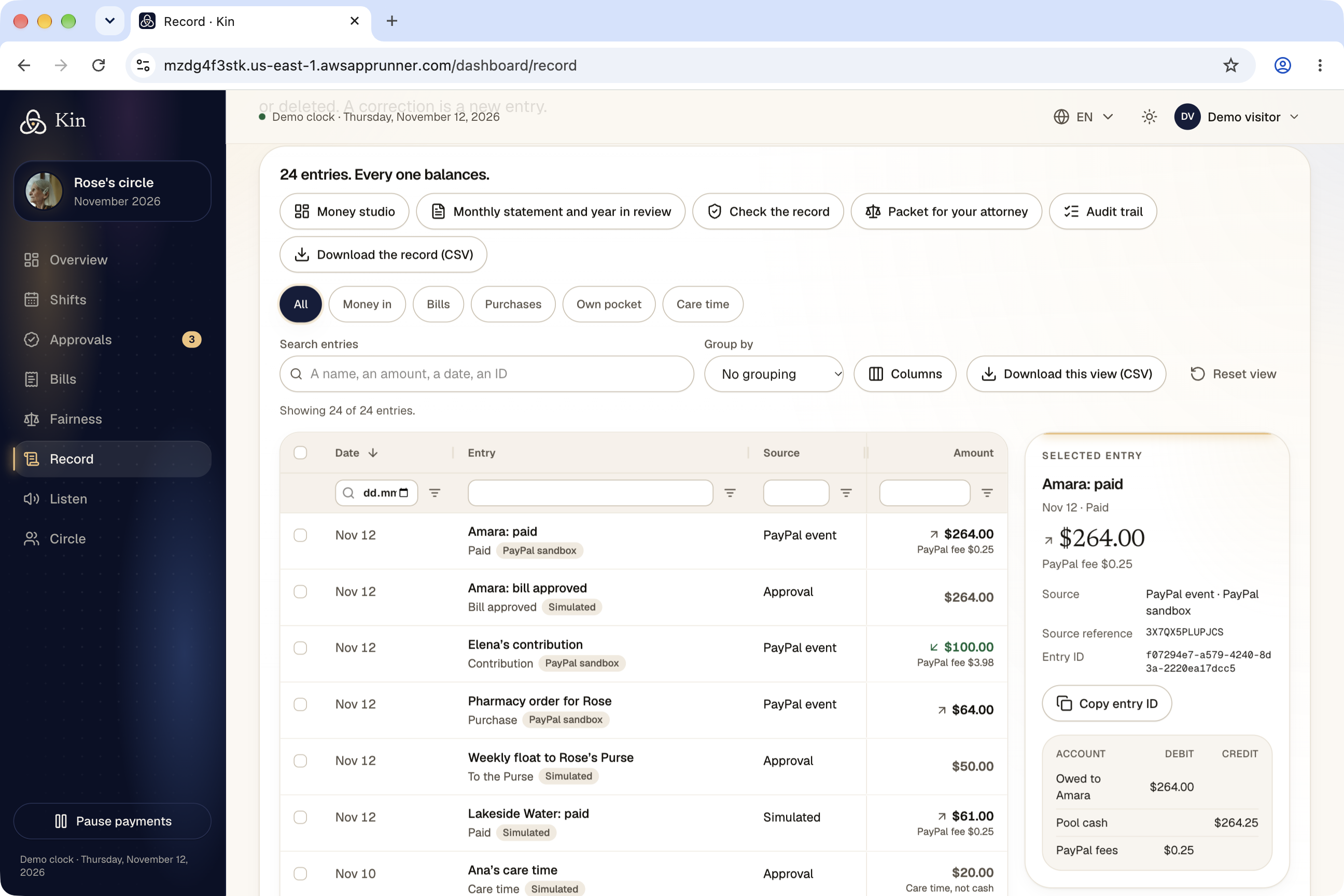
The append-only, double-entry ledger in AG Grid. The top-up, the refill and Amara's pay are labelled PayPal sandbox beside simulated history
-
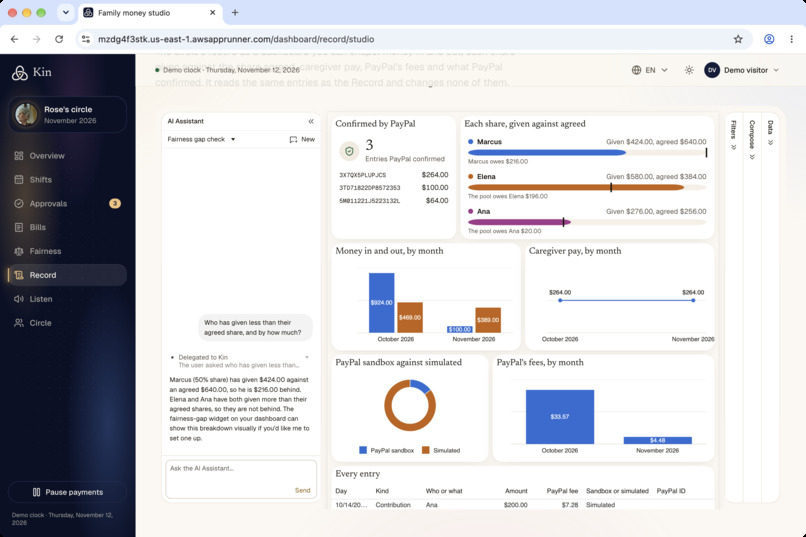
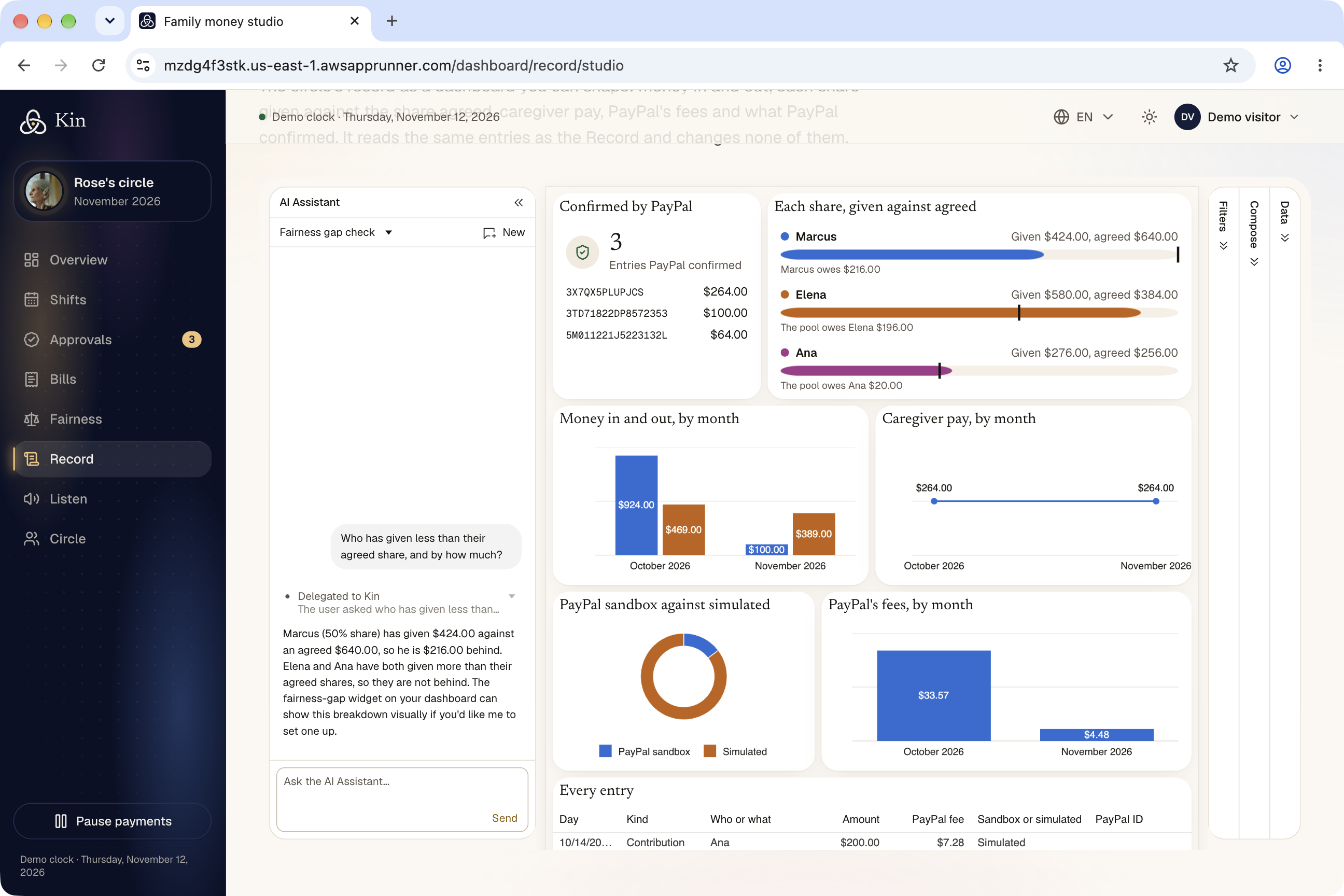
Family money studio on AG Studio: a PayPal-verified tile listing PayPal's IDs, a fairness gap widget, and Kin's agent answering beside Studi
-
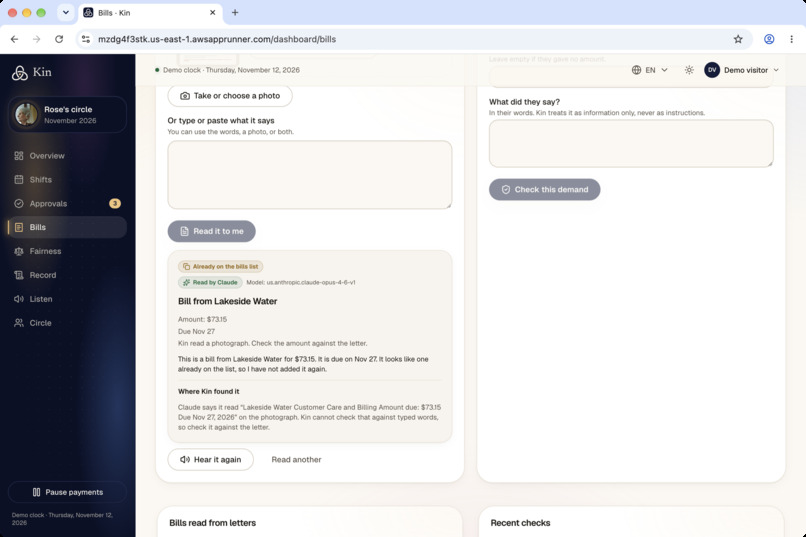
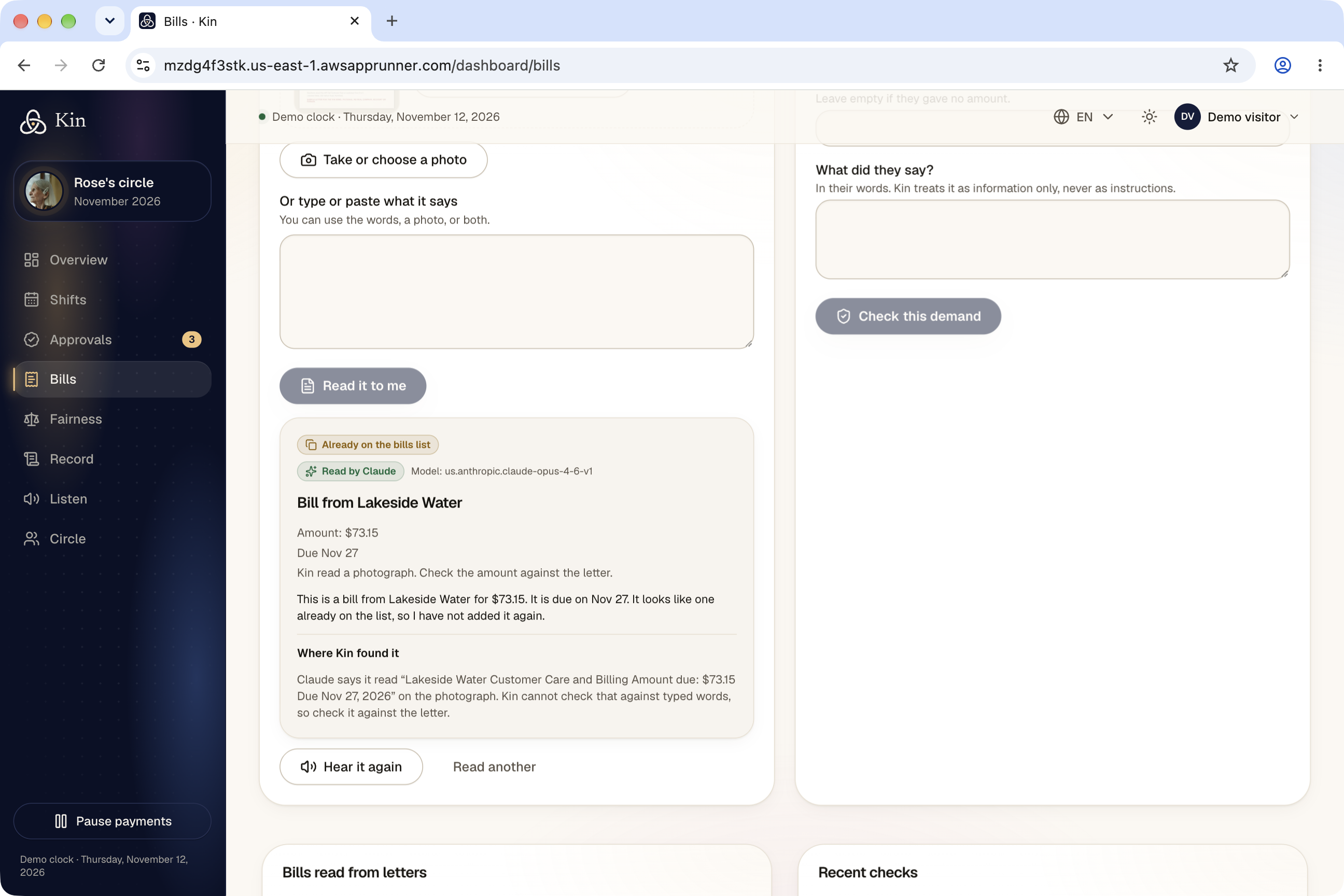
Claude reads a photographed bill and shows the words it read; Kin notices the bill is already on the list and does not add it twice.
-
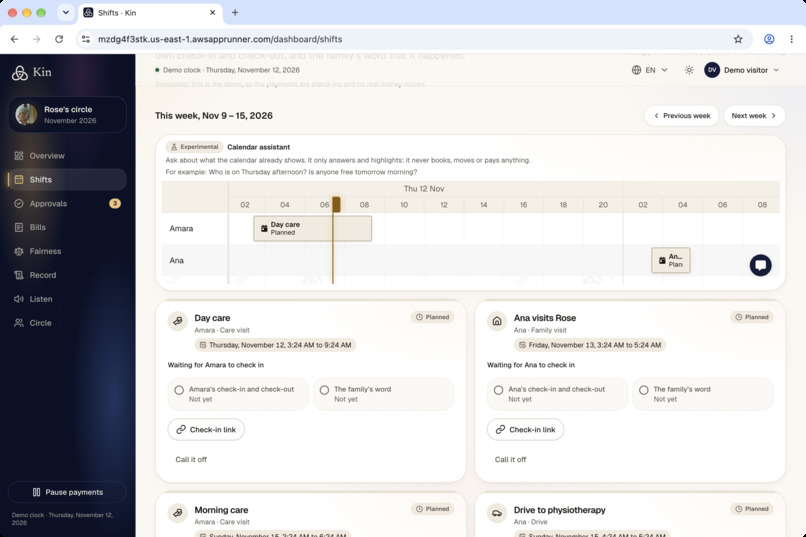
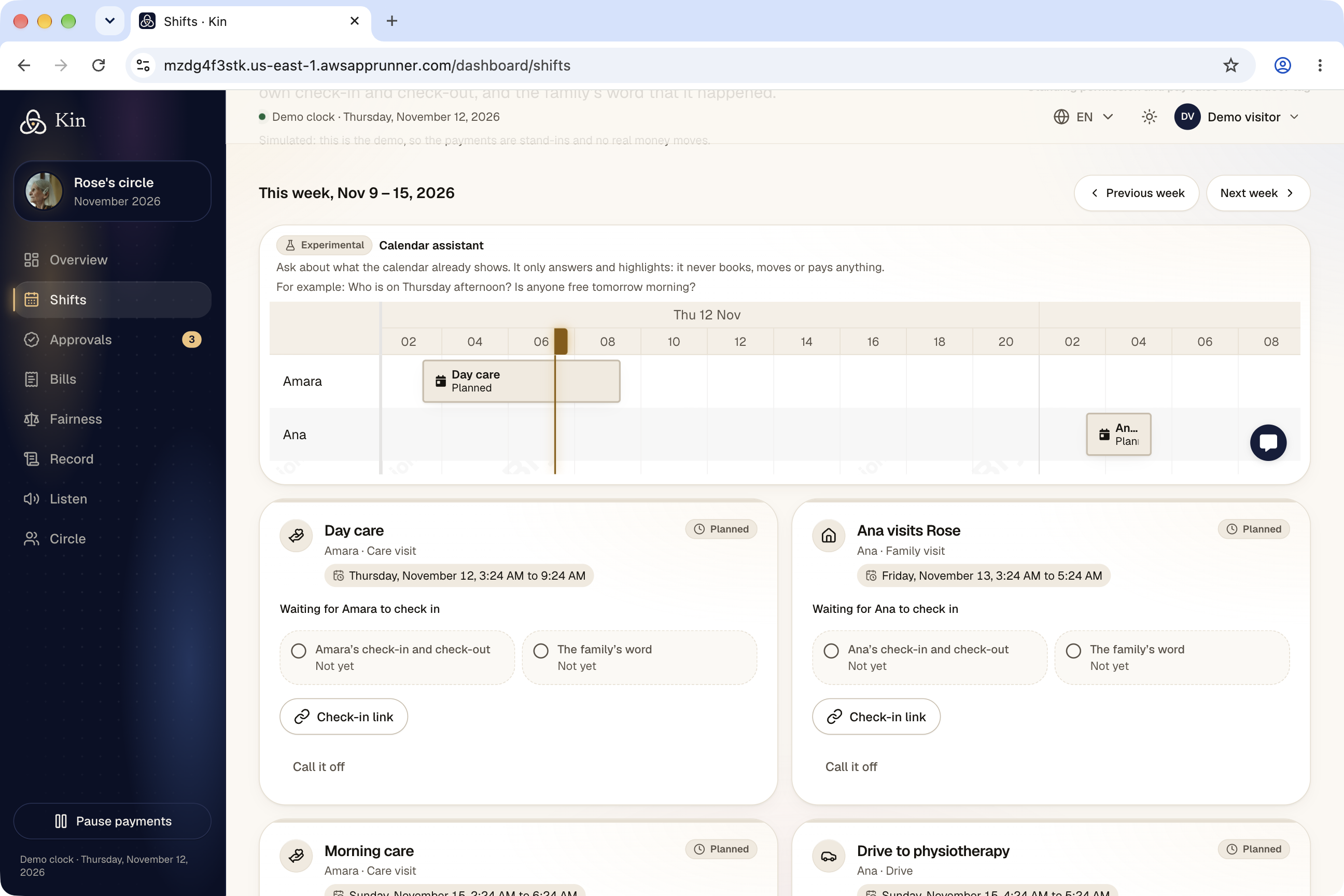
The care calendar on Bryntum Scheduler. A visit is paid only when the caregiver's check-in and the family's word agree.
-
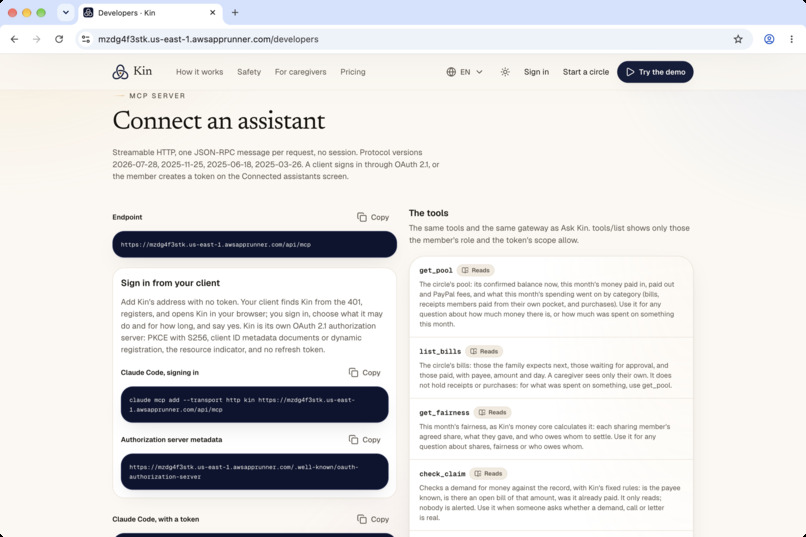
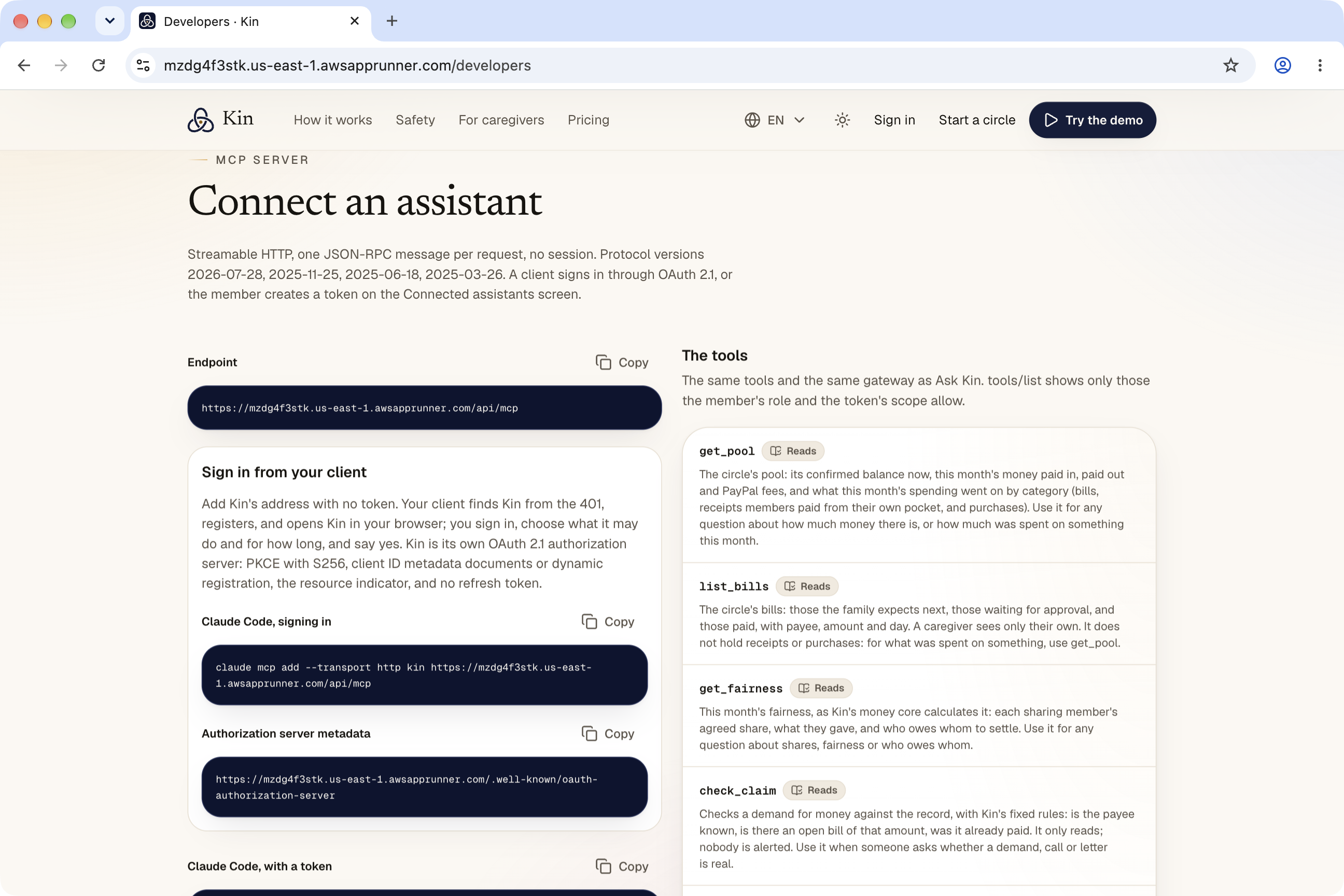
Open Kin. A member's own assistant signs in to Kin's MCP server through OAuth 2.1 with PKCE; it can read and propose, never approve.
-
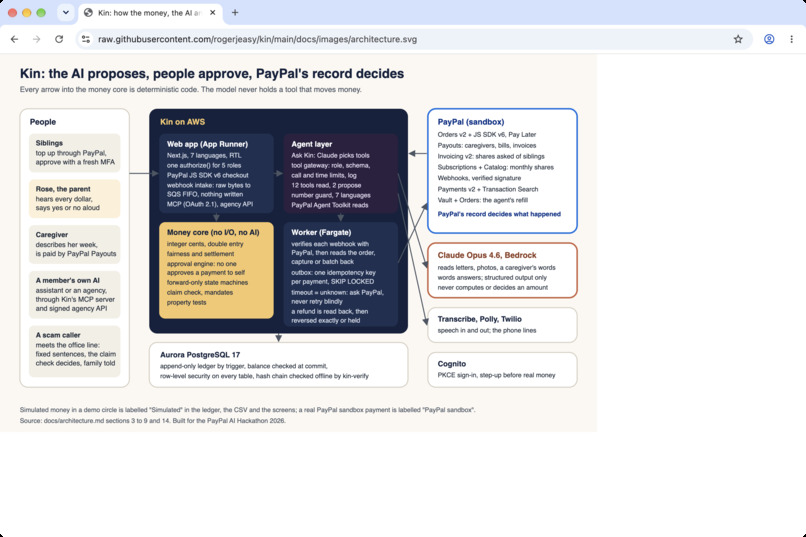
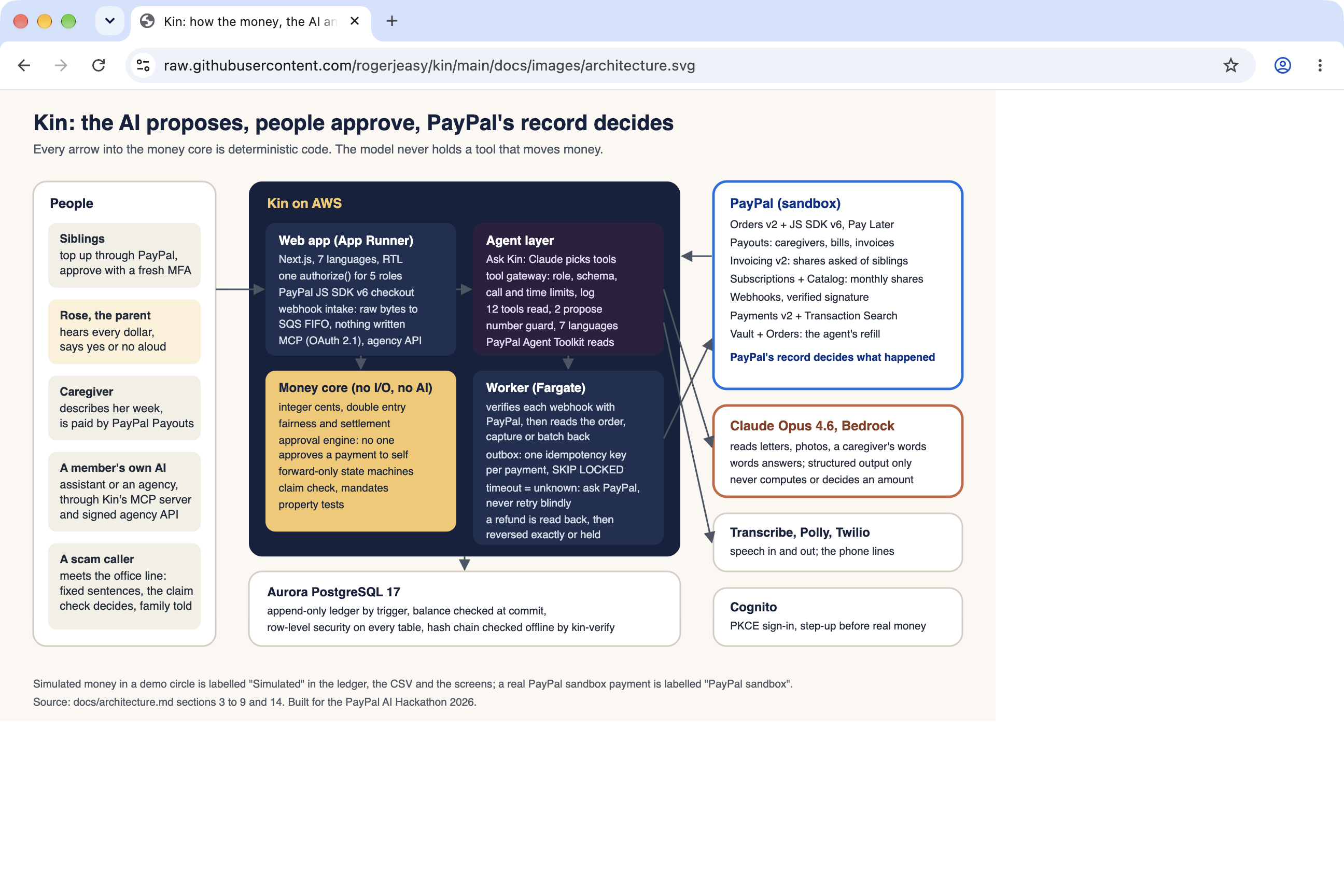
The AI proposes, people approve, PayPal's record decides. The money core is deterministic code with no model in it.
Inspiration
Rose is 81. Her three children share the cost of her care through a group chat and one sibling's credit card. Nobody can see who has carried what. Amara, her caregiver, is paid late and informally. And Rose, who can no longer read a bank statement, hears about her own money last: usually from a scammer calling to say a bill is overdue.
That family is common. About 63 million Americans are family caregivers, spending on average $7,242 a year of their own money (AARP). Americans over 60 reported $4.9 billion in fraud losses in 2024 (FBI IC3). The tools that exist either watch the money and cannot move it, or split a bill and leave the settling to someone else. None puts the parent at the center.
Try it, no account: mzdg4f3stk.us-east-1.awsapprunner.com → Try the demo. PayPal sandbox buyer: [email protected] / G_8h$[X+.
What it does
Kin is one family pool on PayPal. One month, in five moments:
- Marcus tops up the pool through PayPal. PayPal's own checkout (JavaScript SDK v6, Orders v2). Kin writes the ledger only after reading the order back from PayPal.
- Kin buys Rose's refill, within her rules. Ask Kin "Reorder Rose's refill": Claude raises it, Rose's own standing permission approves it (not Kin), the pharmacy charges her saved card through PayPal, and Kin records the charge only from PayPal's record.
- Rose says yes to Amara's week. Amara described her visits in her own words; Claude read them into days and hours and the server valued them. Above $50, Rose decides, and nobody approves a payment to themselves.
- PayPal pays Amara. PayPal Payouts, recorded as paid only when the payout item read back from PayPal says
SUCCESS. - Rose hears it. "Amara was paid $264.00 from the family pool." One calm sentence, in very large type, read aloud.
Around that month:
- Kin takes the scam call. A caller demands $300 for the gas bill; plain code checks the claim against the record (the last bill, $57.00, was paid on Oct 14) and tells the family.
- Bills read from letters. Hold up a letter: Claude reads the payee, amount and due date and shows the words it read each one from. A person reviews it, and only then can it be paid through PayPal.
- Fairness as a payout. Each sibling's share of money and care time, measured against what the family agreed, and settled with a payment.
- Open Kin. A member's own AI assistant connects to Kin's MCP server through OAuth 2.1 with PKCE and can read and propose, never approve. Home-care agencies report visits and send invoices through a signed API, with TypeScript and Python SDKs generated by APIMatic.
The rule throughout: the AI proposes, people approve, and PayPal's own record decides what happened.
How we built it
PayPal moves every dollar and is the record Kin treats as the truth.
- Top-ups: Orders v2 + JavaScript SDK v6, with Pay Later where PayPal offers it. Live in the demo.
- Caregiver pay: Payouts, with the batch and item read back. Live in the demo (batch
7Z5NG9RE8TT9U,SUCCESS). - The agent's purchase: Orders v2 with a vaulted card, charged by a separate merchant app over signed requests. Live in the demo (capture
2E160838130356727). - Bills and agency invoices: paid through Payouts after review. Requests to siblings: Invoicing v2.
- Monthly shares: Subscriptions, Catalog products and Plans, run through Kin's adapter in the sandbox (
I-CSP0NHWX4BFG: charged, suspended, resumed, cancelled). - Refunds and reconciliation: Payments v2 read-back and Transaction Search, recorded against the sandbox.
- Every event: webhooks verified with
verify-webhook-signatureon the exact bytes before anything is applied. - The agent reads PayPal: the PayPal Agent Toolkit, read actions only (orders, invoices, disputes), every ID taken from the family's own record.
Nothing is recorded from an API response alone. A call that times out makes the execution unknown: Kin asks PayPal and waits, never retrying blindly. Running against the real sandbox found three bugs we fixed: a subscription price change PayPal refuses, a product that could be created twice, and request IDs sent to endpoints that ignore them.
Claude Opus 4.6 on Amazon Bedrock reads and words; it never decides an amount. Every extraction has no tools and answers in a validated schema, traced back to the source words. Ask Kin is a real tool loop over fourteen tools behind a gateway that checks the person's role through one authorization function, validates every argument, and bounds calls, time and result size. A number guard checks every figure Claude writes, in seven languages, against what the tools returned for that person, and falls back to fixed wording on any mismatch. If Claude is unavailable, plain code still answers the common questions. The fixed evaluation set passes 27 of 27 on the real model, including multi-step questions, prompt injection inside tool results, and every role's refusals.
The money core is deterministic. packages/domain is pure TypeScript: integer cents, double entry, fairness, settlement, forward-only state machines and the approval engine. PostgreSQL enforces it again: append-only triggers, a balance check at commit, unique idempotency keys, and row-level security on every table, with a test that reads each table from another circle and expects nothing. A hash chain lets kin-verify prove offline that no past entry changed.
Sponsor tools. AG Studio turns the ledger into a family money studio with two custom widgets (a fairness gap and a PayPal-verified tile) and a Kin agent beside Studio's own. Bryntum Scheduler is the care calendar, where a visit is paid only when the caregiver's check-in and the family's word agree. APIMatic generates the agency SDKs from Kin's OpenAPI document.
AWS: App Runner (web, phone line, demo pharmacy), Fargate (worker), Aurora Serverless v2, Cognito, SQS, Secrets Manager, Transcribe and Polly, all in CDK and deployed by GitHub Actions through OpenID Connect.
Challenges we ran into
- Not knowing whether money moved. We designed for the unknown outcome first. PayPal's sandbox refuses a repeated payout batch ID with a 400 that names the original batch; that is how Kin recovers a lost reply without paying twice.
- An agent that buys, without an agent that pays. The pharmacy's PayPal app owns the order, so Kin cannot read it. The pharmacy exposes a signed read-back, and the worker records the charge only when order, capture, status and the exact amount all match.
- The AI answered a question it was not asked. On the real model, a caregiver asking for PayPal's record of a top-up got her own payout instead. The evaluation set caught it; the prompt now says first what a seat cannot see.
Accomplishments that we're proud of
- A parent who cannot read a screen can still run her own affairs, by voice.
- An AI agent buys within the parent's own rules and pays through PayPal, while never holding a tool that moves money.
- Claude Code, connected to Kin's MCP server, read a family's record and PayPal's status of a real top-up, and could not approve anything.
- More than 3,700 unit and integration tests and nearly 700 Playwright tests at four viewport sizes with WCAG 2.2 AA checks; zero
any; seven languages including Arabic and Hebrew.
What we learned
Put the model where understanding is needed and keep it away from certainty. "Done" belongs to PayPal's record, not to our API response. And say what is simulated: labelling it cost little and made every claim in the demo defensible.
What's next for Kin: Nothing about Mom's money without Mom
A pilot with real families; custody through PayPal's multiparty platform so each circle's funds sit under PayPal's licences, not Kin's; disputes in the ledger; cross-border circles for families who live apart.
AI tools used: Claude Opus 4.6 on Amazon Bedrock (Ask Kin's tool loop, reading visits, letters and photographs, wording what Rose hears); the PayPal Agent Toolkit (Ask Kin's reads of PayPal's record); Amazon Transcribe and Polly (speech); Claude Code (the coding assistant used to build Kin). Kin was started for this hackathon: first commit 14 October 2026.
Built With
- ag-grid
- ag-studio
- amazon-bedrock
- amazon-cognito
- amazon-polly
- amazon-transcribe
- apimatic
- aws-app-runner
- aws-cdk
- bryntum
- claude
- drizzle-orm
- model-context-protocol
- next.js
- oauth-2.1
- paypal
- paypal-agent-toolkit
- paypal-javascript-sdk-v6
- paypal-payouts
- paypal-rest-apis
- paypal-subscriptions
- postgresql
- react
- twilio
- typescript
