Inspiration
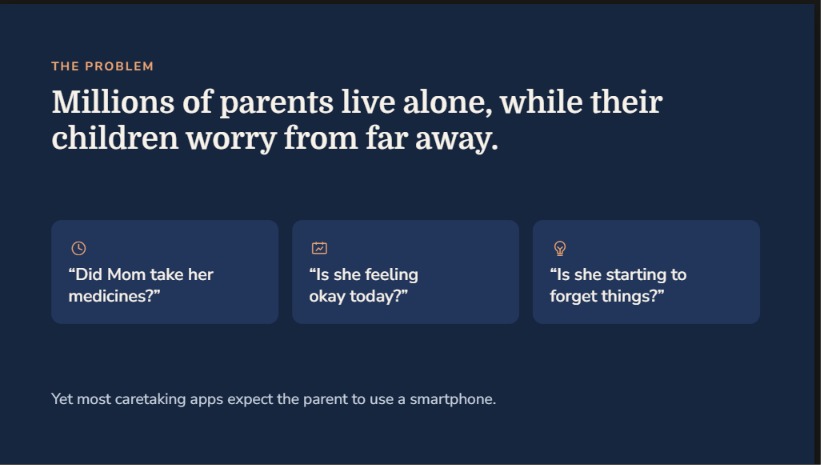
Many of us have parents who live alone in one city while we work in another. We worry about the same things every day: did Mom take her BP tablet, is she eating and sleeping well, is she forgetting more than usual? Most caretaking apps expect the parent to use a smartphone, and many older parents won't. But almost anyone can talk to Alexa. So we asked: what if the parent just talks, and the family stays informed without having to call and check?
What it does
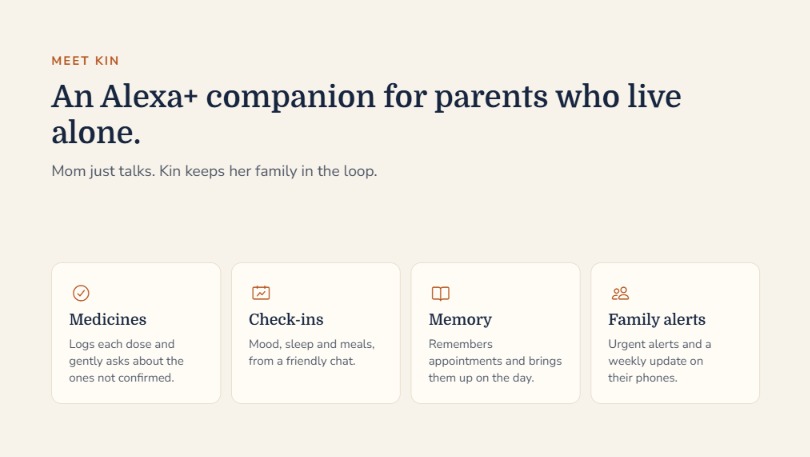
Kin is an Alexa+ companion for parents who live alone. The parent speaks naturally to Alexa, and their children get push alerts and a weekly summary on their phones.
- Medicines: logs doses as taken or skipped and shows today's pills on a smart-display card.
- Memory across sessions: "Remember, doctor on Friday" is saved, and Kin brings it up the next day without being asked.
- Daily check-ins: sleep, food, mood and a short note.
- Pattern spotting: flags repeated skipped doses, mood falling three days in a row, or the same question asked again and again.
- Family alerts: sends real push notifications to the family's phones.
- Reordering: "Order more sugar tablets" gets an "Are you sure?" confirmation first, then places a clearly labelled mock order.
- Weekly digest: Claude on Amazon Bedrock writes a warm summary of the week for the family.
Kin asks before it worries. If nobody logs a dose, Kin marks it unconfirmed, never "missed". The next morning Alexa asks, "Did you take your BP tablet last night?" and records the answer for that exact dose. Only real skips count toward alerts:
$$ \text{alert level} = \begin{cases} \text{mention} & \text{if skips} = 2 \ \text{urgent alert to family} & \text{if skips} \ge 3 \end{cases} $$
If the family was warned and Mom then confirms she took the dose, Kin sends a correction right away: "Mom confirmed taking it. No need to worry." A background watchdog checks every 15 minutes, so urgent problems reach the family even if Mom doesn't say anything.
Safety line: Kin never gives medical advice. It only logs, reminds and alerts.
How we built it
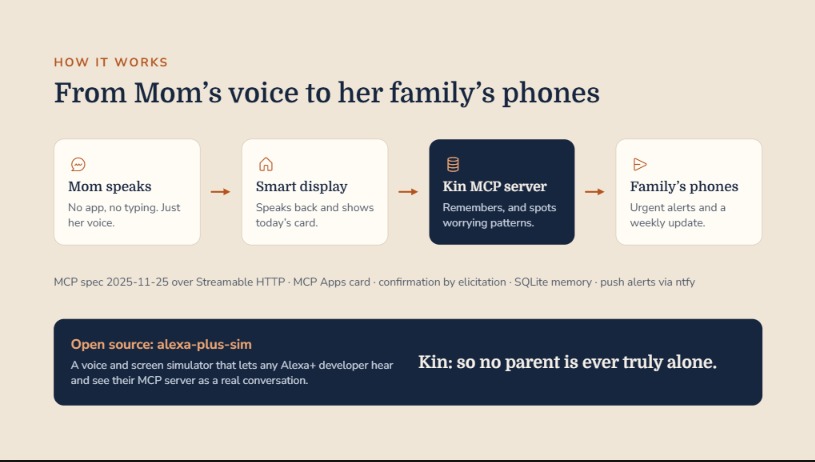
Kin is an MCP server (spec 2025-11-25, Streamable HTTP) written in TypeScript on Node 24 using the official MCP TypeScript SDK. It has 9 tools: daily_checkin, remember, recall, log_medication, get_today, notice_patterns, alert_family, reorder_medicine and family_digest.
- Storage: Node's built-in SQLite with five tables (
meds,doses,checkins,memories,orders). Patterns are recalculated from the records every time, so a corrected answer never leaves a wrong memory behind. - Smart-display card:
get_todayreturns an MCP Apps UI card. - Confirmations:
reorder_medicineuses MCP elicitation for the "Are you sure?" step. - AI: Claude on Amazon Bedrock picks which tools to call and writes the weekly family digest.
- Alerts: push notifications through ntfy.sh.
We also built and open-sourced alexa-plus-sim, a voice and smart-display simulator for any Alexa+ style MCP server. Paste in an MCP server URL, talk into your browser's microphone (Web Speech API), and Claude on Bedrock calls the server's tools. The reply is spoken back, MCP Apps cards are drawn in a smart-display frame, and elicitation requests become spoken confirmations.
Kin has 92 passing tests and alexa-plus-sim has 24. Both repos are MIT-licensed, and Kin also runs in a fallback mode without AWS keys so judges can test it for free.
Challenges we ran into
- Testing without a device: the only way to test an Alexa+ MCP server was MCP Inspector, which means filling in forms and reading raw JSON. We couldn't hear or see Kin as a conversation, so we built alexa-plus-sim, which became our open-source contribution.
- Avoiding false alarms: our first idea was to treat any unlogged dose as missed. That would have flooded families with scary alerts every time Mom simply forgot to say something. Designing the "unconfirmed, then ask, then correct" flow took more thought than any single tool.
- Bedrock access: our requests were refused with
not authorized to perform bedrock-mantle:CreateInferenceuntil we set up an IAM user with the right Bedrock permissions. - No public purchase API: real Amazon ordering isn't available to developers, so reordering creates a clearly labelled mock order.
- Choosing a track: Fire TV, Bee and Ring all needed hardware or simulators we couldn't run on our machines in the time we had. Alexa+ let us ship with pure code.
Accomplishments that we're proud of
- The demo moment works for real: Mom tells Alexa she skipped her tablet, and a few seconds later her son's phone buzzes.
- Kin corrects itself. Most caretaking apps assume the worst; Kin asks first and sends a follow-up when the news is good.
- We shipped two working, tested, open-source projects in about a day and a half.
- alexa-plus-sim is useful to every other Alexa+ developer, not just us.
What we learned
- MCP is a clean way to give a voice assistant real abilities: tools, UI cards and confirmations all fit naturally into one protocol.
- For a family-care product, trust matters more than features. A single false alarm can make a family ignore the next real one.
- Elderly users need the assistant to do the remembering, asking and following up, not the other way round.
- Good developer tools pay off quickly: building the simulator first made every later feature faster to test.
What's next for Kin
- Run Kin on a real Alexa+ device once there's a documented way to connect a self-hosted MCP server.
- Real medicine reordering through a pharmacy partner.
- Support for multiple family members with different alert preferences.
- Deploy to AWS (for example App Runner) so families don't have to run anything themselves.
- Gentle cognitive check-ins to help families notice early signs of memory decline, without ever diagnosing.
Built With
- alexa
- amazon-bedrock
- aws-iam
- claude
- mcp-apps
- model-context-protocol
- node.js
- ntfy
- sqlite
- typescript
- web-speech-api


Log in or sign up for Devpost to join the conversation.