-
-

Kilo Demo Guardian
-
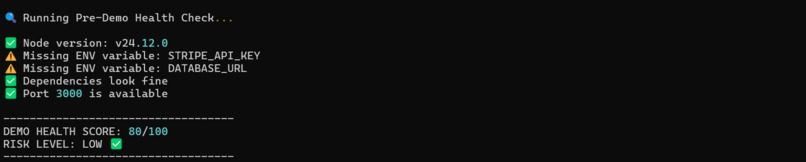
Live Application

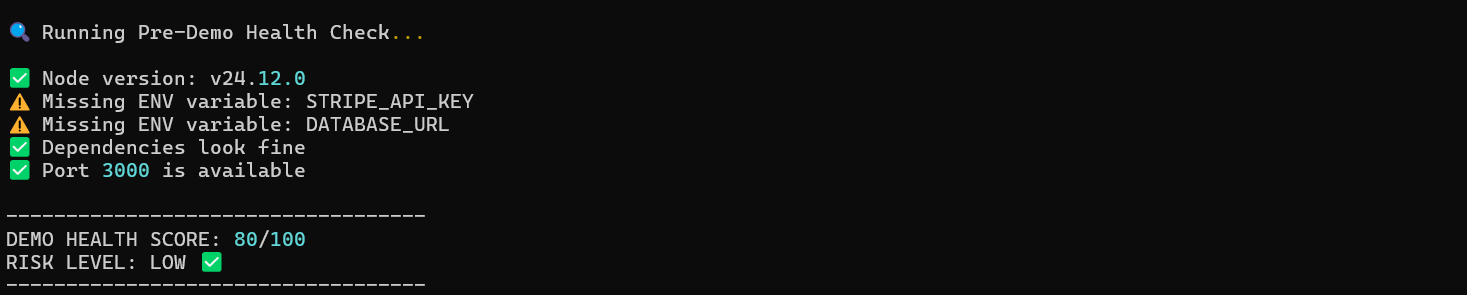
🛡️ Kilo Demo Guardian Because "It worked on my machine" isn't a deployment strategy. 💡 Inspiration Every developer knows the cold sweat of a live demo. You’ve practiced a dozen times, but the moment you hit the stage, the "Demo Gods" strike. Usually, it’s not a complex architectural failure; it’s a missing .env variable, a port conflict, or a slightly mismatched Node version. I realized that most demo failures are caused by environment inconsistencies rather than logic errors. I wanted to quantify this "Demo Risk" and automate the anxiety away. We can model the probability of a demo failure as a function of environmental variables: $$R = f(E, D, P, V)$$ Where: • $E$ = Missing or malformed Environment variables • $D$ = Unmet Dependency requirements • $P$ = Port availability/conflicts • $V$ = Runtime Version compatibility As complexity grows, the risk $R$ compounds. Kilo Demo Guardian was built to verify system health before you ever hit "Enter" on that first demo command.
🚀 What It Does Kilo Demo Guardian is a lightweight CLI tool that acts as a pre-flight checklist for your code. It doesn't just check if your code runs; it checks if the system is ready for it to run perfectly. • Runtime Validation: Checks for specific Node, Python, or Ruby versions. • Environment Auditing: Ensures all required .env keys are present (without leaking values). • Port Scanning: Verifies that required ports (e.g., 3000, 8080) are open and not held hostage by a zombie process. • Health Scoring: Generates a Demo Health Score and classifies risk as LOW, MEDIUM, or HIGH. • CI/CD Ready: Includes JSON output and specific exit codes for automated pipelines.
🏗️ How I Built It I focused on creating a tool that felt "native" to a developer's workflow—fast, colorful, and informative. Component Technology Language Python 3.12 CLI Framework Typer (FastAPI's sibling for CLI) UI/Formatting Rich (for those beautiful terminal tables and status spinners) Configuration PyYAML for .kilo.yml parsing Logic Native subprocess and socket libraries for zero-overhead system checks The architecture is strictly modular. Each "Guardian" (Port Guardian, Env Guardian, etc.) is an independent class, making it easy for contributors to add new validation rules in the future.
⚔️ Challenges Faced • Cross-Platform Consistency: Detecting a "Node version" sounds simple until you have to account for nvm, asdf, and standard binaries across Windows, macOS, and Linux. I had to implement robust path-checking logic to ensure accuracy. • Designing the "Risk Score": I didn't want the score to feel arbitrary. I developed a weighted penalty system where a missing dependency is a "Critical" failure, while a slightly different (but compatible) runtime version is a "Warning." • UX vs. Utility: Balancing a "verbose" mode for debugging with a "clean" mode for quick checks required several iterations of the CLI interface.
🧠 What I Learned This project reinforced that Reliability is a feature. In the rush of a hackathon, we often focus on the Happy Path, but building a tool specifically for the Edge Cases taught me to think like an SRE (Site Reliability Engineer). I also deepened my understanding of system-level networking and how to build extensible CLI tools that other developers actually want to use.
🌱 Future Improvements • Auto-Remediation: An --auto-fix flag to trigger npm install or kill processes sitting on required ports. • Kilo Cloud Integration: Pushing demo health reports to a dashboard for team leads. • AI Diagnostics: Using LLMs to analyze error logs when a check fails and suggest the exact command to fix it.
Built With
- psutil
- python
- python-dotenv
- pyyaml
- rich
- typer

Log in or sign up for Devpost to join the conversation.