About kiki
Inspiration
There are feelings that can't quite be described with words, emotions that are lost in translation, moments shared between people that no language has ever quite captured. The question that started kiki was simple: what if you didn't have to describe how you felt? What if you could just send it?
The inspiration came from thinking about the gaps in human communication. Not the failures of language, but its limits. A mother and child divided by language. Two people from different cultures sitting with the same grief. A feeling so specific it has no name in your language but exists perfectly in someone else's. kiki grew out of curiosity about what communication could look like if it started with feelings, not words.
kiki
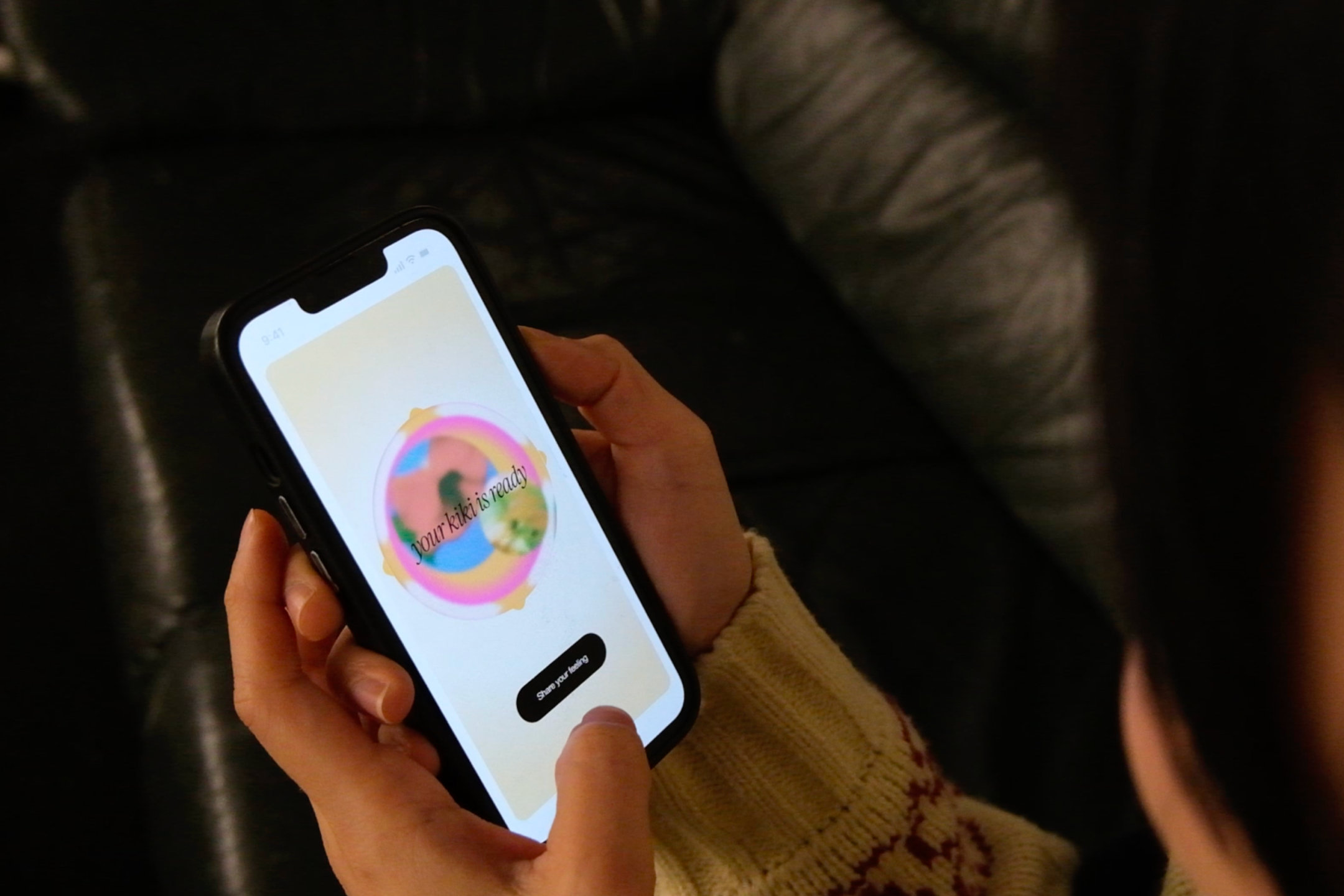
kiki is a speculative sensory system that lets people share emotional states directly, without relying on language. kiki builds an emotional landscape from emotional data that can be sent to another person.
The receiver doesn't get a label or a description. They get a felt experience. The goal is not a perfect transmission but an honest one, something closer to experiencing what the sender is feeling rather than sending a message about it.
Design Methodology
kiki was built as a speculative design project sitting at the intersection of interaction design, sensory research, and communication psychology. The process moved through several stages.
Research into how emotions are processed sensorially and how non-verbal communication works across cultures formed the foundation. From there, concept development shaped what emotional data actually is and how it could be transmitted and received without defaulting to language.
User flow and experience design mapped how someone builds an emotional landscape, shares a feeling, and receives one from someone else. Interface design then translated an inherently invisible feeling into something experiential.
Challenges
The hardest problem was representation. How do you design a system to visualize something that is invisible? Every design decision risked reducing feelings to an icon or a label, which is what we wanted to move beyond.
Finally there was the question of vulnerability. Sharing how you feel, without the protection of words, is an intimate act. Designing the safeguards around that intimacy, became as important as any visual or interaction decision we made.
Accomplishments
Our work with kiki has successfully redefined the boundaries of digital connection by transforming the "invisible" sense of social interoception into a tangible user experience. We began by grounding the tool in the psychological research on communication and created a platform where users can cultivate a deeper awareness of their own emotional states and communication styles. kiki also allows friends and partners to share these states directly, bypassing the exhaustion of video calls and the limitations of text. Ultimately, we are proud that kiki can lay the groundwork for reimagining human communication into something that is no longer primarily language-dependent. kiki offers an inclusive way to express the complex feelings that have historically been lost in translation.
What we learned
Building kiki taught us that emotion is far more complex than any words can carry. Emotional experience is deeply personal and deeply cultural at the same time. The instinct is always to interpret, to label, to make meaning legible. kiki pushed us to resist that consistently.
What's next for kiki
We want to develop the social and shared session experience, building out the space where two people feel something together in real time across distance. We are also interested in exploring kiki beyond the screen, into physical and wearable interfaces.
Longer term, kiki asks a question we think deserves a much bigger conversation. If communication does not have to depend on language, what does that mean for how we understand each other?
Built With
- adobe-creative-suite
- figjam
- figma
- figma-make


Log in or sign up for Devpost to join the conversation.