-
-
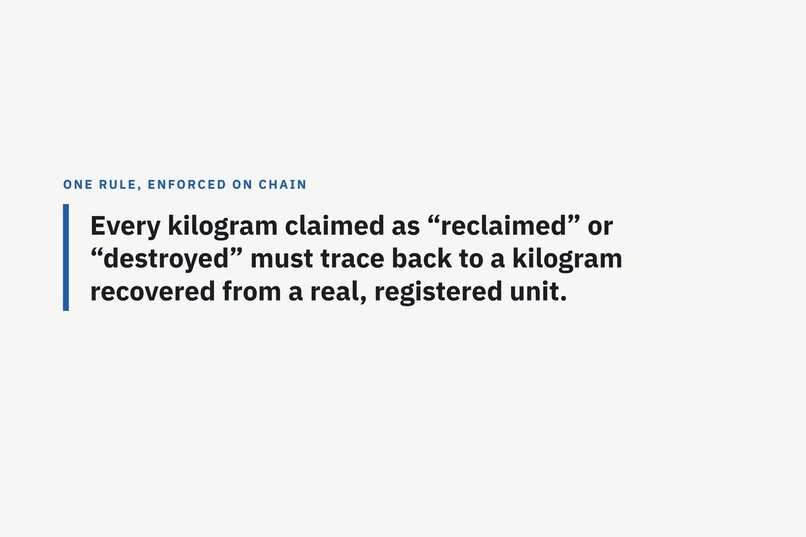
The one rule the contracts enforce: every reclaimed or destroyed kilogram traces back to a kilogram recovered from a registered unit.
-
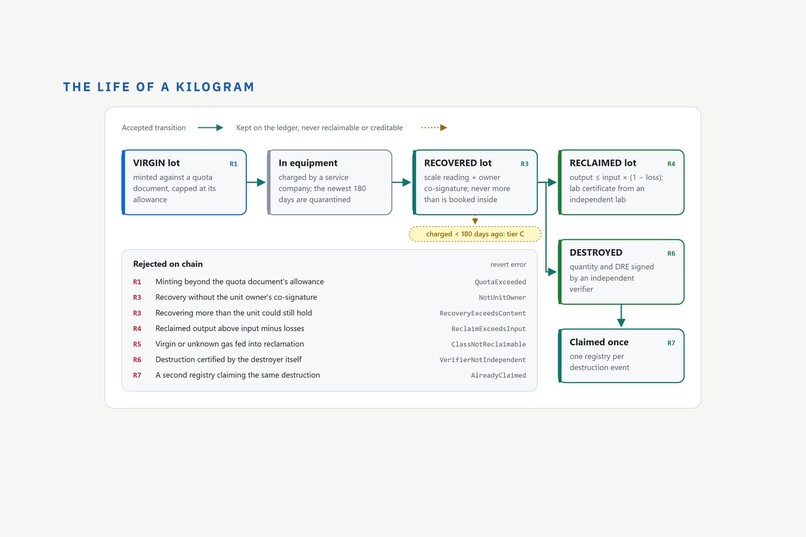
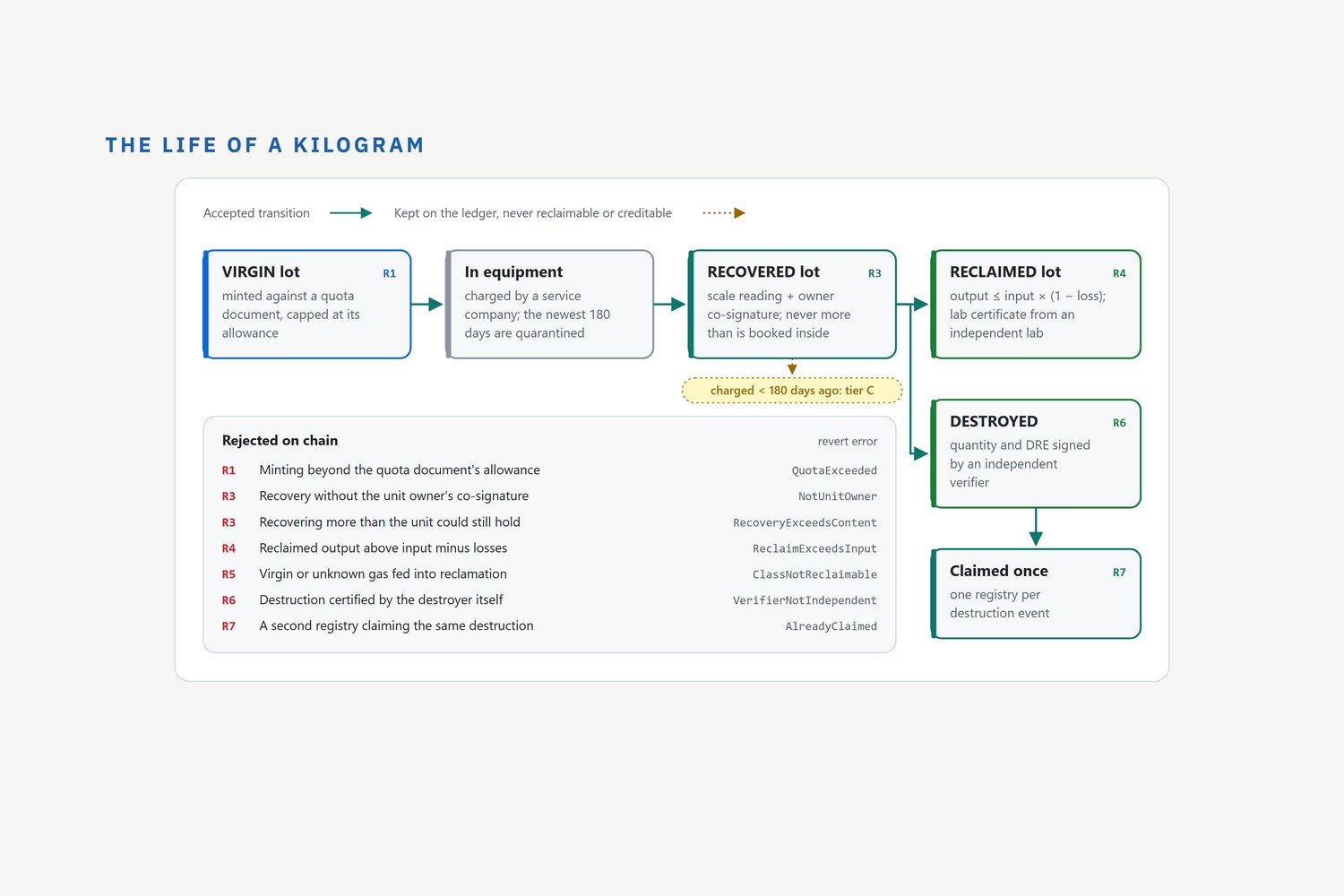
How a kilogram moves: charge, recovery with two signatures, reclamation, destruction with a verifier, and one registry claim.
-
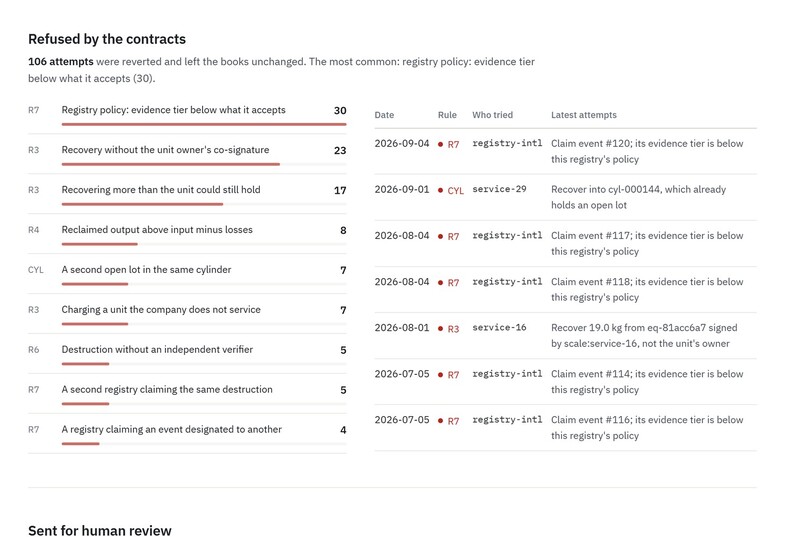
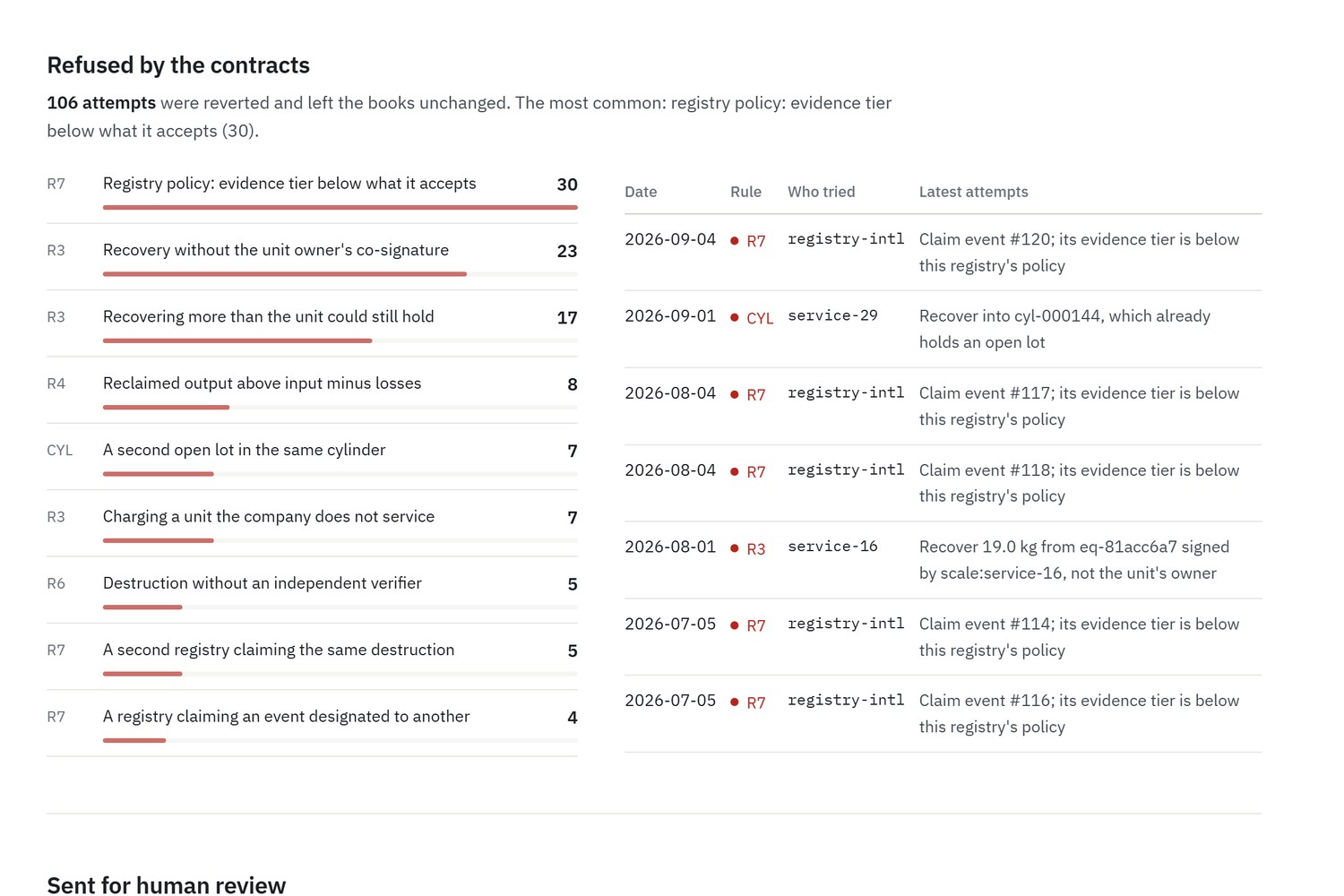
Regulator dashboard: 106 attempts the contracts refused in a simulated three-year market, by rule, with the latest attempts.
-
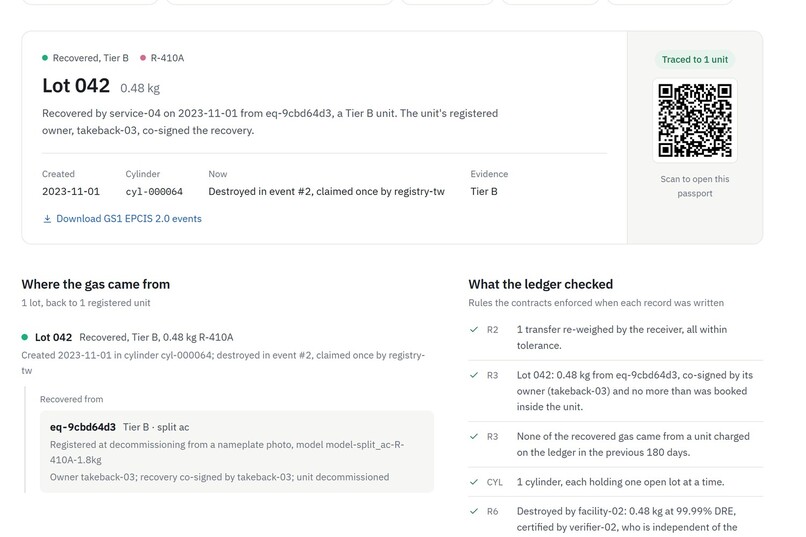
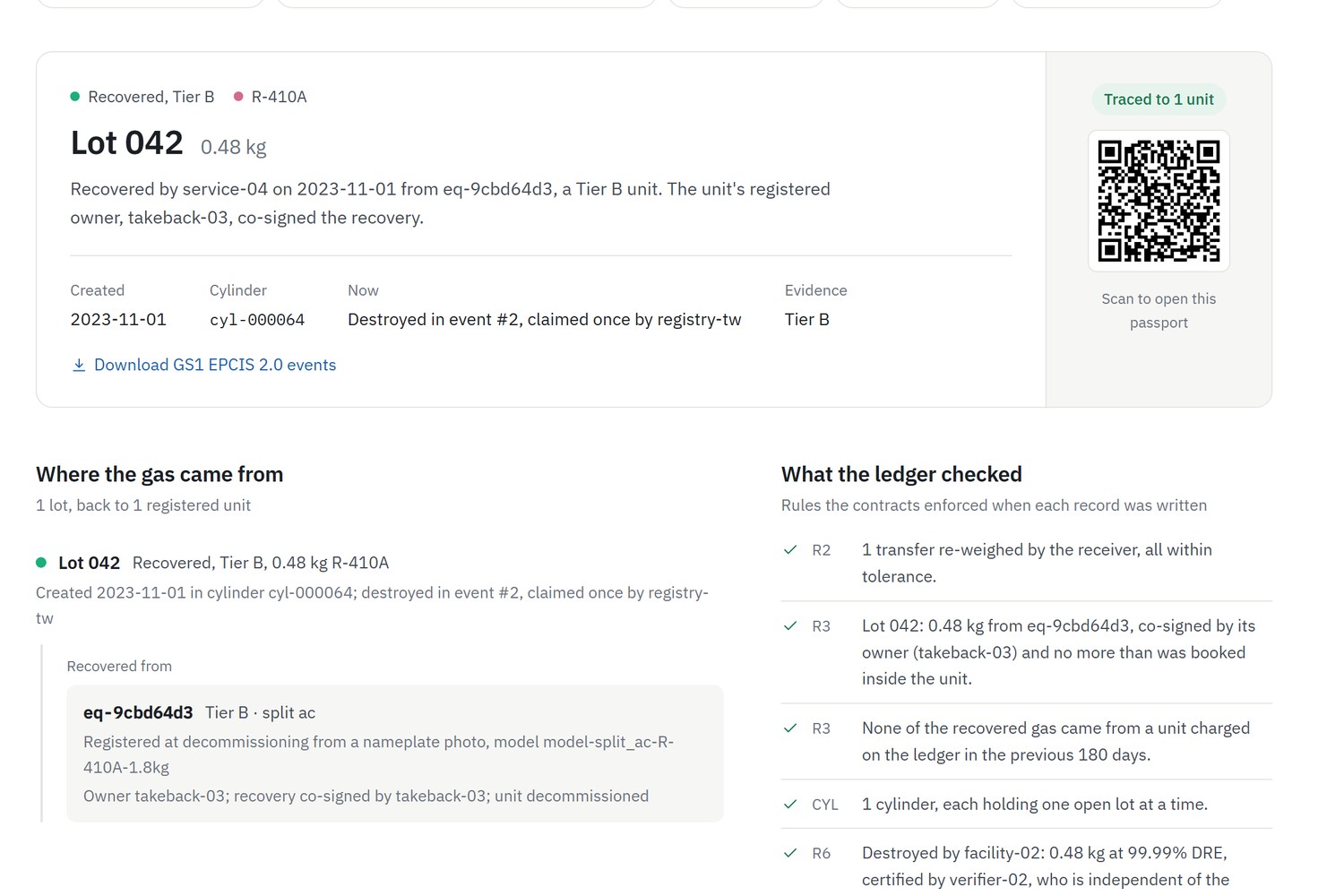
Provenance passport of lot 42: recovered, destroyed and credited once, traced to its unit, with the checks the ledger enforced.
Track 3: Sustainable Supply Chains (also Track 1: Carbon Markets & Emissions Transparency)
Kigali Balance is a shared ledger for HFC refrigerant. It lets a carbon registry, a buyer of reclaimed gas or a regulator check that a kilogram sold as "reclaimed" or credited as "destroyed" was really recovered from a registered unit, and was credited only once.
Try it in two minutes (no wallet, no install)
- Live: regulator dashboard, a simulated three-year market whose books balance to the gram. "Refused by the contracts" shows what was blocked and why.
- One lot: passport of lot 42: recovered, destroyed, credited once, accepted by every rule. In the simulation its unit never existed; the AI flagged both companies that signed for it.
- Video (3:14): youtu.be/UMIC3L5dO80, narrated by me, with subtitles.
- On chain: six contracts, verified on OP Sepolia. Two transactions to read: the designated registry claims destruction event 0, and a second registry tries the same event and is reverted with
AlreadyClaimed. - Code: github.com/ZhenYan1214/kigali-balance.
forge testruns 162 unit tests and 10 fuzzed invariants. - All market data is simulated, and every testnet key is mine (see Limits).
Inspiration
The problem. HFCs, which the Kigali Amendment phases down, are super-pollutants: one kilogram of R-404A warms the planet as much as 3.9 tonnes of CO₂ (GWP 3,922). Two things make a kilogram worth faking:
- Since 2025 the EU bans virgin high-GWP gas for servicing refrigeration, but reclaimed gas is exempt. In Q1 2025 reclaimed R-404A sold at 140% of the virgin price (EU price monitoring), and a reclaimer publicly warned of virgin gas sold as reclaimed. EU seizures of illegal HFCs rose from about 250 t in 2023 to about 670 t in 2024 (EIA, 2026).
- Destroyed refrigerant earns carbon credits. I audited 436 destruction and reclamation projects at ACR, Climate Action Reserve and Verra, behind 42.4 million destruction credits. Certificate-of-destruction identifiers are public for only 31% of them, and no registry publishes which container, and how many kilograms, a credit draws on.
Why it isn't solved. Quotas, technician logs, reclaimer reports and registry issuances are each checked inside their own system. Where two ledgers share a key (California's ARB and the registries), the public records match; between registries there is none, so "not credited elsewhere" rests on a declaration. I found no double counting. Nobody outside can check.
Why I built it. I started from a test, not a topic: a blockchain earns its place only when parties who don't trust each other share a conservation rule (one unit, one claim) and money rides on the record. Battery passports, CBAM tracing and recycled-content ledgers failed it, because regulation or existing tools already cover them. HFC refrigerant passed, and I found no Devpost or ETHGlobal project reconciling refrigerant kilograms.
What it does
One rule: every kilogram claimed as reclaimed or destroyed must trace back to a kilogram recovered from a real, registered unit, and each destruction can be claimed once.
- A unit is registered, and every charge books gas into it.
- A technician's scale signs each recovery, and the unit's owner co-signs. A recovery can never exceed what is booked inside the unit; gas charged in the last 180 days is quarantined.
- A reclaimer accepts only recovered lots. A lab certifies the output, which can never exceed the input minus losses.
- A facility destroys lots with an independent verifier's certificate and names the registry that may claim the event.
- That registry claims the event before issuing credits. Any second claim is refused.
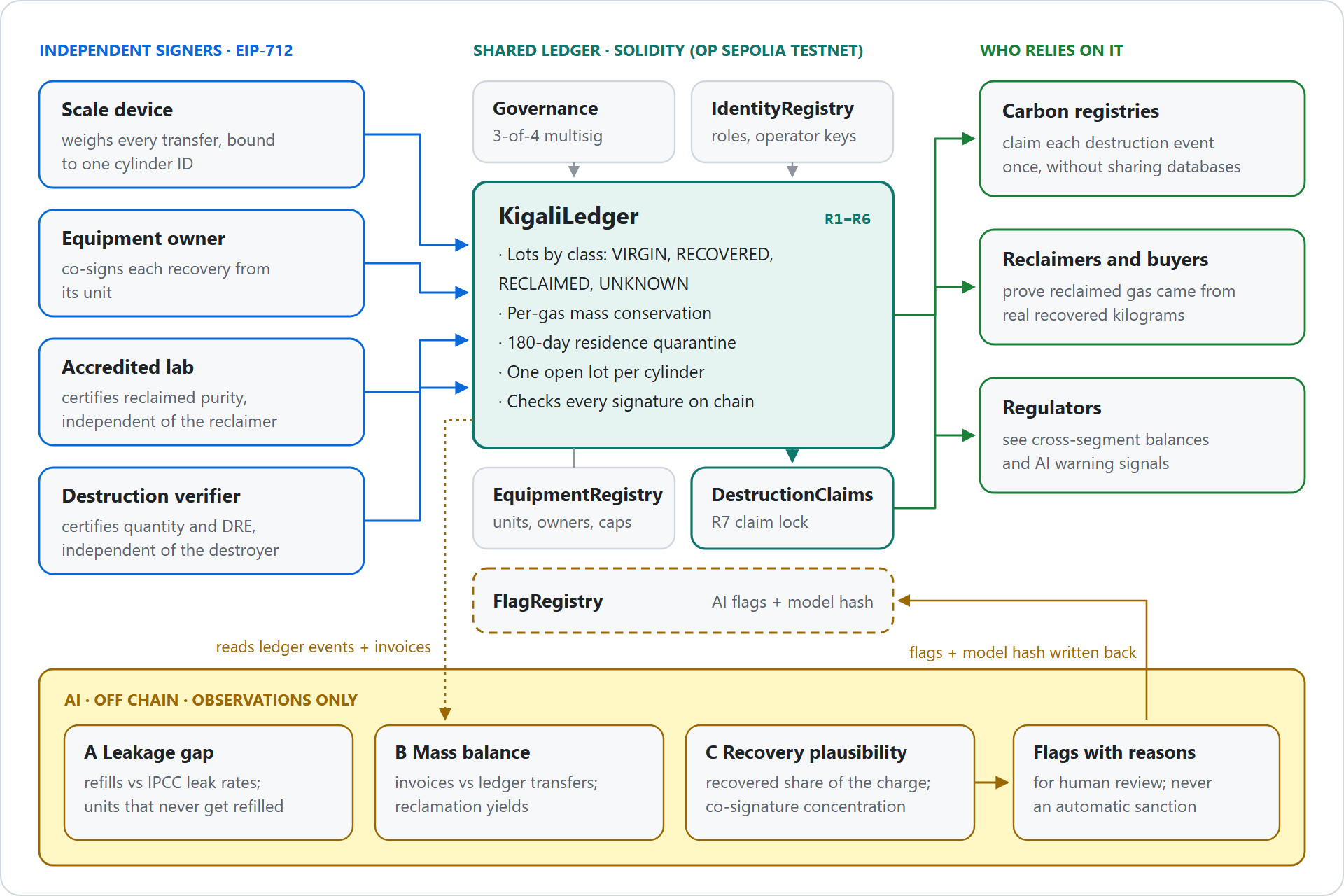
- Three AI modules flag what is allowed but implausible (leak gaps, mass-balance anomalies, implausible recoveries) with readable reasons. They never block anyone; a regulator decides.
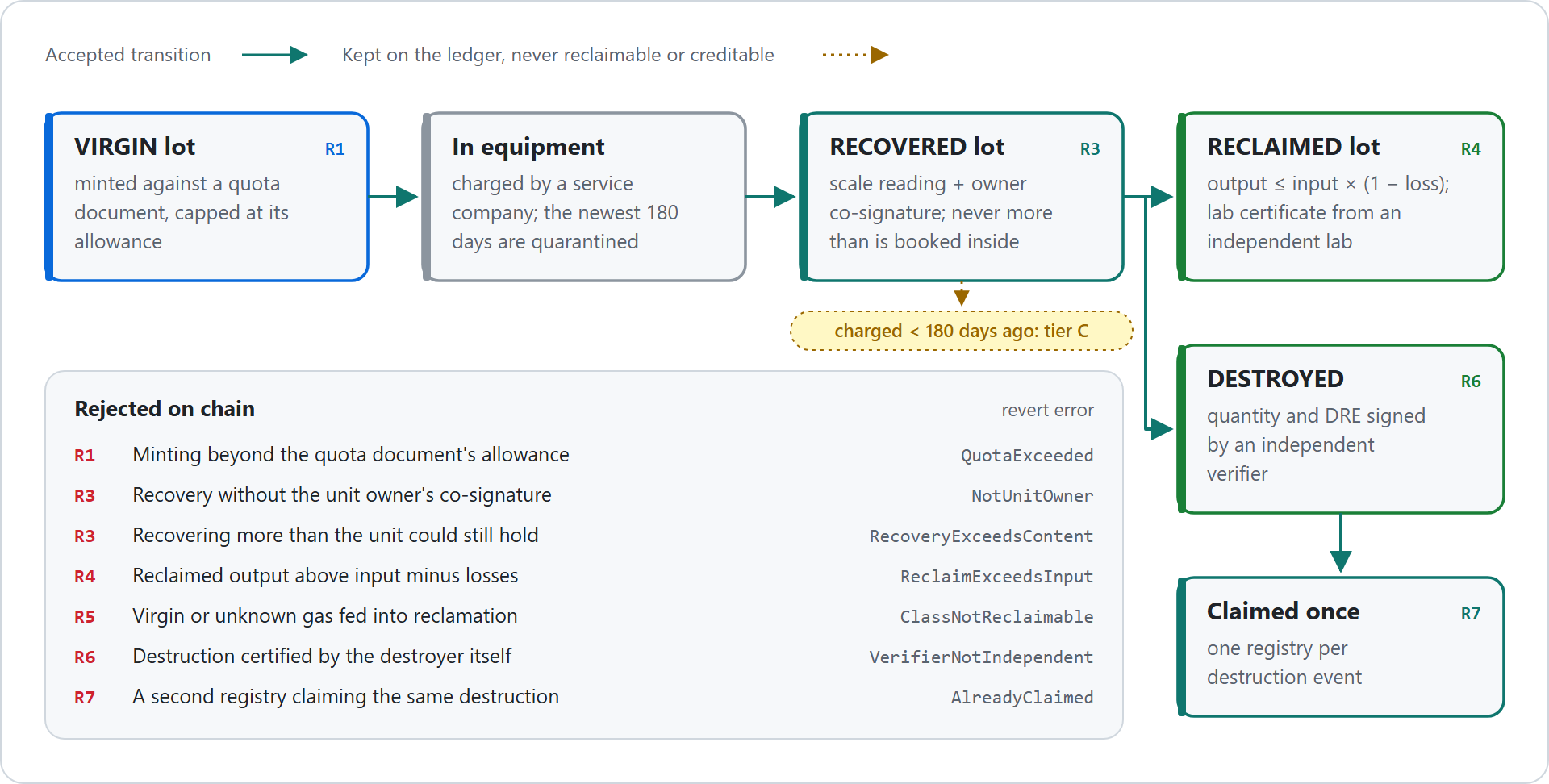
So virgin gas can't become "reclaimed" (a lot's provenance class never changes), a fake recovery needs two colluding signers and stays under the unit's booked content, and no destruction is credited twice, without registries sharing databases.
Users: carbon registries (claim before issuing), buyers of reclaimed gas such as supermarkets (scan a cylinder's passport) and regulators (dashboard and AI review queue). Technicians and owners only sign.
Guarantees: no function, governance included, can edit or delete a lot, and nothing is upgradeable. A 3-of-4 multisig grants roles, binds scales and tunes parameters within hard-coded floors.
Scaling and adoption: throughput is not the limit (a cylinder's full path is about 1.0–1.5 million gas); onboarding signers is: scales, labs and verifiers. Every lot already exports as GS1 EPCIS 2.0, so existing systems can publish events instead of people re-entering them; importing from national systems is roadmap work.
How I built it
- Contracts: six Solidity contracts (Foundry) that verify EIP-712 signatures on chain, deployed on OP Sepolia on 2026-10-21.
- Simulator and differential test: a deterministic three-year market with twelve kinds of injected fraud. All 7,359 events are replayed against the real contracts, and every decision, error and gas total matches a separately written rule mirror.
- AI: Python (scikit-learn, SHAP) that reads only what a regulator could see.
- CI: every push rebuilds everything on a clean machine and must reproduce every committed file byte for byte. Lots export as GS1 EPCIS 2.0.
Why a blockchain, and why OP:
- No operator spans all the parties: several registries, competing reclaimers, gas shipped abroad for destruction. A central database would need an operator every registry trusts; inside one country, a regulator's database is enough.
- Anyone can recompute the books, and the passport reads live lots straight from the chain instead of trusting an operator's export.
- The contract checks every signature, so a forged scale reading is rejected by code.
- OP is a cost choice: a cylinder's full path costs under one US cent at OP Mainnet prices (2026-10-17). Any EVM chain could run it.
Challenges: what I got wrong
- A per-recovery cap could be bypassed by splitting one recovery into several. My own laundering model caught it; capping by booked content removed 88% of the room colluders had.
- An AI-assisted red-team pass (AI agents, not human auditors) found a High-severity hole: undocumented gas could be laundered into creditable gas. A second pass got around my fix. Both are fixed and are now regression tests.
- The forensic pass cut my climate estimate by about three quarters and caught a wrong headline in my audit. I published the corrections.
Results
- Over three simulated years, the AI catches every naive fraudster and flags under 1% of honest companies. Adaptive fraudsters mostly slip through, but only by staying small (4 kg of fake recoveries instead of 136 kg).
- Climate impact: Kigali Balance recovers no gas and claims no credits. For a Japan-sized market, my model puts the effect of verification at a median 0.06 MtCO₂e a year (5th–95th percentile 0.01–0.18), counting only destroyed gas and assuming verification raises recovery by 0–5 percentage points.
Limits
- All market data is simulated, and the AI has only been scored on simulated runs.
- Every testnet key derives from my deployer key: I hold all four governance seats and every demo role. It shows the mechanism, not independence.
- No human audit and no user testing yet. AI flags are written on chain only in my local replay chain.
What's next
- Passport tests with a reclaimer, a registry analyst and Türkiye's ozone unit: can each answer "where did this kilogram come from?"
- One real destruction project end to end, with confidential amounts.
- A pilot that measures how much verifiability raises recovery, and a human audit before real money depends on the contracts.
Built With
- eip-712
- ethereum
- foundry
- github-actions
- html
- javascript
- node.js
- optimism
- pandas
- python
- scikit-learn
- shap
- slither
- solidity
- viem

Log in or sign up for Devpost to join the conversation.