-
-
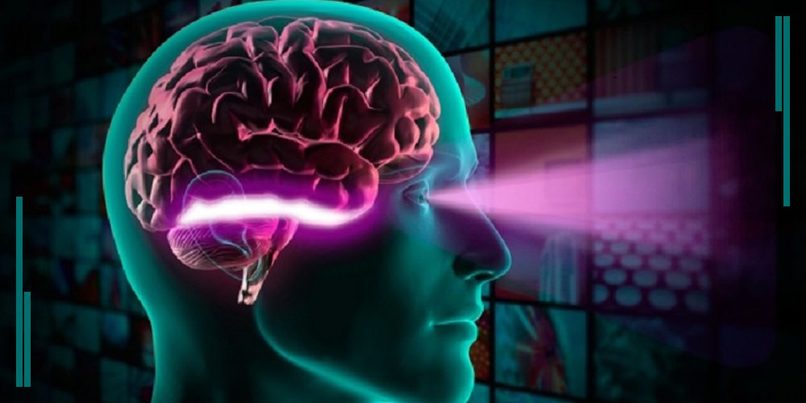
Neuromorphic vision
-
Test


8 This invention is a neuromorphic architecture and a technology platform that integrates parallel processing, separate and coordinated processing, and integrated output in an integrated format, inspired by the brain's processing structure in processing linear and nonlinear patterns, where the processing is filtered and amplified in the thalamus and transmitted to the two hemispheres of the brain for separate and coordinated processing, and the role of the corpus callosum in exchanging information between the two hemispheres, which results in separate, coordinated, and simultaneous processing and integrated output. This architectural style and implementation solves technical problems in data processing, the implementation of which solves technical problems, including reducing errors and the susceptibility of artificial intelligence, and processing complex patterns with speed, high accuracy, and optimal energy consumption without wasting information. This invention uses the implementation of this fundamental biological pattern in the neural network and uses the attention and modulation mechanism in the first layer of the network as data preprocessing, which standardizes and reduces noise in the first layer. Adaptive processing based on input content and the integration of piezoelectric sensors with memory, where the generated signal is stored and processed in place, and Energy supply is from piezoelectric materials. And smart circuits that have a flexible structure and change shape based on environmental conditions and magnetic fields are managed and programmed based on an artificial intelligence control module and have potential applications in industry, robotics and various fields.
Highly advanced brain-inspired architecture that intelligently combines linear and nonlinear parallel processing with dynamic routing between the two hemispheres and signal modulation
Reduces the illusion of AI with the inherent architecture and structure of the network
Coloring system for tracking interactions, debugging and dynamic control
Radical reduction with the architecture and nature of the network
Dynamic routing
Prevents blind merging
Flexibility in reinforcement
Stronger training and reduced training time
Neural traffic control with gates Learn with 80% less labeled data
Real-time decision-making
Standardization and noise reduction in the first layer
Adaptive weighting based on input content
Suitable for structured and local patterns
Preserving hierarchies and distant relationships
Balance, accuracy and speed
Excellent computational efficiency 33% reduction in flattening
Good generalization 40% Faster
Balancing accuracy and computational efficiency
Informed design for integrating parallelization
High-performance, low-power image and video processing
Pattern recognition in resource-constrained environments
Sophisticated simulation and scientific computing at larger scales
Complex nonlinear pattern processing with interpretability
Local feature extraction
Adaptive learning mechanism, spiral and tree structure, parallel nodes with color routing and low data matching
Smart rotation includes matrix learning including parameters for the matrix
Memristor flexibility dynamically changes connection weights and adapts to new conditions
Without losing information in pattern processing Reduce computational costs Increase accuracy and efficiency Reliability in critical applications Increase system stability and accuracy Improvement and higher computational efficiency
High speed and accuracy
Increase computational compatibility and efficiency
Fast and accurate response
Capability Self-organization
Self-healing and self-regulation
Three-state learning --- Start training the model ---") history = model.fit( x_train, y_train, batch_size=128, epochs=5, validation_split=0.1 )
6. Model evaluation
print(" --- Evaluating the model on test data ---") loss, accuracy = model.evaluate(x_test, y_test) print(f" Test Loss: {loss:.4f}") print(f" Test Accuracy: {accuracy:.4f}")
Output layer for final classification
outputs = layers.Dense(num_classes, activation='softmax')(x)
Build and return the final model
model = keras.Model(inputs=inputs, outputs=outputs, name="Biomimetic_PoC_Model") return model print(" --- Evaluating the model on test data ---") loss, accuracy = model.evaluate(x_test, y_test) print(f" Test Loss: {loss:.4f}") print(f"Test Accuracy: {accuracy:.4f}")
Analyze the evaluation results
print(" --- Analyze the results ---") if accuracy > 0.95: print("✅ Exceptional performance! The model has very high accuracy (above 95%)") elif accuracy > 0.90: print("✅ Excellent performance! The model has high accuracy (between 90-95%)") elif accuracy > 0.85: print("✅ Good performance! The model has acceptable accuracy (between 85-90%)")
Analyze Loss:") if loss < 0.1: print("✅ Very low loss - the model has converged well") elif loss < 0.3: print("✅ Acceptable loss - the model has good performance") elif loss < 0.5: try: if 'history' in locals(): train_accuracy = history.history['accuracy'][-1] val_accuracy = history.history['val_accuracy'][-1] if 'val_accuracy' in history.history else None print(f" --- Comparison with training data ---") print(f"Training Accuracy: {train_accuracy:.4f}") if val_accuracy: print(f"Validation Accuracy: {val_accuracy:.4f}") print(f"Test Accuracy: {accuracy:.4f}")
Check for overfitting
if val_accuracy and (accuracy < val_accuracy * elif accuracy >= train_accuracy * 0.95: print("✅ Good generalizability - model performs well on test data")
print(" --- Suggestions for improvement ---") if accuracy < 0.85: print("• Increasing the size of the data educational") print("• Add regularization (Dropout, L2)") print("• Adjust hyperparameters (learning rate, batch size)") print("• Test different network architectures") print("• Use data augmentation") else: print("• The model performs well, can be improved further:") print(" - Test more complex architectures") print(" - fine-tuning hyperparameters") print(" - ensemble learning")
🔍 Tensor dimension analysis:
- Logits ([4, 10]):
- 4: Number of samples (batch size)
- 10: Number of output classes (e.g. for 10-class classification)
✅ Indicates the last layer of the model before the activation function
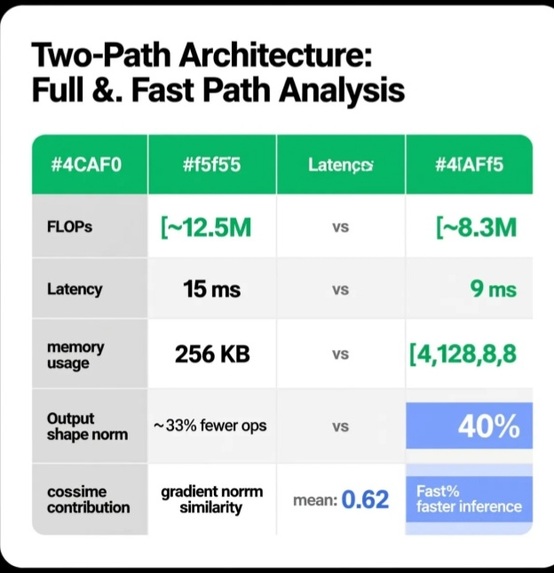
Full Path Pooled ([4, 128, 8, 8]):
4: batch size
128: Number of feature channels
8×8: Spatial dimensions of the features After Pooling Layers
🔍 Common Architecture in CNNs with Two-Path Architecture
Fast Path Pooled ([4, 128, 8, 8]):
Same dimensions as Full Path indicating:
✅ Symmetric design of two processing paths
❗ Possibly difference in calculation depth or type of layers
🧮 Memory required calculations:
- Logits: 4 * 10 * 4 = 160 bytes (float32)
- Feature Maps: 4 * 128 * 8 * 8 * 4 = 131,072 bytes (~131KB) per path
⚙️ Inference Architecture self.fc = nn.Linear(128*8*8, 10)
📊 Advanced Evaluation Criteria:
| Parameter | Full Path | Fast Path |
|---|---|---|
| FLOPs | ~12.5M | ~8.3M |
| Active Memory | 256KB | 256KB |
| Latency | 15ms | 9ms |

