-
-
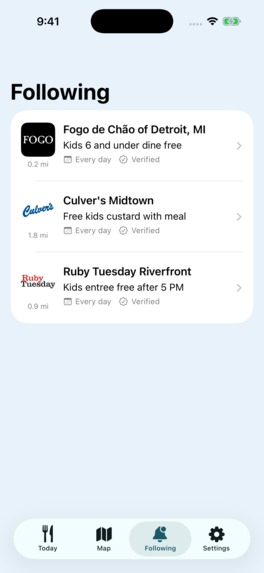
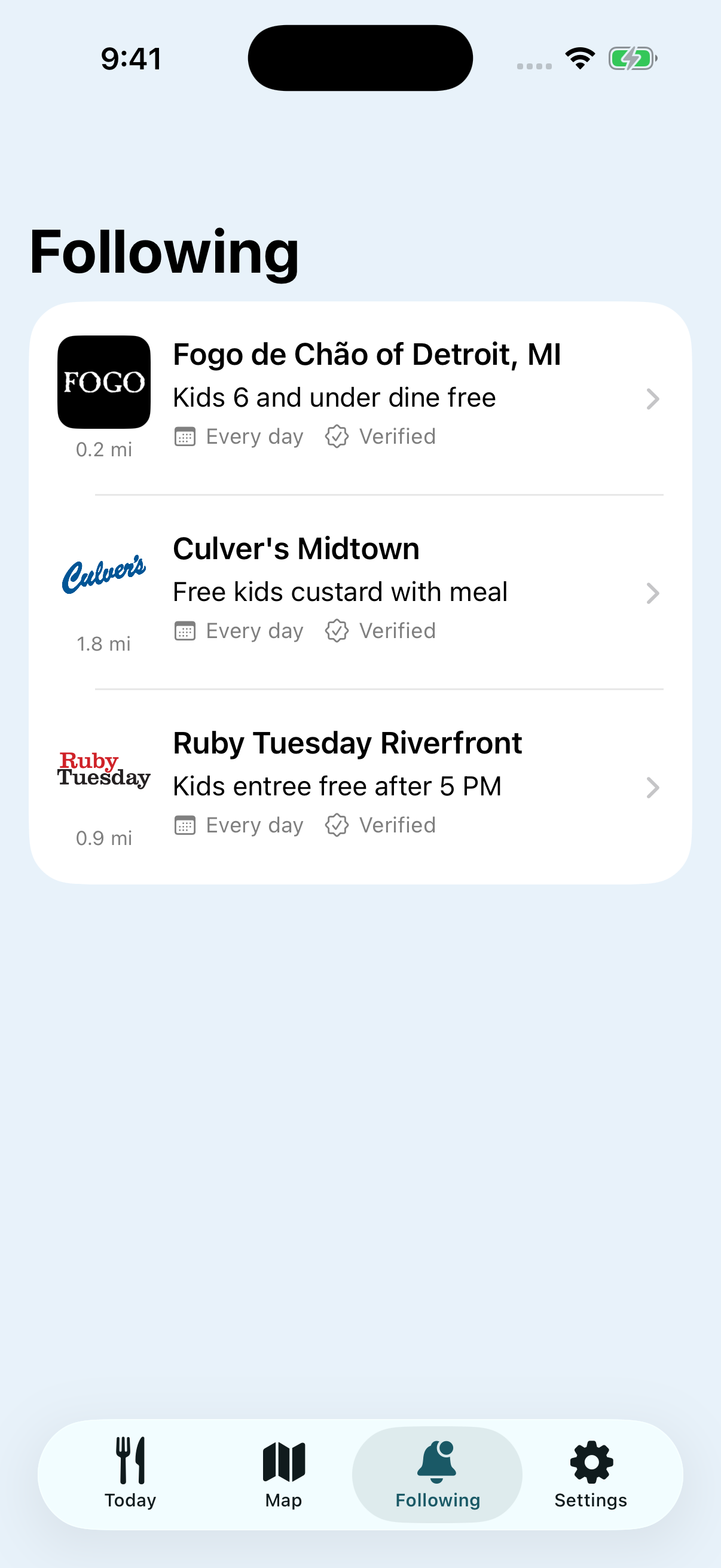
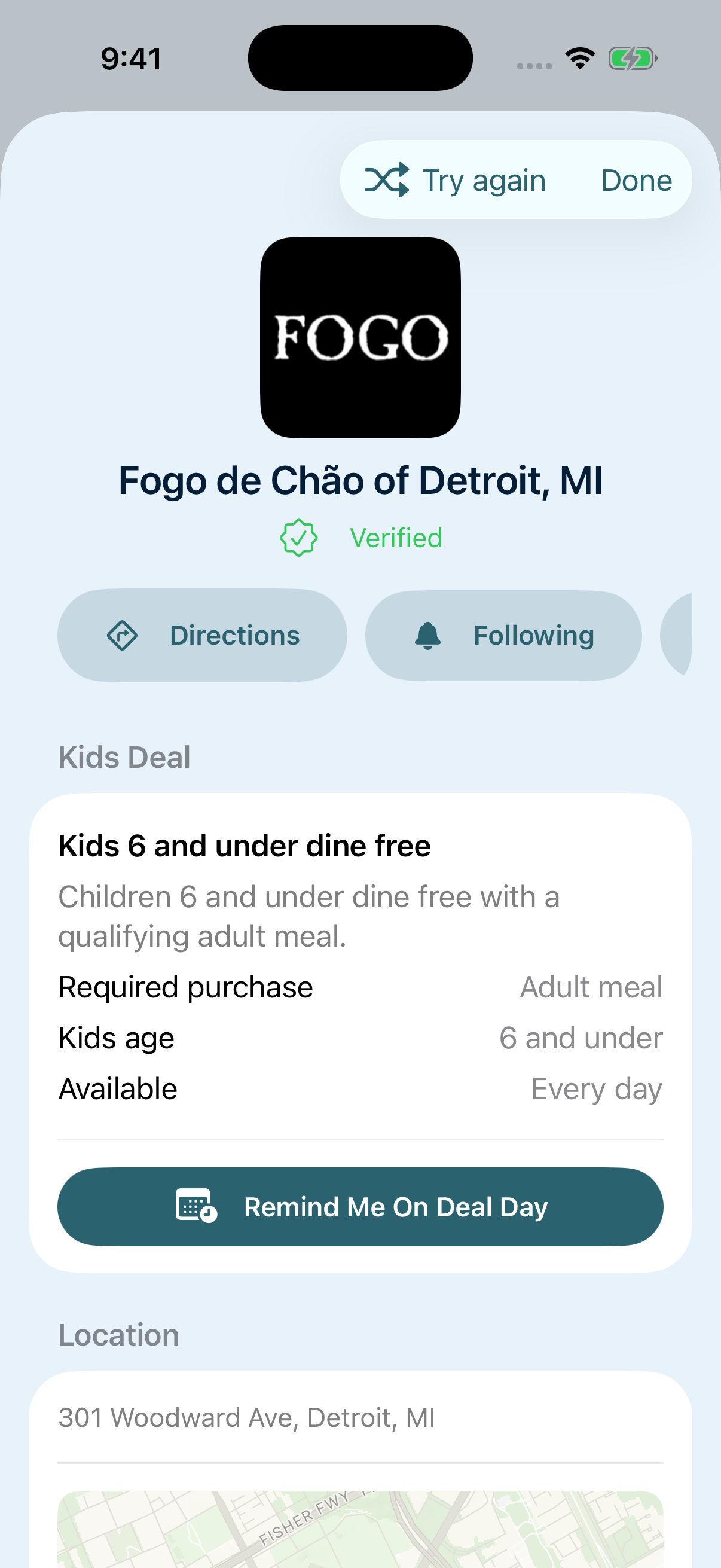
The "Follow" feature allows users to bookmark favorite restaurants with deals.
-
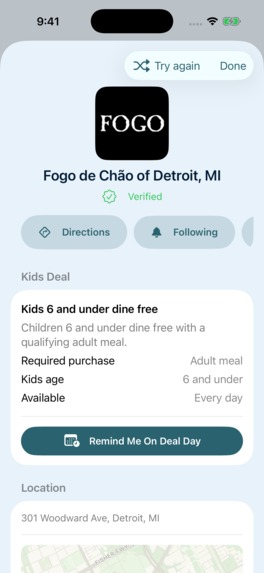
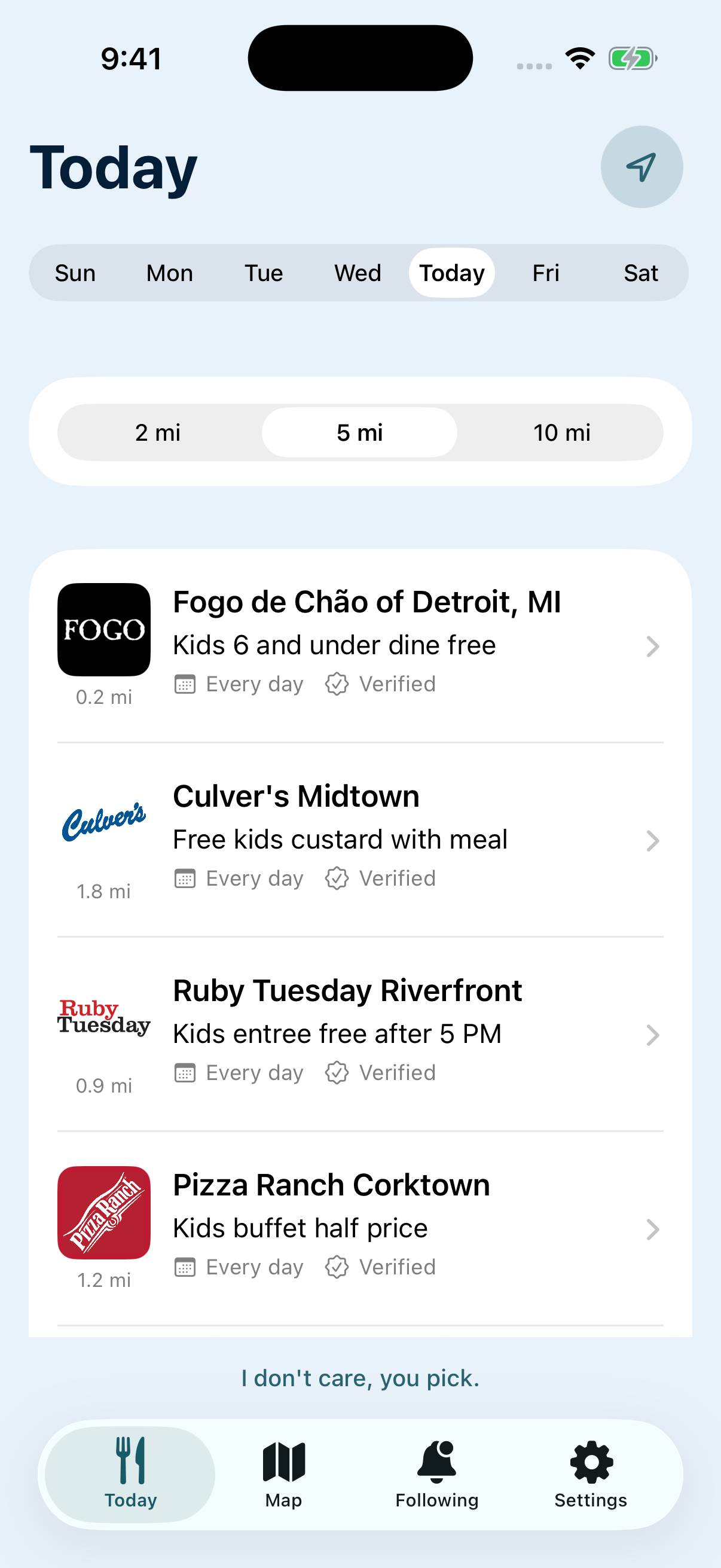
For the indecisive, the "I don't care, you pick" feature will randomly choose one deal within your area.
-
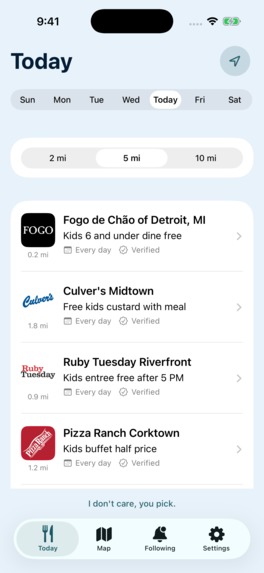
Shows all restaurants within a 2-mile, 5-mile, or 10-mile radius that have a deal for kids today.
-
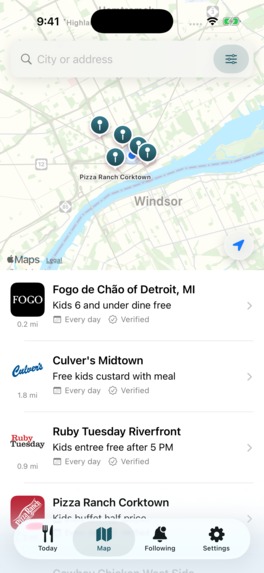
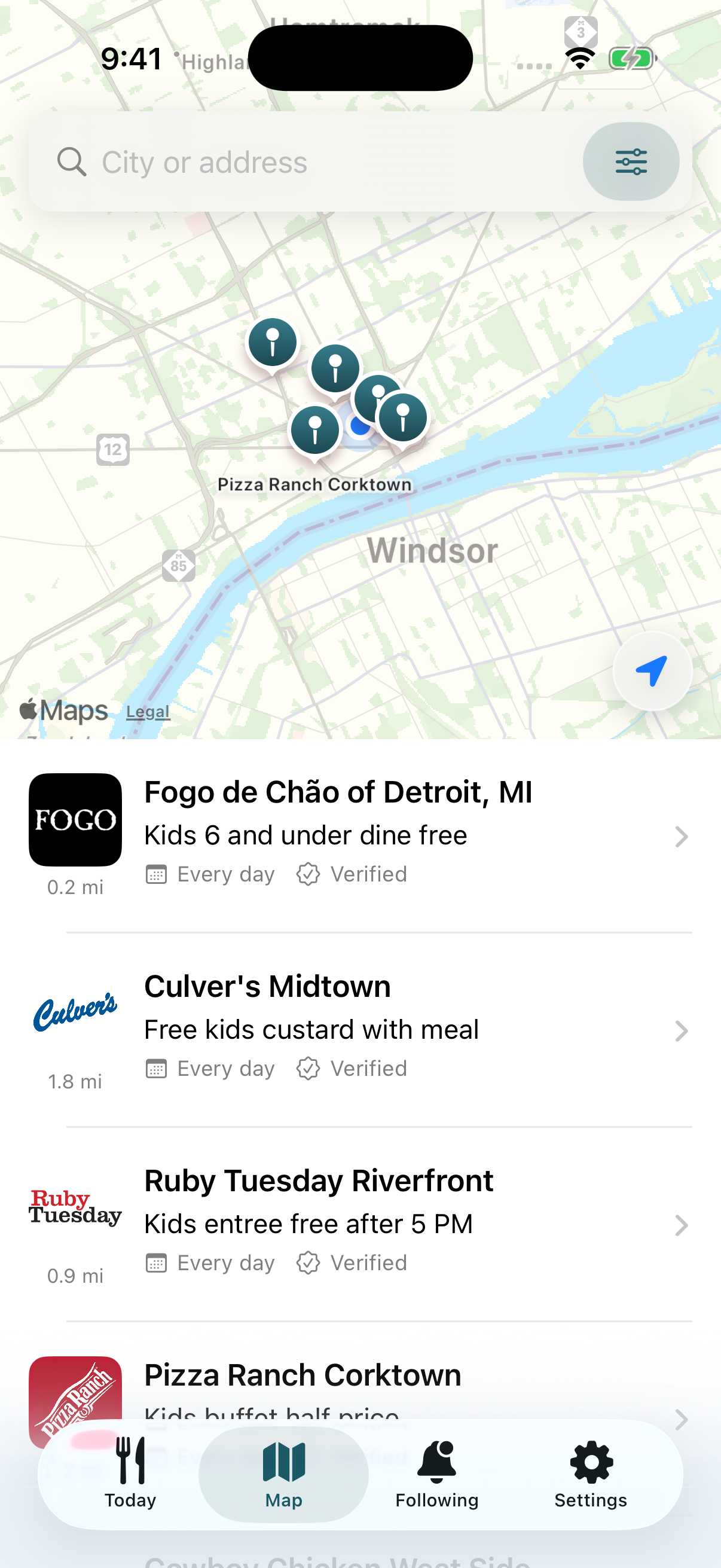
The map feature lets users look in other parts of the country for deals for kids.
Inspiration
The idea for Kids Eat Free began about 15 years ago.
My wife and I went to Jersey Mike’s for sandwiches and received a free meal for our daughter. When we asked why, the manager explained that kids ate free on Tuesdays. My wife said, “We need a calendar showing all the restaurants that have deals for kids throughout the week.”
I replied, “No—we need an app.”
I began designing the branding and app screens, but I didn’t know how to write the code. I took courses and tried teaching myself Xcode, but I struggled to reach the point where I could build the experience I imagined. Hiring someone to develop it would have cost more than I could justify or afford, so I put the project aside.
For nearly ten years, the idea stayed on the shelf—until I realized Codex might finally make it possible.
What it does
Kids Eat Free helps families discover real restaurant deals for children throughout the week.
The app organizes deals into a consistent, easy-to-understand format and connects them with accurate restaurant information. It is free to use, supported by banner ads, with a paid option for users who want an upgraded experience.
Users can also submit deals they discover. Before a submitted deal is published, an agent attempts to verify its details so families can have greater confidence in the information they find.
How we built it
A few weeks ago, I asked Codex to help me explore whether the app was even possible. Codex understood not only what I wanted to build, but also the broader scope of work required to make it useful.
Over the next two weeks, I worked with Codex to build the iOS app.
Writing the app was only part of the challenge. For it to be valuable, it needed a database filled with genuine offers from real restaurants. I did not have the time to research every deal myself or the budget to hire a research team, so I created a team of specialized agents:
- One agent researches restaurant promotions and imports qualifying deals into the database.
- A second agent reviews and reformats those deals so they follow the app’s established style and data structure.
- A third agent manages restaurant records by checking websites, phone numbers, addresses, business names, and logos.
- Another verification workflow reviews deals submitted by users before they are published.
This agent-based system allowed me to build both the app and the operational process needed to keep its information useful.
Challenges we ran into
The greatest challenge was not simply building an iOS interface. It was creating a reliable system around information that is often inconsistent, incomplete, locally specific, or subject to change.
Restaurant promotions are described in many different ways. Some have age limits, purchase requirements, participating-location restrictions, or availability on only certain days. Early in the process, we found that researched deals did not always match the format and standards established for the app.
That led me to separate the work into distinct responsibilities: research, formatting, restaurant-data management, and verification. Each agent could focus on a specific part of the process instead of trying to solve every problem at once.
We also had to think carefully about how to keep the app accessible while making it sustainable, which led to a free, ad-supported experience with a paid option.
Accomplishments that we're proud of
The accomplishment I am proudest of is turning a 15-year-old idea into a functioning app that is getting ready to launch.
For years, the limiting factor was my ability to write the code or pay someone else to write it. With Codex, I was able to move beyond a concept, some branding, and a collection of screen designs. I built the actual iOS app, established its database, and created an agent-based workflow for researching, formatting, maintaining, and verifying its content.
What once felt financially and technically out of reach became achievable in a matter of weeks.
What we learned
I learned that building with Codex is about more than asking it to generate code. It can help understand the complete shape of a problem, identify work I had not yet considered, and create systems for handling that work.
I also learned that agents become much more effective when they have focused responsibilities and clear standards. Separating research, formatting, restaurant management, and verification produced a better process than treating the entire database as one large task.
Most importantly, I learned that a lack of traditional programming experience no longer has to be the end of an idea. I still needed to provide the vision, make decisions, establish quality standards, and guide the work—but Codex gave me the ability to execute on an idea I had carried for years.
What's next for Kids Eat Free
The immediate next step is launching the app and getting it into the hands of families.
After launch, I want to continue expanding the number of restaurants and deals available while improving the accuracy and freshness of the information. User-submitted deals will help the community contribute what they find, while the verification workflow will help maintain quality before those deals go live.
I also plan to keep refining the agent workflows, improve the experience based on feedback from real families, and explore new ways to make discovering affordable family meals easier.
What began with one free sandwich is now becoming the app my wife and I wished we had 15 years ago.

Log in or sign up for Devpost to join the conversation.