-
-
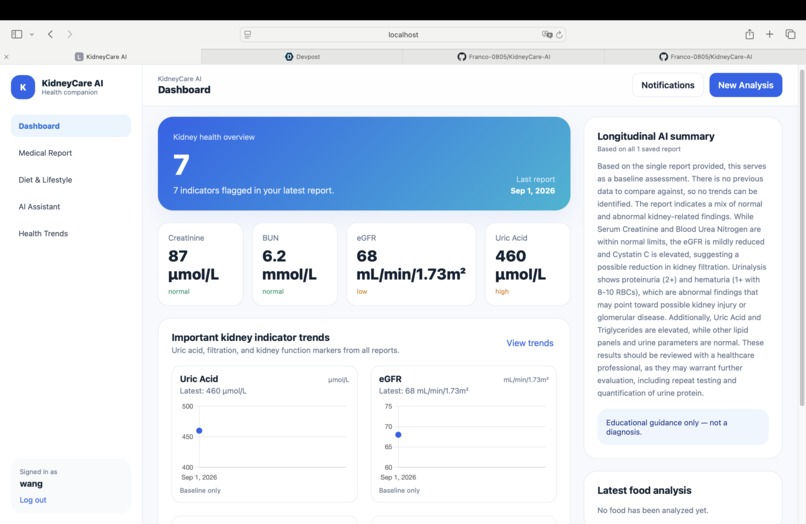
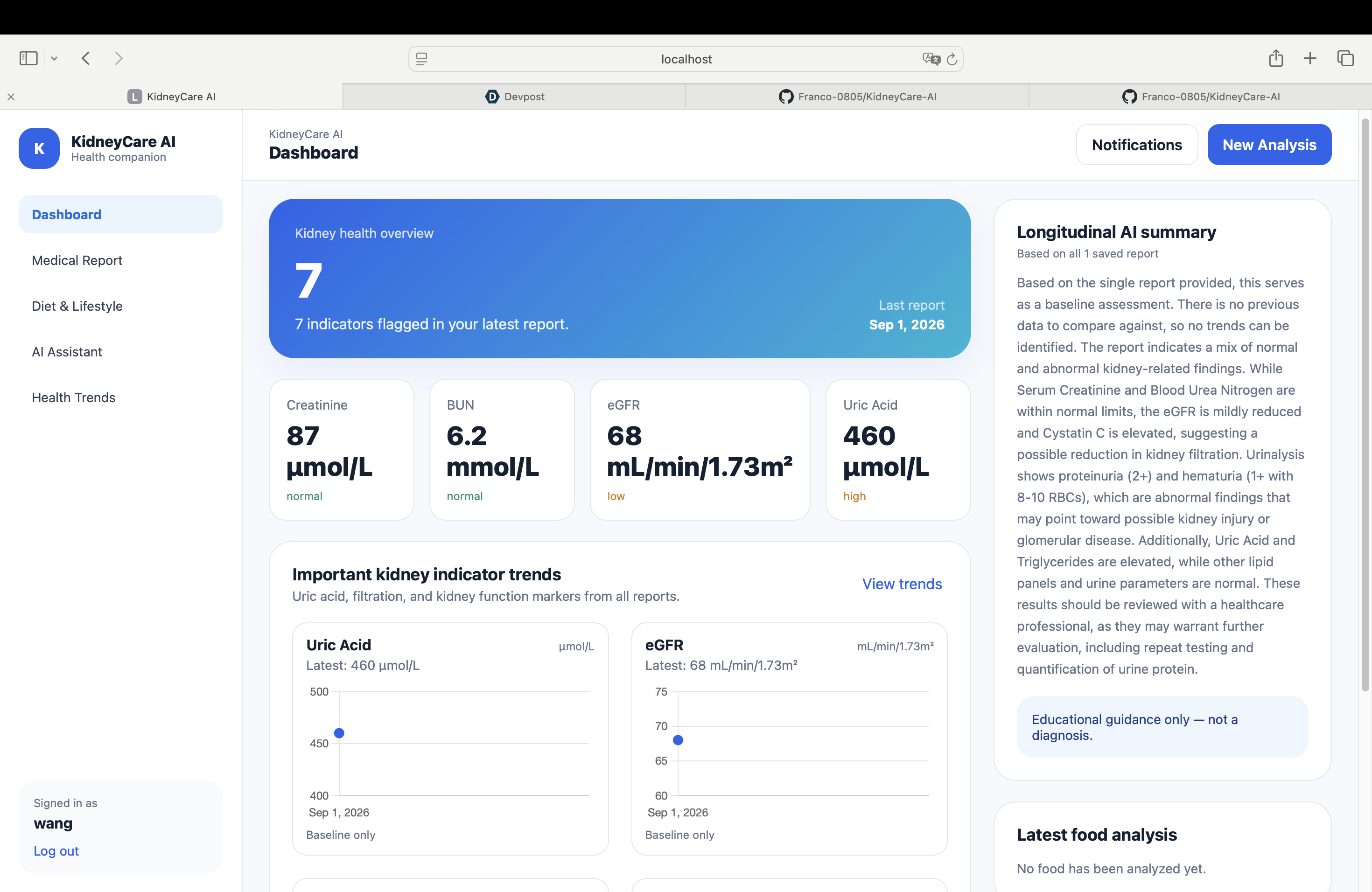
Dashboard — Displays key health insights, recent reports, and activities in one place.
-
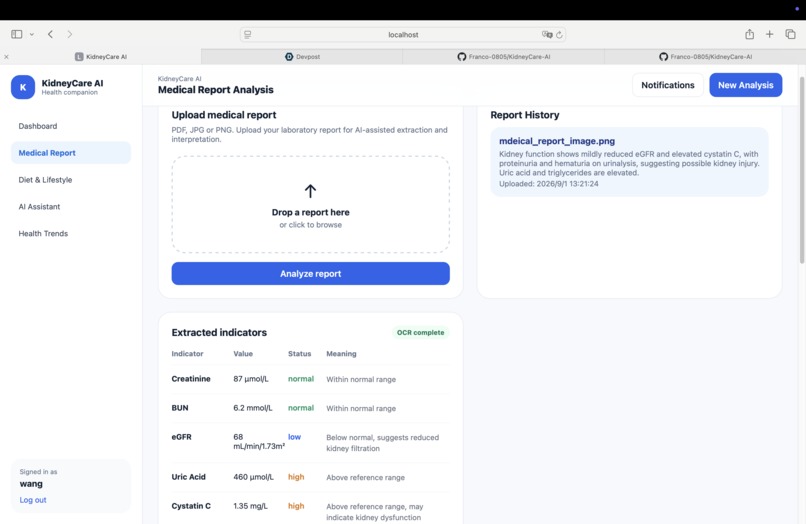
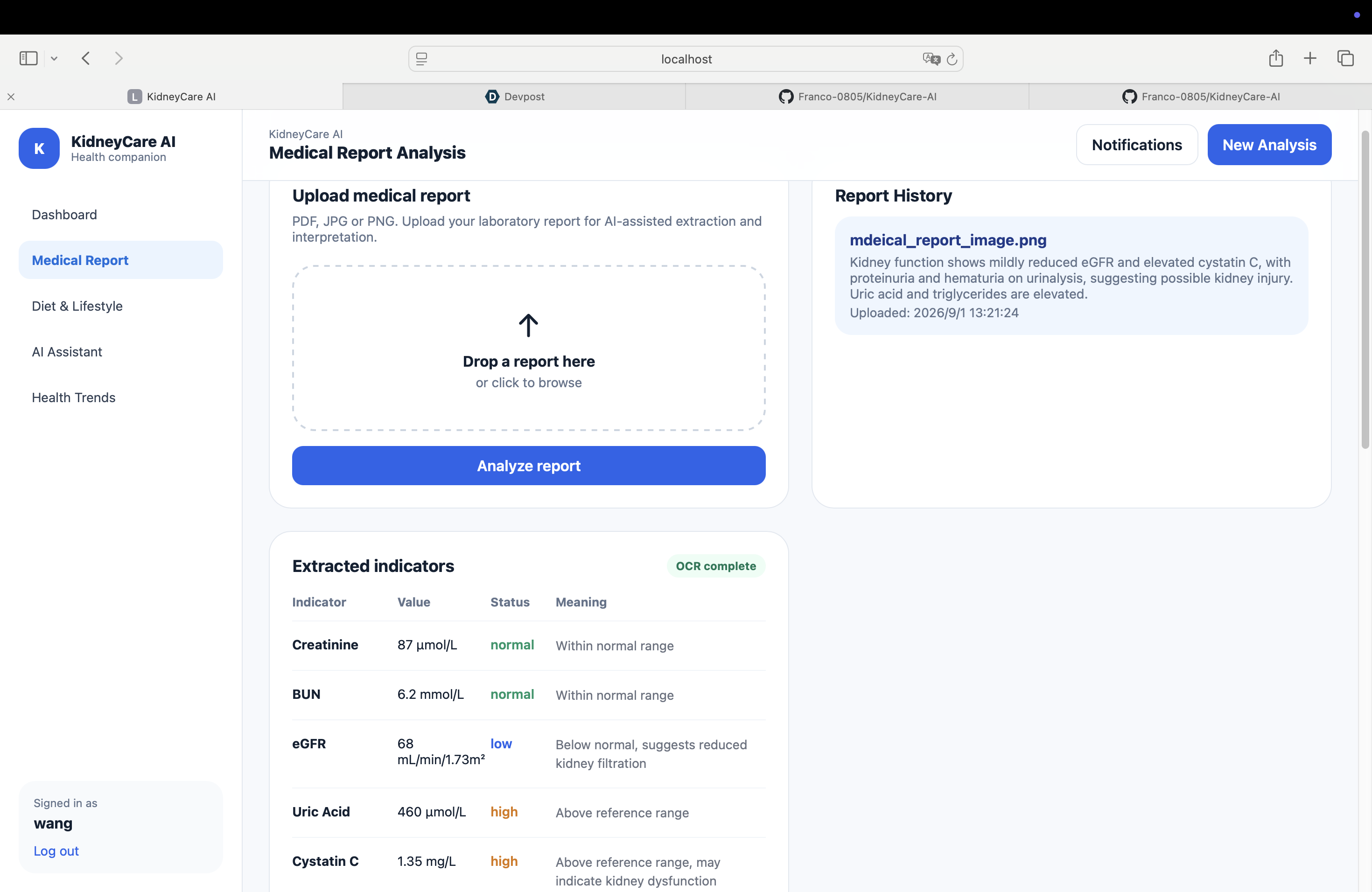
Medical Report Analysis — Extracts and explains key kidney health indicators from uploaded reports.
-
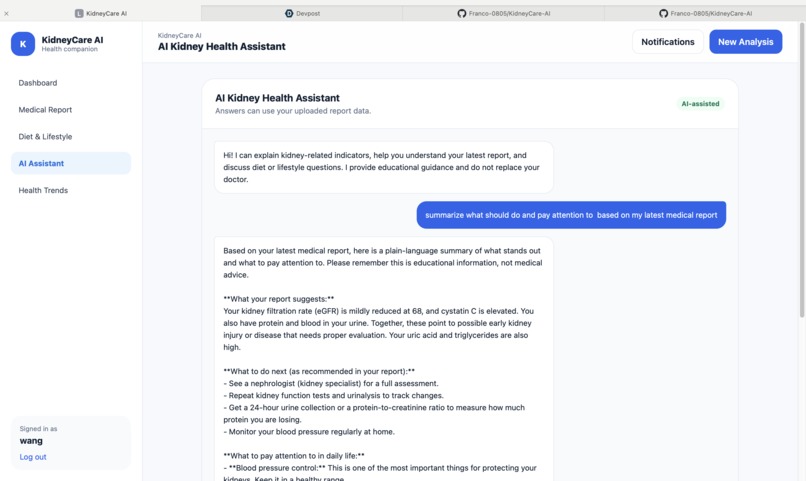
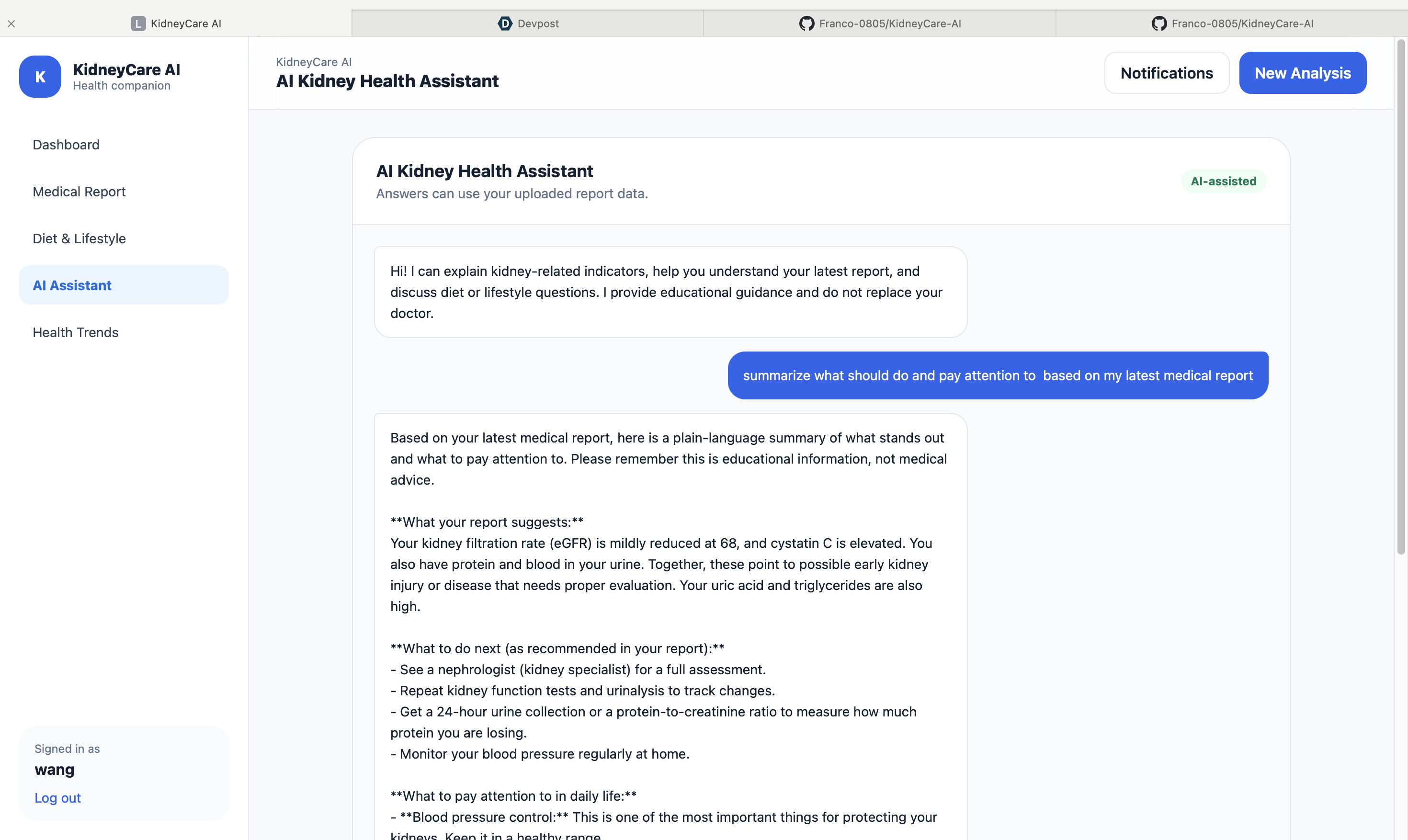
Provides context-aware answers about reports, diet, and kidney health.
-
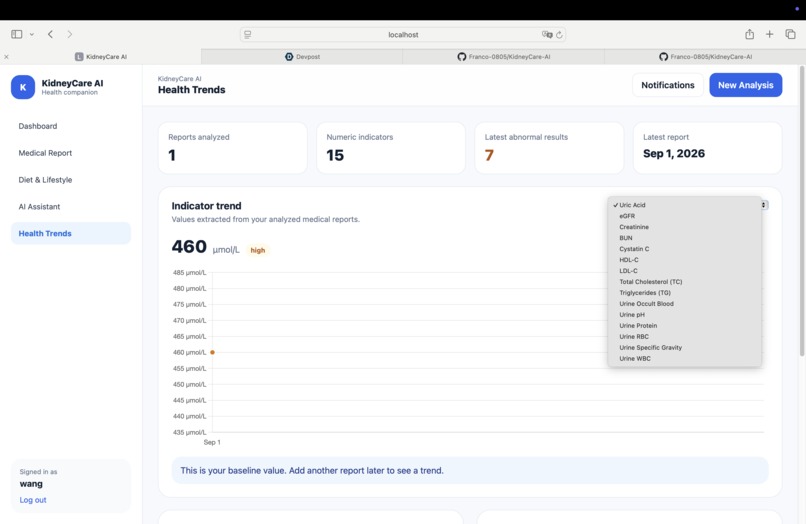
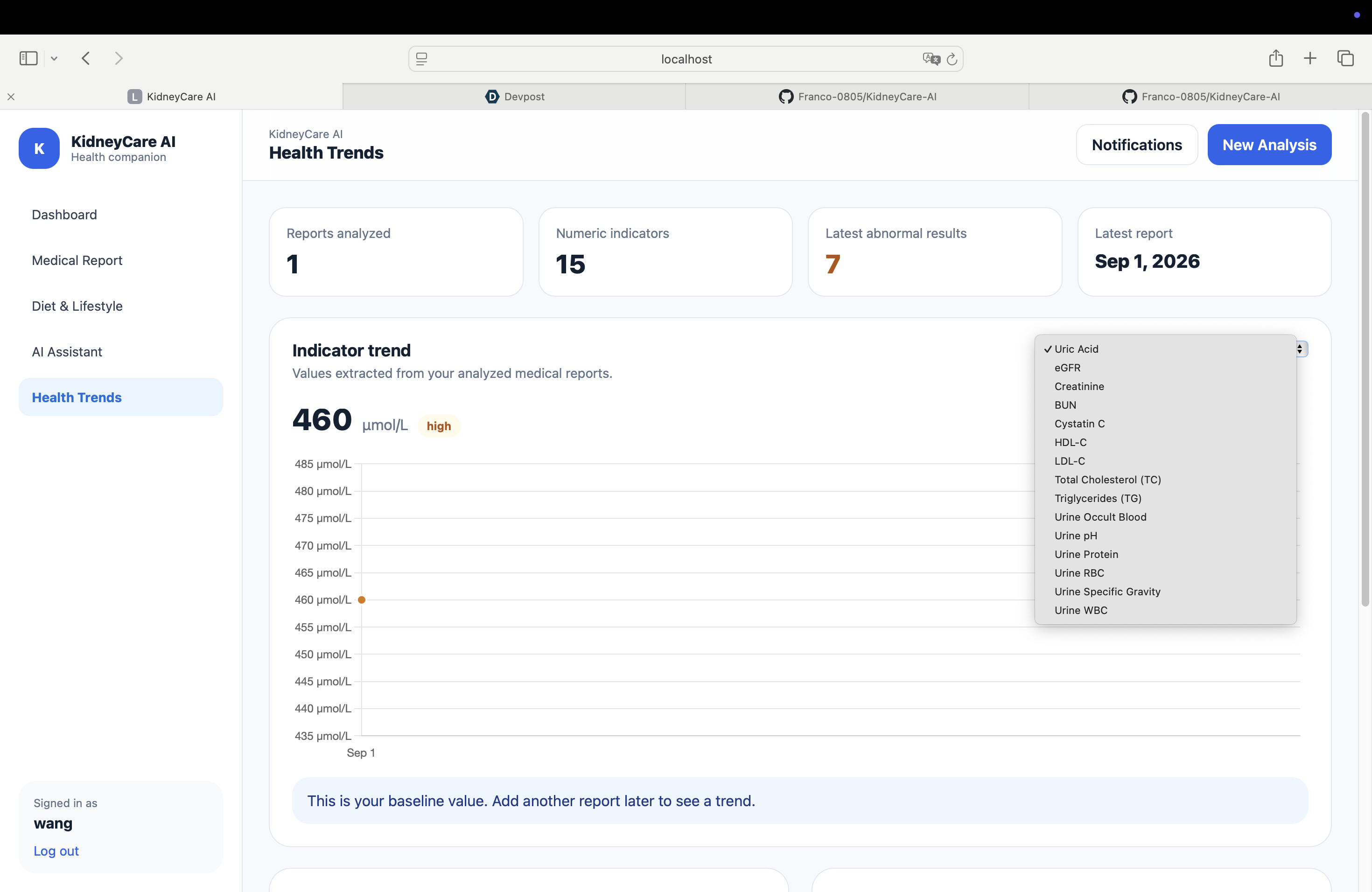
Tracks changes in key kidney health indicators over time.
Inspiration
Kidney health is often difficult to manage because the information patients receive is fragmented across laboratory reports, dietary advice, and medical terminology that can be difficult to understand.
A typical kidney-related laboratory report may contain indicators such as creatinine, eGFR, uric acid, urine protein, and microalbumin. Although these values are important, simply seeing a number outside the reference range does not always help a user understand what it means or what they should pay attention to next.
Diet introduces another challenge. People concerned about kidney health may need to pay attention to factors such as protein, sodium, purines, and other nutritional information, but estimating these from everyday meals is inconvenient.
This inspired me to build KidneyCare AI — a web-based AI assistant that combines medical report analysis, computer vision, nutrition analysis, health history, and conversational AI into one system.
The goal is not to replace doctors or provide medical diagnoses. Instead, KidneyCare AI is designed to help users better organize and understand their health information and make it easier to discuss relevant results with healthcare professionals.
What It Does
KidneyCare AI provides several connected features.
AI Medical Report Analysis
Users can upload kidney-related laboratory reports in PDF or image format.
The system extracts the report content and identifies important indicators such as:
- Creatinine
- eGFR
- Uric acid
- Urine protein
- Microalbumin
- Other kidney-related measurements
The extracted information is transformed into structured data and explained in more understandable language.
Instead of simply displaying abnormal values, the system provides a summary, possible areas of concern, and suggested follow-up questions or actions while clearly avoiding definitive medical diagnosis.
AI Food Analysis
Users can upload a photo of their meal.
A custom-trained YOLO food detection model analyzes the image and attempts to identify food items. The detected foods are then connected to nutritional information.
KidneyCare AI can use this information together with the user's medical report to generate more personalized dietary guidance.
The overall pipeline is:
Image → YOLO Food Detection → Nutrition Data → Medical Context → AI Recommendation
Health History and Trends
Medical report analyses and food analyses are associated with the authenticated user and stored in the database.
This allows KidneyCare AI to maintain a history instead of treating every upload as an isolated interaction.
Historical laboratory indicators can later be used to visualize changes over time, helping users understand trends rather than focusing on a single measurement.
AI Health Assistant
The AI assistant is designed to combine information from the user's recent medical reports and food analyses.
This allows the language model to answer questions with more relevant context instead of functioning as a completely generic chatbot.
How I Built It
KidneyCare AI uses a full-stack architecture.
The frontend was developed using React and Vite, while the backend was built with FastAPI in Python.
For authentication, the backend uses token-based authentication so medical reports and food analysis records can be associated with the correct user.
The application database stores user accounts, report analysis results, and food analysis history.
For medical report processing, uploaded PDFs and images are converted into text and structured into kidney-related indicators. An LLM is then used to explain the extracted information and generate user-friendly summaries.
For food recognition, I experimented with computer vision models before developing a YOLO-based food detection pipeline.
I trained a YOLO model on a dataset containing 100 food categories. After additional fine-tuning, the model's overall [email protected] improved substantially, demonstrating that the model was learning meaningful food features.
The final AI pipeline connects multiple components:
User ↓ React Frontend ↓ FastAPI Backend ↓ Authentication & Database ↓ Medical Report / Food Image ↓ OCR / Computer Vision ↓ Structured Health Data ↓ LLM ↓ Personalized Explanation
Challenges I Faced
One of the biggest challenges was food recognition.
My early food classification experiments worked reasonably well for simple images containing a single food item, but real meals are much more complicated. A single image may contain rice, vegetables, meat, soup, and other foods at the same time.
This motivated me to move toward object detection using YOLO.
Training the model also taught me that a successful training run does not automatically mean that a model will perform well in the real world.
During fine-tuning, the YOLO model improved significantly on the validation dataset. However, when testing images from outside the dataset, I observed that some foods were recognized correctly while others produced low-confidence or incorrect predictions.
This introduced me to an important machine learning problem: generalization and domain shift.
I learned to evaluate the model using more than just training loss. Metrics such as precision, recall, [email protected], and [email protected]:0.95 became important for understanding what the model was actually learning.
Another challenge was connecting independent AI components into a complete application.
Running a model by itself is relatively straightforward. Building a system where:
medical reports are uploaded, the correct user is authenticated, results are stored, food images are analyzed, nutrition data is retrieved, and an LLM receives the correct context
required much more careful backend and data-flow design.
This was one of the most valuable parts of the project.
What I Learned
KidneyCare AI taught me that building an AI application is much more than calling an AI API.
I gained practical experience with:
- React frontend development
- FastAPI backend development
- REST APIs
- Authentication and JWT
- Database design
- OCR and document processing
- Computer vision
- YOLO object detection
- Transfer learning and fine-tuning
- Precision, recall, and mAP evaluation
- LLM integration
- Prompt and structured-output design
- Connecting AI models to real application workflows
Most importantly, I learned how different AI techniques can work together.
Computer vision is useful for understanding images.
Language models are useful for interpreting structured information and communicating it to users.
Databases provide historical context.
Backend APIs connect these components into one usable system.
KidneyCare AI became an opportunity for me to understand how an end-to-end AI product is actually engineered rather than treating each AI model as an isolated experiment.
What's Next
There are several areas I would like to continue improving.
The first is the food detection model. Real-world testing showed that additional diverse training data is needed to improve generalization, particularly for complex meals and visually similar food categories.
I also plan to improve health trend visualization so users can more easily follow changes in indicators such as uric acid, creatinine, eGFR, and urine protein over time.
Another important direction is improving the AI assistant by providing it with structured context from the user's historical reports and food analyses.
Ultimately, I want KidneyCare AI to evolve from several individual AI features into a connected health information assistant where computer vision, medical report processing, historical data, and conversational AI work together to help users better understand their kidney health.

Log in or sign up for Devpost to join the conversation.