Inspiration
I'm an amateur music producer, and I felt this was a niche that ChatGPT and Codex could help me fix. Even if it helps only a special few, I hope that it keeps workflow decisions tight by offering useful feedback and options to try on one's mix.
What it does
Ki’Diyan’s Music Mix Analyzer helps developing producers understand not only what is happening technically in a mix, but what those choices may make a listener feel. That's what makes music real and impactful.
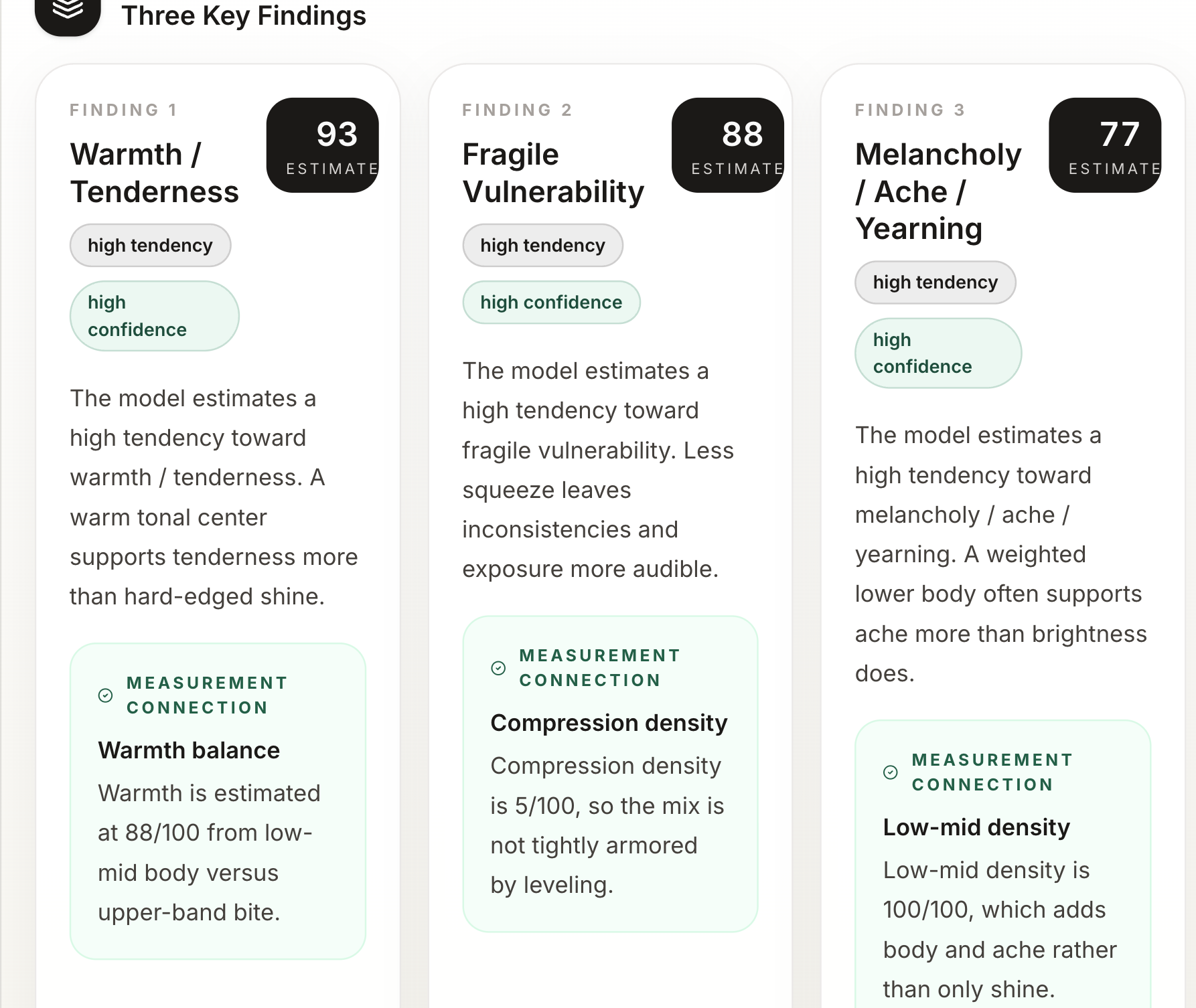
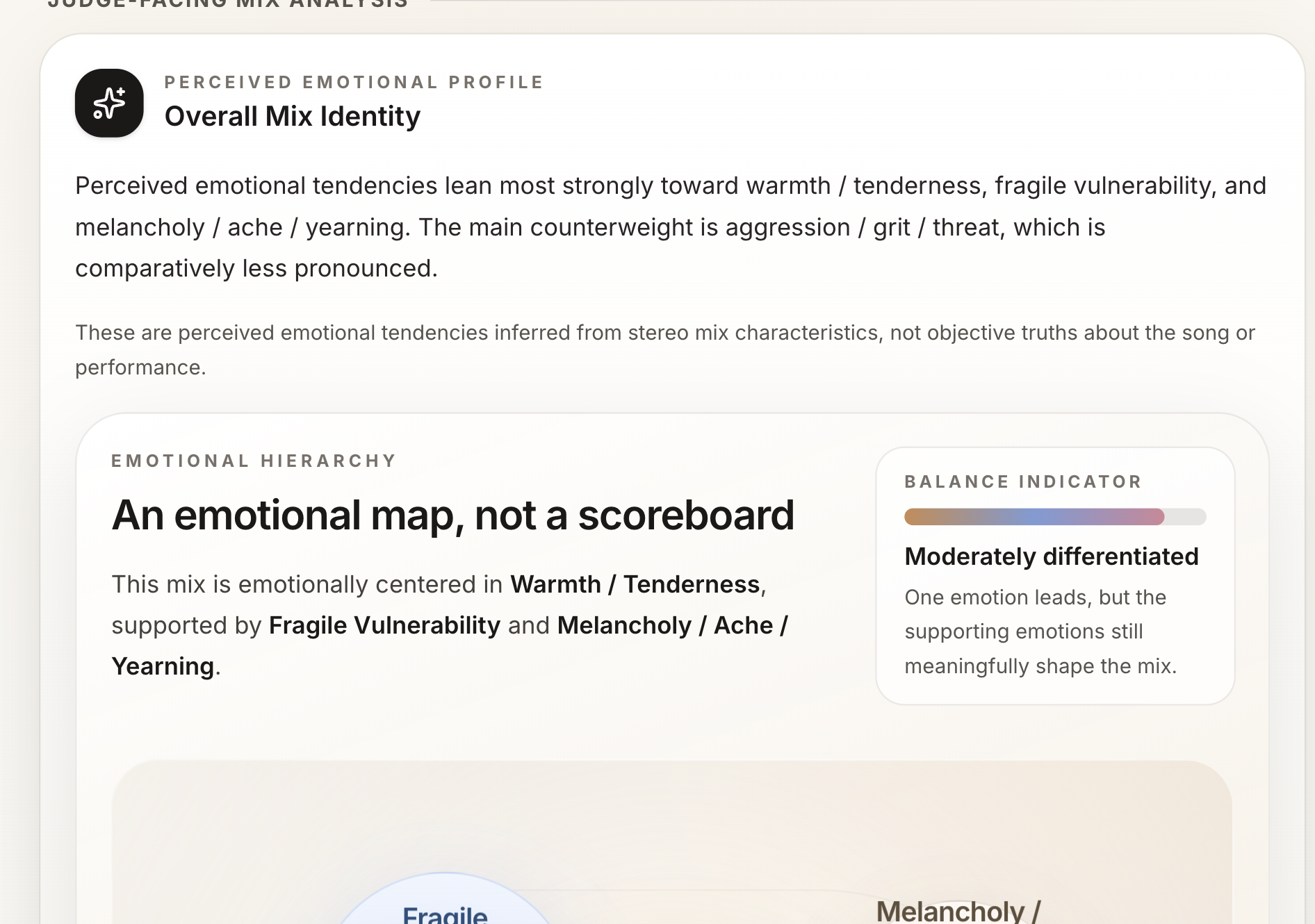
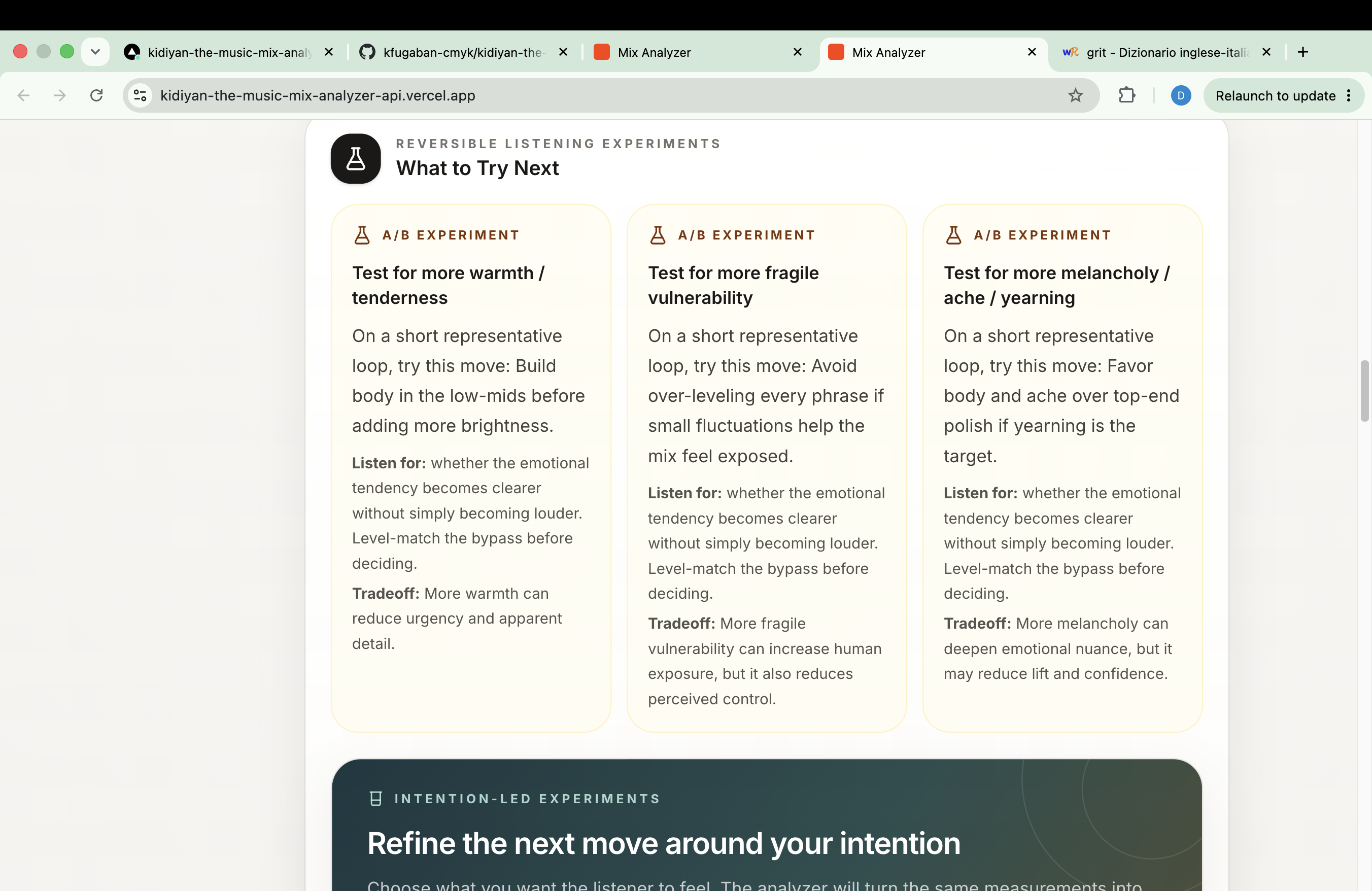
Users can upload a WAV or MP3 file, or immediately test the app with a bundled 30-second sample mix. The audio is analyzed locally in the browser for characteristics such as tonal balance, dynamics, compression density, stereo behavior, and low-mid presence. The app then translates those measurements into cautious, evidence-linked emotional tendencies such as warmth, vulnerability, melancholy, openness, urgency, or grit. Rather than grading the mix, it explains why each tendency appeared and turns the findings into reversible A/B listening experiments.
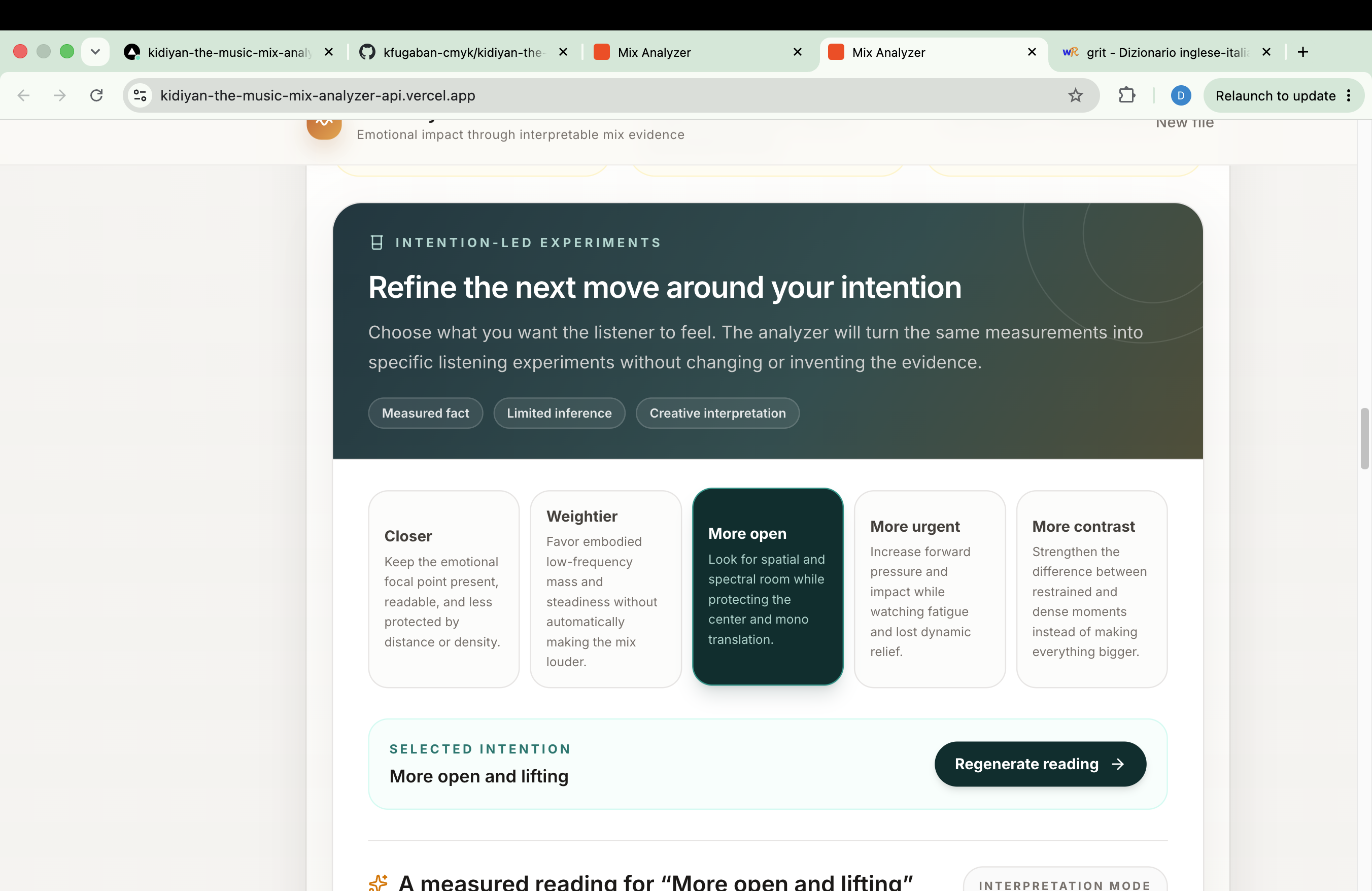
Users can also select a creative intention—such as making the mix feel closer, weightier, more open, more urgent, or more contrasting—and receive recommendations grounded in the same measured evidence. This is arguably the most useful feature, as this narrows down the analysis, and provides useful, tailored feedback. :)
How we built it
The project was built as a React and Vite application with browser-local audio decoding and feature extraction. Uploaded audio remains in page memory and is not sent to a server or permanently stored.
Codex worked directly with the repository to accelerate implementation. It helped build and refactor React components, connect the audio-analysis flow, create reusable findings and experiment cards, implement the intention selector, add automated checks, debug deployment issues, and configure the Vercel Function.
GPT-5.6 powers the optional structured interpretation layer. It does not receive the audio itself. It receives only a validated, bounded ledger of extracted measurements and the user’s selected production intention. It then organizes that evidence into interpretations, suggested listening experiments, expected effects, and creative tradeoffs.
If GPT-5.6 or the server function is unavailable, the app automatically falls back to deterministic local interpretation rules. GPT-5.5 was also used earlier in the process for product ideation, interface critique, feature prioritization, wording refinement, and developing implementation prompts for Codex.
Challenges we ran into
One of the biggest challenges was translating technical audio measurements into emotionally meaningful language without overstating what the data can prove. Musical emotion is subjective, so the app needed to be useful without pretending that a mix has one objectively correct emotional meaning.
Another challenge was preventing the experience from becoming overwhelming. Early versions included too much information at once, so the interface was reorganized around an overall identity, three key findings, and a smaller set of actionable experiments.
I also had to make the AI output trustworthy. Recommendations needed to stay connected to actual measurements rather than becoming generic mixing advice.
Accomplishments that we're proud of
I am especially proud that the app demonstrates the full workflow end to end: it accepts real audio, measures it locally, explains the findings, and produces actionable next steps.
The app does not reduce the user’s work to a score. Every major interpretation is connected to evidence, and every recommendation is framed as a reversible experiment with a possible tradeoff.
I am also proud of the privacy-preserving architecture. Unreleased music never needs to be uploaded to GPT-5.6. Only the extracted measurement ledger and selected intention are sent to the interpretation function.
The bundled sample mix makes the project immediately testable, while the deterministic fallback ensures that the core experience still works without an API key.
What we learned
I learned that interpretability is just as important as generating an answer. Producers are more likely to trust a suggestion when they can see the measurement behind it and understand what they are being asked to listen for.
I also realized that creative tools should preserve uncertainty rather than hide it. Emotional labels work better as possible tendencies than as definitive claims.
Codex was most effective when given focused product constraints and a clear definition of the desired behavior. The strongest workflow was iterative: identify a problem, ask Codex to inspect the relevant code, review the change, test it, and refine it.
Finally, I learned that GPT-5.6 is most useful here when it is constrained by structured evidence. The quality of the interpretation depends not only on the model, but on the boundaries placed around what it may claim.
What's next for Ki'Diyan's Music Mix Analyzer
The next step is testing the app with more producers, genres, and listening environments to improve calibration and learn which explanations are genuinely useful.
Future versions could compare two revisions of the same mix, analyze individual song sections over time, show how measurements change between versions, and support collaborative feedback between artists and engineers.
Additional possibilities include genre-aware interpretation, stem-level analysis, saved project histories, downloadable producer reports, and educational modes that teach users how technical changes affect perception.
The long-term goal is to make audio analysis more emotionally relevant, understandable, and actionable—especially for independent artists and developing producers who may not have regular access to an experienced mix engineer.

Log in or sign up for Devpost to join the conversation.